I’ve long wondered what it was about ancient languages—as opposed to modern ones—that so captivated me. For more than half my life now (21 years long), they’ve been at the center of my intellectual and emotional world. I’ve done much internal archaeology on this, and here’s where I’ve landed.
What first drew me to ancient languages wasn’t beauty, or history, or even mystery—this much I knew. But I’ve figured it out, after much reflection: it was structure. At age ten, I was told that Latin had a “very mathematical” nature—and I had a very mathematical mind. That was the pitch that won me over when I was choosing between French, Mandarin, Spanish, and Latin in fourth grade. My friends—older kids who knew me from our accelerated math class—urged me to choose Latin. “It works the way you do,” they said.
From the beginning, I had a knack for it. Parsing Latin felt like solving elegant equations: all those declension and conjugation charts, the case endings, the tightly constructed sentences. I found the clarity of it deeply satisfying. It’s also what got me into etymology, many a linguist’s bridge into the discipline. I was thrilled to learn that words, and thereby language itself, had discrete histories we could uncover and unlock.
And, to be honest, I was also avoiding something. I’ve had a lifelong fear of being wrong—especially out loud. The thought of sounding like a toddler in French or Mandarin mortified me, even at that age. Ancient languages, by contrast, required no vocal performance—or at least none you could be substantially corrected on.2 As Mary Beard wrote, it’s a tremendous freedom to read a language without needing to order a pizza in it.
But beyond the safety of silence and the comfort of structure, ancient languages offered me something stranger and deeper. They are, paradoxically, both rigid and wild—formally inflected, syntactically unruly. Their rich systems of agreement allow a kind of grammatical anarchy. That contradiction fascinated me. And then, there was the sheer alterity: the profound otherness I was only beginning to grasp. These languages came from far away—across centuries and empires—and they had nothing to do with me.
What I didn’t expect was how intimate they would feel. There’s something magical about reaching across time and space to hear men (alas, mostly men) from millennia ago speak. I feel, in some small way, like I’m raising the dead (see blog title!), giving voice to what was nearly lost. There is mystery in this, in the impossibility of perfect translation, in the silence that always remains. But there is also joy. Sitting at a wooden table, poring over ancient texts with comrades-for-a-semester, I’ve never felt isolated. If anything, I’ve felt surrounded—by the dead, yes, but also by other living readers, deep in the muck of it all.
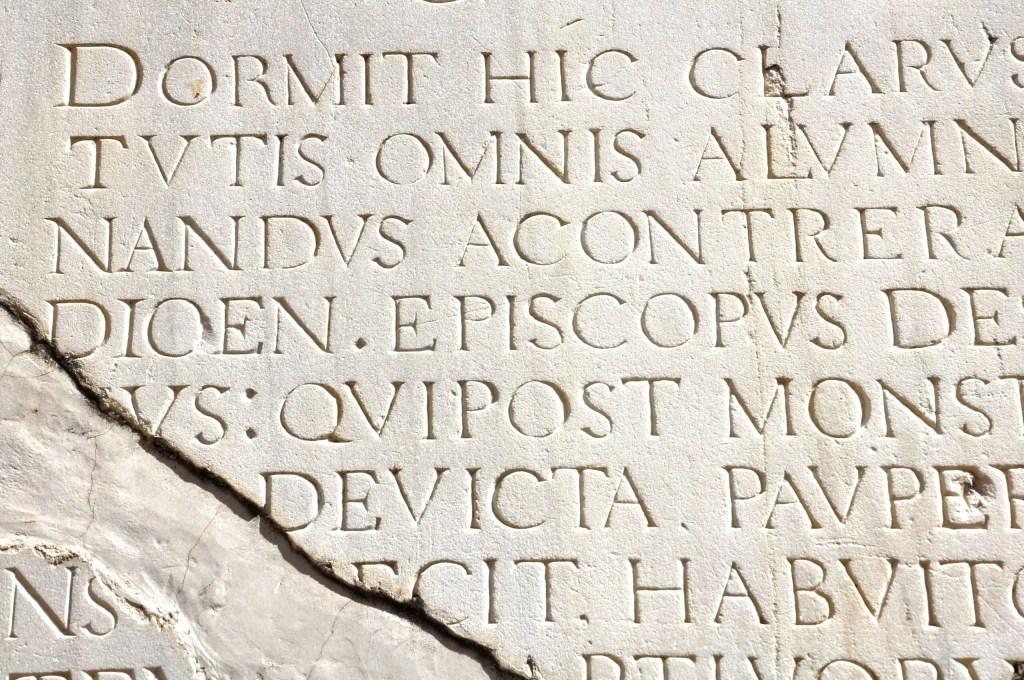
Inscriptions are my great love: language not filtered through scribes or stylists, but carved directly, once, and then cast into the abyss memoriarum. To read an inscription is to hear a voice that was not supposed to last this long. It reminds me that people have always been this way: strange, familiar, brutal, kind, just like us.3 That realization has made me a softer person, I think. More attuned. You can’t spend your days in conversation with the past—and with the people who help you interpret it—without becoming more human.
There’s also a tension I feel—quiet but insistent—between my deep love of ancient languages and my commitments to the present. Studying the dead can sometimes feel like retreat: a kind of sequestration in the library, the archive, the ivory tower. And yet, this is also the work that sharpens my ethics. It’s by looking at the long arc of language, power, and survival that I’ve come to understand how political language always is—what gets written down, whose names are preserved, whose voices fade. So while it might look like I’m hiding in the past, I don’t think I am. I’m studying the structures that built the world we live in now—and learning how fragile, and how remakeable, those structures are.
It’s changed the questions I ask, too. I no longer want to know only what words mean, or what they do. I want to know how they came to be. Who made them. Why they changed. What pressures they both buckled under and resisted. That’s the kind of inquiry ancient languages have trained me for.
Lately, though, something has changed. For the first time, I’m stepping away from silence. I’m learning a living language—French—and it’s bringing all kinds of old fears and new questions to the surface. But that’s a story for next time, once I’m deeper in it.
- To the point I got internet-famous for being a budding particle physicist, which got me invited to labs and observatories around the world, including NYU’s, Columbia’s, and CERN, home of the Large Hadron Collider. ↩︎
- After a while, you remember that a Latin “v” is pronounced [w], silly as it sounds aloud. [wɛni widi wiki] just doesn’t hit like [vɛni vidi vit͡ʃi]. ↩︎
- Read some of the archaic Theran graffiti (pp. 22-25 of this paper) if you want to see that teenage boys have, in fact, always been teenage boys. ↩︎


Leave a reply to The Tritropic Line, 1: The Art of an Opening – To Wake the Dead Cancel reply