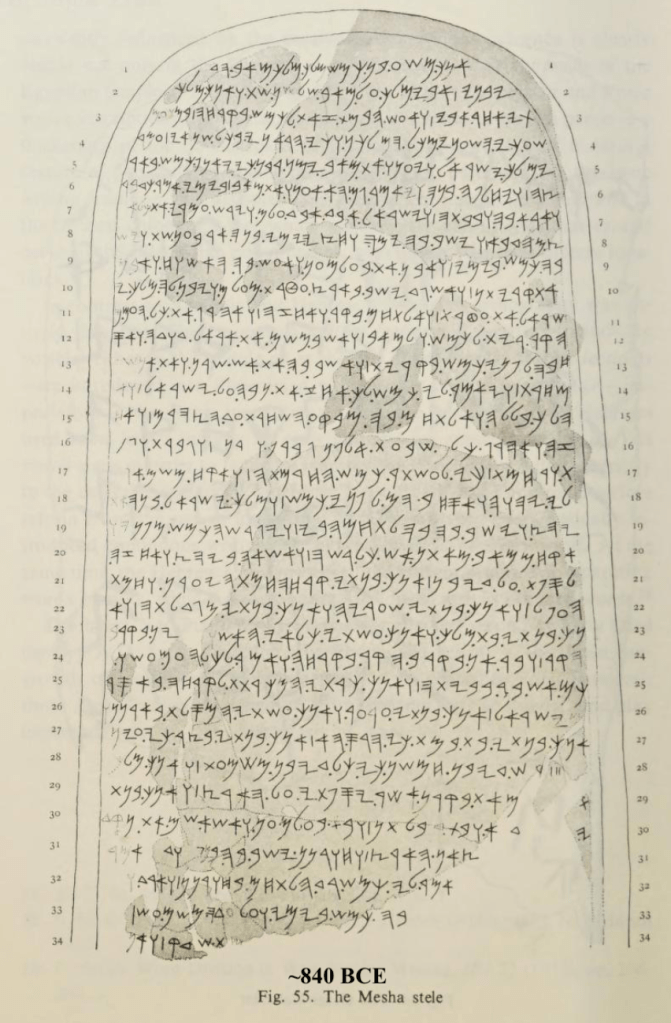
Tag: writing systems

  • Tools of the Trade, 8: Meta-Tools: Courses for Aspiring Philologists and Archaeo-Linguist Hybrids

    I frequently get asked what classes to take if you want to work with ancient languages, inscriptions, museums, or language technology. This post is a reflection—not a blueprint—on how I’ve built a courseload that supports interdisciplinary work in epigraphy, historical linguistics, and digital tools, and what I’d recommend to others just starting out.

    Start with the Languages (But Be Strategic)

    If you’re reading this, chances are you already love ancient languages. So yes—take Latin. Take Greek. But if you have more than one on your list, resist the urge to take them all at once. Instead, start with one—preferably the one with the strongest institutional support—and stagger the rest. I did Latin in high school, Greek in my first year of college, and Akkadian in my second. That pacing gave me room to go deep into each one without burning out. Now, with that foundation, I’m able to handle several languages at the advanced level without losing clarity or joy.

    If it interests you, try to take—or propose an independent study in—a language that uses a non-alphabetic script early on. Whether it’s cuneiform, hieroglyphs, or Linear B, working with a writing system that doesn’t map neatly onto speech will sharpen your sense of what writing is, how it encodes meaning, and how it changes across time. It will also raise questions—paleographic, technological, cognitive—that you may find yourself returning to long after the class ends.

    Take Linguistics Early (You’ll Use It Constantly)

    I’m biased—I’m a linguist—but even if you don’t plan to major in it, an intro to linguistics course will radically shift how you read ancient languages. You’ll start spotting things like vowel gradation, phonological assimilation, and case alignment everywhere. Once you’ve got the basics, courses like historical linguistics, syntax, or phonology can help you engage more confidently with scholarship and identify patterns in inscriptions, dialect variation, or reconstructed forms. Even if you don’t go further in formal coursework, just knowing the lingo goes a long way—and will keep paying off, quietly and consistently, across everything else you study.

    Follow the Inscriptions and Those Who Teach Them

    If you want to work with writing systems or epigraphy, find the people who do that at your institution. In this field, people often matter more than courses. Research your professors. Read what they’ve written. Faculty bios will give you a general idea of their focus, but their CVs are often more revealing—long, yes (I’ve seen them run 50 pages), but worth scanning for article titles and projects that align with your own interests.

    Getting close to those key people might mean enrolling in something tangential—say, an intro to Greek art—just to build a relationship. Or asking if you can do an independent study reading inscriptions in translation. Some of my best classes weren’t labeled “epigraphy” at all—they were seminars where I was encouraged to bring paleographic questions into the final project. In one case, that was Data Science for Archaeology with Prof. Justin Pargeter, a course that shaped my thinking far beyond its original scope.

    Think Across Disciplines, but Choose a Home

    You’ll need a home base—a department that knows you, supports your work, and can write you letters. Having an intellectual anchor like that is not only strategic, it’s also deeply grounding. That said, your course list doesn’t have to stay confined to one department—and honestly, it probably shouldn’t. Academia is moving ever more toward interdisciplinary inquiry, and the best course of study often cuts across traditional boundaries.

    Some of my most formative classes have been outside my major—art history, computer science, even religious studies (Akkadian lives in Judaic Studies at NYU). Let your questions guide you. If you’re wondering why Phoenician letters look the way they do, or what it means to “revive” a dead language, go find the classes that give you tools to explore those questions, wherever they live.

    Just make sure you’re also building depth somewhere. Breadth can open doors—but it’s depth that gets you through them. Grad schools, mentors, and collaborators alike are looking for people who know how to ask big questions, but also how to sit with them for a long time.

    Study Abroad, If You Can

    There’s no substitute for learning ancient languages in place—or at least near the landscapes, museums, and excavation contexts where they come alive. Study abroad isn’t just about location; it’s about intensity, continuity, and community. My time in Greece, especially on digs and museum visits, made Greek less abstract and more human. It exposed me to a range of paths in classics and gave me access to resources—like fragmentary inscriptions in drawers—and rhythms, like reading in the field, that continue to shape how I think about epigraphy and transmission.

    If you’re aiming for grad school or museum work, study-abroad experience shows initiative. It signals that you’ve navigated other academic systems, worked across language barriers, and engaged directly with material culture. If your program includes language immersion—even better. Even if the modern language isn’t your focus, it sharpens your ear and re-situates ancient texts as living inheritances.

    If funding is a concern, don’t write it off. Many programs offer scholarships, and departments often quietly support students who ask early. At big schools like NYU, the key is often finding the right person—the one who knows how to unlock the support already available.

    Don’t Be Afraid of Skill-Based Classes

    If you’re anything like me, it’s easy to stay in the comfort zone of ancient texts and theoretical conversations. But some of the most valuable courses I’ve taken have been hands-on: digital humanities, data science, archaeological methods, computer science. These classes taught me how to manage a dataset, build a research tool, and think across evidence types. They’ve led directly to portfolio projects, study opportunities, and unexpected collaborations—and they’ve made my work in the ancient world more dynamic and durable.

    Leave Room to Be Surprised

    Some of my most formative classes were ones I hadn’t planned to take: a seminar on the topography and monuments of Athens (Prof. Robert Pitt), a deceptively simple primer in Greek archaeology that opened into real depth (Prof. Hüseyin Öztürk), and a course on the structure of the Russian language (Prof. Stephanie Harves). These were spaces where I tested my assumptions and rewired my thinking. Try to leave room in your schedule each year for one course that isn’t strictly “on track,” but that speaks to something curious or unsettled in you. That’s often where real questions begin.

    Last Word: Plan Backwards

    If you’re thinking about grad school or a research career, try working backwards. Look at the programs you might apply to—what do they expect? What languages, methods, or subfields appear in course requirements or faculty research? Then take classes that prepare you for those conversations. The goal isn’t to become someone else’s version of a scholar—it’s to become the version of yourself who belongs in the rooms you want to be in.

    Closing

    When in doubt, ask people. Older students, professors, internet strangers who study Linear B. This path isn’t something I mapped out alone—almost every turning point in my academic life has come from a conversation, an offhand recommendation, or a generous reply to a cold email. I’ve built my way forward through the advice of others, and I’m always happy to pay it forward.

    In a follow-up post, I’ll share how to structure independent study: designing personal projects, sustaining long-term reading, and building a research portfolio beyond the classroom. Done well, this kind of work lets you follow your own questions, test your interests, and create something distinctly your own. It’s also one of the clearest ways to show grad schools and mentors that you know how to learn without a syllabus.

    Stay tuned. And as always, if you’re not sure where to start, I’d love to hear what you’re thinking about.
  • Adventures in Materiality, 2: Carving the Flood: An Amateur Attempt

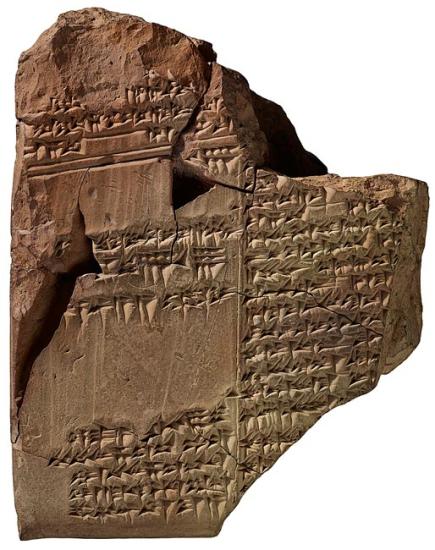
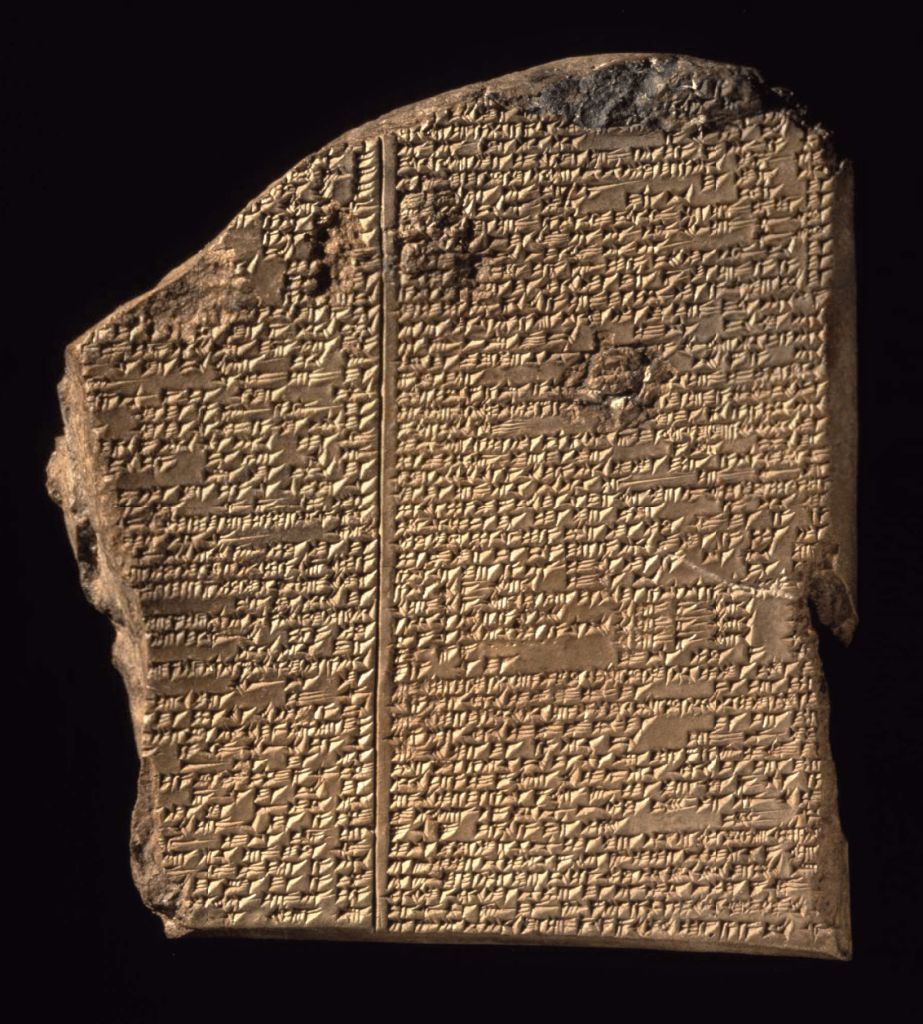
    Image of the Flood Tablet as stored in the British Museum: accession number K.3375.
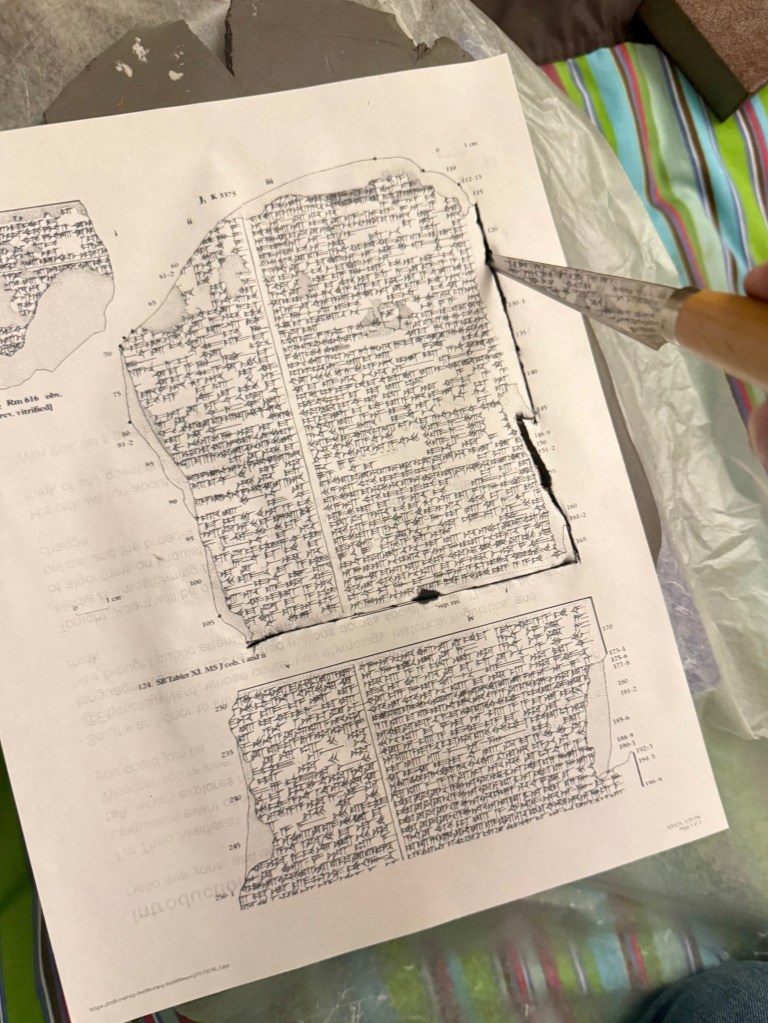
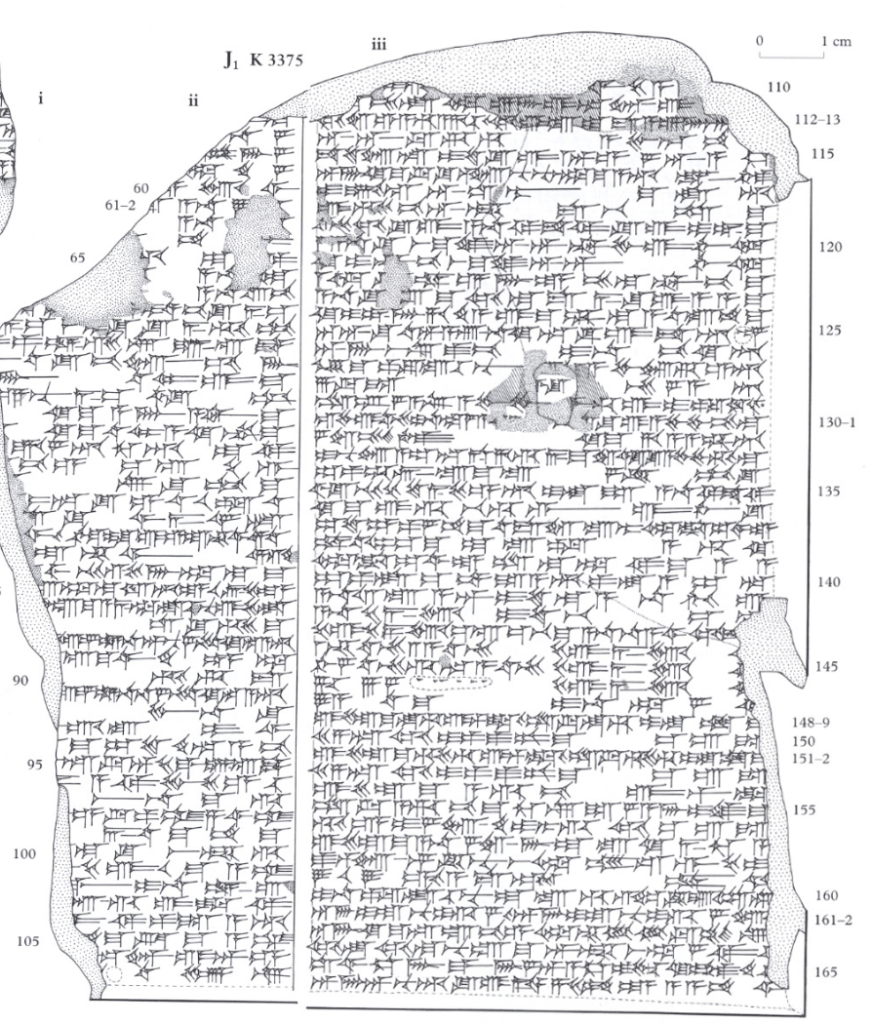
    Lineart of the Flood Tablet as documented in the CDLI: accession number P273210..

    0. Prologue: Why Copy the Flood Tablet?

    Replication has become one of my favorite hobbies. I love artifacts, but as any archaeologist or collector will tell you, the barriers to actually owning them are steep—financial, legal, and ethical. How do you store them? protect them? justify having them at all? But when you make something yourself—when you replicate an ancient object by hand—you bypass all that. You get the closeness—a heightened closeness, I’d say—without the risk.

    That’s what drew me to recreate the Flood Tablet. Buying a cast would’ve set me back about a hundred dollars. But I wanted to see what I’d learn if I made one myself. Not just held it, but shaped it. Because creating a replica doesn’t just mimic an object—it stages a kind of encounter. You begin with a clean surface, unlike the fragmentary originals, or those replicas that emerge fully formed, and fully unformed, from the get. But when you make it yourself: every crack, every slip, every flaw is something you have to introduce yourself. You get to know the object from the inside out—not just what it looks like, but how it resists you.

    I picked this Flood Tablet precisely because it’s ambitious. It’s one of the most iconic inscriptions in the ancient world—a kind of cultural Rosetta Stone, linking Mesopotamian, biblical, and classical traditions. In fact, upon its discovery in the nineteenth century, its similarity to the later Abrahamic tradition sent shockwaves through the scholarly community—truly, its impact cannot be understated.

    What’s also beautiful and moving about it is its subject: survival, memory, and catastrophic loss. And it’s been copied, again and again, across centuries. To replicate it now is to take part in that long chain of transmission. It’s not just a story of a flood. It’s a story about what writing saves.

    1. The Original: Tablet XI and Its Aura

    A tablet subsequently discovered, containing the same story, approx. a millennium older than this tablet. Now in the Morgan Library: accession number 225906.

    Tablet XI of the Epic of Gilgamesh is arguably the most famous cuneiform text in the world. It tells the story of a great flood, a chosen survivor, a divine warning, and a boat filled with life—centuries before the Book of Genesis recorded a similar arc. In the narrative, Utnapishtim recounts to Gilgamesh how he escaped destruction, was granted immortality, and ultimately became the bearer of a knowledge that even kings could not command. It is one of the clearest points of contact between Mesopotamian myth and later Near Eastern and Mediterranean traditions. Read a translation here.

    Found in Nineveh (in the north of modern Iraq, on the Tigris River) on May 7, 1873 by archaeologist George Smith, the tablet is a large, convex slab of clay, its surface densely packed with tight, disciplined cuneiform lines. The edges are broken, some signs lost.

    But it’s not a draft or a throwaway. It was meant to endure. To try to recreate it is, in a small way, to step into that intention. The curvature, the spacing, the subtle tilt of each wedge: all these formal features speak not just to aesthetics, but to the technical mastery of the scribes who made them. This isn’t just a myth we inherited. It’s a craftwork that once held it.

    2. The Process

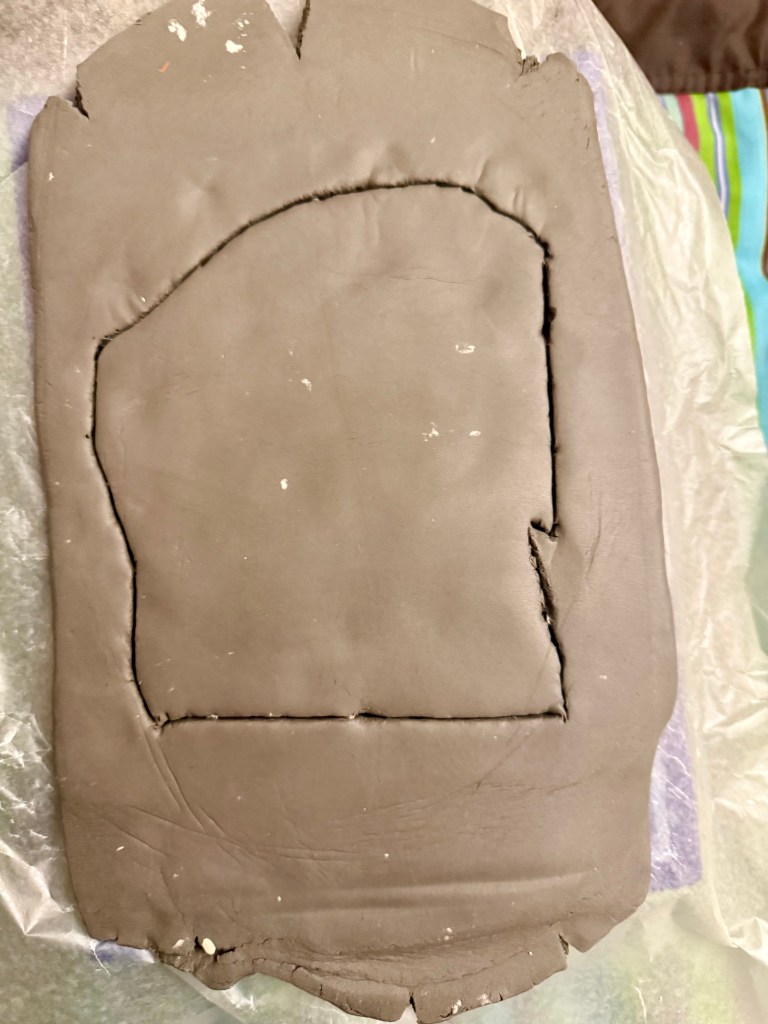
    I started with two pounds of grey air-dry clay and rolled it out to a thickness of about ¾ of an inch. I wanted enough depth to accommodate firm impressions without risking breakage—a balance between durability and responsiveness.

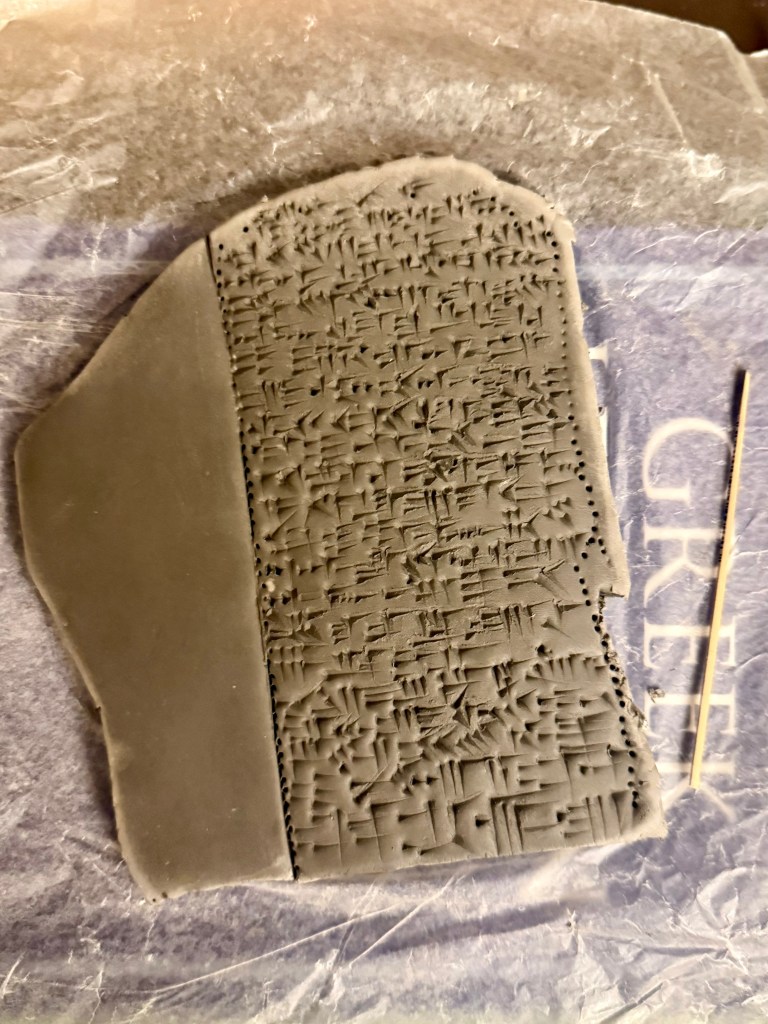
    Once I had a smooth surface, I printed a to-scale lineart of one side of the original tablet and laid it directly over the clay. Using a potter’s knife, I cut around the outline to form a proper slab.

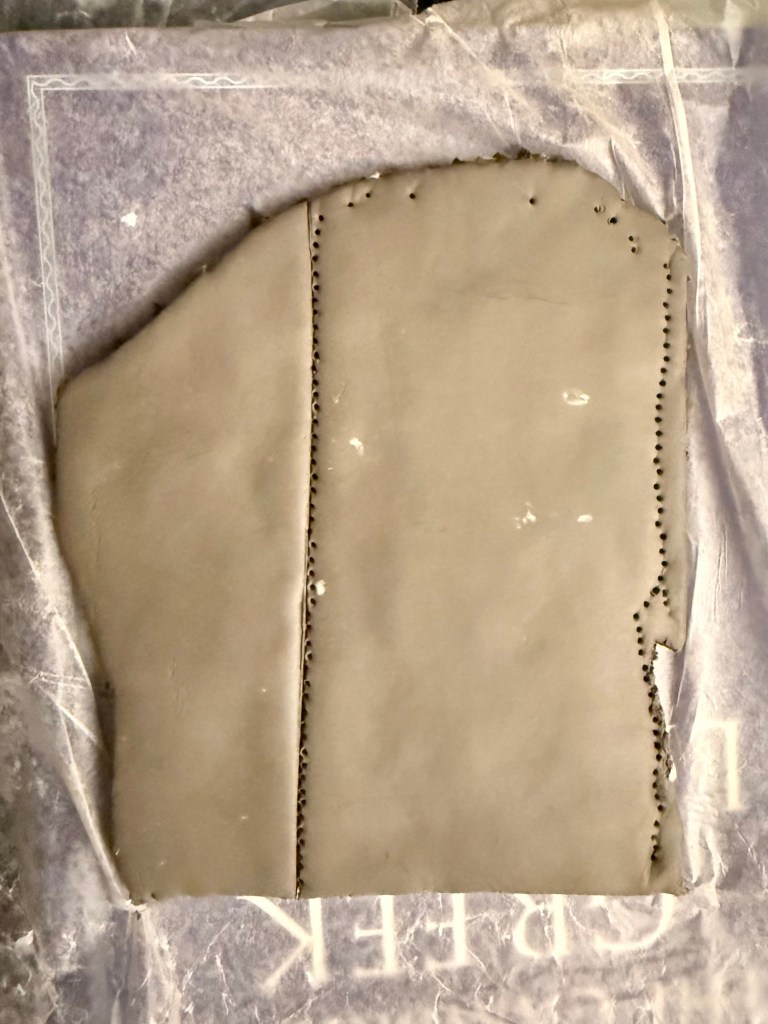
    I then scored the signature cleft line that bisects the original tablet. That line helped me rule the text. After that, to mark where each line of writing would begin and end, I took a needle and, with the paper still on top, pricked small bounding dots at the start and stop of every line. This gave me a grid of sorts—not formal ruling, but a subtle framework for spacing. I used actual cuneiform signs from the standard text, fitting in as much as I could per line (which, as I’ll tell you shortly, turned out to be not very much at all).

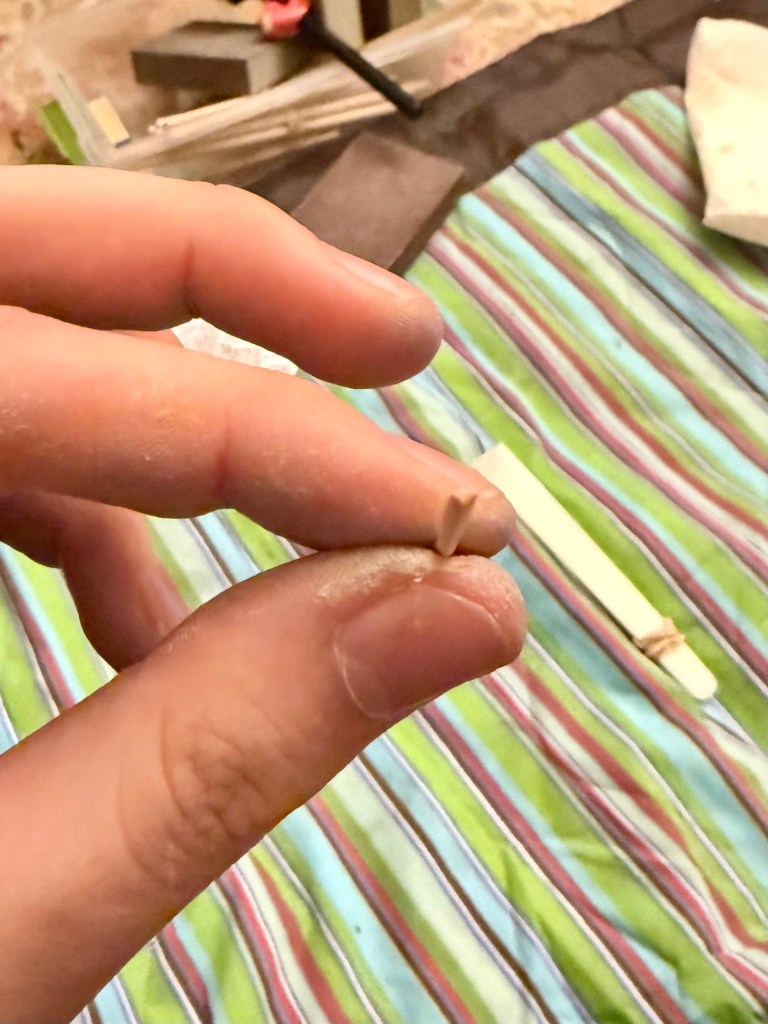
    For the inscription itself, I used a homemade stylus made from a square wooden dowel. I had sanded down one corner to create a slightly beveled edge that let me grip it more naturally—pinching it between thumb and middle finger, with my index finger guiding from above. In the course of things, I ended up using two styli. The first began to dull mysteriously partway through, possibly due to the water I kept brushing onto the clay to keep it soft. The wood was porous, and the repeated wetting may have softened or blunted its edges. I hadn’t expected tool fatigue quite so early in the process.

    3. Difficulties: Scale, Fatigue, and the Limits of Enthusiasm

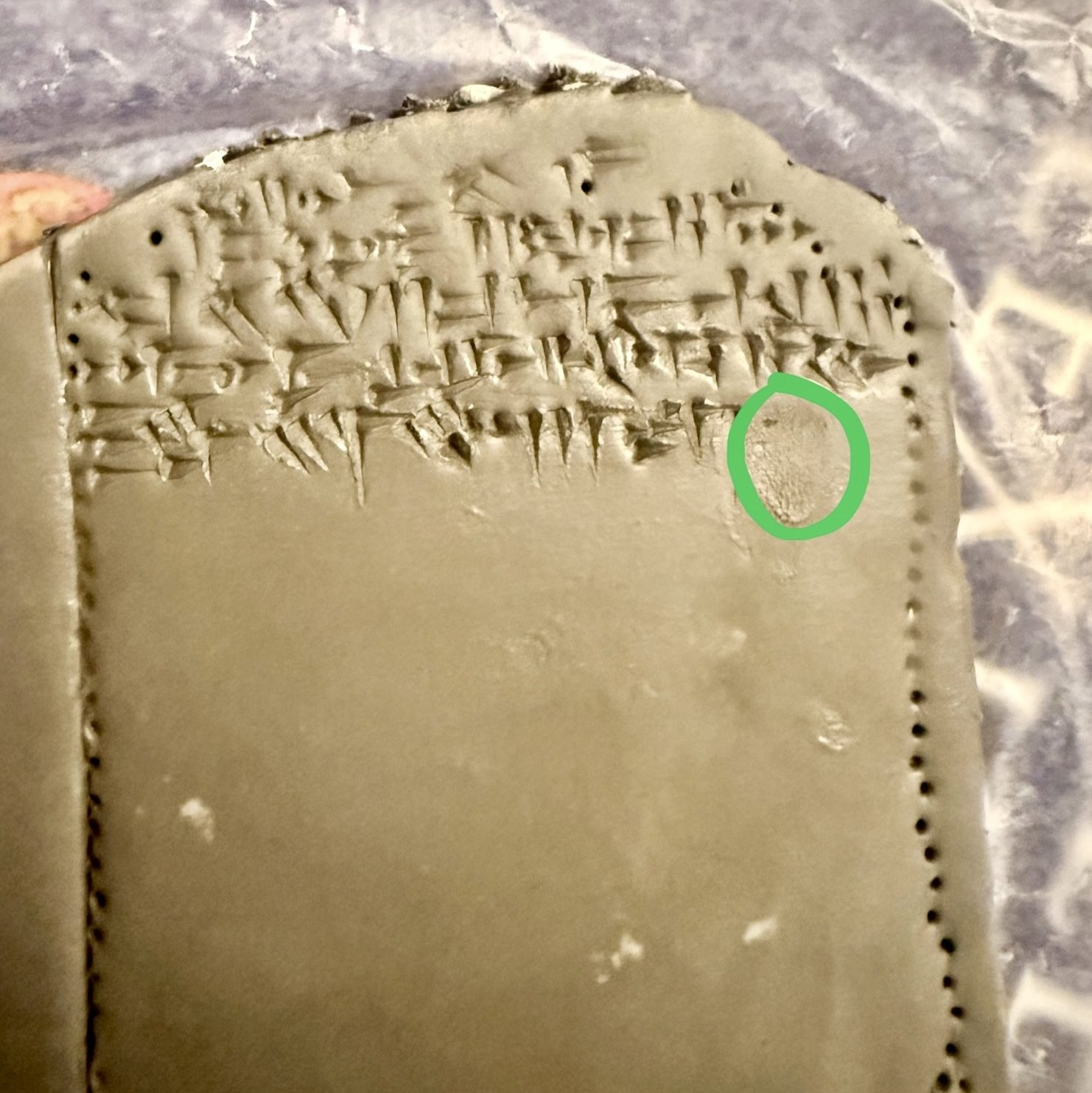
    What surprised me most was just how big my signs ended up being. Between the bluntness of my stylus and the limits of my own control, I found I could only produce cuneiform signs that were two to three times the height of the original inscriptions—and at least twice the width. The clay itself wasn’t the issue. If anything, it was a pleasure to work with: I kept smearing water across the surface with my fingertip, especially over unused areas, and that seemed to make the impressions cleaner and more precise. The medium was surprisingly forgiving, an example of an erasure using this technique is given above, in the green circle. My hands were not as pliant.

    I started at the top of the right-hand side of the tablet, and you can tell. My signs grew noticeably larger over time as fatigue set in. I spent around two hours just pressing wedges into the clay, and by the end I was feeling it. Not just in my hand, but in my attention span. I’d wildly underestimated how much text I could fit on the slab at the scale I was working—I probably would’ve needed to double the size to get anywhere close to the full line count of the original.

    By the end, I had learned what I came to learn—and felt ready to let it rest. I don’t plan to do the other side or fill in any missing fragments. This was enough to teach me what I wanted to know: how hard it is, how slow it is, how deliberate every single wedge has to be. The work left me with admiration, exhaustion, and just enough satisfaction to call it finished.

    4. Why It Was So Hard—And What That Tells Us

    This was the smallest scale of replica I’ve ever attempted, and still, my signs were roughly 2.5 times the size of the originals. And even at that inflated scale, I’m not confident I could accurately draw what I carved just by looking at the replica. That tells me a lot. It explains, viscerally, why there was an elite scribal class in Mesopotamian society, and why their training was so extensive. It wasn’t just about memorizing hundreds of signs—though that alone is a feat, especially for scribes working in multiple languages. It was about navigating a medium that added layers of challenge: spacing, shaping, texture, tool wear, and fatigue.

    I’ve long wanted to understand what made cuneiform so difficult—not just as a writing system, but as a practice. Even after studying the language on paper, I didn’t fully grasp the physical demands until I tried it myself.

    I wish we had spent even a single thirty-minute session in Akkadian I making tablets, especially at a small scale like this. The pedagogical value would’ve been enormous. You suddenly understand not just the abstract difficulty of the writing system, but the labor infrastructure around it—the apprenticeship, the specialization, the patience. This little experiment gave me a glimpse into that world, and for that, I’m genuinely grateful.

    5. Closing: A New Kind of Knowing

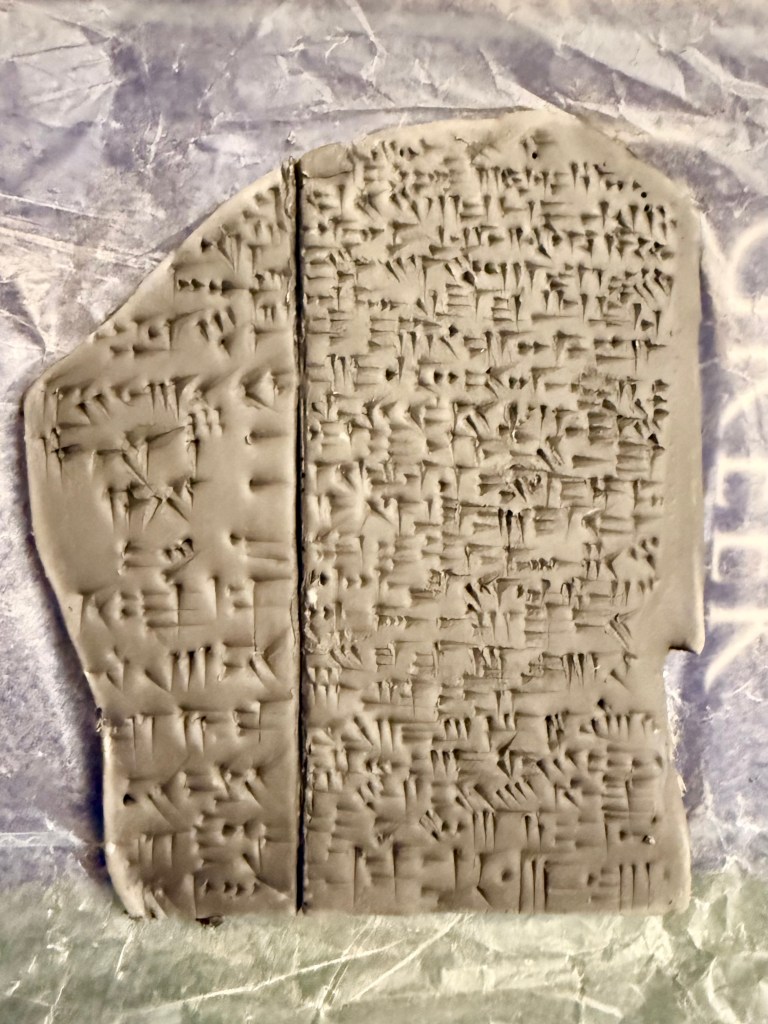
    I ended up with a lopsided, oversized, and incomplete tablet. But also: textured, hard-won, and deeply instructive. In the end, as it turns out, this wasn’t really about copying Tablet XI. It was about spending time inside its logic—its weight, its line spacing, its forgiving-but-not medium—and learning something I couldn’t have understood from a textbook.

    If you’re studying cuneiform, or even just curious about ancient writing, I can’t recommend this kind of tactile experiment enough. Make a stylus. Roll some clay from your local art-supply store. Try a single line. Your respect for those scribes will double. And you’ll probably come away, as I did, with something small and slightly ridiculous to keep on your shelf—a cracked echo of something monumental. Decidedly not a replica. Rather a kind of conversation.

    Here’s the “finished” product:

  • APEX Updates, 2: What is the Transmission Problem? A Brief History of My Research Question

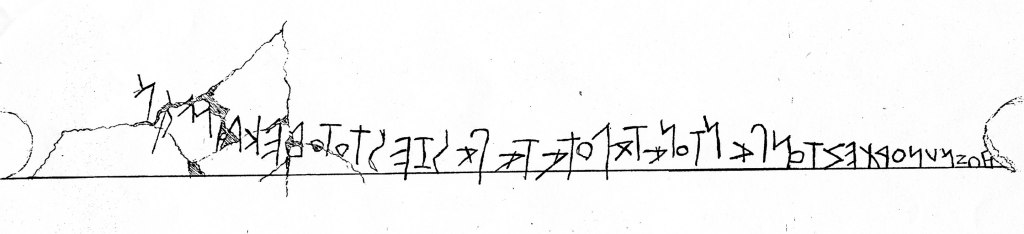
    If the first APEX post was about tracing letters, this one is about why those traces matter. Underneath every variant alpha or eccentric epsilon is a deeper question: when, how, and under what conditions did the Greek alphabet emerge from its West Semitic predecessor? This question, which is known in the scholarship as the transmission problem, lies at the core of alphabetic studies, and despite over a century of scholarship, it remains fiercely contested. To map alphabetic transmission is not just to track graphical similarity, but to reckon with how cultures borrow, adapt, forget, and reimagine the systems by which they make language visible.

    At its simplest, the transmission problem asks: When did the Greeks adopt the Phoenician script? But the real terrain is messier. Did the transfer happen once or multiple times? Was it sudden or gradual? Coordinated or ad hoc? Which region of the Greek-speaking world was first? Exactly which Semitic script was the donor—or was there a confluence of models? And what kind of evidence—linguistic, paleographic, archaeological—should we privilege when our sources conflict?

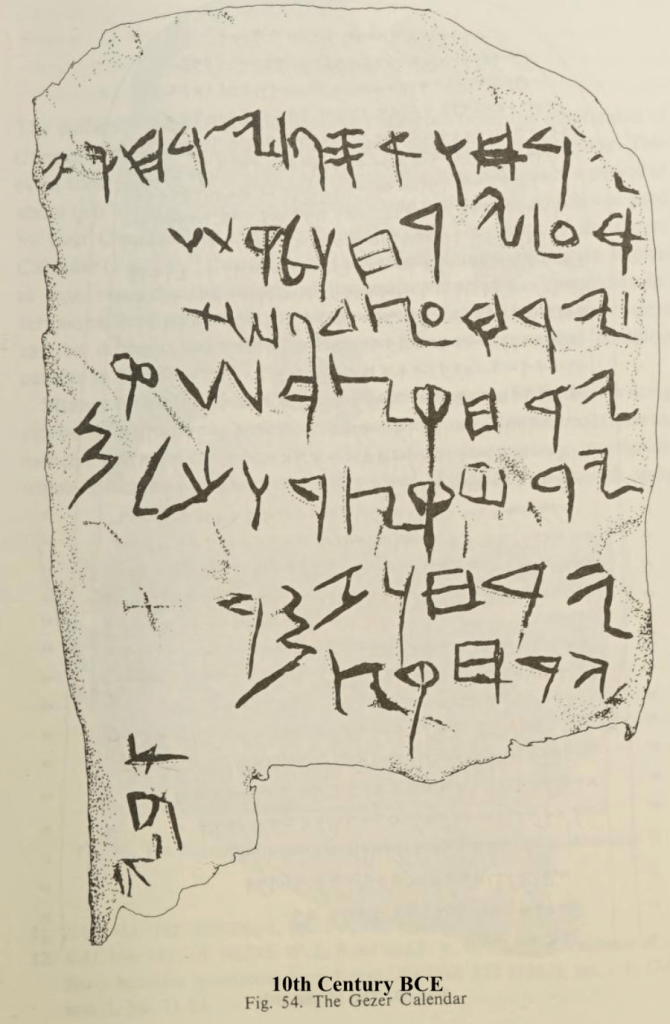
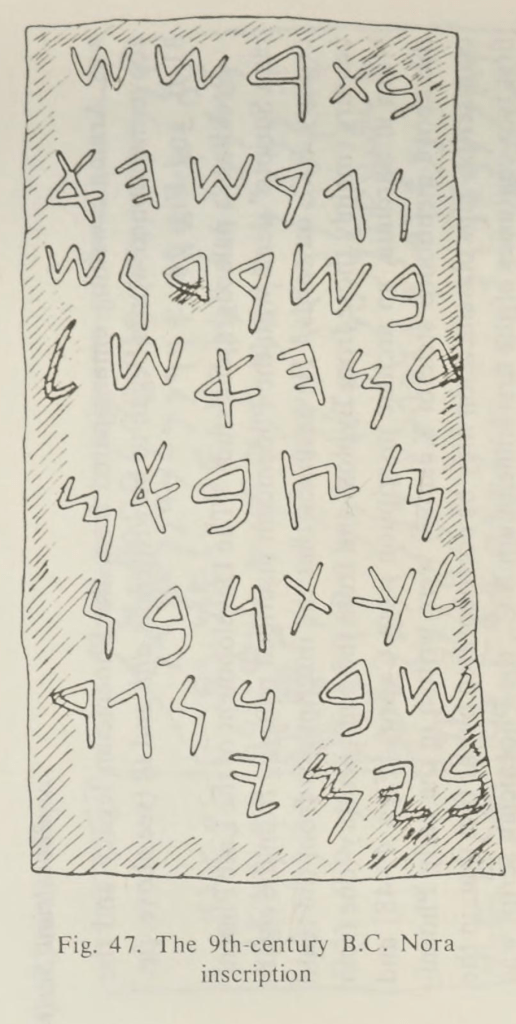
    Historically, the debate has followed disciplinary lines. Scholars trained in Semitic philology and Near Eastern studies tend to favor a high date for the transmission: sometime in the 11th or 10th century BCE, before the traditional Greek Geometric period (in older scholarship, referred to as the “Greek Dark Age”). This camp emphasizes the strong formal similarities between early Greek and Phoenician letterforms, arguing that Greek epichoric scripts most closely resemble Phoenician forms from around 1050 BCE, not the later shapes one would expect if transmission occurred in the 8th century. Joseph Naveh, for instance, in his landmark Early History of the Alphabet (1982), argued that the Greek system must have branched off before major innovations appear in the Phoenician script, such as the angular mem or evolved forms of shin. Naveh saw the Greek alphabet as a snapshot of an earlier Semitic system—evidence, in his view, of early contact and early borrowing.

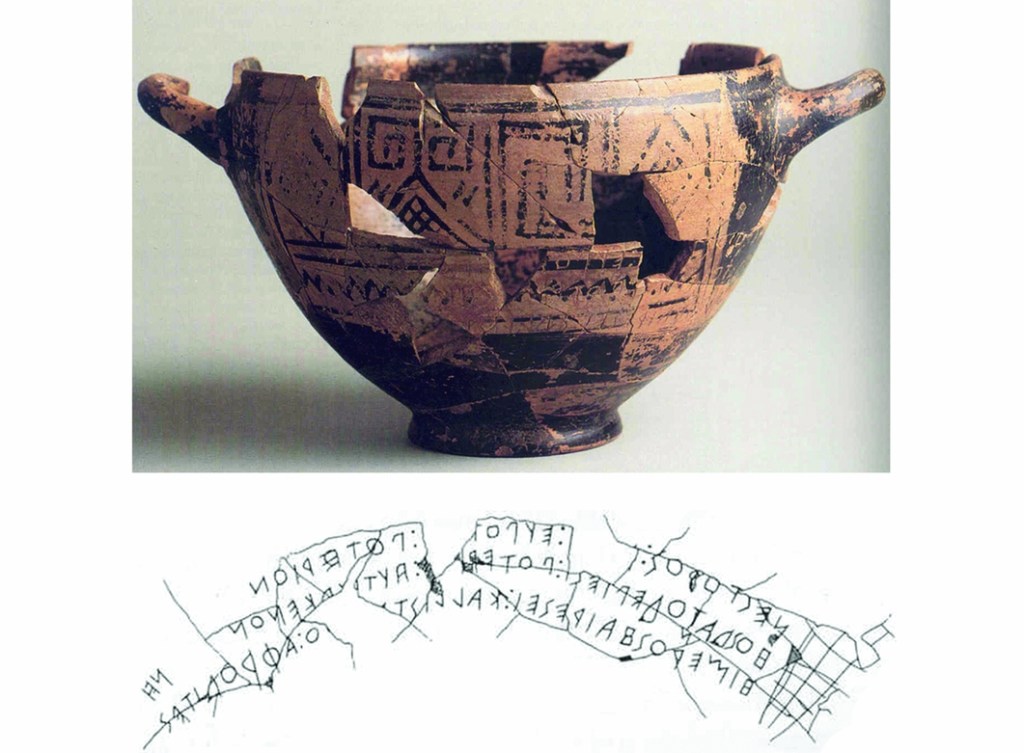
    On the other side of the debate, Classicists and archaeologists tend to argue for a low date, favoring the 8th century BCE. Their reasoning draws primarily from stratified archaeological contexts: the earliest securely datable Greek inscriptions—such as the Dipylon oinochoe and the Nestor’s Cup from Pithekoussai—belong to the mid-to-late 8th century. Rhys Carpenter was among the earliest and most forceful voices in this camp. In a 1933 article, he wrote that “the argumentum a silentio grows every year more formidable and more conclusive,” referring to the continued absence of any Greek alphabetic inscriptions predating the eighth century (“The Antiquity of the Greek Alphabet,” AJA 37 [1933]: 8–29, at p. 27). For Carpenter, the lack of material evidence was not a gap to be explained away, but itself a powerful datum: if earlier use had existed, we would likely have found traces by now.

    This school is generally skeptical of typological comparison, pointing out that letterforms evolve unevenly and can be conservative in certain contexts. Archaeological absence, while never conclusive, is taken seriously—especially when paired with the sudden, near-simultaneous appearance of inscriptions across disparate sites in the 8th century, suggesting a relatively rapid uptake of a recently acquired script. Later scholars, such as Barry B. Powell, built on this foundation. In Homer and the Origin of the Greek Alphabet (1991), Powell controversially argued that the Greek alphabet was deliberately invented for the purpose of recording Homeric verse, dating the invention to around 750 BCE. Though widely criticized for its teleology and lack of evidence for such a top-down design, Powell’s theory exemplifies the kind of interdisciplinary crossfire that defines this problem: where linguistic function, archaeological data, and cultural ideology all collide.

    Roger D. Woodard, in Greek Writing from Knossos to Homer (1997), pushed back against Powell while still supporting a relatively late date. Woodard views the alphabet’s adaptation as a process shaped not only by contact with Phoenician traders but also by internal Greek developments—especially the memory of Linear B and broader shifts in literacy practices. He emphasizes the complex interplay between tradition and innovation, seeing the Greek vowel system as a structural solution that could only emerge in a linguistic environment receptive to phonological precision.

    The question remains open, but APEX offers a different kind of approach. Rather than anchoring the debate to a single origin point, I focus on regional trajectories and graphical evidence: how letterforms vary, travel, and settle. If the Semitic party line reads the Greek alphabet as a photograph of Phoenician forms from 1000 BCE, and the archaeological model sees it as an emergent public tool of the 8th century, then I want to understand how specific graphemes move through space and time. Which forms remain stable across centuries? Which mutate rapidly? And what can that tell us about the process of transmission, rather than the moment of origin?

    In fact, the most immediate goal of the APEX project is to evaluate whether the Greek letterforms do, in fact, most closely resemble the Semitic models from around 1000 BCE—as the high-date camp maintains—or if their nearest parallels lie elsewhere in the Phoenician typology. The intention is to move beyond qualitative comparisons and scholarly intuition, toward a quantitative, statistically grounded assessment of letterform similarity. By measuring and modeling these visual relationships systematically, APEX aims to provide a more objective foundation for dating the moment of greatest resemblance between the Greek and Phoenician scripts.

    Rather than jumping straight into letterform similarity metrics, though, the next update will take a detour—one that’s no less crucial. Before the vectors can speak, they must be named, contextualized, and organized. APEX Updates, 3: Encoding Decisions will explore how I’m structuring the metadata that surrounds each traced letter: what counts as “context,” how information is tagged, and why every dataset is also a narrative. As it turns out, deciding how to describe a letter may be just as revealing as deciding how to compare it.

  • Tablets and Tribulations, 1: Lapse and Return

    2023: Tablet replica I made from a drawing in Huehnergard’s grammar.

    I first took Akkadian a few years ago. Since then, the language has been sitting in a kind of suspended animation: just far enough away to feel unreachable, just close enough to make me feel guilty.

    This post kicks off Tablets and Tribulations, a new series chronicling my return to Akkadian. I’ll be using it to track my progress, share insights, and reflect on what it means to study something this complex, this demanding, and this strange.

    Why Akkadian?

    Akkadian sits at the intersection of my academic obsessions: Semitic linguistics, the history of writing systems, and the psycholinguistics of script. It’s a dead language, but not a fossilized one. The more you read it, the more it pulses: with bureaucracy, with poetry, with prayer. And the writing system—a sprawling, phonetically polyvalent syllabary riddled with ideograms—is completely unlike the tight alphabets I’m used to. It demands patience, pattern-recognition, and grit.

    There’s also no shortage of material, with estimates of the number of excavated Akkadian texts reaching as high two million—meaning it quite possibly has the most documents of any ancient language; in fact, according to my professor Ronald Wallenfels, more documents than all ancient languages combined. Put that in your pipe and smoke it.

    I’m also drawn to it because I’m not naturally good at it. Greek and Latin came to me more intuitively, their logics familiar in a way I hadn’t expected. Akkadian doesn’t let me do that. It forces me to slow down, to wrestle with my perfectionism, to train my brain in new ways. And I love that. I want to get good at something hard. I want to overcome the mental blocks that have held me back before.

    What’s Changed

    Since that early study, I’ve broadened my exposure to Semitic linguistics and become more confident working with both the script and the medium. I’ve also made peace with how humbling this language is. Once, I even told a syntax class—confidently—that Akkadian had no demonstratives, only to moments later fact-check myself and discover that it had three distinct tiers of them. I then had to publicly correct myself and told them to pray for me… as I had a quiz on Akkadian pronominals the next period.

    I’m now studying with two grammars, Huehnergard and Caplice, using Labat’s sign list as my main reference. I’m also switching from just drawing signs to pressing them into clay, and my wax tablets—less sketchbook, more scribal. I’ll be posting more about that process (and my tablet replicas) soon.

    What to Expect from This Series

    Tablets and Tribulations will be part language log, part material exploration, and part meditation on what it means to study a language with no living speakers and a script that defies modern intuition. Future posts will likely include:

    • Syntax deep dives (word order, case, verb chains, etc.)
    • Close readings of texts (legal, literary, magical, bureaucratic)
    • Reflections on learning signs and navigating polyvalence
    • Notes on scribal training and cuneiform technique
    • My own experimental archaeology: pressing and firing tablets
    • Anecdotes from the museum and the classroom
    • Psycholinguistic musings on how syllabaries shape cognition
    • Occasional moments of crisis and triumph

    This is going to be hard. But I want that. I want to stretch, stumble, and get back up. That balance—rigor with joy—is what I’m working toward. Each week with Akkadian reminds me how study disciplines the self—not just the mind.

    So here’s to the first step. The tablets await.

  • Monthly Reads, 1: March 2025

    Monthly Reads, 1: March 2025

    There’s no single unifying theme to this list—but there is a feeling. I’m reaching, at once, toward the origins of writing and the frontiers of language technology. It’s structure that’s defining me at the moment: how systems encode meaning, whether that’s Greek orthography or neural networks. And in between, I let myself breathe with fiction—stories that play with form, time, and voice themselves.

    Recently Finished:

    • Epigraphic Evidence
      A technical addition to my current work on inscriptions. Like black coffee: not always easy to imbibe, but quite efficient.
    • Data Science (MIT Press Essential Knowledge series)
      A clean introduction—refreshing for thinking about data both ancient and modern.
    • Ripley’s Game (Patricia Highsmith)
      Cold, elegant, amoral. Hilarious at points. A good palate cleanser between denser texts.
    • The Sequel (Jean Hanff Korelitz)
      Read this mostly for plot, not language—but I love thinking about narrative structures and the great Second Novel Problem.
    • The English Understand Wool (Helen DeWitt)
      Sharp, strange, and delightful. I love a novel about an out-of-touch eccentric navigating the world.

    Currently Reading:

    • Kairos (Jenny Erpenbeck)
      A novel about political and personal time, and a very complicated affair. Thorny for sure.
    • Word by Word: The Secret Life of Dictionaries (Kory Stamper)
      The theme of choice made at all stages of lexicography deeply resonates with me as I encode my own systemic information. Chapters like “Bitch” and “Posh” capture this especially well.
    • Writing and the Origins of Greek Literature (Barry B. Powell)
      I keep coming back to this one in small sips. Chapters go down easy.
    • Greek Writing from Knossos to Homer (Roger D. Woodard)
      Foundational for understanding the transmission of the Greek alphabet. Very well written and thoroughly researched.
    • Algorithms (MIT Press Essential Knowledge series)
      A manageable way to reframe my thinking on rules and structure—not unlike real-life syntactical derivations.
    • Machine Learning (MIT Press Essential Knowledge series)
      Challenging. Still finding where I fit in here. Hoping I can apply to my APEX project by Stage 3.
    • JSON for Beginners
      Very practical for APEX, which is structured with JSON and makes heavy use of standoff annotation. This allows me to encode uncertainty and multiplicitous readings, lowering the amount of assumptions baked into the dataset.
    • Co-Intelligence: Living and Working with AI (Ethan Mollick)
      For someone working on ancient inscriptional data, the future of coworking with AI is too relevant to ignore.

    I wouldn’t call this a reading list so much as a reading state, a snapshot of what it feels like to be in the thick of things: academic work, blog writing, thesis planning, and whatever this slow journey toward modern spoken French is shaping up to be.

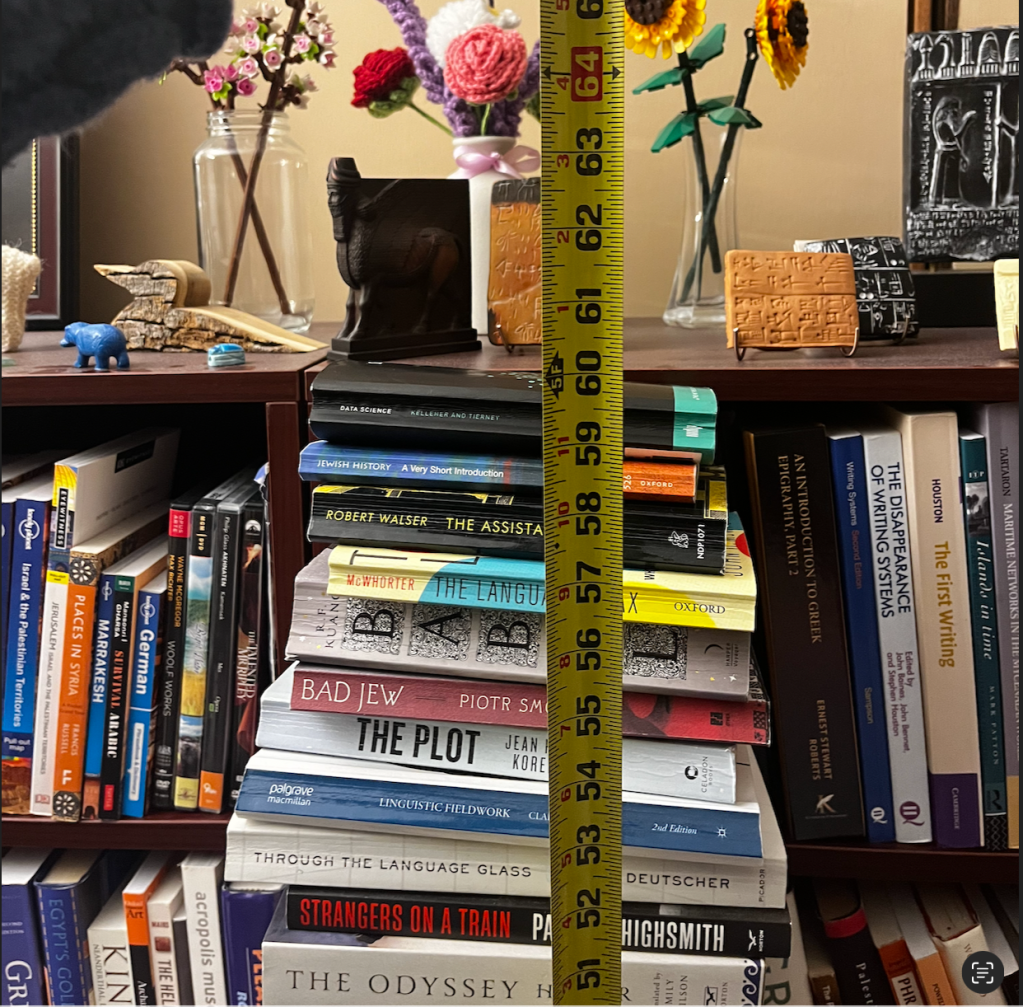
    Picture: I’ve been stacking my recent reads as a kind of personal monument—hoping to match my own height before summer.