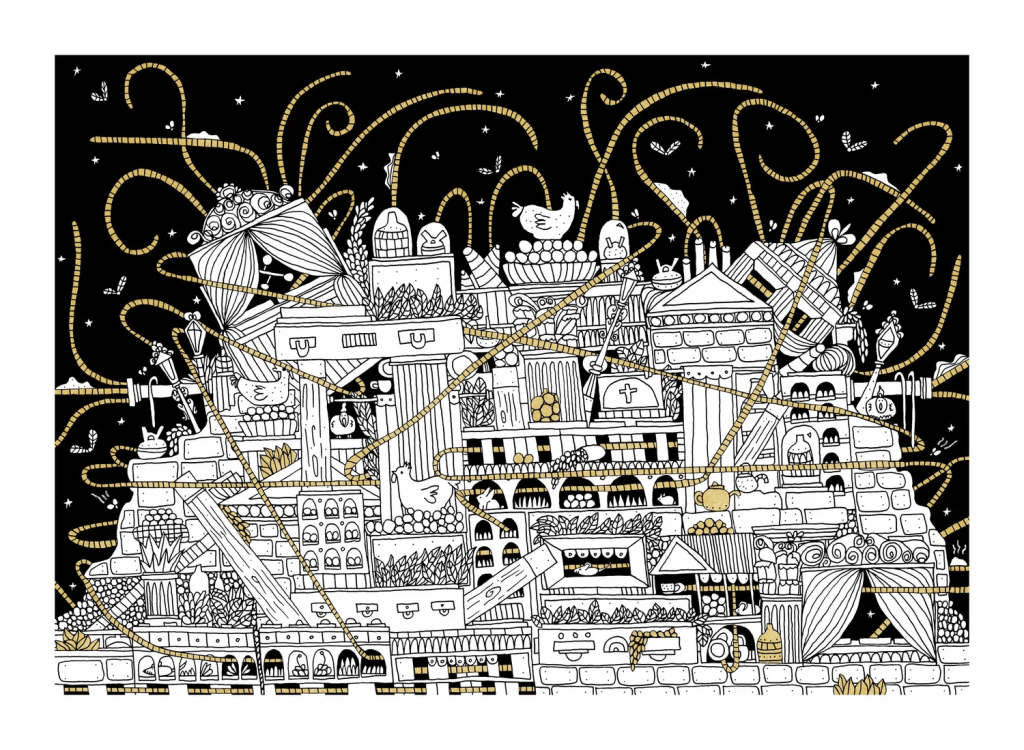
Clarice from Calvino’s Invisible Cities, as drawn by Karina Puente.
In the last decade the digital humanities have built an ethics of stewardship around two frameworks: FAIR and CARE.
Data, we’re told, should be Findable, Accessible, Interoperable, Reusable; its use should uphold Collective benefit, Authority to control, Responsibility, and Ethics. These principles have given structure to a once-couture, even cowboy, practice. They taught us that visibility is a virtue, that openness can be an act of justice. They made data management legible—something one could rate, certify, or defend.
Yet legibility is never neutral. FAIR presumes that clarity is the highest good; CARE assumes that control can be cleanly assigned. Both, however gently, rest on the dream of completeness: that if we organize our data well enough, we might finally see the whole.
APEX lives where that dream dies. The inscriptions I trace resist closure. They are fragmentary, re-inscribed, half-lost. Every dataset carries the tremor of its source—a chipped delta, a missing ‘alep, a surface that refuses to yield. The data, like the stones themselves, is frail.
I’ve begun to imagine a third paradigm: one that keeps FAIR’s discipline and CARE’s ethics but admits that in the humanities, stability is fictional. Call it FRAIL: Findable, Reproducible, Accountable, Interpretive, and Liminal.
Findable—disappearance helps no one.
Reproducible—others should be able to retrace our steps, even if they find another path.
Accountable—provenance and responsibility cannot be dispensed of.
Interpretive—ambiguity, when recorded, becomes part of the evidence itself.
Liminal—some knowledge dwells on thresholds: certainty and speculation, artifact and idea.
FRAIL doesn’t replace FAIR or CARE but grows from them. It asks what stewardship looks like when the object of study is itself uncertain, when our task is to hold the fragment without pretending it is whole.
At this point I keep returning to Calvino’s Invisible Cities. In “Cities and Names 4,” he writes of Clarice, a city that forever rebuilds itself from the shards of its earlier selves:
“Only this is know for sure: a given number of objects is shifted within a given space, at times submerged by a quantity of new objects, at times worn out and not replaced; the rule is to shuffle them each time, then try to assemble them. Perhaps Clarice has always been only a confusion of chipped gimcracks, ill-assorted, obsolete.”
Clarice is every archive we have ever built. Its fragments persist, rearranged with each generation, their order provisional, their meaning renewed by use. FRAIL data lives in that same condition: never whole, yet never lost—structures of care built from what survives. The humanities have always been a discipline of rebuilding Clarice.
To keep data FRAIL is therefore not to weaken it but to recognize its true strength: the capacity to bear transformation without disowning its past. Rigor becomes a form of tenderness. Reproducibility includes hesitation. The dataset, like the inscription, becomes layered, self-aware, and open to rereading.
In APEX I try to move toward that kind of data: technically precise yet narratively honest, transparent about its mediation, willing to show its seams. The goal isn’t immortality but traceability—to make each decision legible without pretending it ends the story.
Perhaps that is what stewardship finally means: not to eliminate fragility, but to hold it safely, as one holds a fragment of Clarice—knowing it has already been broken, and still believing it can be assembled again.
The art of losing isn’t hard to master; so many things seem filled with the intent to be lost that their loss is no disaster.
Lose something every day. Accept the fluster of lost door keys, the hour badly spent. The art of losing isn’t hard to master.
Then practice losing farther, losing faster: places, and names, and where it was you meant to travel. None of these will bring disaster.
I lost my mother’s watch. And look! my last, or next-to-last, of three loved houses went. The art of losing isn’t hard to master.
I lost two cities, lovely ones. And, vaster, some realms I owned, two rivers, a continent. I miss them, but it wasn’t a disaster.
—Even losing you (the joking voice, a gesture I love) I shan’t have lied. It’s evident the art of losing’s not too hard to master though it may look like (Write it!) like disaster.
Can loss be mastered, or merely rehearsed?
Bishop’s villanelle proposes, in a way, that repetition is training, can be practiced, that form and control can make loss bearable. Her composure in the face of grief is compelling; stoicism always tempts the wounded mind. Yet the paradox of tone and form—her unflappable cant, the neat tercets, its refrain that promises discipline where grief ought to exist—is impossible to ignore.
The form is an argument, and its unraveling coherence speaks to a profound tension. Each recurrence of the refrain weakens its authority, until mastery itself begins to sound like mimicry. The poem’s structure mimics denial. Every return of “The art of losing isn’t hard to master” sounds more and more like self-persuasion than wisdom. There’s this extreme rhetoric of control that is increasingly overtaken by the tremor of what escapes it.
Form as containment—that’s the key thread here. The villanelle is a form obsessed with return, which makes it an ironic vessel for a poem about moving on. Syntax becomes a kind of fate, in my opinion: by choosing this structure, Bishop cages herself in an inescapable neurosis, no doubt intentionally. As with all forms we cling to—habit, routine, scholarship—it becomes both ritual and trap.
Her quasi-enjambment, too (“—Even losing you…”), stretch the villanelle almost to breaking—but never beyond, not in her hands. Whether it counts as enjambment at all is debatable. It’s nearly a continuous sentence across a stanza break, even though the prior sentence ends with a period. The em dash unsettles that finality: was the thought complete, or has the speaker decided, mid-breath, that it wasn’t?
There’s a mirroring at work here. The poem’s discipline enacts the speaker’s composure, yet that same discipline exposes her desperation to stay intact—both for herself and for others. To write a poem is to face inward; to publish it, outward. It is a saving of face and a measured loss of it.
“Lose something every day” sounds like a rule in a manual—domestic(ated), manageable—this impersonal, authoritative voice distances her from the wrenching-away that is loss, and puts her in the territory of disengagement from on high.
But note the escalating scale of loss—keys, an hour, a mother’s watch, houses, cities, continents, you. We can read this as a kind of curriculum: a stoic pedagogy that keeps failing upward. First comes the loss of convenience and access—doors that briefly refuse to open—then time itself; then a representation of time, something that both measures duration and embodies continuity, that in two senses keeps time. After that, a door that will never open again; then larger places, perhaps soured by memory (it’s unclear to me what Bishop means by losing “cities” and “continents”); and finally, the addressee—the greatest loss of all, by the poem’s own logic.
Each stanza revises the promise of “no disaster” until it barely, if at all, convinces. By the end, the loss of the addressee—one person—is weighed against irretrievable things: time, heirlooms, memory embodied in place. Bishop strains believability here; repetition becomes not comfort but corrosion, a gradual wearing away of self.
When does style stop protecting the self and start exposing it? I’d argue that it is the last line: “though it may look like (Write it!) like disaster.”
That parenthetical rupture is where the villanelle—and language itself—betrays its own extent. Here, language reaches its limit: the moment Wittgenstein warned of, when the boundary of speech becomes the boundary of world. The form insists on repetition even at the poem’s most tormenting point. It’s the poem’s scream under its breath, the instant Bishop forces herself to name what she cannot rationalize away.
Even the italics matter. It isn’t “Write it!”—as it would be if rendered simply as an inward thought—but “Write it!”, a specific verbal (but not verb-phrase) imperative. The command exposes writing itself as an act of commitment: to inscribe the unbearable, to fix the truth she can no longer evade. And it’s fitting, as Wilde once said, that “a poet can survive anything but a misprint.”
Yet we cannot ignore the poet’s agency with that line. It’s also an intrusion of authorial will, Bishop interrupting her own line to compel honesty. The command is both a confession and a flouting of form. It punctures the poem’s staid decorum, revealing all that earlier composure was scaffolding for this climactic moment. The poem’s grammar at last fractures under the excruciating pressure of declaring losing the addressee was de minimis.
To return to the above question: Bishop’s control is exquisite, but her vulnerability is captured perfectly in the syntax: note the doubling of “like,” something readers may gloss over, “autocorrecting” in their brain, but it’s this very stutter that beautifully undoes her mastery. The imperative tone has turned to pleading.
The art of losing proves to be an art only because it cannot be perfected.
Close reading itself may be a kind of loss, losing the illusion (delusion?) that meaning is stable, that distance is comfortable. Bishop’s refrain mirrors the scholar’s: returning to the same line, across space or time, until it yields—or refuses to. The art of reading, like that of losing, “isn’t hard to master,” at least until it reaches something too-close, enough to resist impersonal analysis. At that point, one must remain—with the text, with the loss—awake to what cannot be understood without the self.
Bishop’s villanelle doesn’t close; it circles. The refrain ends where it began, but altered by exposure. Our poet doesn’t teach detachment in this poem, despite appearing to. The didacticism is rather about endurance through excruciating pain—a theme I can’t help but connect to Homer’s Odyssey, to be driven far (ὃς μάλα πολλὰ πλάγχθη) but still moving, even after two decades of loss after loss. The villanelle, then, like the epic, becomes a ritual for staying with pain until it can be metabolized into form—not escape it, but to give it shape.
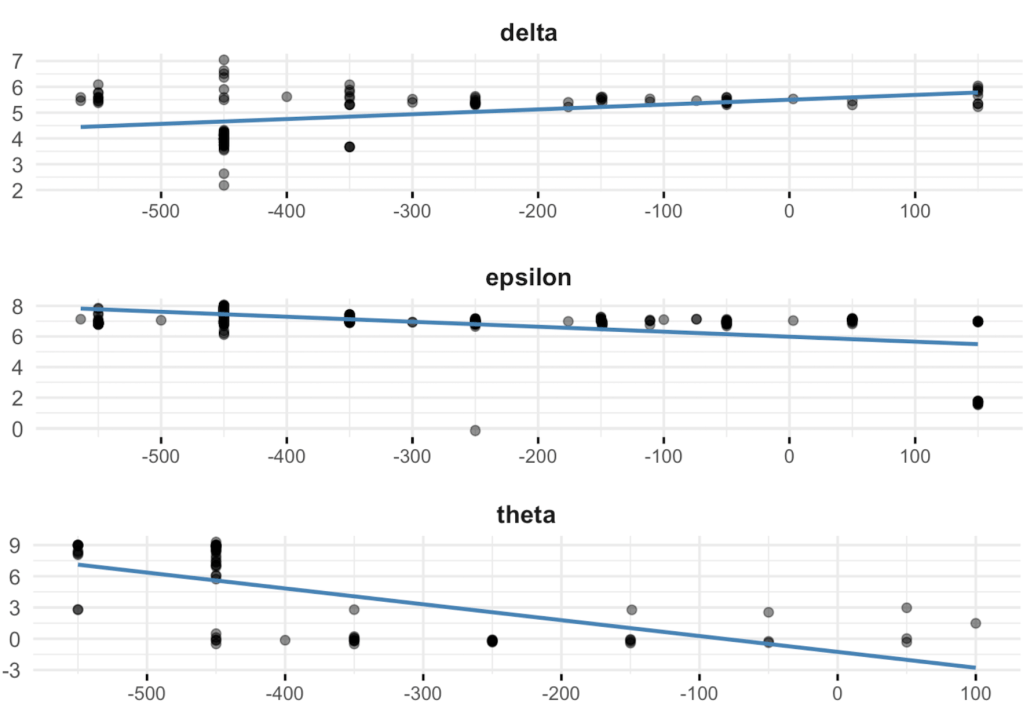
Complexity trends for three letters over 700 years on Euboea, from my forthcoming diachronic study.
When I began APEX seven months ago, I wrote that before theory comes tracing—the act of turning old strokes into structured data. Half a year later, that small act has grown into something larger: a functioning, extensible research environment capable of analyzing thousands of letterforms across hundreds of inscriptions.
If the last few months have been about proving the analytical potential of APEX, this one has been about deepening its usability—turning it from a powerful engine into a genuine workspace. The latest version, 1.9.1, focuses on the graphical user interface, which I only dreamed of last April. The idea was to give form to the human side of paleographemics: how scholars see, record, and reason through inscriptions.
The platform now balances two goals that usually pull in opposite directions. It is rigorous enough to handle multilingual, multi-directional corpora across millennia, yet flexible enough to capture interpretive uncertainty and scholarly disagreement.
1. The Corpus Grows
APEX now contains its first completed regional corpus: 209 lead curse tablets from 5th-century BCE Styra (Euboea), encompassing 1,857 individual glyphs, each manually traced, annotated, and analyzed through the full APEX pipeline. Alongside this is a parallel dataset of another 99 Euboean inscriptions, spanning roughly eight centuries—from the Archaic through the Hellenistic period—processed through an exploratory workflow still in development.
Together, these two datasets represent 4,990 glyphs from the island of Euboea alone, making this one of the largest and most detailed regional paleographic corpora currently in existence. This body of material allows APEX not only to test technical scalability but to examine a single region’s graphical traditions across a complete chronological arc.
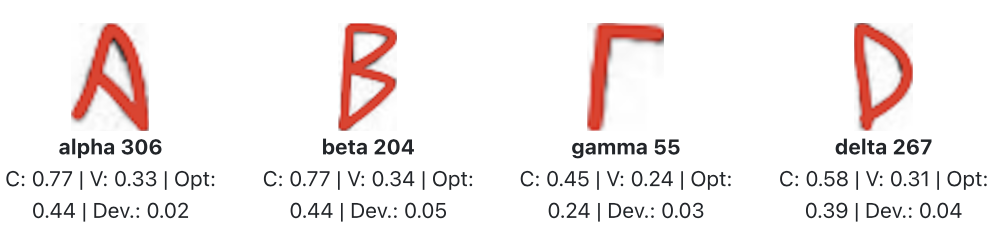
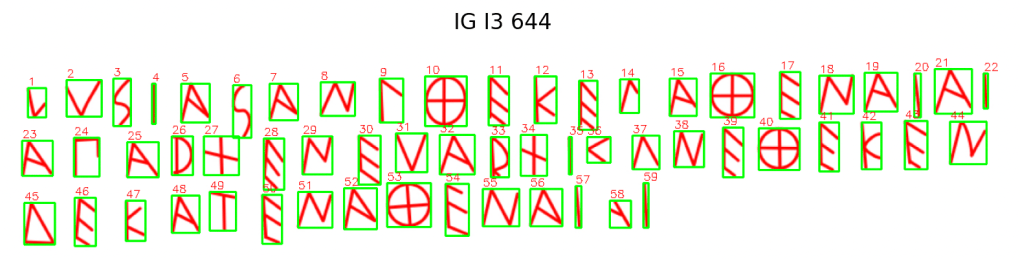
Selected gallery of “Most Typical Glyphs by Letter” from Styra lead tablet report.
Within Styra alone, clear structural tendencies emerge. Across the 1,857 analyzed glyphs, symmetry and complexity show a strong inverse relationship, as expected, but now quantified. Others—especially theta and, unexpectedly, many iotas—deviate, showing that simplicity and circularity were not universal ideals but locally negotiated habits.
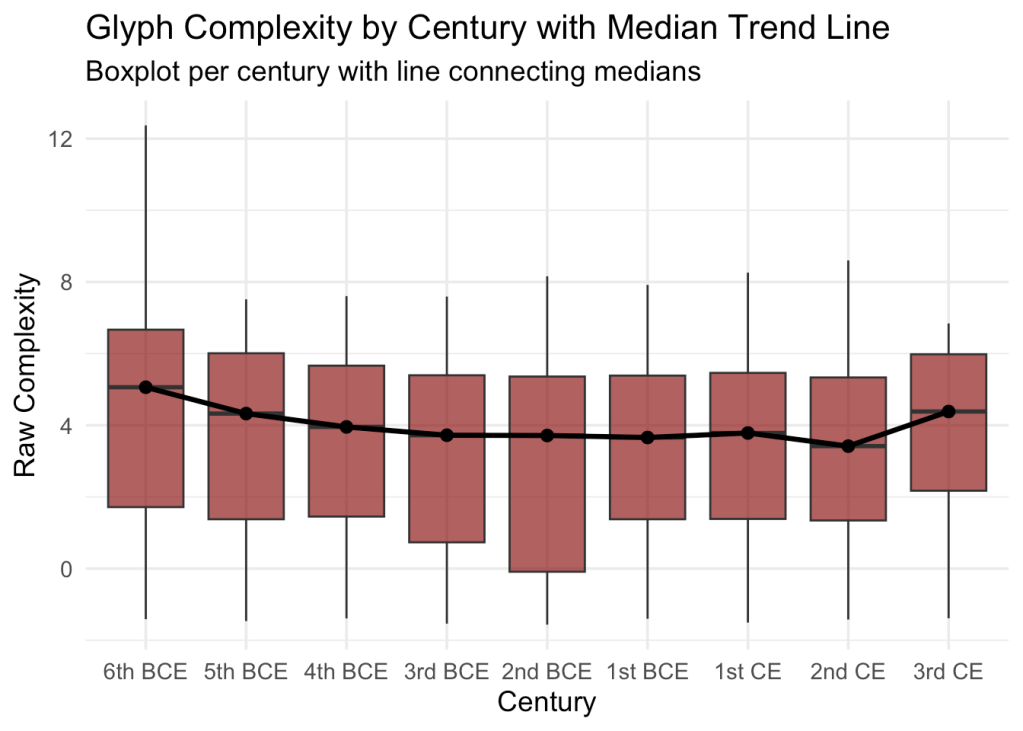
Classical intuitions—decreasing complexity through the Archaic and Early Classical periods, a plateau, then a late stylistic uptick—are confirmed here, but more importantly, they’re now quantified
Across the broader eight-century span, early tendencies toward angularity give way to smoother, more balanced forms. Though not universally—delta stands out, evolving from a 2-stroke rounded D-shape to the familiar 3-stroke angular Δ, a shift that mirrors the broader transition from ductus-driven to design-driven writing. Nonetheless, this broadly confirmed long-standing epigraphic intuitions, but for the first time, making them concrete and measurable.
Taken together, the data suggest that what epigraphers once described qualitatively as a “balanced hand” or “tidy style” can now be measured as a structural principle—evidence that writers (whoever they may be, trained scribes or so-called ordinary people) in 5th-century Styra pursued an underlying visual economy that blurred the boundary between mechanical habit and aesthetic intention.
2. The Interface Takes Shape
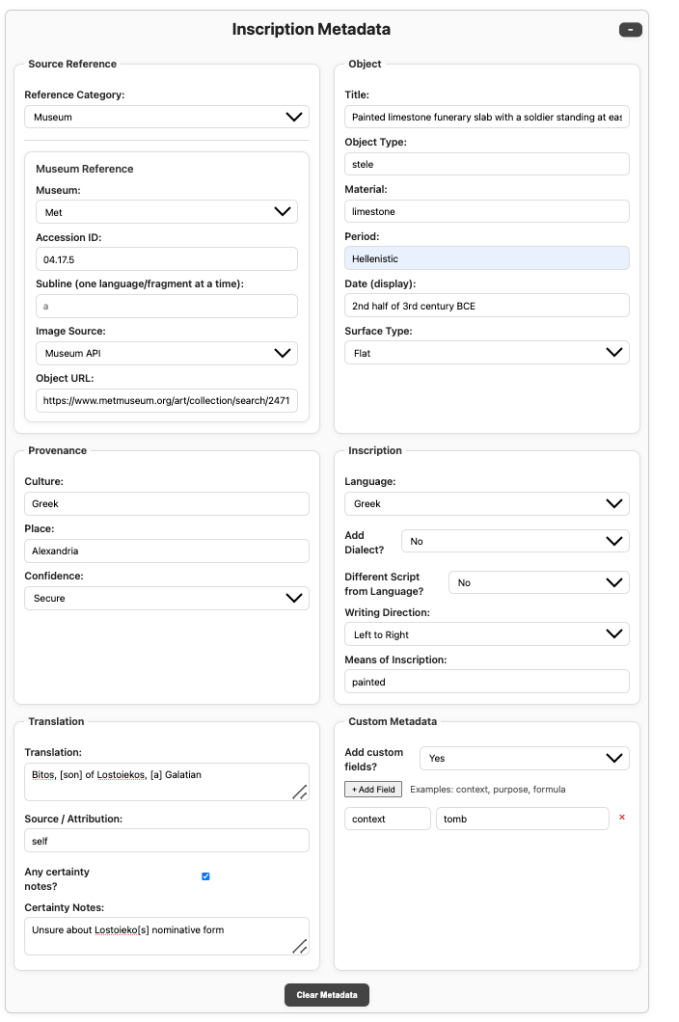
v1.9.1 particularly hinges on a comprehensive Inscription Metadata panel—a modular framework for recording everything an inscription can tell us: provenance, language, writing direction, translation, confidence, and context.
The (very granular) metadata panel, designed for maximum precision. This will later allow highly dimensional, unsupervised machine learning (ML) to be performed.
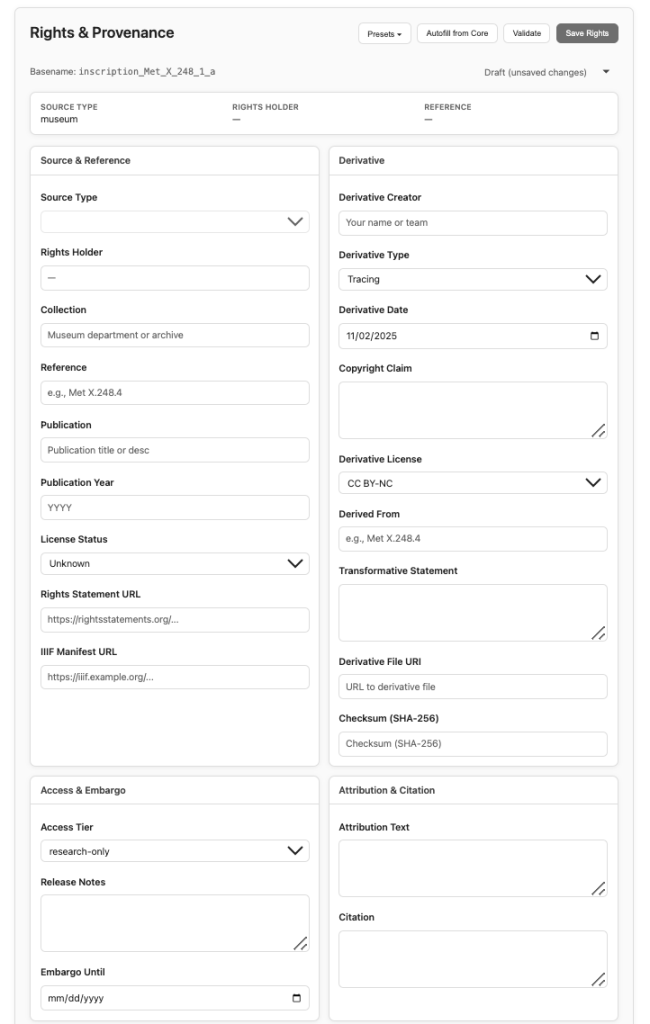
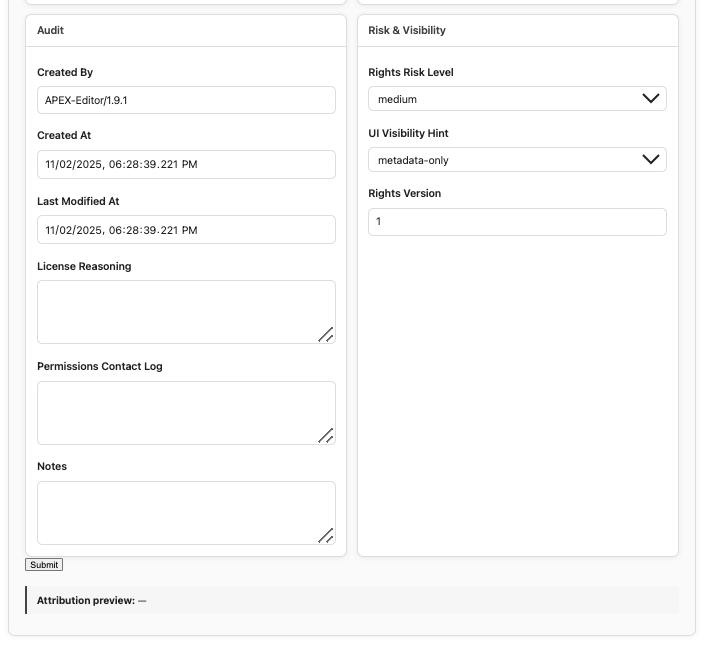
Furthermore, there’s an extensive rights and permissions panel just below that. This enables future rights-safe integration with public databases, preserving sensitive and restricted information from accidental reproduction—critical in heritage preservation and in preventing looting/destruction, especially in conflict zones. Now that I’m pivoting to working with data outside of the public domain, this is a non-negotiable feature, and I hope this is a practice that others replicate when fusing rights-diverse corpora. Below is the model of that.
Each record can now be broken into sublines, allowing users to specify separate languages and writing directions within a single inscription. This makes it possible to manually encode boustrophedon layouts, alternating left-to-right and right-to-left lines without losing reading order. The same applies for multilingual inscriptions: the user isolates each portion of a different language subline to analyze individually. However, true schlangenschrift—the serpentine style of continuous directional change—remains a technical frontier still ahead, but the architecture for handling it is now in place.
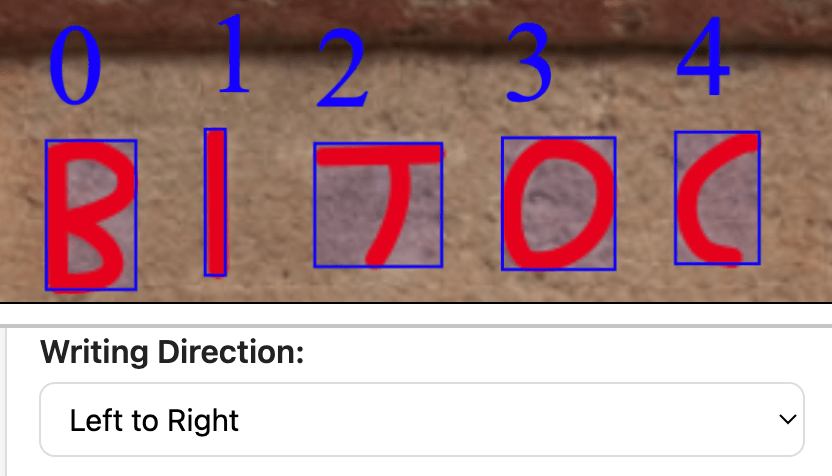
For a Greek inscripion.For an Aramaic inscription.
Bounding boxes are direction-aware, indexed according to reading orientation, ensuring that extracted visual features align correctly with the direction of writing. Metadata imports from museum APIs are now supported, and flexible fields allow users to enter additional descriptors such as inscription purpose, formula, or archaeological context.
3. Encoding the Human Element
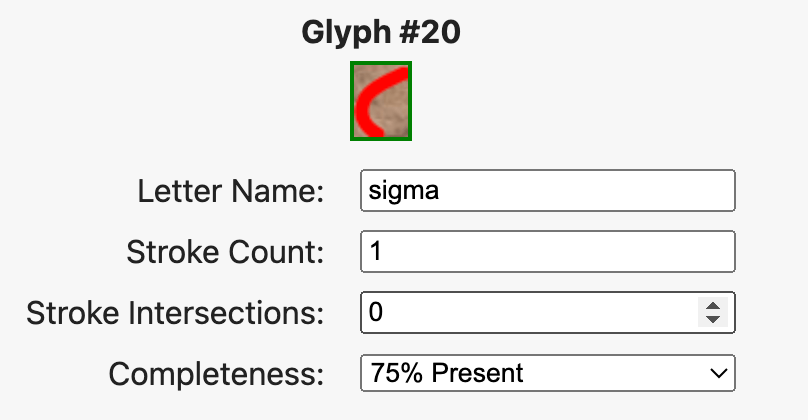
Each glyph now carries its own metadata through a compact per-glyph panel. Users can record completeness, stroke count, and intersection data, and—critically—can flag alternative readings where forms are contested. The new Scholarship Mode attributes alternate identifications to specific scholars or corpora, creating a visible interpretive genealogy and turning disagreement into structured data.
5-tier completeness flags now present.
What results is a layered model of knowledge. APEX no longer treats the epigrapher’s uncertainty as noise; it considers it data. Each recorded disagreement becomes part of the historical record of how these inscriptions have been read.
User can now cite alternative readings and the reasoning for them.
4. Intelligent Defaults
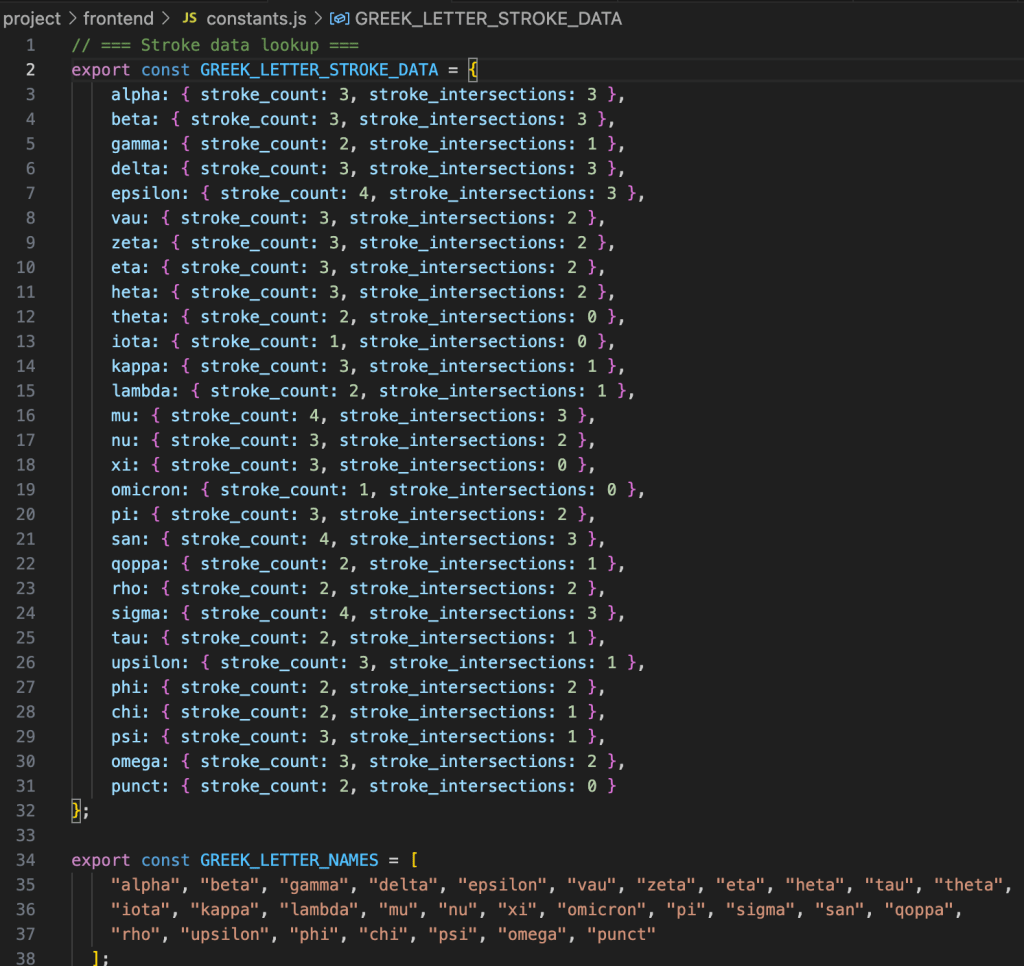
Five editable, language-aware dictionaries now exist for the GCELL script cluster, i.e., Greek, Coptic, Etruscan, Latin, and Lydian. There are another five dictionaries on the way for the PASHA branch: Phoenician, Aramaic, Semitic, Hebrew, and Arabian. This capability autofills letter names with their expected stroke and intersection counts, cutting per-glyph processing time by ~70%. These default expectations provide baselines for feature extraction and make visible the subtle divergences that define local or experimental hands.
The dynamic Greek dictionary.
5. From Interface to Insight
The combination of robust metadata, per-glyph fields, and structured dictionaries has turned APEX into a living research environment. A researcher can now import an object from a museum API, record multilingual metadata, define directionality, tag individual glyphs, and export a ready-to-analyze JSON file—all within a single interface.
Early exploratory notebooks using the full eight-century dataset are already visualizing regional drift and stylistic convergence over time. Though not yet publishable, these models provide a first view of how letterforms move within and between centuries, forming clusters of continuity and outliers of innovation.
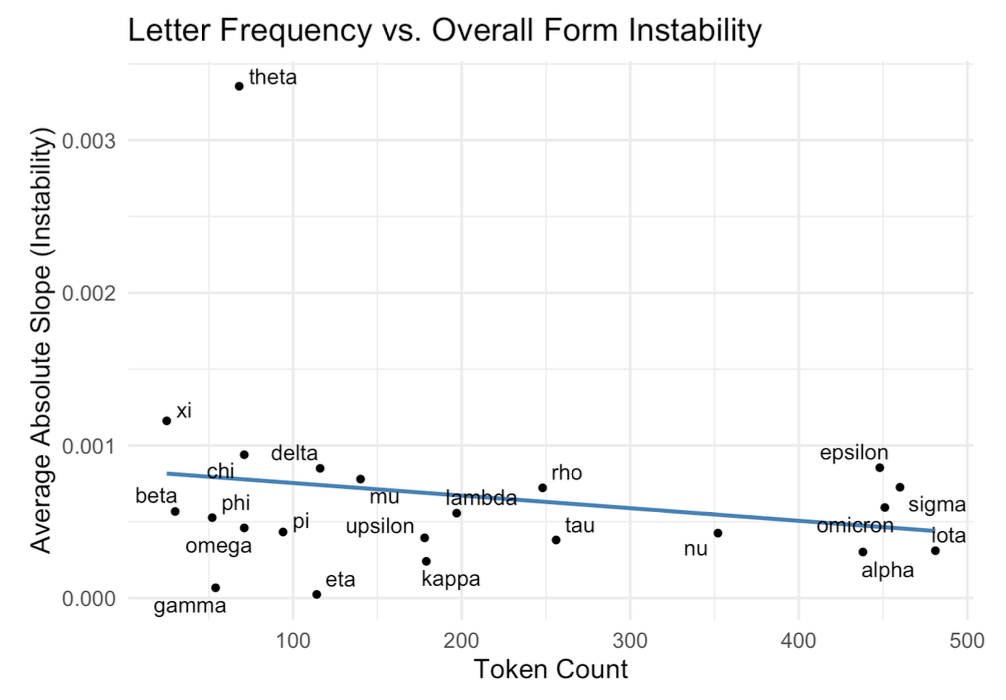
Critically, they also provide examples contrary to certain received wisdom. See the following chart, and note that the p-value of this correlation is p = 0.37, well above the <0.05 threshold for statistical significance in the social sciences.
In the eight-century dataset, letter frequency shows only a weak and statistically insignificant relationship to graphical stability. The trend line slopes slightly downward—more common letters like alpha, sigma, and omicron are somewhat more stable—but the effect is far from reliable. This suggests that the conventional linguistic expectation—that frequently used units remain more conservative—does not translate cleanly to letterforms. Here, stability may follow style and medium more than frequency.
6. Reflection
The major achievement of this phase is not simply scale—it’s integration. APEX has reached a point where drawing, data entry, and interpretation form a continuous loop. Each inscription is both a record of ancient writing and a record of modern reading.
With nearly five thousand glyphs from one major region already processed, APEX is beginning to reveal what paleographemics promises: the ability to study writing as a cultural system that can be seen, measured, and compared without losing its human texture.
Back in February, I thought two months was enough time to date the transmission of the Greek alphabet.
That was my starting point: a delusional hope. And indeed I began APEX with scant technical ability—poor grasp of concepts and a month of coding background—just a sense that there was something doable at the intersection of computational method and ancient script. That if I could just find a way to measure the shapes of letters, I might be able to tell a new kind of story about how the alphabet traveled, evolved, settled into forms.
It turns out: no, I can’t date the transmission of the alphabet, not at 21, not in 10 weeks. But what I can do is more interesting than I could’ve imagined.
The first time my bounding boxes returned in the correct order, it felt like a miracle. Then came the multiline inscriptions, then symmetry, then even raw drawings, not traced. Every breakthrough brought a little more light. Eventually I wasn’t just copying, being derivative—I was quantifying, contributing. My complexity metric sharpened. The overlay lines grew more reliable. And like a planet in formation, the project developed a center of gravity—and it began to cohere.
And I encountered some surprises, as in the section “Dipylon: When the Data Doesn’t Flinch.” A particular early inscription came back less complex than many of the later ones I tested. That result challenged not just my expectations, but my entire premise. It forced me to reckon with how many qualitative judgments still underpin every “quantitative” metric I generate. What counts as complexity? What gets weighted, and why? Those choices are human. They’re mine.
That’s the most important thing I’ve learned: you don’t escape interpretation by adding math. You just make the interpretation a little more legible. Hopefully.
But still: I measured something. I made a system that can trace chaos and extract structure—not to flatten but honor. The alphabet, in its earliest known Greek forms, is no longer just a field of intuition or artistry or tradition. It’s data. It’s patterns. It’s beautiful.
What does this moment feel like? It feels like I just landed a man on the moon, as in that grainy black-and-white footage: men in short-sleeved white shirts and skinny ties, erupting with joy when the impossible became real. That’s me right now—except I’m just an undergrad with an old laptop and the stubborn belief that I can make something for the field I love.
After months of tracing, testing, and theorizing, APEX just did something real. AlphaBase is expanding. This is what it felt like to land the letters.
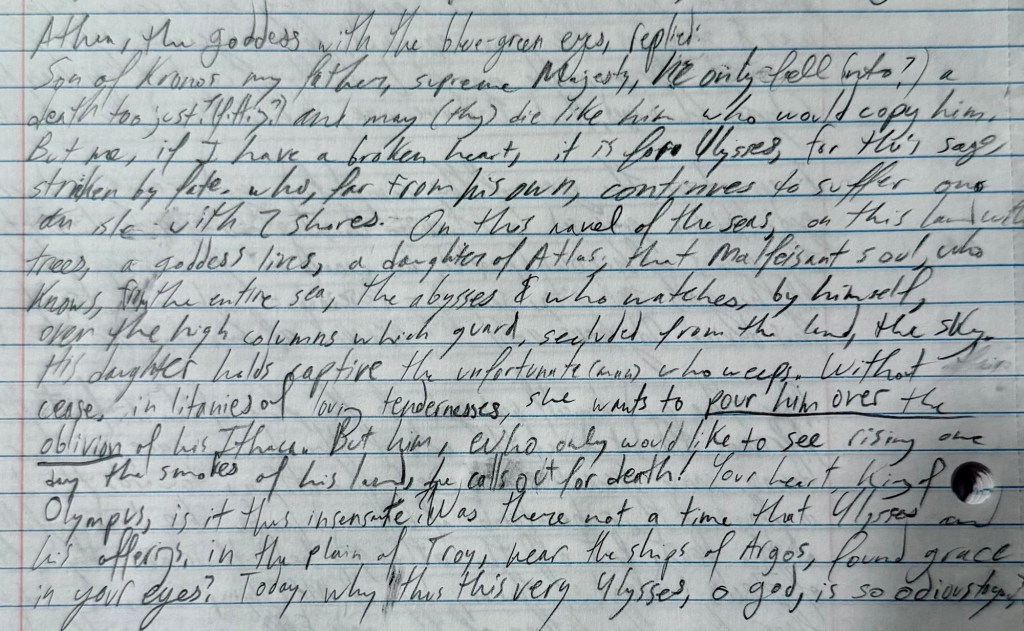
A passage, translated from Bérard, that I found particularly moving. In it, Athena pleads to Zeus, asking that he find mercy in his hardened heart for Odysseus.
Reading for friction, not fluency
In the first week of Tritropic, I found myself reading the same passage in French and Greek on the same day. It seemed like a good idea: reinforce the meaning, triangulate expression, hold the line up to two kinds of light. Instead, once I’d puzzled out the syntax and meaning in one language, the second version became trivial. All the work had already been done, particularly because Bérard’s French hews so closely to the original—here a gift and a curse, since the shape of the sentence had already been laid bare.
What should have been a second act of discovery turned into a performance of memory. And that, for me, is a dead end.
So I’m revising my approach for the next month to see if a new structure works. I now read a Book of the Odyssey in French across a week, then return to the same section in Greek for the next two or three weeks. This reintroduces mystery—just enough forgetting to force me to re-earn my understanding. Each version remains itself so I can’t lean on one to carry the other. However, there’s just enough closeness, I think, for comparison of translation choices. Theory of translation is something I quite want to pursue through this—it’d be a shame to lose that aspect.
Scaffolds and Syntax
In these early days, I’ve learned to be wary of digital tools—pop-up glosses, online parsers, translation extensions. There’s a difference between using scholarly supports and just outsourcing thought. Too often, I found myself parsing without learning. Clicking my way through a passage gave me the answer but not the understanding.
To counter that, I’ve built what I call a “Reading Ladder” for the French. It begins with a cold read—no tools, no support, just me and the text, making guesses about syntax and structure. Next, I pass through a deeper parsing stage, using only a grammar and a basic dictionary to confirm key unknowns, not every minor term. Only after this do I allow myself to consult a translation or ask my fluent friends, not as a crutch but as a corrective.
I plan two final stages once I get my bearings more. These are expressive exercises: retelling the passage in my own French, rereading it aloud for rhythm, and briefly stepping outside the text to engage with something stylistically adjacent—a short piece by Gide, a 19th-century abstract on epic poetics, anything that stretches my sense of what French can do.
Throughout this process, I plan on keeping a syntax journal. Each week, I record one sentence I understood without help, one that tripped me up (with notes on why), and one that delighted me. The journal is to be a miniature Grammaire Bérardienne. It also is meant as a reminder that joy is a form of comprehension.
Greek and Joyful Tedium
Greek, with its distance from both English and the Attic I’m familiar with, is a harder beast—and all the more rewarding because of it. I’ve adopted a multi-pass system here as well. The first time through, I read aloud without stopping. No dictionary, no notes, just the text and the shape of the sentence as much as I can discern it. I underline words I don’t know, try to guess at their meaning from morphology, meter, or context. Only after that do I allow myself to return and parse each word carefully. By then, I’ve already begun to intuit some of the patterns, and the parsing feels earned rather than imposed.
Twice a week, I do blind parsing drills. I take a short passage, cover any translation, and write out the morphological analysis of each verb and noun—tense, mood, case, number, person, source verb or noun. Then I translate from scratch. It’s humbling, but it builds exactly the muscles I’m trying to train.
Every month, I’m going to try to reread an entire Book in Greek with no aids. It’s the closest this kind of study gets to strength training. My professors have told me one of the best things you can do for your Greek (and language skills generally) is to reread, since you’re no longer in just decode-mode. This very much helped me last semester in my Lucian class. The sense of fluency that emerges—halting, but unmistakable—is worth every hour.
I also keep a personal lexicon, noting each unfamiliar form, particle usage, or idiom that gives me pause. And every few weeks, I’ll try my hand at short Homeric compositions—just five or six lines using words and constructions I’ve encountered. In the meantime, I’m studying from two Quizlets: one of the 500 most common Homeric vocabulary items, and one with 70+ important ‘small words.’
What the Text Offers
What I hadn’t fully expected was just how well-suited the Odyssey is for this kind of iterative, interleaved learning. Its repetitions are pedagogical for me. Vocabulary recurs with slight variations, idioms reappear in altered contexts, and the syntax is often rhythmic enough to imprint itself on the brain. Bérard understands this, and he mirrors Homer’s scaffolding with care. His French extends Homer’s use of anaphora, his vocabulary choices build on one another, and his ceremonial tone reinforces structure as it elevates the prose.
In both languages, challenge ramps up at a manageable pace. I’m only a few pages in, but already I can sense the increasing complexity—more embedded clauses, trickier participial constructions, and richer metaphor. But nothing feels unearned. The text supports you even as it stretches you.
Perseverance, Not Performance
There’s a line at the beginning—one I have reached in both languages—that keeps echoing in my head: ὃς μάλα πολλὰ πλάγχθη. It’s often rendered loosely as “he who was greatly tossed about,” but the Greek is more literal than that, and stranger: he who was driven off far or much. It conjures not just aimless wandering, but compelled displacement—someone pushed off course by forces beyond his control.
Bérard translates it as celui qui tant erra—“the one who wandered so much.” Murray’s version is starker: “the man who was driven far astray.” Murray evokes motion without agency, but Bérard is softer, more open to interpretation on whether this wandering was chosen or forced. Yet they both understand that πλάγχθη is not just travel, but deviation.
The line isn’t just about Odysseus, however. It describes what it means to read a difficult language honestly. You’re driven, sometimes astray, but still in motion.
Difficulty, for me, is no longer something to overcome. I recognize it now as an essential condition for progress. Every time I misparse a participle or mistake a clause boundary, I get a little closer to understanding—not just the sentence, but the langauge system that generated it. That’s the rhythm of the tritropic line: wandering with purpose.
2023: Tablet replica I made from a drawing in Huehnergard’s grammar.
I first took Akkadian a few years ago. Since then, the language has been sitting in a kind of suspended animation: just far enough away to feel unreachable, just close enough to make me feel guilty.
This post kicks off Tablets and Tribulations, a new series chronicling my return to Akkadian. I’ll be using it to track my progress, share insights, and reflect on what it means to study something this complex, this demanding, and this strange.
Why Akkadian?
Akkadian sits at the intersection of my academic obsessions: Semitic linguistics, the history of writing systems, and the psycholinguistics of script. It’s a dead language, but not a fossilized one. The more you read it, the more it pulses: with bureaucracy, with poetry, with prayer. And the writing system—a sprawling, phonetically polyvalent syllabary riddled with ideograms—is completely unlike the tight alphabets I’m used to. It demands patience, pattern-recognition, and grit.
There’s also no shortage of material, with estimates of the number of excavated Akkadian texts reaching as high two million—meaning it quite possibly has the most documents of any ancient language; in fact, according to my professor Ronald Wallenfels, more documents than all ancient languages combined. Put that in your pipe and smoke it.
I’m also drawn to it because I’m not naturally good at it. Greek and Latin came to me more intuitively, their logics familiar in a way I hadn’t expected. Akkadian doesn’t let me do that. It forces me to slow down, to wrestle with my perfectionism, to train my brain in new ways. And I love that. I want to get good at something hard. I want to overcome the mental blocks that have held me back before.
What’s Changed
Since that early study, I’ve broadened my exposure to Semitic linguistics and become more confident working with both the script and the medium. I’ve also made peace with how humbling this language is. Once, I even told a syntax class—confidently—that Akkadian had no demonstratives, only to moments later fact-check myself and discover that it had three distinct tiers of them. I then had to publicly correct myself and told them to pray for me… as I had a quiz on Akkadian pronominals the next period.
I’m now studying with two grammars, Huehnergard and Caplice, using Labat’s sign list as my main reference. I’m also switching from just drawing signs to pressing them into clay, and my wax tablets—less sketchbook, more scribal. I’ll be posting more about that process (and my tablet replicas) soon.
What to Expect from This Series
Tablets and Tribulations will be part language log, part material exploration, and part meditation on what it means to study a language with no living speakers and a script that defies modern intuition. Future posts will likely include:
Syntax deep dives (word order, case, verb chains, etc.)
Close readings of texts (legal, literary, magical, bureaucratic)
Reflections on learning signs and navigating polyvalence
Notes on scribal training and cuneiform technique
My own experimental archaeology: pressing and firing tablets
Anecdotes from the museum and the classroom
Psycholinguistic musings on how syllabaries shape cognition
Occasional moments of crisis and triumph
This is going to be hard. But I want that. I want to stretch, stumble, and get back up. That balance—rigor with joy—is what I’m working toward. Each week with Akkadian reminds me how study disciplines the self—not just the mind.
Every big project starts with a deceptively small question. For me, it was: how do you turn a carved letter into data?
APEX (Alphabetic Paleography Explorer) is my attempt to map how the Greek alphabet developed and spread—first across Greek-speaking regions, then into other scripts entirely. But before I can compare, model, or visualize anything, I need something more fundamental: a dataset that doesn’t just record letters, but understands them. That’s where things get tricky.
Step 0: Drawing the Inscriptions
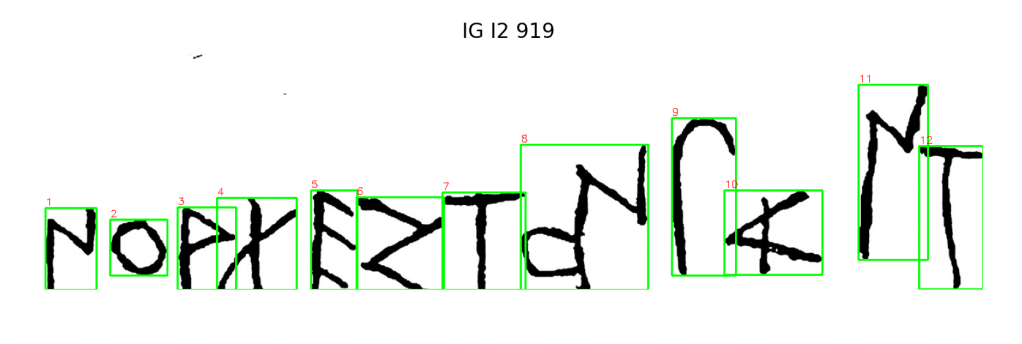
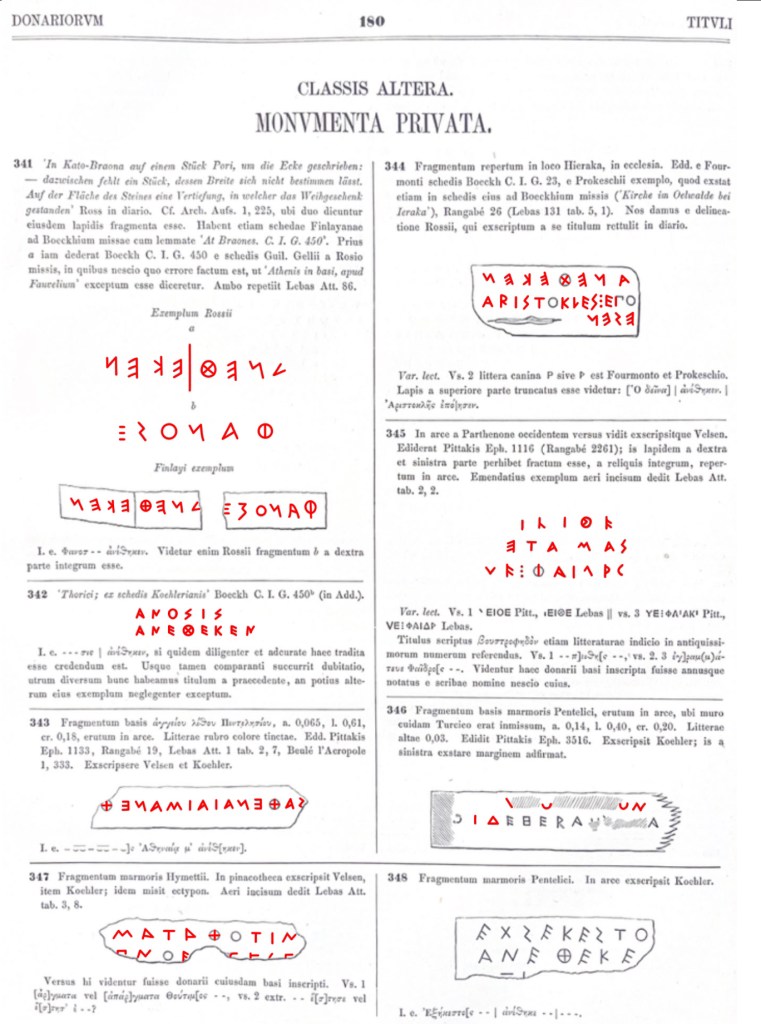
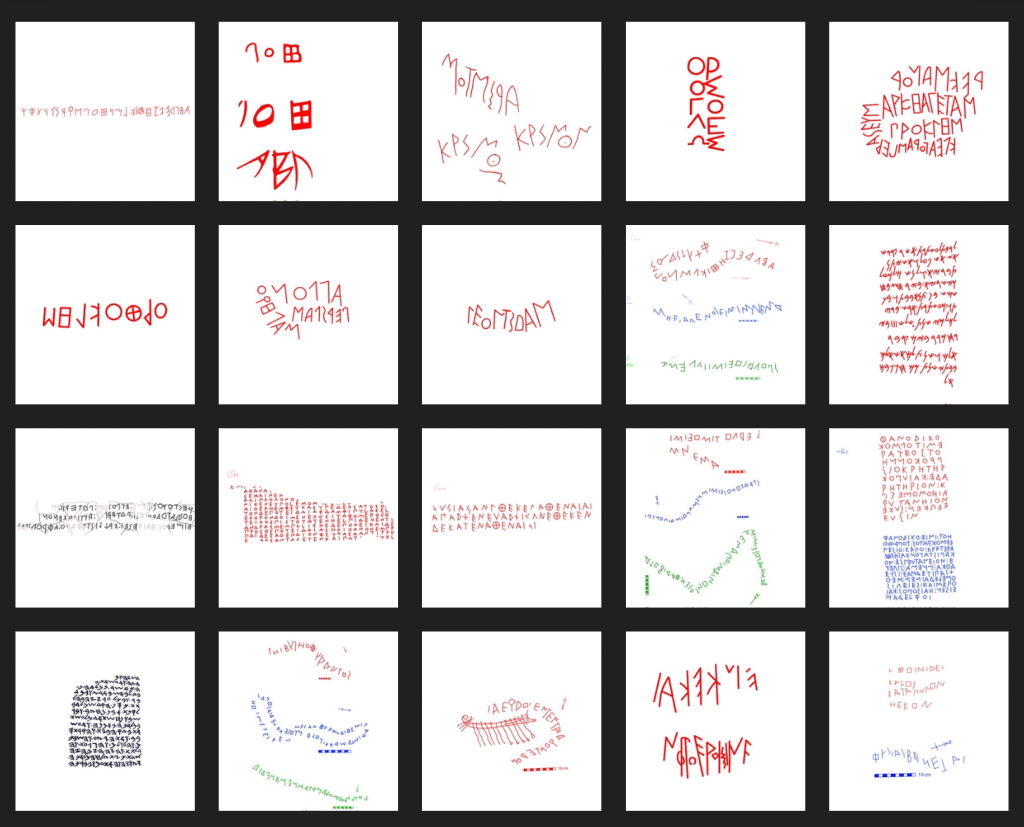
Most corpora don’t offer clean, high-res images. They give us facsimiles—drawn reconstructions, often made by epigraphers decades ago. I tried using automated skeletonization on those, but the results were messy and inconsistent. So I went manual: scanning documents and tracing letters by hand on my iPad.
It’s slow. But it gives me clean, consistent vector forms that reflect how letters were actually drawn—and forces me to look closely at every curve, stroke, and variation. In a sense, this is my own kind of excavation.
What I Track
Each inscription gets logged with basic info: where it was found, what it was written on, when it was made (as best we can tell), and how damaged it is. But the real heart of the project is the letters.
From this, I can start comparing how different regions handled the same letter—Did their rho have a loop? Was their epsilon closed?—and whether that tells us something about cultural contact or local invention.
The Workflow
The data entry pipeline looks like this:
Scan + trace the letterform
Enter the inscription’s metadata
Manually mark letter positions and reading direction
Extract geometric features automatically
Save everything as structured, nestable JSON
It’s part computer vision, part field notes, and part quiet staring at a very old alpha until you start to feel like it’s looking back.
Why This Level of Detail?
Because I want to ask big questions—how alphabets travel, which paths are innovations vs. imitations—but I don’t want to ask them fuzzily. Too much work on writing systems either leans purely qualitative or strips out the messiness for the sake of clean data. APEX is an attempt to hold both: interpretive richness and formal structure.
This dataset—AlphaBase, soon to be expanded to other open-access museum collections and public domain corpora—is the scaffolding. It’s how I’ll test transmission models later on. But even on its own, it’s already revealing things—like which letterforms stay stable across centuries, and which are quick to splinter under pressure.
APEX begins here: not with theory, but with tracing. With building a system that doesn’t just store letterforms, but actually listens to what they’re doing. That’s what this first trench is for. Now I get to start digging.



 To Wake the Dead