Tag: Tools of the Trade

  • Tools of the Trade, 9: Meta-Tools: Networking in Undergrad (Without Faking It)

    One of the most frequent pieces of advice given to undergraduates is: “network.” But for students in the humanities—especially those who want to study ancient languages, inscriptions, or museum work—that advice often feels vague, awkward, or transactional. This is definitely a conceptual hurdle that I’ve had to overcome.

    This post is my attempt to reframe that word into something more grounded: building relationships, but not performatively. Rather, I strive to do so through shared questions, good conversations, and sustained curiosity. I’m not an expert on this at all, but I’ve built a small but meaningful network of scholars who know what I care about, who challenge and support me, and who have helped shape the work I do. This is how I’ve approached it, and what I’d tell someone starting out.

    Start Local, Then Reach Out

    The best place to start is with the people at your own institution. NYU, being so big, has been a wonderful place for this—with 60,000 students and some 6,000 instructors, it’s a goldmine for people who know what they’re talking about.

    But the following advice applies to any school. Go to office hours. Take professors’ classes—not just because the syllabus looks good, but because you’re genuinely interested in how they think. Even if the class isn’t squarely in your area, getting to know the professor might lead to mentorship, research opportunities, or simply perspective you didn’t know you needed. I talked about this in the last post, but it can’t be stressed enough.

    Before going to office hours, do your homework. I usually read at least two of a professor’s articles in advance—preferably recent, but not necessarily—and do a deep first pass early on, then a quick skim again right before the meeting to refresh my memory. I come with questions not just about the content, but about the field: how did this approach emerge? What debates is it part of? What’s happening at the edge of this subfield right now, and who’s leading it?

    If someone you’d like to connect with isn’t at your institution, email is a powerful tool—when used well. Keep it short, be deferential, have a clear purpose, and make it easy for them to see how they can help. Mention a mutual contact if you have one, such as if they were in the same PhD cohort as a professor at your school or have a student from your undergrad program in their graduate school. However, even a lighter connection—“I came across your work while reading X’s article on…”—can do a lot. You can also ask for an introduction from a professor, but I’ve even gently-warmed cold emails have worked just fine for me.

    Follow Up (without Hovering)

    It’s easy to get caught in the anxiety of “now what?” after a good meeting or email exchange. My best advice: space it out. A thank-you email goes a long way, especially if you reference something specific they shared. After that, I keep a simple handwritten list of who I’ve contacted, what we discussed, and whether they asked me to follow up.

    If you’re working on a long-term project—like my alphabet transmission project, APEX—then sending a short update every month or so when you hit a milestone is a great way to keep people in the loop without overwhelming them. Scholars are busy. Respect their time; this lets you build a slow, steady relationship.

    Bring Something to the Table

    This doesn’t mean showing off. It means coming into conversations with curiosity and initiative. If you’ve had an idea while reading someone’s work—an application, a parallel, a method they might not have used—bring it up gently and frame it as a question. “Have you ever tried applying X to your corpus?” can be a meaningful way to signal that you’re not just a reader, but a thinker too.

    One of the best questions I’ve learned to ask: “Are there any scholars or articles you’d recommend I look at to get a better sense of the field?” When you’re in multiple disciplines, the literature is bottomless. A suggestion from someone experienced can save you weeks of guesswork—and deepen the conversation at the same time.

    Use Clubs and Events to Build Connections

    One of the unexpected benefits of running the League of Linguistics is that it’s allowed me to reach out to scholars in a semi-official capacity. If you’re organizing an event, moderating a panel, or just planning a syllabus, you have an excuse to email someone you admire—not for yourself, but on behalf of a community. Sometimes they’ll help. Sometimes they’ll become contacts down the line.

    Just make sure you’re doing this in good faith. The event should serve your members first. But if it opens up a conversation with someone you’d like to work with, that’s a bonus worth nurturing.

    Know What You’re Asking For

    Always have a purpose when reaching out. Want to talk about their recent article? Ask for feedback on a related idea? Get advice about graduate programs? Whatever it is, make it clear in the first few lines. Don’t make them guess what you want. And don’t send them a novella. Long emails are a fast way to get ignored—not because professors are rude, but because they’re busy, and clarity is a form of respect.

    At the same time, everyone’s different. Some scholars love a detailed intro. Others would rather get three lines asking for a Zoom call and figure out the rest in conversation. When in doubt, start concise—and adjust based on the cues they give you.

    Etiquette

    Until you’re told otherwise, when you’re in undergrad, always address someone as Professor Lastname. If they sign off with initials, play it safe. Only switch to a first name if they clearly invite it—either in their signature, or later in the conversation. Respect for titles isn’t just about hierarchy—it’s about showing that you’ve taken care in reaching out.

    And if they don’t respond? It’s okay. Let it go. Especially if they’re at another institution, or heading multiple research projects, or simply overwhelmed, it’s not about you. If the connection’s meant to grow, you’ll have other chances. If not, trust that others will say yes. I’ve found academics on the whole to be extremely generous with their time, resources, and knowledge. You’ll find your people.

    Final Thoughts

    The best conversations I’ve had didn’t come from trying to impress someone; they came from being honest about what I care about, what I don’t know, and what I’m trying to figure out. Humility, curiosity, and gratitude are perhaps the most winning combination—especially when you’re early in your career. You don’t need to have all the answers, you just need to be a person worth talking to again.

    And one last thing: projects help. If you’re working on something—an independent research blog, a digital tool, a language revitalization game—it gives you a way to reach out that feels natural, not forced. “I’m building something, and I thought of you” is often a more compelling opener than a plain “Can we talk?”

    If you’re trying to build up these kinds of contacts, I hope this helps. If you’ve already started, I’d love to hear what’s worked for you. And if you’re not sure where to begin—reach out. I’m still learning too.

  • Tools of the Trade, 8: Meta-Tools: Courses for Aspiring Philologists and Archaeo-Linguist Hybrids

    I frequently get asked what classes to take if you want to work with ancient languages, inscriptions, museums, or language technology. This post is a reflection—not a blueprint—on how I’ve built a courseload that supports interdisciplinary work in epigraphy, historical linguistics, and digital tools, and what I’d recommend to others just starting out.

    Start with the Languages (But Be Strategic)

    If you’re reading this, chances are you already love ancient languages. So yes—take Latin. Take Greek. But if you have more than one on your list, resist the urge to take them all at once. Instead, start with one—preferably the one with the strongest institutional support—and stagger the rest. I did Latin in high school, Greek in my first year of college, and Akkadian in my second. That pacing gave me room to go deep into each one without burning out. Now, with that foundation, I’m able to handle several languages at the advanced level without losing clarity or joy.

    If it interests you, try to take—or propose an independent study in—a language that uses a non-alphabetic script early on. Whether it’s cuneiform, hieroglyphs, or Linear B, working with a writing system that doesn’t map neatly onto speech will sharpen your sense of what writing is, how it encodes meaning, and how it changes across time. It will also raise questions—paleographic, technological, cognitive—that you may find yourself returning to long after the class ends.

    Take Linguistics Early (You’ll Use It Constantly)

    I’m biased—I’m a linguist—but even if you don’t plan to major in it, an intro to linguistics course will radically shift how you read ancient languages. You’ll start spotting things like vowel gradation, phonological assimilation, and case alignment everywhere. Once you’ve got the basics, courses like historical linguistics, syntax, or phonology can help you engage more confidently with scholarship and identify patterns in inscriptions, dialect variation, or reconstructed forms. Even if you don’t go further in formal coursework, just knowing the lingo goes a long way—and will keep paying off, quietly and consistently, across everything else you study.

    Follow the Inscriptions and Those Who Teach Them

    If you want to work with writing systems or epigraphy, find the people who do that at your institution. In this field, people often matter more than courses. Research your professors. Read what they’ve written. Faculty bios will give you a general idea of their focus, but their CVs are often more revealing—long, yes (I’ve seen them run 50 pages), but worth scanning for article titles and projects that align with your own interests.

    Getting close to those key people might mean enrolling in something tangential—say, an intro to Greek art—just to build a relationship. Or asking if you can do an independent study reading inscriptions in translation. Some of my best classes weren’t labeled “epigraphy” at all—they were seminars where I was encouraged to bring paleographic questions into the final project. In one case, that was Data Science for Archaeology with Prof. Justin Pargeter, a course that shaped my thinking far beyond its original scope.

    Think Across Disciplines, but Choose a Home

    You’ll need a home base—a department that knows you, supports your work, and can write you letters. Having an intellectual anchor like that is not only strategic, it’s also deeply grounding. That said, your course list doesn’t have to stay confined to one department—and honestly, it probably shouldn’t. Academia is moving ever more toward interdisciplinary inquiry, and the best course of study often cuts across traditional boundaries.

    Some of my most formative classes have been outside my major—art history, computer science, even religious studies (Akkadian lives in Judaic Studies at NYU). Let your questions guide you. If you’re wondering why Phoenician letters look the way they do, or what it means to “revive” a dead language, go find the classes that give you tools to explore those questions, wherever they live.

    Just make sure you’re also building depth somewhere. Breadth can open doors—but it’s depth that gets you through them. Grad schools, mentors, and collaborators alike are looking for people who know how to ask big questions, but also how to sit with them for a long time.

    Study Abroad, If You Can

    There’s no substitute for learning ancient languages in place—or at least near the landscapes, museums, and excavation contexts where they come alive. Study abroad isn’t just about location; it’s about intensity, continuity, and community. My time in Greece, especially on digs and museum visits, made Greek less abstract and more human. It exposed me to a range of paths in classics and gave me access to resources—like fragmentary inscriptions in drawers—and rhythms, like reading in the field, that continue to shape how I think about epigraphy and transmission.

    If you’re aiming for grad school or museum work, study-abroad experience shows initiative. It signals that you’ve navigated other academic systems, worked across language barriers, and engaged directly with material culture. If your program includes language immersion—even better. Even if the modern language isn’t your focus, it sharpens your ear and re-situates ancient texts as living inheritances.

    If funding is a concern, don’t write it off. Many programs offer scholarships, and departments often quietly support students who ask early. At big schools like NYU, the key is often finding the right person—the one who knows how to unlock the support already available.

    Don’t Be Afraid of Skill-Based Classes

    If you’re anything like me, it’s easy to stay in the comfort zone of ancient texts and theoretical conversations. But some of the most valuable courses I’ve taken have been hands-on: digital humanities, data science, archaeological methods, computer science. These classes taught me how to manage a dataset, build a research tool, and think across evidence types. They’ve led directly to portfolio projects, study opportunities, and unexpected collaborations—and they’ve made my work in the ancient world more dynamic and durable.

    Leave Room to Be Surprised

    Some of my most formative classes were ones I hadn’t planned to take: a seminar on the topography and monuments of Athens (Prof. Robert Pitt), a deceptively simple primer in Greek archaeology that opened into real depth (Prof. Hüseyin Öztürk), and a course on the structure of the Russian language (Prof. Stephanie Harves). These were spaces where I tested my assumptions and rewired my thinking. Try to leave room in your schedule each year for one course that isn’t strictly “on track,” but that speaks to something curious or unsettled in you. That’s often where real questions begin.

    Last Word: Plan Backwards

    If you’re thinking about grad school or a research career, try working backwards. Look at the programs you might apply to—what do they expect? What languages, methods, or subfields appear in course requirements or faculty research? Then take classes that prepare you for those conversations. The goal isn’t to become someone else’s version of a scholar—it’s to become the version of yourself who belongs in the rooms you want to be in.

    Closing

    When in doubt, ask people. Older students, professors, internet strangers who study Linear B. This path isn’t something I mapped out alone—almost every turning point in my academic life has come from a conversation, an offhand recommendation, or a generous reply to a cold email. I’ve built my way forward through the advice of others, and I’m always happy to pay it forward.

    In a follow-up post, I’ll share how to structure independent study: designing personal projects, sustaining long-term reading, and building a research portfolio beyond the classroom. Done well, this kind of work lets you follow your own questions, test your interests, and create something distinctly your own. It’s also one of the clearest ways to show grad schools and mentors that you know how to learn without a syllabus.

    Stay tuned. And as always, if you’re not sure where to start, I’d love to hear what you’re thinking about.

  • Tools of the Trade, 7: Toolkit: Akkadian

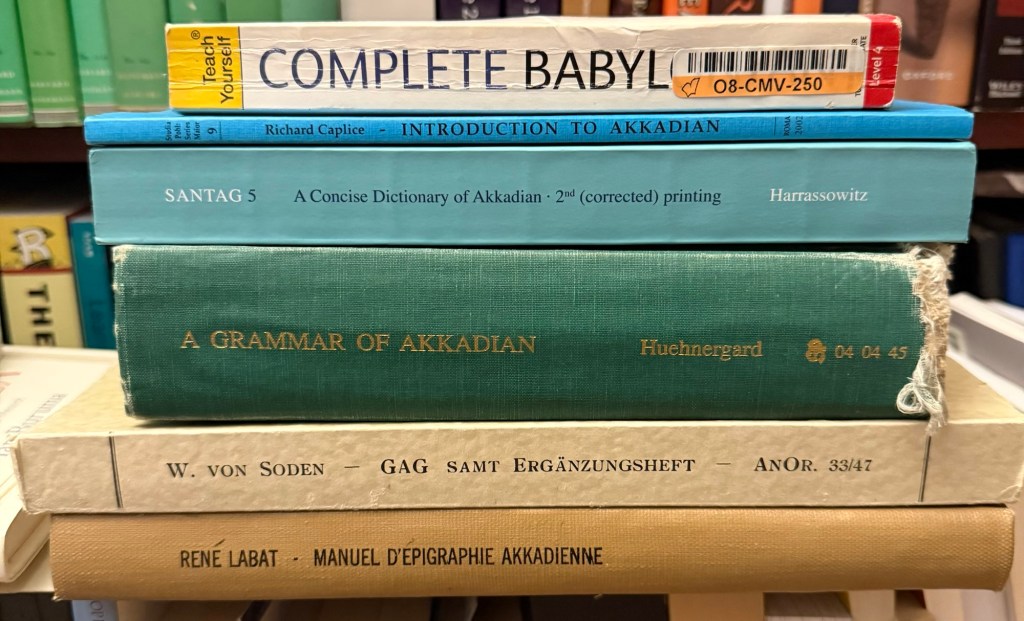
    Some of my physical collection.

    Akkadian is a Semitic language written in the cuneiform script, with texts ranging from royal inscriptions and law codes to letters, contracts, and epics like Gilgamesh. This toolkit gathers the core resources I use to study the language, from mastering the sign list to parsing verbal forms. Whether you’re preparing for graduate study, brushing up for a seminar, or just drawn to the richness of Mesopotamian literature, these are the tools that ground my work with Akkadian.

    A quick note: some of these are in German and French, and of course not everyone reads those. However, Google Translate handles them very well if you upload a screenshot of a paragraph, and as my modern languages are not the strongest yet, I’ve found it invaluable. Use this link to access.

    Huehnergard – A Grammar of Akkadian
    The most widely used modern introduction to Akkadian, especially for Old Babylonian. Combines clear grammatical explanations with exercises, paradigms, and a reading sequence. Thorough and approachable.
    Read online

    Caplice – Introduction to Akkadian
    More compact and reference-oriented than Huehnergard, with streamlined grammar sections and bilingual text readings. Works well as a complement or for review.
    Read online

    Labat – Manuel d’épigraphie akkadienne: Signes cunéiformes, syllabaires, idéogrammes
    The definitive sign list for Akkadian cuneiform. Includes syllabic values, logograms, variant shapes, and transcription equivalents. Indispensable when reading from tablets or facsimiles.
    Read online

    Digital Tools

    ePSD2 (The Electronic Pennsylvania Sumerian Dictionary)
    Although primarily for Sumerian, ePSD2 is invaluable for logogram glosses and cross-referencing Akkadian readings of signs. Frequently cited in scholarly work.
    Access online

    ORACC (Open Richly Annotated Cuneiform Corpus)
    A massive and expanding corpus of annotated Akkadian texts in transliteration and translation, with tools for exploring morphology, genre, and metadata. Excellent for seeing how grammar functions in real texts.
    Access online

    Wiktionary
    There is no single definitive online Akkadian dictionary, but entries on Wiktionary can help with basic word lookup in transliteration.
    Access online

    Advanced Topics

    Von Soden – Grundriss der Akkadischen Grammatik
    The classic grammar of Akkadian, written in German. Highly detailed, especially in verbal system analysis and historical variants.
    Read online

    Goetze / Landsberger – Text Editions
    Once you’ve completed initial grammar work, reading annotated text editions from scholars like Goetze or Landsberger will help solidify your grasp of style, genre, and dialect variation.

    Conclusion

    This toolkit focuses on Old Babylonian and Standard Babylonian as the primary dialects, but the resources here will give you enough flexibility to branch into Assyrian, Middle Babylonian, and other variants. Akkadian is a richly inflected language with a complex writing system, and the path to fluency is best grounded in patient sign recognition, morphological fluency, and careful reading.

    These are the resources I’ve found most helpful in learning and returning to Akkadian. If you know of other tools or have advice from the field, I’d love to hear what’s missing.

    View other toolkits.

  • Tools of the Trade, 6: Toolkit: Classical Latin

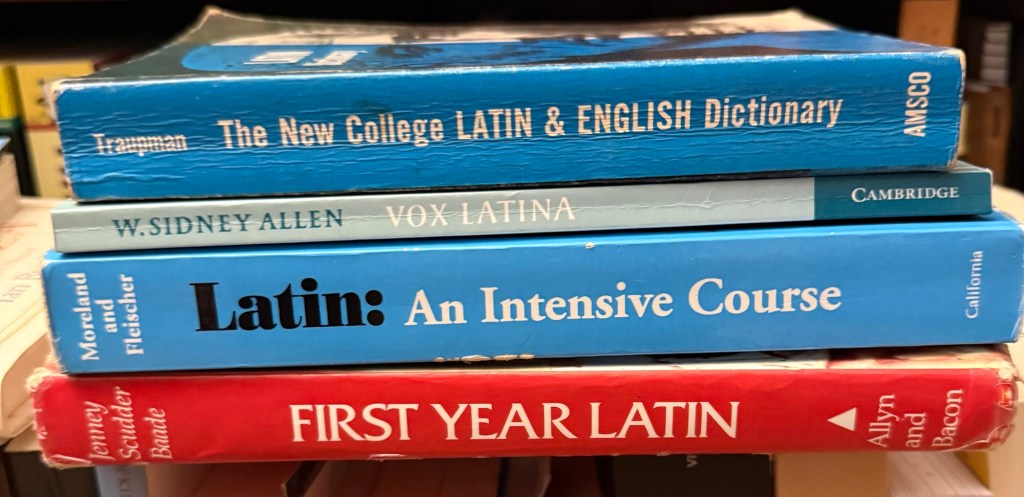
    Some of my physical collection.

    This post collects the top resources I rely on in my study of Classical Latin. The focus here is on tools that are both rigorous and usable—resources I’ve returned to over years (from age 10!) of working with Latin literature, grammar, and historical texts. Whether you’re reading Cicero, Ovid, or Caesar, this toolkit offers a dependable foundation across grammar, vocabulary, style, and reading.

    To Get Started

    Moreland & Fleischer – Latin: An Intensive Course
    A rigorous, grammar-driven introduction to Latin designed for rapid acquisition, often used in intensive summer programs. Each chapter includes vocabulary, grammatical explanations, and exercises, with a strong focus on reading unadapted Latin early. Ideal for learners who appreciate a no-nonsense, immersion-style approach.
    Read online

    Digital Tools

    Logeion
    A fast and comprehensive dictionary interface that includes Lewis & Short, the Elementary Lewis, and other Latin lexica. Entries often include frequency, examples, and morphological info.
    Access online

    Whitaker’s Words
    A downloadable tool (and web version) that parses Latin word forms and offers root definitions. Fast and simple, especially for checking unknown inflected forms.
    Access online

    Perseus Word Study Tool
    Useful for parsing unfamiliar word forms and locating them in context. Linked to the Perseus Digital Library’s extensive collection of classical texts.
    Access online

    The Latin Library
    An enormous archive of classical, medieval, and ecclesiastical Latin texts. No parsing or commentary—just clean, plain Latin.
    Access online

    Hexameter.co
    An interactive tool for learning and practicing dactylic hexameter. Features lines from Vergil, Ovid, Lucretius, and AP Latin selections.
    Access online

    Advanced Topics

    Allen & Greenough – New Latin Grammar
    The most detailed traditional Latin grammar in English, covering syntax, morphology, prosody, and style. Still a go-to reference for advanced students and scholars.
    Read online

    Gildersleeve & Lodge – Latin Grammar
    An alternative to Allen & Greenough with a slightly different emphasis and some unique syntactic classifications. Dense but rewarding for deep grammatical work.
    Read online

    W. Sidney Allen — Vox Latina
    A sister volume to Vox Graeca as mentioned in the Classical Greek Toolkit post. Covers similar ground. Quite foundational; covers many of the quirks of classical pronunciation.
    Read online

    Conclusion

    This toolkit prioritizes depth and clarity in equal measure. Latin is not just a language of forms—it’s a language of authors, arguments, and rhythm. These tools have supported me in reading widely and attentively, and I hope they’ll do the same for you.

    Have favorite resources not listed here? I’d love to hear what’s missing.

    View other toolkits.

  • Tools of the Trade, 5: Toolkit: Mycenaean Greek

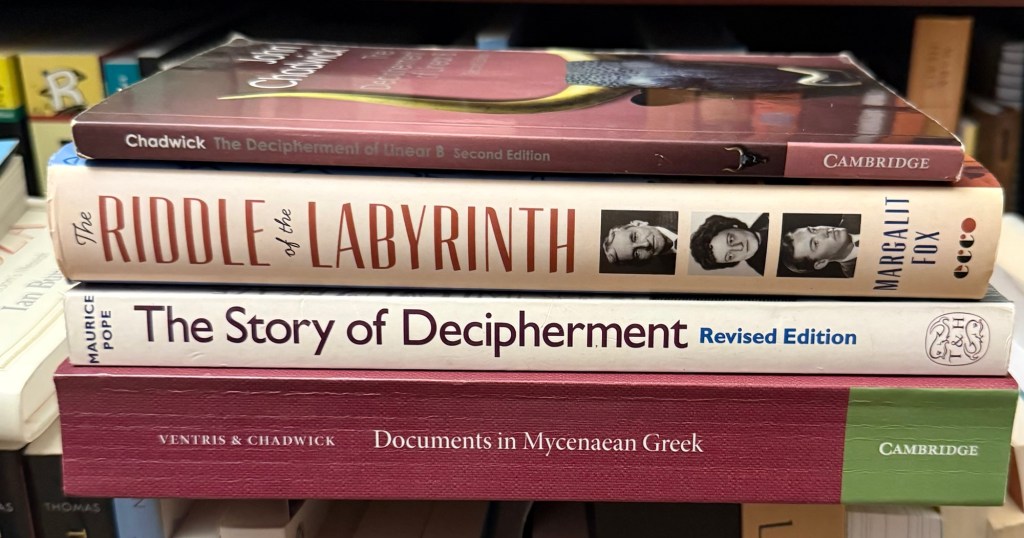
    Some of my physical collection.

    Mycenaean Greek is the earliest recorded form of the Greek language, written in the Linear B syllabary and preserved primarily in administrative documents from palatial centers like Knossos and Pylos. This toolkit collects the core resources I use for studying the language, writing system, and historical context of Mycenaean. While it’s not a language most people “read” in the same way as Homeric or Classical Greek, it’s foundational for understanding the development of the Greek language and the Aegean Bronze Age.

    To Get Started

    Hooker – Linear B: An Introduction
    A concise and accessible introduction to the Linear B writing system, Mycenaean phonology, and key vocabulary. Useful for getting oriented before diving into transcriptions or corpora.
    Read online

    Chadwick – The Decipherment of Linear B
    An essential historical account of how Linear B was deciphered, written by one of its key figures. While dated in some linguistic details, it’s an engaging entry point into the script and its rediscovery.
    Read online

    Digital Tools

    Palaeolexicon: Mycenaean Greek Word List
    A searchable online lexicon of Mycenaean Greek, based on attested forms and reconstructions. Includes syllabic spellings and interpretations. Useful for quick lookups when reading inscriptions.
    Access online

    LiBER (Linear B Electronic Resources)
    An extensive online resource that includes a searchable corpus, transcriptions, sign lists, and links to digitized tablets. Maintained by the University of Cambridge.
    Access online

    Advanced Topics

    Ventris & Chadwick – Documents in Mycenaean Greek
    The foundational reference edition of Linear B tablets, with transcriptions, translations, and commentary. Volume I covers the grammar and lexicon; Volume II includes full texts.
    Read online

    Duhoux & Morpurgo Davies (eds.) – A Companion to Linear B: Mycenaean Greek Texts and Their World
    A more recent scholarly collection covering writing practices, administrative function, linguistics, and interpretive issues. Indispensable for research-level study.
    Read online [Volume 1, Volume 2, Volume 3]

    Aura Jorro – Diccionario Micénico
    A comprehensive lexicon of Mycenaean Greek, keyed to Linear B spellings. In Spanish but used internationally by specialists.
    Read online [Volume 1, Volume 2]

    Conclusion

    Mycenaean Greek is not a reading language in the traditional sense, but it offers unparalleled access to the earliest phase of Greek—its phonology, morphology, and vocabulary in situ. For linguists, epigraphers, and anyone curious about the Bronze Age Aegean, these tools provide a clear entry into the world of palace records and early writing.

    This list includes the materials I’ve found most dependable in my own work. If you’ve found other resources—especially for working with the tablets themselves—I’d love to hear what’s missing.

    View other toolkits.

  • Tools of the Trade, 4: Toolkit: Homeric Greek

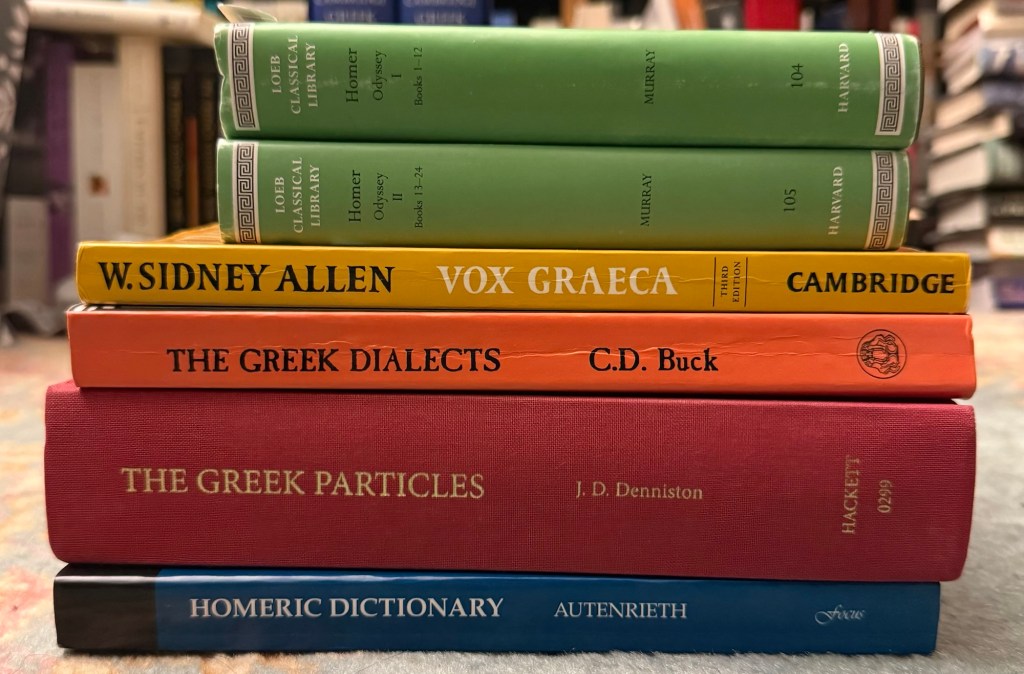
    Some of my collection.

    This post collects the top resources I rely on when reading Homeric Greek, especially the Iliad and Odyssey. While much of the grammar overlaps with Classical Greek, Homeric Greek has distinct forms, vocabulary, and meter that call for specialized tools. The following resources—ranging from primers to advanced philological references—are what I return to again and again when working with epic.

    To Get Started

    Pharr – Homeric Greek: A Book for Beginners
    An older but remarkably focused introduction built around Iliad 1. Includes grammar notes specific to Homeric forms, extensive vocabulary, and progressively annotated readings.
    Read online

    Benner – Selections from Homer’s Iliad
    An excellent annotated reader of Iliad Books I–VI, with extensive grammatical commentary keyed to each line. Ideal for intermediate readers.
    Read online

    Cunliffe – A Lexicon of the Homeric Dialect
    Still the standard Homeric dictionary. Organized by root and form, with citations from epic texts and brief semantic notes.
    Read online

    Digital Tools

    Logeion
    Cunliffe’s Homeric Lexicon is fully searchable on Logeion alongside LSJ. You can easily compare definitions across lexica and check frequency data within the epics.
    Access online

    Perseus Word Study Tool
    Input any inflected form and receive morphological analysis with links to lexicon entries and usage examples across a wide corpus of Greek texts.
    Access online

    Top 500 Homeric Words Deck
    Compiled by Chicago, these are the most common vocabulary items in Homer’s epics, and knowing them makes for an efficient path to smooth reading.
    Access online

    Greek Particles Deck
    Compiled by a Quizlet user, this deck contains over 80 of the most common and important Greek particles to know.
    Access online

    Perseus Digital Library
    Includes the full texts of the Iliad and Odyssey with parsing tools, English translations, and links to grammatical and lexical resources.
    Access online

    Chicago Homer
    Tailored specifically for Homeric epic. Offers side-by-side Greek and English translations, word-by-word morphological data, and metrical annotation.
    Access online

    Advanced Topics

    Monro – A Grammar of the Homeric Dialect
    A classic reference that systematically treats the phonology, morphology, and syntax of Homeric Greek. A bit dense, but indispensable for serious linguistic inquiry.
    Read online

    Buck – The Greek Dialects: Grammar and Selected Readings
    A valuable reference for understanding the dialectal features present in Homeric Greek, which blends primarily Ionic forms with traces of Aeolic. While not focused solely on Homer, this book helps clarify unusual forms and offers broader context for the epic language tradition.
    Read online

    William S. Annis – An Introduction to Greek Meter
    Offers a clear and concise explanation of dactylic hexameter with scansion exercises and helpful mnemonics.
    Read online

    Hexameter.co
    An interactive site that gamifies learning dactylic hexameter. Offers scansion tools for Homer (and 3 Latin authors too). Helpful for developing aural sensitivity and fluency in poetic rhythm.
    Access online

    Conclusion

    This toolkit focuses on materials that prioritize Homeric Greek as a distinct linguistic system—neither a dialect nor a transitional phase, but a carefully stylized literary register. Whether you’re reading your first lines of the Iliad or preparing to write on Homeric formulae or meter, these tools offer a dependable path forward.

    This list isn’t exhaustive, but it covers the resources I’ve found most useful in my own studies. Are there others you swear by for Homeric Greek? I’d love to hear what’s missing.

    View other toolkits.

  • Tools of the Trade, 3: Toolkit: Classical Greek

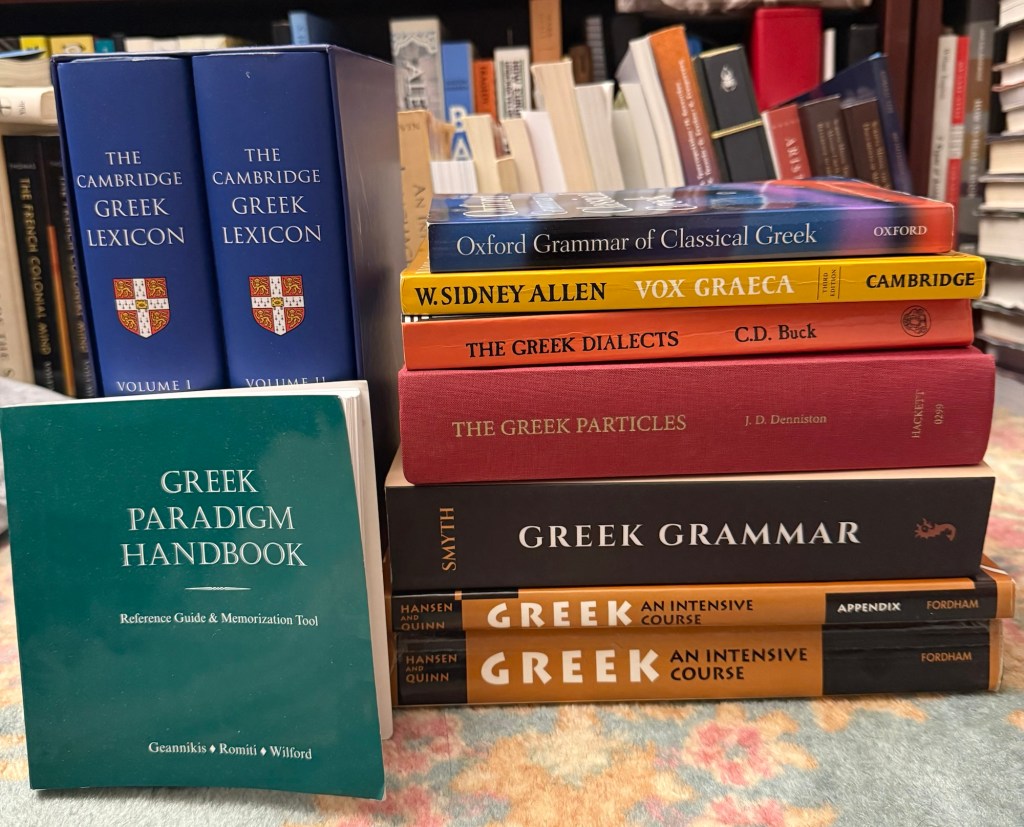
    A small portion of my collection.

    This post collects the top resources I rely on in my own study of Classical Greek. For each category—grammar, vocabulary, reading tools, and advanced study—I’ve selected the best materials available, with a focus on clarity, depth, and long-term usefulness. Whether you’re just beginning or looking to sharpen your command of dialects, meter, or style, this toolkit offers a reliable foundation. These are the books and tools I return to again and again when reading Classical Greek, especially texts in the Attic-Ionic dialect continuum.

    To Get Started

    Hansen & Quinn – Greek: An Intensive Course
    A demanding but highly structured introduction to Classical Greek, often used in college-level intensive courses. Includes graded readings, grammar explanations, and exercises.
    Read online
    H&Q Vocabulary Decks: Quizlet class

    Smyth – Greek Grammar
    A comprehensive and authoritative reference grammar, covering all aspects of Classical Greek morphology and syntax. Best used alongside reading or for targeted review.
    Read online

    Digital Tools

    Logeion
    A lexical lookup tool developed by the University of Chicago. It aggregates major dictionaries, including Liddell-Scott-Jones (LSJ), “Middle Liddell,” and Autenrieth. Entries include frequency data, sample passages, morphological breakdowns, and cross-references.
    Access online

    Perseus Word Study Tool
    Input any inflected form and receive morphological analysis with links to lexicon entries and usage examples across a wide corpus of Greek texts.
    Access online

    Greek Particles Deck
    Compiled by a Quizlet user, this deck contains over 80 of the most common and important Greek particles to know.
    Access online

    Perseus Digital Library
    A major online collection of Greek texts, including works by Homer, Herodotus, Plato, and others. Offers on-hover parsing, English translations, and links to dictionaries and grammar tools.
    Access online

    Advanced Topics

    W. Sidney Allen – Vox Graeca: The Pronunciation of Classical Greek
    A foundational work on ancient Greek phonology and historical pronunciation. Includes reconstructions of Attic phonetics and prosody, with attention to evidence from meter, spelling, and comparative linguistics.
    Read online

    Buck – The Greek Dialects: Grammar and Selected Readings
    A readable introduction to the major dialect groups of Ancient Greek, with grammatical summaries and annotated sample texts. Useful for epigraphy, lyric poetry, and comparative philology.
    Read online

    William S. Annis – An Introduction to Greek Meter
    A concise and accessible guide to reading Greek poetry metrically. Covers major meters with clear examples and scanning advice.
    Read online

    Denniston – The Greek Particles
    An advanced and nuanced treatment of Greek particles. Indispensable for close reading and stylistic analysis, especially in prose authors like Thucydides and Plato.
    Read online

    Conclusion

    This list isn’t exhaustive, but it covers the materials I’ve found most reliable and rewarding. Are there tools or texts you swear by that aren’t here? I’d love to hear what you think is missing.

    View other toolkits.

  • Tools of the Trade: Language Toolkits Incoming!

    The next portion of Tools of the Trade will focus on a series of “core toolkits” for a variety of languages. These will be linked here as they roll out over the next few days. The first five, in order, will be:

    1. Classical Greek,
    2. Homeric Greek,
    3. Mycenaean Greek,
    4. Classical Latin, and
    5. Akkadian.

    If any more are added, I’ll link them here as well. I’m planning on doing Phoenician and Middle Egyptian at some point, and maybe even posts on families, probably Semitic and Indo-European. After that, there will be two more posts on epigraphic tools, followed by a series of computational ones, and then probably some meta-tools (e.g., guides to digital organization, etc.). After that it’s anyone’s game, and I fully welcome suggestions. Feel free to email me here if there’s anything you’ve been wanting to get into but haven’t found good resources for.

  • Tools of the Trade, 2: Epigraphy: Perseus and Logeion

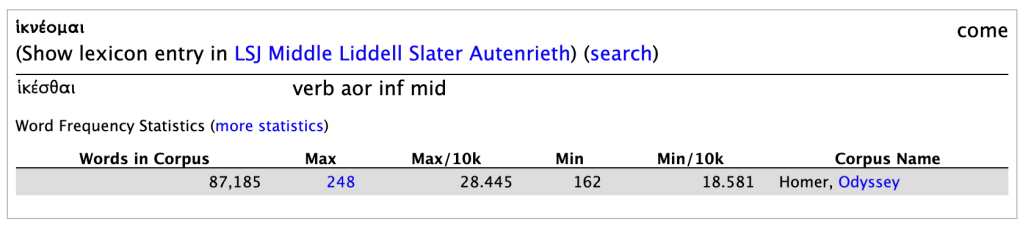
    Perseus’s result for ἱκνέομαι: a quick parser, giving form and summary of corpus occurrences.
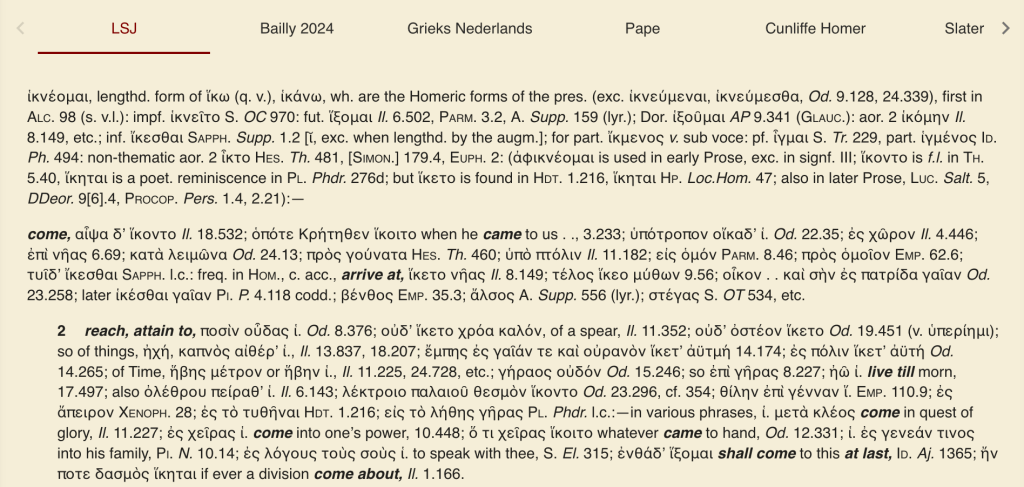
    Partial Logeion result for the same word: collates detailed results from nine separate dictionaries with a 10th tab for corpus occurrences.

    For anyone studying Latin or Ancient Greek—whether casually, academically, or obsessively—two digital tools stand out as indispensable: Perseus and Logeion. I use both almost every day. While they serve overlapping purposes, each has its own strengths, and learning to navigate between them has made my reading smoother, faster, and more precise.

    Perseus, formally known as the Perseus Digital Library, is one of the earliest and most ambitious digital humanities projects in the field of Classics. It provides access to a massive collection of Greek and Latin texts with built-in parsing tools, dictionary links, and (often outdated but still helpful) English translations. Its strength lies in contextual reading—hovering over any word in a text will generate a parsing suggestion and a link to its dictionary entry, which makes it incredibly useful when working through a new author or a grammatically complex passage. The Word Study Tool allows you to input any inflected form and get a list of possible morphological analyses and dictionary headwords, with links to example passages. However, it’s important to note that these parsings are generated by algorithms and are not always reliable, especially for ambiguous forms. The interface can also feel a bit dated, and not all texts are equally well formatted, but for quick reading and parsing, Perseus is great.

    By contrast, Logeion is a sleek and powerful lexicon aggregator developed by the University of Chicago. Unlike Perseus, it doesn’t offer complete texts, but it excels at lexical depth. When you enter a word—either in Latin or Greek—Logeion pulls results from multiple dictionaries at once, including LSJ, Middle Liddell, Autenrieth, Lewis & Short, Elementary Lewis, Frieze-Dennison, and others. You also get frequency data, example passages, and, in some cases, idiomatic usages or English-to-Greek reverse entries. Logeion doesn’t parse for you, so you need to know or guess the dictionary form of the word. But once you do, the definitions it offers are more precise and informative than any single dictionary alone. I often use it to compare lexical nuance across genres or authors, and it’s especially helpful when I want to confirm the meaning of a word I already sort of “know.”

    The way I use these two tools in tandem is pretty straightforward. When I’m reading through a text, especially something new or poetic, I usually begin in Perseus. I use the on-hover parsing and the Word Study Tool to get oriented, especially with verbs and particles. Once I have the base form, I switch over to Logeion to dig deeper into meaning, idiom, or usage across contexts. Logeion becomes especially helpful when I’m writing, translating, or thinking more syntactically. In many ways, Perseus is like a field guide with helpful margin notes, while Logeion is the serious reference work you turn to when you want to be exact.

    If you’re just starting out, don’t feel pressured to master everything at once. But learning to toggle between Perseus and Logeion will give you a huge advantage—especially if you’re not always reading with a print dictionary on hand or don’t have institutional resources. I’ve used these tools for years—they’ve remained central across every stage of my study. They’re fast, free, and surprisingly deep once you know where to look.

    If you’ve found tricks for using them more efficiently, or if you have a favorite feature I didn’t mention, let me know what’s missing.

  • Tools of the Trade, 1: Epigraphy: The Local Scripts of Archaic Greece by L.H. Jeffery

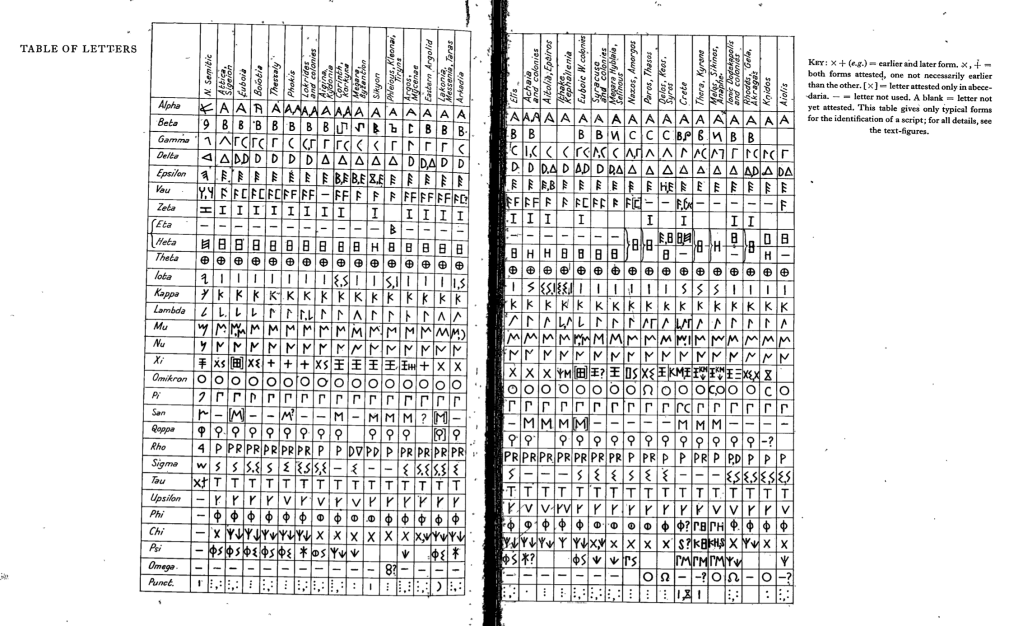
    Jeffery’s summary table of all epichoric scripts at the end of LSAG.
    It is foundational for any work on early regional Greek scripts.

    There are very few books I consider truly irreplaceable in my research. Lilian H. Jeffery’s The Local Scripts of Archaic Greece is one of them. First published in 1961 and revised in 1990 with A.W. Johnston, this book remains the reference for regional variations in the Greek alphabet during the archaic period. It’s where I first learned to read epichoric inscriptions with the eye of a paleographer rather than a Classicist alone.

    The book is very hard to find, and I only got my copy at an even remotely affordable price after months of scouring secondhand sellers. While copies still circulate among libraries and the used book market, I wanted to make it more accessible to others working in this area. So I hunted diligently before finding it on the Internet Archive. You can read or download it here:
    The Local Scripts of Archaic Greece (1990 ed.) – Internet Archive

    Jeffery’s study remains foundational for any work on early Greek writing—not just in Athens or Ionia, but across the full spectrum of regional scripts: Corinthian, Euboian, Attic-Boeotian, Cretan, Cycladic, and others. It includes extensive commentary, maps, and an invaluable inscriptional catalogue organized by region, with drawings and typographic transcriptions. The 1990 revision added important corrections, expanded references, and additional illustrative material. For those of us studying alphabetic transmission, especially the Phoenician-Greek interface or the evolution of letterforms over time, this book is indispensable.

    What makes Local Scripts especially useful is that it bridges the gap between paleography, archaeology, and linguistics. Jeffery doesn’t just chart when and where a particular variant of alpha or epsilon shows up—she explains what those variations might imply for chronology, influence, and contact. And although her typology has been revised and challenged in places (especially with the discovery of new inscriptions), her system remains a critical baseline for almost every study that’s come after.

    Whether you’re interested in early Greek literacy, the transmission of the alphabet, the sociopolitical meaning of epigraphy, or just want to be able to tell the difference between Laconian and Euboian chi, this is the book to start with. I hope having it freely available will be helpful to others navigating this fragmentary and fascinating material.

    Do you have other resources you pair with Jeffery? I’d love to hear what we can supplement LSAG with.