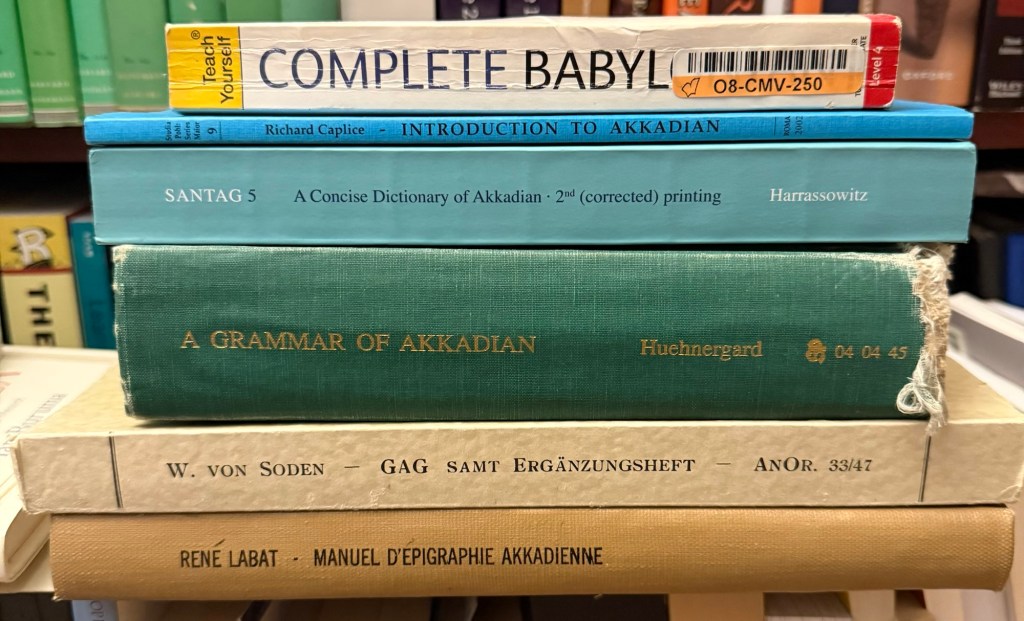
Akkadian is a Semitic language written in the cuneiform script, with texts ranging from royal inscriptions and law codes to letters, contracts, and epics like Gilgamesh. This toolkit gathers the core resources I use to study the language, from mastering the sign list to parsing verbal forms. Whether you’re preparing for graduate study, brushing up for a seminar, or just drawn to the richness of Mesopotamian literature, these are the tools that ground my work with Akkadian.
A quick note: some of these are in German and French, and of course not everyone reads those. However, Google Translate handles them very well if you upload a screenshot of a paragraph, and as my modern languages are not the strongest yet, I’ve found it invaluable. Use this link to access.
Huehnergard – A Grammar of Akkadian
The most widely used modern introduction to Akkadian, especially for Old Babylonian. Combines clear grammatical explanations with exercises, paradigms, and a reading sequence. Thorough and approachable.
Read online
Caplice – Introduction to Akkadian
More compact and reference-oriented than Huehnergard, with streamlined grammar sections and bilingual text readings. Works well as a complement or for review.
Read online
Labat – Manuel d’épigraphie akkadienne: Signes cunéiformes, syllabaires, idéogrammes
The definitive sign list for Akkadian cuneiform. Includes syllabic values, logograms, variant shapes, and transcription equivalents. Indispensable when reading from tablets or facsimiles.
Read online
Digital Tools
ePSD2 (The Electronic Pennsylvania Sumerian Dictionary)
Although primarily for Sumerian, ePSD2 is invaluable for logogram glosses and cross-referencing Akkadian readings of signs. Frequently cited in scholarly work.
Access online
ORACC (Open Richly Annotated Cuneiform Corpus)
A massive and expanding corpus of annotated Akkadian texts in transliteration and translation, with tools for exploring morphology, genre, and metadata. Excellent for seeing how grammar functions in real texts.
Access online
Wiktionary
There is no single definitive online Akkadian dictionary, but entries on Wiktionary can help with basic word lookup in transliteration.
Access online
Advanced Topics
Von Soden – Grundriss der Akkadischen Grammatik
The classic grammar of Akkadian, written in German. Highly detailed, especially in verbal system analysis and historical variants.
Read online
Goetze / Landsberger – Text Editions
Once you’ve completed initial grammar work, reading annotated text editions from scholars like Goetze or Landsberger will help solidify your grasp of style, genre, and dialect variation.
Conclusion
This toolkit focuses on Old Babylonian and Standard Babylonian as the primary dialects, but the resources here will give you enough flexibility to branch into Assyrian, Middle Babylonian, and other variants. Akkadian is a richly inflected language with a complex writing system, and the path to fluency is best grounded in patient sign recognition, morphological fluency, and careful reading.
These are the resources I’ve found most helpful in learning and returning to Akkadian. If you know of other tools or have advice from the field, I’d love to hear what’s missing.


 To Wake the Dead