Tag: poetry

  • The Close Read, 2: “One Art,” Elizabeth Bishop

    The art of losing isn’t hard to master;
    so many things seem filled with the intent
    to be lost that their loss is no disaster.

    Lose something every day. Accept the fluster
    of lost door keys, the hour badly spent.
    The art of losing isn’t hard to master.

    Then practice losing farther, losing faster:
    places, and names, and where it was you meant
    to travel. None of these will bring disaster.

    I lost my mother’s watch. And look! my last, or
    next-to-last, of three loved houses went.
    The art of losing isn’t hard to master.

    I lost two cities, lovely ones. And, vaster,
    some realms I owned, two rivers, a continent.
    I miss them, but it wasn’t a disaster.

    —Even losing you (the joking voice, a gesture
    I love) I shan’t have lied. It’s evident
    the art of losing’s not too hard to master
    though it may look like (Write it!) like disaster.

    Can loss be mastered, or merely rehearsed?

    Bishop’s villanelle proposes, in a way, that repetition is training, can be practiced, that form and control can make loss bearable. Her composure in the face of grief is compelling; stoicism always tempts the wounded mind. Yet the paradox of tone and form—her unflappable cant, the neat tercets, its refrain that promises discipline where grief ought to exist—is impossible to ignore.

    The form is an argument, and its unraveling coherence speaks to a profound tension. Each recurrence of the refrain weakens its authority, until mastery itself begins to sound like mimicry. The poem’s structure mimics denial. Every return of “The art of losing isn’t hard to master” sounds more and more like self-persuasion than wisdom. There’s this extreme rhetoric of control that is increasingly overtaken by the tremor of what escapes it.

    Form as containment—that’s the key thread here. The villanelle is a form obsessed with return, which makes it an ironic vessel for a poem about moving on. Syntax becomes a kind of fate, in my opinion: by choosing this structure, Bishop cages herself in an inescapable neurosis, no doubt intentionally. As with all forms we cling to—habit, routine, scholarship—it becomes both ritual and trap.

    Her quasi-enjambment, too (“—Even losing you…”), stretch the villanelle almost to breaking—but never beyond, not in her hands. Whether it counts as enjambment at all is debatable. It’s nearly a continuous sentence across a stanza break, even though the prior sentence ends with a period. The em dash unsettles that finality: was the thought complete, or has the speaker decided, mid-breath, that it wasn’t?

    There’s a mirroring at work here. The poem’s discipline enacts the speaker’s composure, yet that same discipline exposes her desperation to stay intact—both for herself and for others. To write a poem is to face inward; to publish it, outward. It is a saving of face and a measured loss of it.

    “Lose something every day” sounds like a rule in a manual—domestic(ated), manageable—this impersonal, authoritative voice distances her from the wrenching-away that is loss, and puts her in the territory of disengagement from on high.

    But note the escalating scale of loss—keys, an hour, a mother’s watch, houses, cities, continents, you. We can read this as a kind of curriculum: a stoic pedagogy that keeps failing upward. First comes the loss of convenience and access—doors that briefly refuse to open—then time itself; then a representation of time, something that both measures duration and embodies continuity, that in two senses keeps time. After that, a door that will never open again; then larger places, perhaps soured by memory (it’s unclear to me what Bishop means by losing “cities” and “continents”); and finally, the addressee—the greatest loss of all, by the poem’s own logic.

    Each stanza revises the promise of “no disaster” until it barely, if at all, convinces. By the end, the loss of the addressee—one person—is weighed against irretrievable things: time, heirlooms, memory embodied in place. Bishop strains believability here; repetition becomes not comfort but corrosion, a gradual wearing away of self.

    When does style stop protecting the self and start exposing it? I’d argue that it is the last line: “though it may look like (Write it!) like disaster.”

    That parenthetical rupture is where the villanelle—and language itself—betrays its own extent. Here, language reaches its limit: the moment Wittgenstein warned of, when the boundary of speech becomes the boundary of world. The form insists on repetition even at the poem’s most tormenting point. It’s the poem’s scream under its breath, the instant Bishop forces herself to name what she cannot rationalize away.

    Even the italics matter. It isn’t “Write it!”—as it would be if rendered simply as an inward thought—but “Write it!”, a specific verbal (but not verb-phrase) imperative. The command exposes writing itself as an act of commitment: to inscribe the unbearable, to fix the truth she can no longer evade. And it’s fitting, as Wilde once said, that “a poet can survive anything but a misprint.”

    Yet we cannot ignore the poet’s agency with that line. It’s also an intrusion of authorial will, Bishop interrupting her own line to compel honesty. The command is both a confession and a flouting of form. It punctures the poem’s staid decorum, revealing all that earlier composure was scaffolding for this climactic moment. The poem’s grammar at last fractures under the excruciating pressure of declaring losing the addressee was de minimis.

    To return to the above question: Bishop’s control is exquisite, but her vulnerability is captured perfectly in the syntax: note the doubling of “like,” something readers may gloss over, “autocorrecting” in their brain, but it’s this very stutter that beautifully undoes her mastery. The imperative tone has turned to pleading.

    The art of losing proves to be an art only because it cannot be perfected.


    Close reading itself may be a kind of loss, losing the illusion (delusion?) that meaning is stable, that distance is comfortable. Bishop’s refrain mirrors the scholar’s: returning to the same line, across space or time, until it yields—or refuses to. The art of reading, like that of losing, “isn’t hard to master,” at least until it reaches something too-close, enough to resist impersonal analysis. At that point, one must remain—with the text, with the loss—awake to what cannot be understood without the self.

    Bishop’s villanelle doesn’t close; it circles. The refrain ends where it began, but altered by exposure. Our poet doesn’t teach detachment in this poem, despite appearing to. The didacticism is rather about endurance through excruciating pain—a theme I can’t help but connect to Homer’s Odyssey, to be driven far (ὃς μάλα πολλὰ πλάγχθη) but still moving, even after two decades of loss after loss. The villanelle, then, like the epic, becomes a ritual for staying with pain until it can be metabolized into form—not escape it, but to give it shape.
  • The Tritropic Line, 1: The Art of an Opening

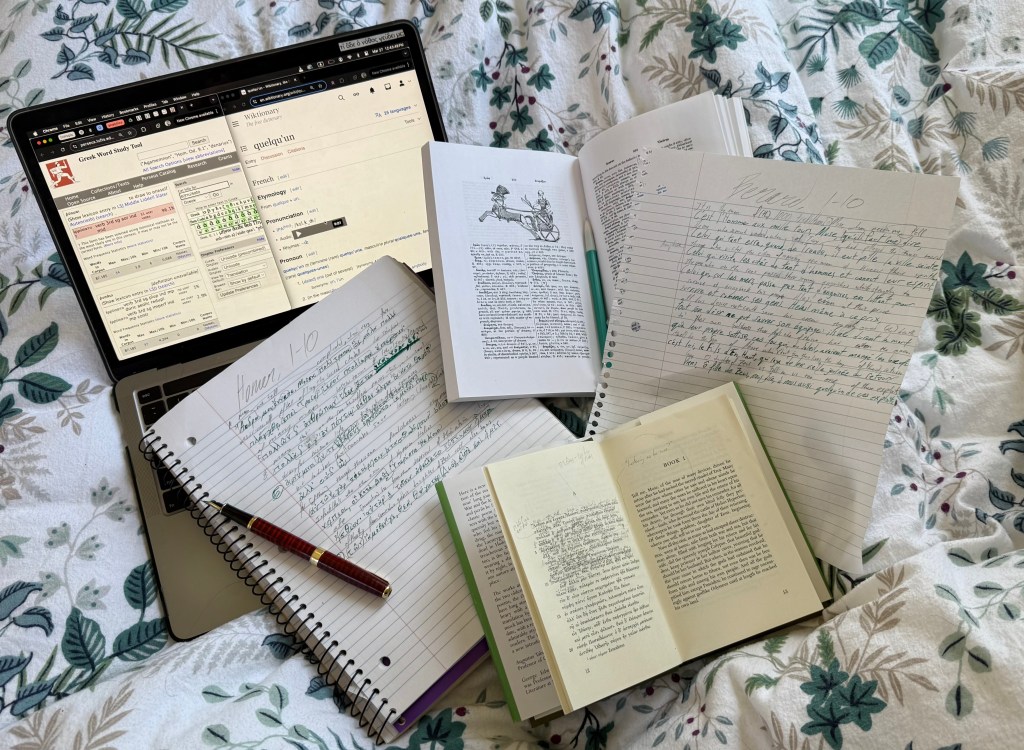
    Homer I.1-10 across three languages—with a bit of etymology on the side.

    Sing to me of the line turned thrice.

    When Homer calls Ulysses polytropos, he conjures a man of many turns—clever, wayward, folded in on himself. But I think of the line itself: turned once, then again, and again.

    This series takes its name from that multiplicity—because I, too, am reading each line far more than once. A minimum of three times, actually: English (Murray), French (Bérard), and the original Greek. The goal is not to triangulate a single meaning, but to feel the pressure points, the fault lines where interpretation shifts. The line becomes a hinge, a thing that can bear weight because it bends. Tritropic is about following that movement: reading with the grain, against, and across it.

    I start at the question of beginnings. To open something well—an argument, a poem, a conversation—is to create a direction; it prepares the reader for movement without determining the destination. This is the art I want to think about: how an opening invites us in. What is foregrounded, what is sacrificed: what choices author and translator (perhaps a false distinction) are forced to negotiate.

    So this is the first go. Tritropic starts from no thesis, but instead a posture: curious, slant, slightly off-center. Like Ulysses on the shore, this is always arriving, always about to depart.


    Introduction

    Let’s begin with an overview of the three versions and their respective approaches to opening the Odyssey—what each one foregrounds, what gets relegated to the background. From there, we’ll move into close readings of selected lines and phrases to ground the analysis. Finally, we’ll wrap up with a reflection on the interpretive choices each version makes.

    Overview

    I chose these translations for fidelity rather than flourish. I’ve read more poetic renditions of the Odyssey before—this January, I listened to Emily Wilson’s iambic pentameter version, particularly relishing the experience of orality—and enjoyed them greatly. But since my aim here is to learn both Epic Greek and modern French precisely, I sought translations that hew closely to the original line structure. The occasional flourish is still present, of course, but ideally these embellishments echo Homer’s own style, rather than showcasing the translator’s innovations.

    1. Greek (Homer): Epic immediacy and economy. The poem begins mid-thought without naming Odysseus, as if the story is already in motion. The identity of the hero is constructed through epithet and action, not personal detail. Syntax, too, reflects this: the Muse is invoked not in isolation but embedded within the sentence, mid-line, as part of the narrative’s machinery rather than as ornament. The structure is tightly coiled, balancing compression with clarity. It prioritizes movement, ethos, and a certain moral ambiguity: the line blames the men’s deaths on their own actions, but doesn’t dwell on it. The register is neutral, even austere. It’s less about grandeur than narrative pressure.

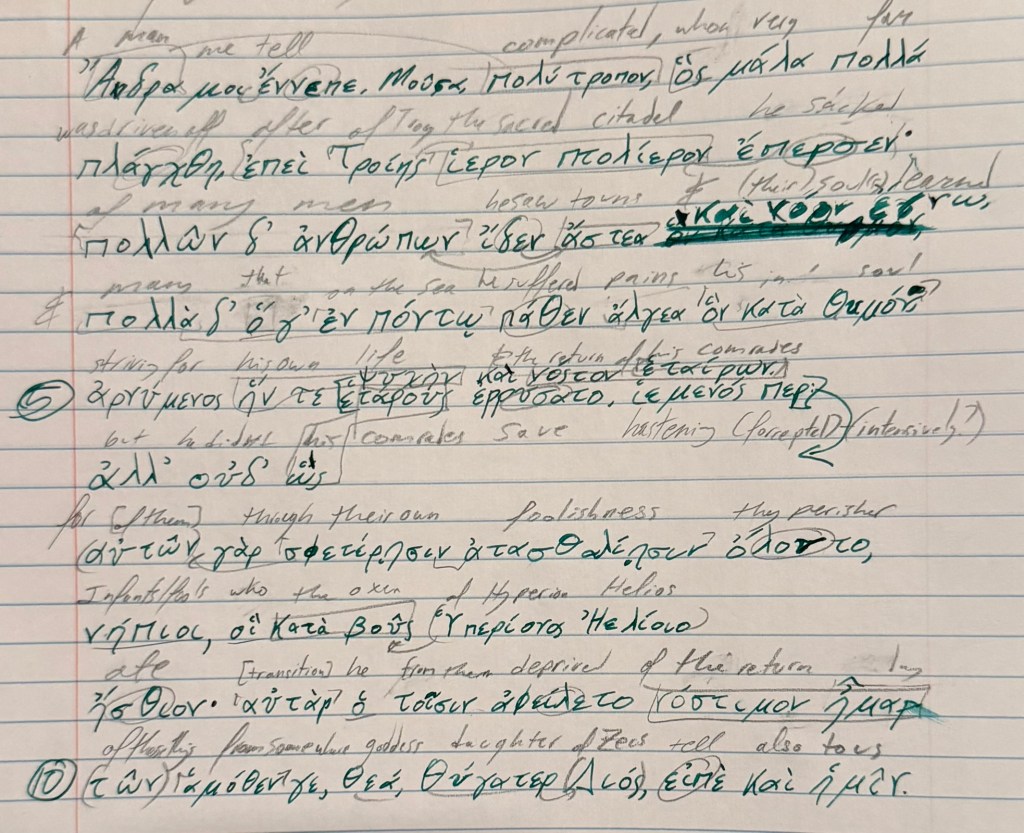
    ἄνδρα μοι ἔννεπε, μοῦσα, πολύτροπον, ὃς μάλα πολλὰ
    πλάγχθη, ἐπεὶ Τροίης ἱερὸν πτολίεθρον ἔπερσεν:
    πολλῶν δ᾽ ἀνθρώπων ἴδεν ἄστεα καὶ νόον ἔγνω,
    πολλὰ δ᾽ ὅ γ᾽ ἐν πόντῳ πάθεν ἄλγεα ὃν κατὰ θυμόν,
    ἀρνύμενος ἥν τε ψυχὴν καὶ νόστον ἑταίρων. (5)
    ἀλλ᾽ οὐδ᾽ ὣς ἑτάρους ἐρρύσατο, ἱέμενός περ:
    αὐτῶν γὰρ σφετέρῃσιν ἀτασθαλίῃσιν ὄλοντο,
    νήπιοι, οἳ κατὰ βοῦς Ὑπερίονος Ἠελίοιο
    ἤσθιον: αὐτὰρ ὁ τοῖσιν ἀφείλετο νόστιμον ἦμαρ.
    τῶν ἁμόθεν γε, θεά, θύγατερ Διός, εἰπὲ καὶ ἡμῖν. (10)

    Handwritten markup of Odyssey lines 1–10 in Greek with interlinear notes and translation cues
    My handwritten markup of the Greek: an early attempt to track structure, emphasis, and ambiguity.

    2. French (Bérard): Elevated, rhetorical, almost ceremonial. The anaphoric structure builds rhythm and stature, layering Odysseus’s identity through a litany of actions. He’s gradually evoked, perhaps even summoned, through his deeds and suffering. The effect is reverent, with an undertone of moral reflection. Where Homer enters mid-thought, Bérard expands the opening, giving it space and resonance. It feels less like a launch and more like an unveiling.

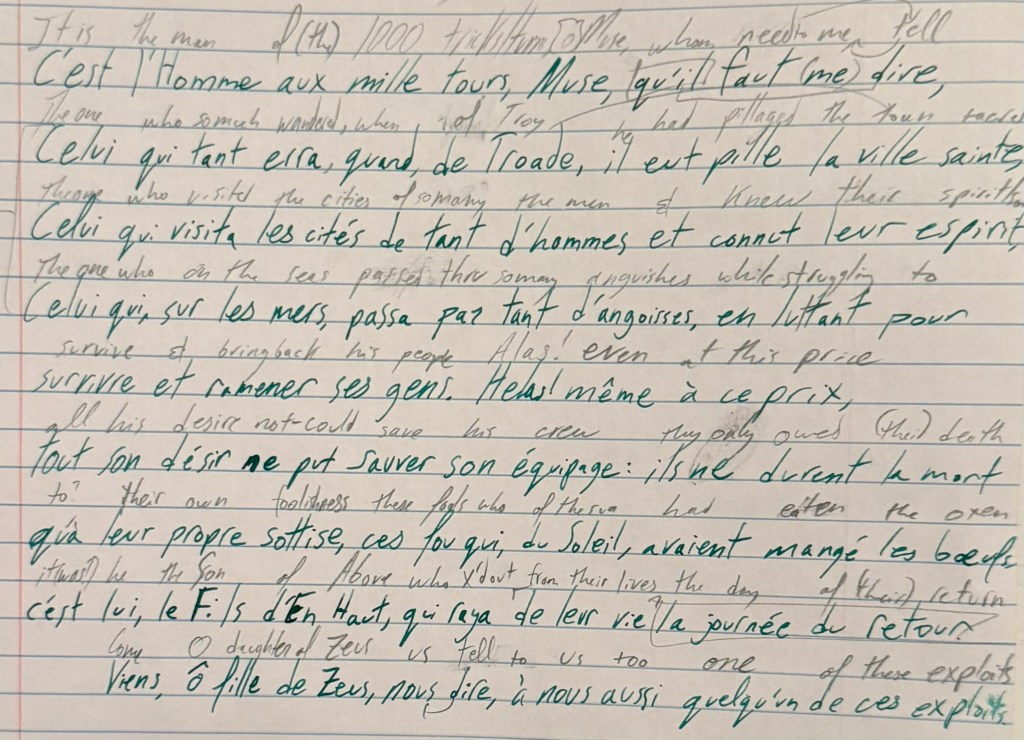
    C’est l’Homme aux mille tours, Muse, qu’il faut me dire—celui qui tant erra quand, de Troade, il eut pillé la ville sainte; celui qui visita les cités de tant d’hommes et connut leur esprit; celui qui, sur les mers, passa par tant d’angoisses, en luttant pour survivre et ramener ses gens. Hélas! même à ce prix, tout son désir ne put sauver son équipage: ils ne durent la mort qu’à leur propre sottise, ces fous qui, du Soleil, avaient mangé les bœufs; c’est lui, le Fils d’En Haut, qui raya de leur vie la journée du retour. Viens, ô fille de Zeus, nous dire, à nous aussi, quelqu’un de ces exploits.

    Handwritten markup of Bérard’s French translation of Odyssey lines 1–10 with English glosses and emphasis underlines
    My markup of the French: tracing rhythm, repetition, and the tonal shift from epic immediacy to ceremonial unveiling.

    3. English (Murray): Spare, formal, and slightly distanced. Murray often mirrors the Greek more directly, especially in structure and sequence, but smooths out its syntactic tension. The tone is restrained, almost academic—archival rather than evocative. This is a translation written for sense, not sensation. Compared to Bérard, it holds back emotionally, but gains a kind of angular precision. It doesn’t call attention to itself, but allows the structure of the Greek to show through in quiet outline.

    Tell me, Muse, of the man of many devices, driven far astray after he had sacked the sacred citadel of Troy. Many were the men whose cities he saw and whose minds he learned, and many the woes he suffered in his heart upon the sea, seeking to win his own life and the return of his comrades. Yet even so he did not save his comrades, for all his desire, for through their own blind folly they perished fools, who devoured the cattle of Helios Hyperion; whereupon he took from them the day of their returning. Of these things, goddess, daughter of Zeus, beginning where you will, tell us in our turn.

    Close Readings

    1. πολύτροπος and its discontents

    We have no choice but to begin with the very first phrase—so thoroughly debated and reinterpreted throughout Homeric scholarship. I want to focus on the word πολύτροπον (polytropon), and how Murray and Bérard each handle it. Murray uses “the man of many devices,” while Bérard chooses l’Homme aux mille tours—“the man of a thousand tricks” or “turns,” with tours carrying the connotation of sleight-of-hand, deception, or magical illusion. Both gesture toward resourcefulness, but neither quite captures the full semantic range of the Greek. More critically, both seem to assume a certain foreknowledge of Odysseus’s character—baking in the idea that he is clever or crafty from the outset, rather than allowing that identity to emerge gradually.

    Let’s briefly review the three primary senses of πολύτροπος. First, there’s the literal reading: “much turned” or “widely traveled”—someone who has been spun about by experience or circumstance. Second, we have the metaphorical sense: “turning many ways,” with its implications of cunning or adaptability—this is the sense Murray and Bérard both foreground. Finally, there’s a broader, more abstract reading: “varied,” “manifold,” or “complex,” which Emily Wilson interestingly captures with her rendering: “Tell me about a complicated man.”

    My view is that we are not yet supposed to know Odysseus is wily. Rather, the poem opens with a quality that invites interpretation—ambiguous enough to resonate differently as the narrative unfolds. The word sets up a possibility, one that the story gradually confirms, refines, and occasionally challenges. The opening line becomes a touchstone for the question of who Odysseus really is—and how we come to know him.

    That’s why, as compelling as l’Homme aux mille tours is, it risks being too definitive, overly revealing. But this is the dilemma: no single word in English or French captures all three senses of πολύτροπος without tipping the translator’s hand. A phrase suggesting “much turned about” would arguably be more faithful to the line’s ambiguity and the shape of the sentence as a whole. But the translator is constrained by the target language’s limitations—by the impossibility of fully conveying the layered meanings carried by one word in the original. This, in turn, raises fascinating questions about what a translator should do when faced with a linguistic and semantic compression that resists clean transfer.

    2. Anaphora of Celui qui

    Bérard’s most striking structural departure from Homer is his use of anaphora: the repeated phrase “Celui qui…” (“he who…”), which appears three times in quick succession. This repetition is entirely absent from the Greek, which presents Odysseus’s identity in a single, flowing participial phrase. Bérard, by contrast, builds Odysseus slowly and ceremonially—almost liturgically—through a catalogue of trials. The effect is grand, formal, and reverent: Odysseus is not simply introduced, but elevated, summoned through a rhythmic invocation of his feats. Each “Celui qui…” functions like a rung on a ladder, progressively constructing the man through his actions and sufferings. It slows the tempo of the opening and foregrounds the translator’s interpretive stance: this is not an epic dropped into mid-action, but a hero’s life laid out for consideration. In doing so, Bérard shifts the invocation from Homer’s abrupt immediacy to something closer to an unveiling. We are asked not simply to listen to a tale, but to witness an emergence.

    3. Le Fils d’En Haut vs Helios Hyperion

    Another departure comes in the form of Bérard’s rendering of Helios Hyperion, the Sun God whose sacred cattle the crew consumed. Where Homer gives us Ὑπερίονος Ἠελίοιο—a doubling of name and epithet that emphasizes divine lineage and radiant power—Bérard offers a striking paraphrase: le Fils d’En Haut, “the Son of the One Above” or “the Son from on High.” While not a direct equivalent, this phrase preserves the sense of elevated origin and distance, reframing Helios less as a named deity and more as a remote, celestial force. The capitalization of En Haut subtly enhances this effect, suggesting a kind of cosmic authority. The result is a tone that feels more solemn, even vaguely moralizing, than the Greek, which names Helios with mythic familiarity. Bérard’s version trades specificity for grandeur, shifting us from epic genealogy to something abstract and severe.

    The original suggests a cosmic, almost elemental force—Helios as a being of grandeur and consequence, but not necessarily judgment. Bérard’s phrasing, by contrast, injects a sense of moral authority and divine retribution. It subtly shifts the register from epic cosmology to something more solemn and punitive, perhaps more familiar to modern readers raised in Abrahamic traditions. It’s a moment where fidelity bends toward resonance—and in doing so, reorients the ethical frame of the passage.

    Conclusion

    Taken together, these choices (lexical, structural, and tonal) reveal the translator’s position as co-creator. The opening of the Odyssey is a test of orientation. What kind of man is Odysseus? What kind of journey is this? And what kind of voice is being summoned to tell it? Each version answers those questions differently—by emphasizing character, or pacing, or cosmic justice—and in doing so, opens several paths at once. The line, turned thrice, doesn’t narrow but widens.


    And in this act of beginning—of turning the line three times—I’m also opening something in myself.

    If you read the first Marginalia post, you know that I’ve long felt more at ease among the dead. Ancient languages have given me structure, distance, and safety: a world of forms I could move through silently, precisely, without the risk of mispronunciations. I called it intimacy, and it was. But it was also retreat.

    Now, for the first time, I’m trying something different. I’m learning a living language to actually use it in my life. And I’m doing it by going to what I know best: texts I already love, structures I’ve long studied, lines I can trust to guide me. I’m approaching French from the inside out, trying to inhabit it the way I first dwelled in Latin: structurally, curiously, joyfully.

    This attempt is a kind of bridge for me: between ancient and modern, dead and living, silence and sound. That’s what this Tritropic project is, at heart: not just about literacy, but about vocalizing too. I don’t know where this will go. But I’m here, at the opening, bent toward what comes next.