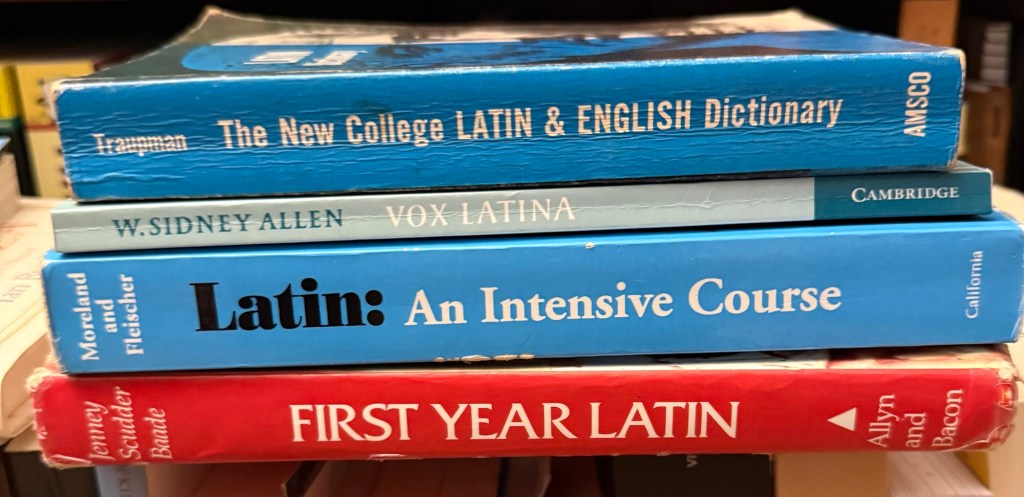
This post collects the top resources I rely on in my study of Classical Latin. The focus here is on tools that are both rigorous and usable—resources I’ve returned to over years (from age 10!) of working with Latin literature, grammar, and historical texts. Whether you’re reading Cicero, Ovid, or Caesar, this toolkit offers a dependable foundation across grammar, vocabulary, style, and reading.
To Get Started
Moreland & Fleischer – Latin: An Intensive Course
A rigorous, grammar-driven introduction to Latin designed for rapid acquisition, often used in intensive summer programs. Each chapter includes vocabulary, grammatical explanations, and exercises, with a strong focus on reading unadapted Latin early. Ideal for learners who appreciate a no-nonsense, immersion-style approach.
Read online
Digital Tools
Logeion
A fast and comprehensive dictionary interface that includes Lewis & Short, the Elementary Lewis, and other Latin lexica. Entries often include frequency, examples, and morphological info.
Access online
Whitaker’s Words
A downloadable tool (and web version) that parses Latin word forms and offers root definitions. Fast and simple, especially for checking unknown inflected forms.
Access online
Perseus Word Study Tool
Useful for parsing unfamiliar word forms and locating them in context. Linked to the Perseus Digital Library’s extensive collection of classical texts.
Access online
The Latin Library
An enormous archive of classical, medieval, and ecclesiastical Latin texts. No parsing or commentary—just clean, plain Latin.
Access online
Hexameter.co
An interactive tool for learning and practicing dactylic hexameter. Features lines from Vergil, Ovid, Lucretius, and AP Latin selections.
Access online
Advanced Topics
Allen & Greenough – New Latin Grammar
The most detailed traditional Latin grammar in English, covering syntax, morphology, prosody, and style. Still a go-to reference for advanced students and scholars.
Read online
Gildersleeve & Lodge – Latin Grammar
An alternative to Allen & Greenough with a slightly different emphasis and some unique syntactic classifications. Dense but rewarding for deep grammatical work.
Read online
W. Sidney Allen — Vox Latina
A sister volume to Vox Graeca as mentioned in the Classical Greek Toolkit post. Covers similar ground. Quite foundational; covers many of the quirks of classical pronunciation.
Read online
Conclusion
This toolkit prioritizes depth and clarity in equal measure. Latin is not just a language of forms—it’s a language of authors, arguments, and rhythm. These tools have supported me in reading widely and attentively, and I hope they’ll do the same for you.
Have favorite resources not listed here? I’d love to hear what’s missing.
 To Wake the Dead