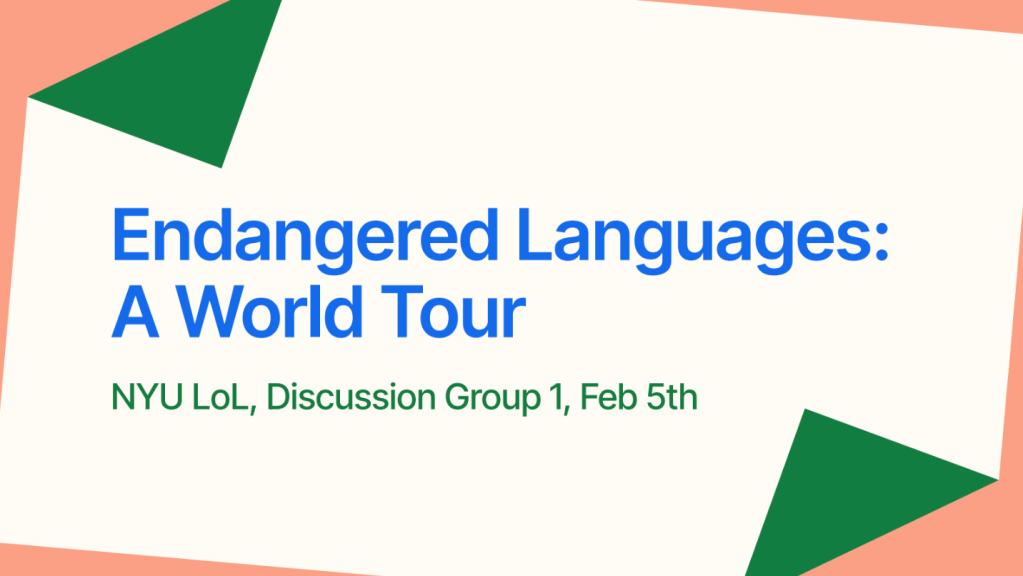
Though this is technically Linguistics for All, 2, this post is about NYU League of Linguistics’ first discussion group of the semester—I’m posting it now because a few people asked for the recap, and I’m more than happy to oblige.
The conversation focused on typological features found in endangered languages—many of them rare in the languages of the world and very unexpected (to English speakers, that is). We took a fast but focused world tour: Austronesian syntax, Mayan phonology, Bantu morphology, and more. The goal wasn’t comprehensiveness, but curiosity. What kinds of things can human languages do? And what’s at stake when we lose examples of those things?
Some of the questions that came up:
How do syntactic constraints shift when the verb comes first? When the object comes before the subject?
Why might a language have a vast and highly irregular consonant inventory? Why might sound changes that are quite unique cross-linguistically emerge?
What’s it like to speak a language where every noun has to fit into one of twenty classes, each with its own agreement pattern?
The point was to slow down and marvel at the extent of linguistic diversity, and just what we’d lose if those languages went extinct. These features are beautiful, in my opinion, but they’re also systemically instructive. They tell us what’s possible in the “design space” of language, and how they resist the tidy models that formalists sometimes prefer.
For those who couldn’t attend, the slides are linked here along with a short primer on the pre-event readings & videos, plus a folder of journal articles and book chapters in a shared Google Drive. Unfortunately, we weren’t able to record the session, but I’m hoping to incorporate some of this material into future blog entries or curriculum tools.
And if this is your first time hearing about the League, drop me a line at tfavdw@nyu.edu—we meet semi-regularly and welcome anyone curious about language in any form. NYU affiliates and non-NYU people can both attend.
Stay tuned for our next session: a hands-on cryptography and forensic linguistic game using real linguistic data, running during midterms as a low-stakes puzzle night (with some surprise mechanics). It’ll be at 10 Washington Place, NY, NY, at 6:30pm on April 1st. More details are available at nyulol.org, and a recording of the presentation portion, delivered by a leading forensic linguist, will be posted shortly after the event.
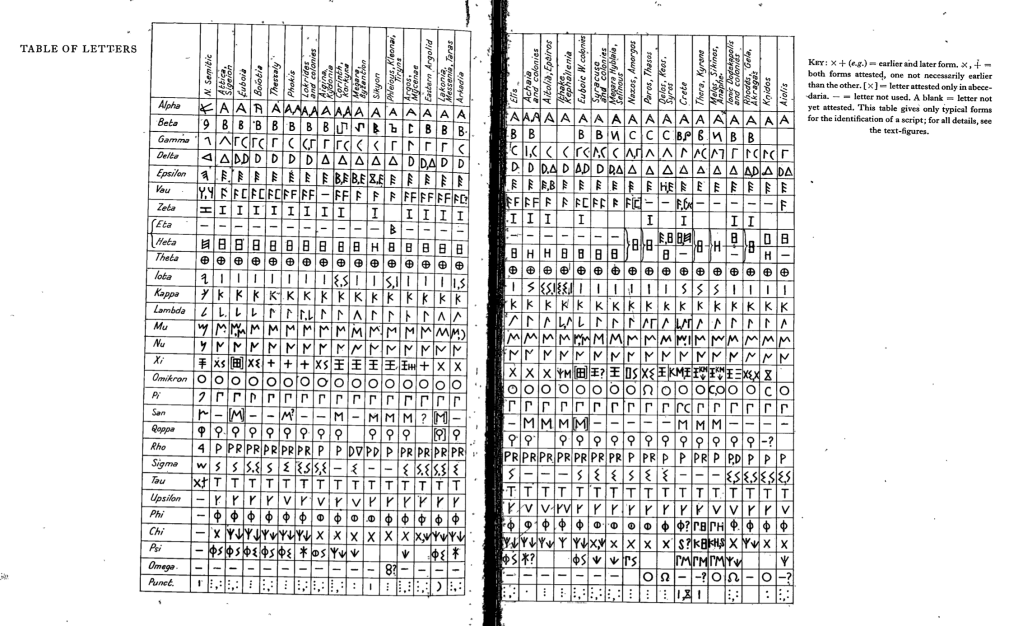
Jeffery’s summary table of all epichoric scripts at the end of LSAG. It is foundational for any work on early regional Greek scripts.
There are very few books I consider truly irreplaceable in my research. Lilian H. Jeffery’s The Local Scripts of Archaic Greece is one of them. First published in 1961 and revised in 1990 with A.W. Johnston, this book remains the reference for regional variations in the Greek alphabet during the archaic period. It’s where I first learned to read epichoric inscriptions with the eye of a paleographer rather than a Classicist alone.
The book is very hard to find, and I only got my copy at an even remotely affordable price after months of scouring secondhand sellers. While copies still circulate among libraries and the used book market, I wanted to make it more accessible to others working in this area. So I hunted diligently before finding it on the Internet Archive. You can read or download it here: The Local Scripts of Archaic Greece (1990 ed.) – Internet Archive
Jeffery’s study remains foundational for any work on early Greek writing—not just in Athens or Ionia, but across the full spectrum of regional scripts: Corinthian, Euboian, Attic-Boeotian, Cretan, Cycladic, and others. It includes extensive commentary, maps, and an invaluable inscriptional catalogue organized by region, with drawings and typographic transcriptions. The 1990 revision added important corrections, expanded references, and additional illustrative material. For those of us studying alphabetic transmission, especially the Phoenician-Greek interface or the evolution of letterforms over time, this book is indispensable.
What makes Local Scripts especially useful is that it bridges the gap between paleography, archaeology, and linguistics. Jeffery doesn’t just chart when and where a particular variant of alpha or epsilon shows up—she explains what those variations might imply for chronology, influence, and contact. And although her typology has been revised and challenged in places (especially with the discovery of new inscriptions), her system remains a critical baseline for almost every study that’s come after.
Whether you’re interested in early Greek literacy, the transmission of the alphabet, the sociopolitical meaning of epigraphy, or just want to be able to tell the difference between Laconian and Euboian chi, this is the book to start with. I hope having it freely available will be helpful to others navigating this fragmentary and fascinating material.
Do you have other resources you pair with Jeffery? I’d love to hear what we can supplement LSAG with.
2023: Tablet replica I made from a drawing in Huehnergard’s grammar.
I first took Akkadian a few years ago. Since then, the language has been sitting in a kind of suspended animation: just far enough away to feel unreachable, just close enough to make me feel guilty.
This post kicks off Tablets and Tribulations, a new series chronicling my return to Akkadian. I’ll be using it to track my progress, share insights, and reflect on what it means to study something this complex, this demanding, and this strange.
Why Akkadian?
Akkadian sits at the intersection of my academic obsessions: Semitic linguistics, the history of writing systems, and the psycholinguistics of script. It’s a dead language, but not a fossilized one. The more you read it, the more it pulses: with bureaucracy, with poetry, with prayer. And the writing system—a sprawling, phonetically polyvalent syllabary riddled with ideograms—is completely unlike the tight alphabets I’m used to. It demands patience, pattern-recognition, and grit.
There’s also no shortage of material, with estimates of the number of excavated Akkadian texts reaching as high two million—meaning it quite possibly has the most documents of any ancient language; in fact, according to my professor Ronald Wallenfels, more documents than all ancient languages combined. Put that in your pipe and smoke it.
I’m also drawn to it because I’m not naturally good at it. Greek and Latin came to me more intuitively, their logics familiar in a way I hadn’t expected. Akkadian doesn’t let me do that. It forces me to slow down, to wrestle with my perfectionism, to train my brain in new ways. And I love that. I want to get good at something hard. I want to overcome the mental blocks that have held me back before.
What’s Changed
Since that early study, I’ve broadened my exposure to Semitic linguistics and become more confident working with both the script and the medium. I’ve also made peace with how humbling this language is. Once, I even told a syntax class—confidently—that Akkadian had no demonstratives, only to moments later fact-check myself and discover that it had three distinct tiers of them. I then had to publicly correct myself and told them to pray for me… as I had a quiz on Akkadian pronominals the next period.
I’m now studying with two grammars, Huehnergard and Caplice, using Labat’s sign list as my main reference. I’m also switching from just drawing signs to pressing them into clay, and my wax tablets—less sketchbook, more scribal. I’ll be posting more about that process (and my tablet replicas) soon.
What to Expect from This Series
Tablets and Tribulations will be part language log, part material exploration, and part meditation on what it means to study a language with no living speakers and a script that defies modern intuition. Future posts will likely include:
Syntax deep dives (word order, case, verb chains, etc.)
Close readings of texts (legal, literary, magical, bureaucratic)
Reflections on learning signs and navigating polyvalence
Notes on scribal training and cuneiform technique
My own experimental archaeology: pressing and firing tablets
Anecdotes from the museum and the classroom
Psycholinguistic musings on how syllabaries shape cognition
Occasional moments of crisis and triumph
This is going to be hard. But I want that. I want to stretch, stumble, and get back up. That balance—rigor with joy—is what I’m working toward. Each week with Akkadian reminds me how study disciplines the self—not just the mind.
Homer I.1-10 across three languages—with a bit of etymology on the side.
Sing to me of the line turned thrice.
When Homer calls Ulysses polytropos, he conjures a man of many turns—clever, wayward, folded in on himself. But I think of the line itself: turned once, then again, and again.
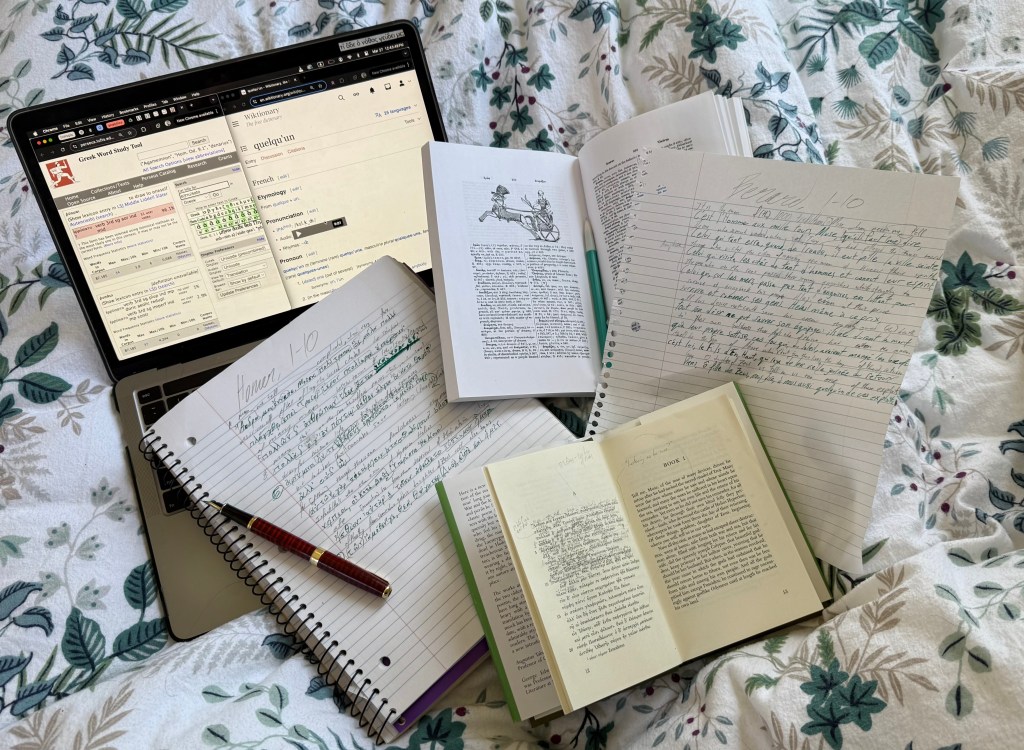
This series takes its name from that multiplicity—because I, too, am reading each line far more than once. A minimum of three times, actually: English (Murray), French (Bérard), and the original Greek. The goal is not to triangulate a single meaning, but to feel the pressure points, the fault lines where interpretation shifts. The line becomes a hinge, a thing that can bear weight because it bends. Tritropic is about following that movement: reading with the grain, against, and across it.
I start at the question of beginnings. To open something well—an argument, a poem, a conversation—is to create a direction; it prepares the reader for movement without determining the destination. This is the art I want to think about: how an opening invites us in. What is foregrounded, what is sacrificed: what choices author and translator (perhaps a false distinction) are forced to negotiate.
So this is the first go. Tritropic starts from no thesis, but instead a posture: curious, slant, slightly off-center. Like Ulysses on the shore, this is always arriving, always about to depart.
Introduction
Let’s begin with an overview of the three versions and their respective approaches to opening the Odyssey—what each one foregrounds, what gets relegated to the background. From there, we’ll move into close readings of selected lines and phrases to ground the analysis. Finally, we’ll wrap up with a reflection on the interpretive choices each version makes.
Overview
I chose these translations for fidelity rather than flourish. I’ve read more poetic renditions of the Odyssey before—this January, I listened to Emily Wilson’s iambic pentameter version, particularly relishing the experience of orality—and enjoyed them greatly. But since my aim here is to learn both Epic Greek and modern French precisely, I sought translations that hew closely to the original line structure. The occasional flourish is still present, of course, but ideally these embellishments echo Homer’s own style, rather than showcasing the translator’s innovations.
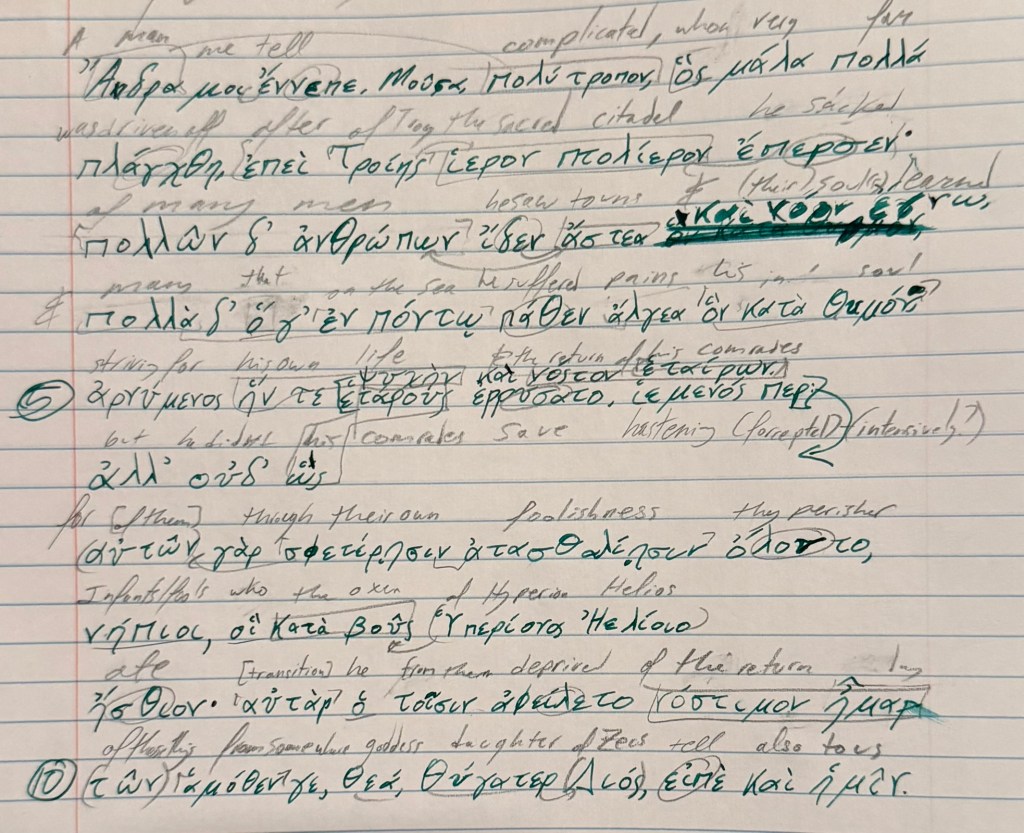
1. Greek (Homer): Epic immediacy and economy. The poem begins mid-thought without naming Odysseus, as if the story is already in motion. The identity of the hero is constructed through epithet and action, not personal detail. Syntax, too, reflects this: the Muse is invoked not in isolation but embedded within the sentence, mid-line, as part of the narrative’s machinery rather than as ornament. The structure is tightly coiled, balancing compression with clarity. It prioritizes movement, ethos, and a certain moral ambiguity: the line blames the men’s deaths on their own actions, but doesn’t dwell on it. The register is neutral, even austere. It’s less about grandeur than narrative pressure.
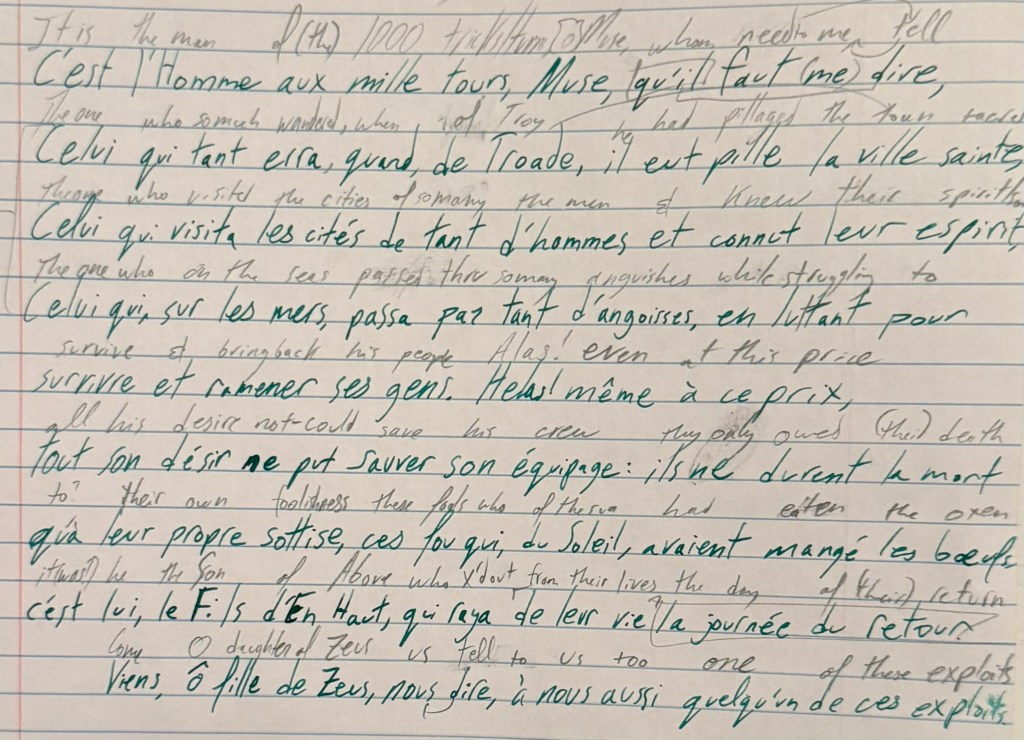
My handwritten markup of the Greek: an early attempt to track structure, emphasis, and ambiguity.
2. French (Bérard): Elevated, rhetorical, almost ceremonial. The anaphoric structure builds rhythm and stature, layering Odysseus’s identity through a litany of actions. He’s gradually evoked, perhaps even summoned, through his deeds and suffering. The effect is reverent, with an undertone of moral reflection. Where Homer enters mid-thought, Bérard expands the opening, giving it space and resonance. It feels less like a launch and more like an unveiling.
C’est l’Homme aux mille tours, Muse, qu’il faut me dire—celui qui tant erra quand, de Troade, il eut pillé la ville sainte; celui qui visita les cités de tant d’hommes et connut leur esprit; celui qui, sur les mers, passa par tant d’angoisses, en luttant pour survivre et ramener ses gens. Hélas! même à ce prix, tout son désir ne put sauver son équipage: ils ne durent la mort qu’à leur propre sottise, ces fous qui, du Soleil, avaient mangé les bœufs; c’est lui, le Fils d’En Haut, qui raya de leur vie la journée du retour. Viens, ô fille de Zeus, nous dire, à nous aussi, quelqu’un de ces exploits.
My markup of the French: tracing rhythm, repetition, and the tonal shift from epic immediacy to ceremonial unveiling.
3. English (Murray): Spare, formal, and slightly distanced. Murray often mirrors the Greek more directly, especially in structure and sequence, but smooths out its syntactic tension. The tone is restrained, almost academic—archival rather than evocative. This is a translation written for sense, not sensation. Compared to Bérard, it holds back emotionally, but gains a kind of angular precision. It doesn’t call attention to itself, but allows the structure of the Greek to show through in quiet outline.
Tell me, Muse, of the man of many devices, driven far astray after he had sacked the sacred citadel of Troy. Many were the men whose cities he saw and whose minds he learned, and many the woes he suffered in his heart upon the sea, seeking to win his own life and the return of his comrades. Yet even so he did not save his comrades, for all his desire, for through their own blind folly they perished fools, who devoured the cattle of Helios Hyperion; whereupon he took from them the day of their returning. Of these things, goddess, daughter of Zeus, beginning where you will, tell us in our turn.
Close Readings
1. πολύτροπος and its discontents
We have no choice but to begin with the very first phrase—so thoroughly debated and reinterpreted throughout Homeric scholarship. I want to focus on the word πολύτροπον (polytropon), and how Murray and Bérard each handle it. Murray uses “the man of many devices,” while Bérard chooses l’Homme aux mille tours—“the man of a thousand tricks” or “turns,” with tours carrying the connotation of sleight-of-hand, deception, or magical illusion. Both gesture toward resourcefulness, but neither quite captures the full semantic range of the Greek. More critically, both seem to assume a certain foreknowledge of Odysseus’s character—baking in the idea that he is clever or crafty from the outset, rather than allowing that identity to emerge gradually.
Let’s briefly review the three primary senses of πολύτροπος. First, there’s the literal reading: “much turned” or “widely traveled”—someone who has been spun about by experience or circumstance. Second, we have the metaphorical sense: “turning many ways,” with its implications of cunning or adaptability—this is the sense Murray and Bérard both foreground. Finally, there’s a broader, more abstract reading: “varied,” “manifold,” or “complex,” which Emily Wilson interestingly captures with her rendering: “Tell me about a complicated man.”
My view is that we are not yet supposed to know Odysseus is wily. Rather, the poem opens with a quality that invites interpretation—ambiguous enough to resonate differently as the narrative unfolds. The word sets up a possibility, one that the story gradually confirms, refines, and occasionally challenges. The opening line becomes a touchstone for the question of who Odysseus really is—and how we come to know him.
That’s why, as compelling as l’Homme aux mille tours is, it risks being too definitive, overly revealing. But this is the dilemma: no single word in English or French captures all three senses of πολύτροπος without tipping the translator’s hand. A phrase suggesting “much turned about” would arguably be more faithful to the line’s ambiguity and the shape of the sentence as a whole. But the translator is constrained by the target language’s limitations—by the impossibility of fully conveying the layered meanings carried by one word in the original. This, in turn, raises fascinating questions about what a translator should do when faced with a linguistic and semantic compression that resists clean transfer.
2. Anaphora of Celui qui
Bérard’s most striking structural departure from Homer is his use of anaphora: the repeated phrase “Celui qui…” (“he who…”), which appears three times in quick succession. This repetition is entirely absent from the Greek, which presents Odysseus’s identity in a single, flowing participial phrase. Bérard, by contrast, builds Odysseus slowly and ceremonially—almost liturgically—through a catalogue of trials. The effect is grand, formal, and reverent: Odysseus is not simply introduced, but elevated, summoned through a rhythmic invocation of his feats. Each “Celui qui…” functions like a rung on a ladder, progressively constructing the man through his actions and sufferings. It slows the tempo of the opening and foregrounds the translator’s interpretive stance: this is not an epic dropped into mid-action, but a hero’s life laid out for consideration. In doing so, Bérard shifts the invocation from Homer’s abrupt immediacy to something closer to an unveiling. We are asked not simply to listen to a tale, but to witness an emergence.
3. Le Fils d’En Haut vs Helios Hyperion
Another departure comes in the form of Bérard’s rendering of Helios Hyperion, the Sun God whose sacred cattle the crew consumed. Where Homer gives us Ὑπερίονος Ἠελίοιο—a doubling of name and epithet that emphasizes divine lineage and radiant power—Bérard offers a striking paraphrase: le Fils d’En Haut, “the Son of the One Above” or “the Son from on High.” While not a direct equivalent, this phrase preserves the sense of elevated origin and distance, reframing Helios less as a named deity and more as a remote, celestial force. The capitalization of En Haut subtly enhances this effect, suggesting a kind of cosmic authority. The result is a tone that feels more solemn, even vaguely moralizing, than the Greek, which names Helios with mythic familiarity. Bérard’s version trades specificity for grandeur, shifting us from epic genealogy to something abstract and severe.
The original suggests a cosmic, almost elemental force—Helios as a being of grandeur and consequence, but not necessarily judgment. Bérard’s phrasing, by contrast, injects a sense of moral authority and divine retribution. It subtly shifts the register from epic cosmology to something more solemn and punitive, perhaps more familiar to modern readers raised in Abrahamic traditions. It’s a moment where fidelity bends toward resonance—and in doing so, reorients the ethical frame of the passage.
Conclusion
Taken together, these choices (lexical, structural, and tonal) reveal the translator’s position as co-creator. The opening of the Odyssey is a test of orientation. What kind of man is Odysseus? What kind of journey is this? And what kind of voice is being summoned to tell it? Each version answers those questions differently—by emphasizing character, or pacing, or cosmic justice—and in doing so, opens several paths at once. The line, turned thrice, doesn’t narrow but widens.
And in this act of beginning—of turning the line three times—I’m also opening something in myself.
If you read the first Marginalia post, you know that I’ve long felt more at ease among the dead. Ancient languages have given me structure, distance, and safety: a world of forms I could move through silently, precisely, without the risk of mispronunciations. I called it intimacy, and it was. But it was also retreat.
Now, for the first time, I’m trying something different. I’m learning a living language to actually use it in my life. And I’m doing it by going to what I know best: texts I already love, structures I’ve long studied, lines I can trust to guide me. I’m approaching French from the inside out, trying to inhabit it the way I first dwelled in Latin: structurally, curiously, joyfully.
This attempt is a kind of bridge for me: between ancient and modern, dead and living, silence and sound. That’s what this Tritropic project is, at heart: not just about literacy, but about vocalizing too. I don’t know where this will go. But I’m here, at the opening, bent toward what comes next.
There’s no single unifying theme to this list—but there is a feeling. I’m reaching, at once, toward the origins of writing and the frontiers of language technology. It’s structure that’s defining me at the moment: how systems encode meaning, whether that’s Greek orthography or neural networks. And in between, I let myself breathe with fiction—stories that play with form, time, and voice themselves.
Recently Finished:
Epigraphic Evidence A technical addition to my current work on inscriptions. Like black coffee: not always easy to imbibe, but quite efficient.
Data Science (MIT Press Essential Knowledge series) A clean introduction—refreshing for thinking about data both ancient and modern.
Ripley’s Game (Patricia Highsmith) Cold, elegant, amoral. Hilarious at points. A good palate cleanser between denser texts.
The Sequel (Jean Hanff Korelitz) Read this mostly for plot, not language—but I love thinking about narrative structures and the great Second Novel Problem.
The English Understand Wool (Helen DeWitt) Sharp, strange, and delightful. I love a novel about an out-of-touch eccentric navigating the world.
Currently Reading:
Kairos (Jenny Erpenbeck) A novel about political and personal time, and a very complicated affair. Thorny for sure.
Word by Word: The Secret Life of Dictionaries (Kory Stamper) The theme of choice made at all stages of lexicography deeply resonates with me as I encode my own systemic information. Chapters like “Bitch” and “Posh” capture this especially well.
Writing and the Origins of Greek Literature (Barry B. Powell) I keep coming back to this one in small sips. Chapters go down easy.
Greek Writing from Knossos to Homer (Roger D. Woodard) Foundational for understanding the transmission of the Greek alphabet. Very well written and thoroughly researched.
Algorithms (MIT Press Essential Knowledge series) A manageable way to reframe my thinking on rules and structure—not unlike real-life syntactical derivations.
Machine Learning (MIT Press Essential Knowledge series) Challenging. Still finding where I fit in here. Hoping I can apply to my APEX project by Stage 3.
JSON for Beginners Very practical for APEX, which is structured with JSON and makes heavy use of standoff annotation. This allows me to encode uncertainty and multiplicitous readings, lowering the amount of assumptions baked into the dataset.
Co-Intelligence: Living and Working with AI (Ethan Mollick) For someone working on ancient inscriptional data, the future of coworking with AI is too relevant to ignore.
I wouldn’t call this a reading list so much as a reading state, a snapshot of what it feels like to be in the thick of things: academic work, blog writing, thesis planning, and whatever this slow journey toward modern spoken French is shaping up to be.
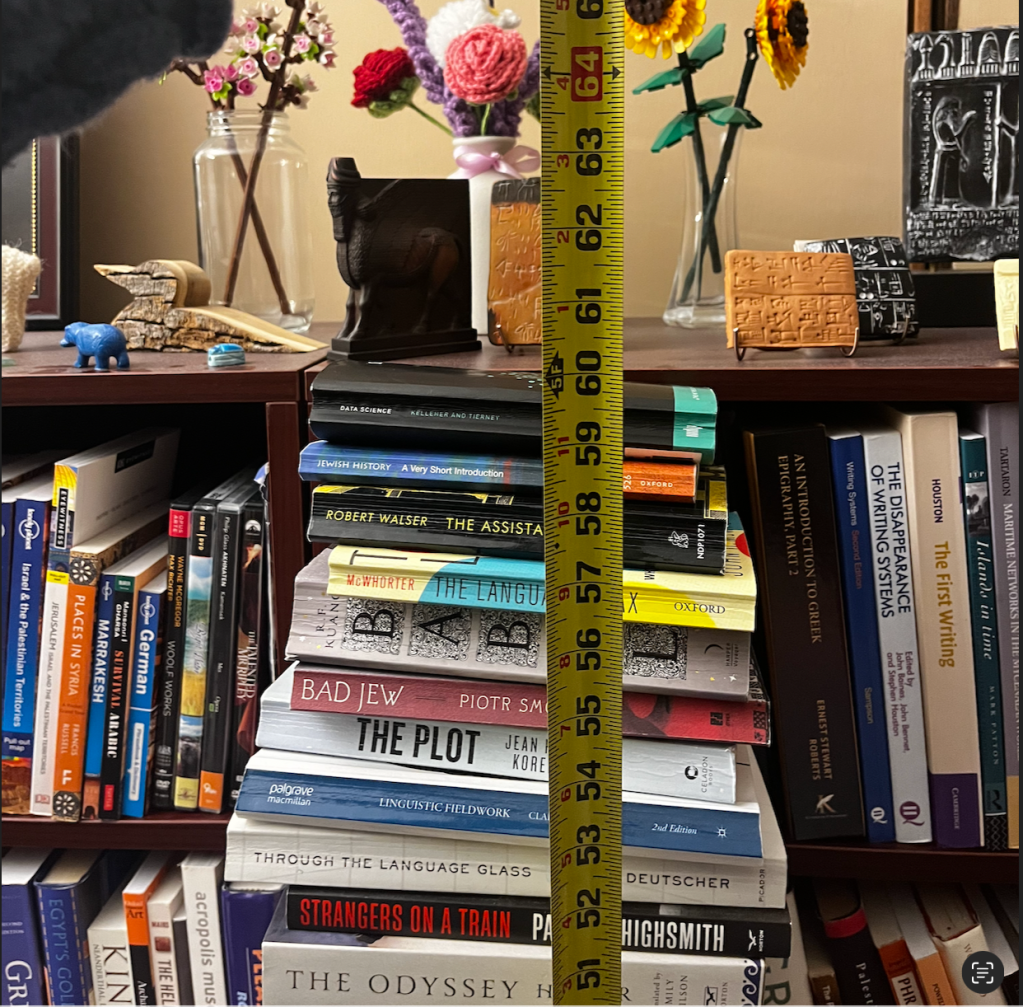
Picture: I’ve been stacking my recent reads as a kind of personal monument—hoping to match my own height before summer.
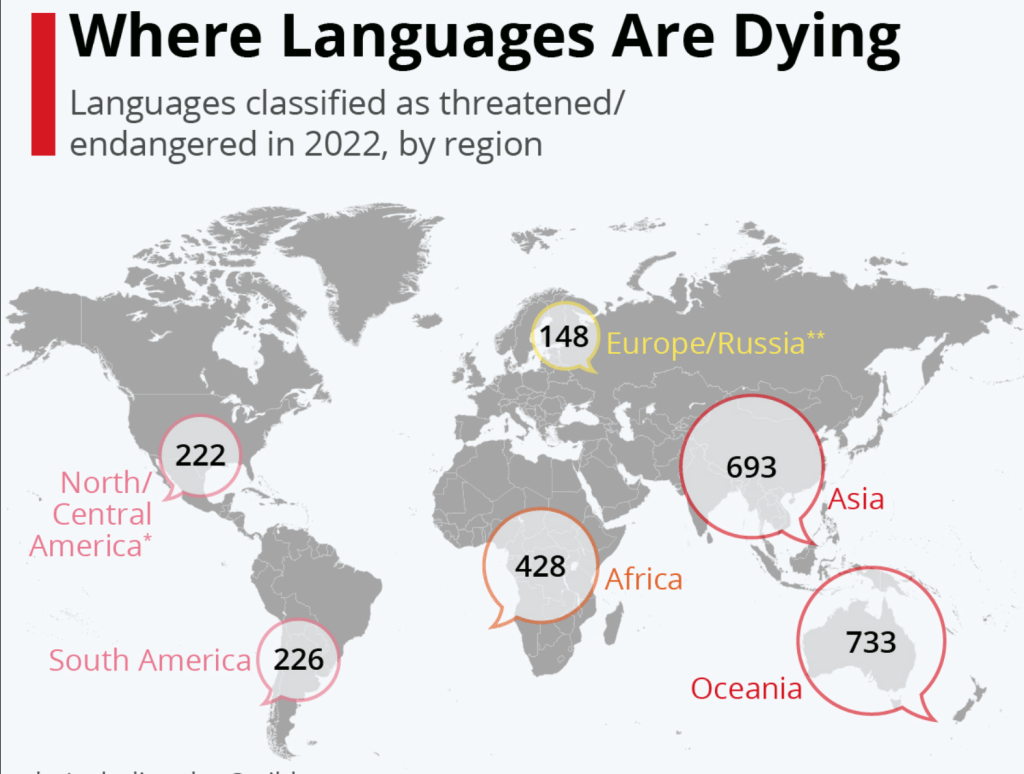
Over the past two months, I had the chance to lead two discussion groups for the NYU League of Linguistics. The first concerned endangered language typology, highlighting interesting features from languages across the world: Austronesian verb-initial sentences, unique Mayan phonologies, and rich Bantu noun classes & declensions.
The second focused on revitalization efforts (video here) around the world, focusing on Hawaiian, Welsh, and Hebrew. We explored how languages can be revived when intergenerational transmission is fading, and what gets negotiated along the way. Key questions were: What counts as success in revitalization? What has become of our own ancestral languages, and why? What trade-offs—like the loss of minority dialects—do we accept? And crucially: where do we, as linguists, fit in?
Together, these sessions became an profound study in contrast: one examining how endangered languages structure and make sense of the world, the other how we might help them endure in it.
As someone who works primarily with dead languages, this topic holds a particular fascination for me. I live among the dead—scripts etched into stone, grammars fossilized in treatises, phonologies inferred but never heard. Endangered languages, by contrast, are not yet dead. Revitalization efforts aim to preserve what I usually only encounter after the fact: living, breathing language. That shift in focus—from excavation to preservation—has reshaped how I think about what linguistic work can be.
It also deepens our understanding of language change. Revitalization doesn’t freeze a language in time—it lets us see what happens next. Take Hawaiian, whose famously tiny consonant inventory (only eight!) allows a wide range of free variation. Will it continue to shrink? Will contrasts harden? Watching a language evolve under new sociopolitical pressures offers historical linguists like me something rare: the chance to witness change not as reconstruction, but as unfolding reality.
One thing that became clear between the two sessions was the importance of community and agency. Typological structures are fascinating—but they exist amid complicated social structures. We came away with a deeper appreciation for linguistic diversity as a lived reality. Our role, ultimately, is not to fix or play savior—but to listen, support, and amplify the work already being done.

 To Wake the Dead