Tag: language toolkit

  • Tools of the Trade, 7: Toolkit: Akkadian

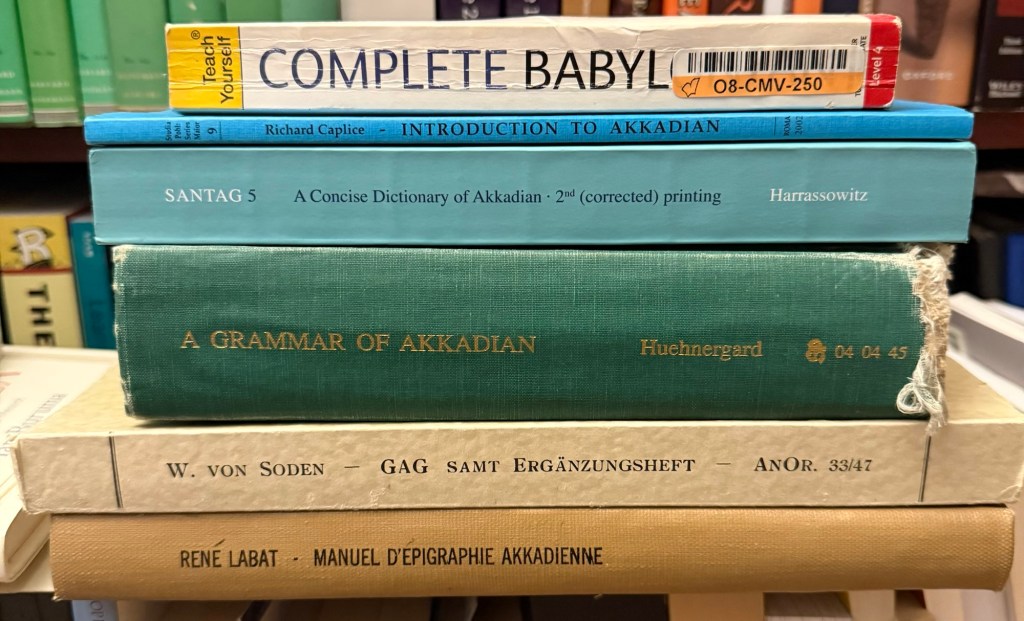
    Some of my physical collection.

    Akkadian is a Semitic language written in the cuneiform script, with texts ranging from royal inscriptions and law codes to letters, contracts, and epics like Gilgamesh. This toolkit gathers the core resources I use to study the language, from mastering the sign list to parsing verbal forms. Whether you’re preparing for graduate study, brushing up for a seminar, or just drawn to the richness of Mesopotamian literature, these are the tools that ground my work with Akkadian.

    A quick note: some of these are in German and French, and of course not everyone reads those. However, Google Translate handles them very well if you upload a screenshot of a paragraph, and as my modern languages are not the strongest yet, I’ve found it invaluable. Use this link to access.

    Huehnergard – A Grammar of Akkadian
    The most widely used modern introduction to Akkadian, especially for Old Babylonian. Combines clear grammatical explanations with exercises, paradigms, and a reading sequence. Thorough and approachable.
    Read online

    Caplice – Introduction to Akkadian
    More compact and reference-oriented than Huehnergard, with streamlined grammar sections and bilingual text readings. Works well as a complement or for review.
    Read online

    Labat – Manuel d’épigraphie akkadienne: Signes cunéiformes, syllabaires, idéogrammes
    The definitive sign list for Akkadian cuneiform. Includes syllabic values, logograms, variant shapes, and transcription equivalents. Indispensable when reading from tablets or facsimiles.
    Read online

    Digital Tools

    ePSD2 (The Electronic Pennsylvania Sumerian Dictionary)
    Although primarily for Sumerian, ePSD2 is invaluable for logogram glosses and cross-referencing Akkadian readings of signs. Frequently cited in scholarly work.
    Access online

    ORACC (Open Richly Annotated Cuneiform Corpus)
    A massive and expanding corpus of annotated Akkadian texts in transliteration and translation, with tools for exploring morphology, genre, and metadata. Excellent for seeing how grammar functions in real texts.
    Access online

    Wiktionary
    There is no single definitive online Akkadian dictionary, but entries on Wiktionary can help with basic word lookup in transliteration.
    Access online

    Advanced Topics

    Von Soden – Grundriss der Akkadischen Grammatik
    The classic grammar of Akkadian, written in German. Highly detailed, especially in verbal system analysis and historical variants.
    Read online

    Goetze / Landsberger – Text Editions
    Once you’ve completed initial grammar work, reading annotated text editions from scholars like Goetze or Landsberger will help solidify your grasp of style, genre, and dialect variation.

    Conclusion

    This toolkit focuses on Old Babylonian and Standard Babylonian as the primary dialects, but the resources here will give you enough flexibility to branch into Assyrian, Middle Babylonian, and other variants. Akkadian is a richly inflected language with a complex writing system, and the path to fluency is best grounded in patient sign recognition, morphological fluency, and careful reading.

    These are the resources I’ve found most helpful in learning and returning to Akkadian. If you know of other tools or have advice from the field, I’d love to hear what’s missing.
    View other toolkits.

  • Tools of the Trade, 6: Toolkit: Classical Latin

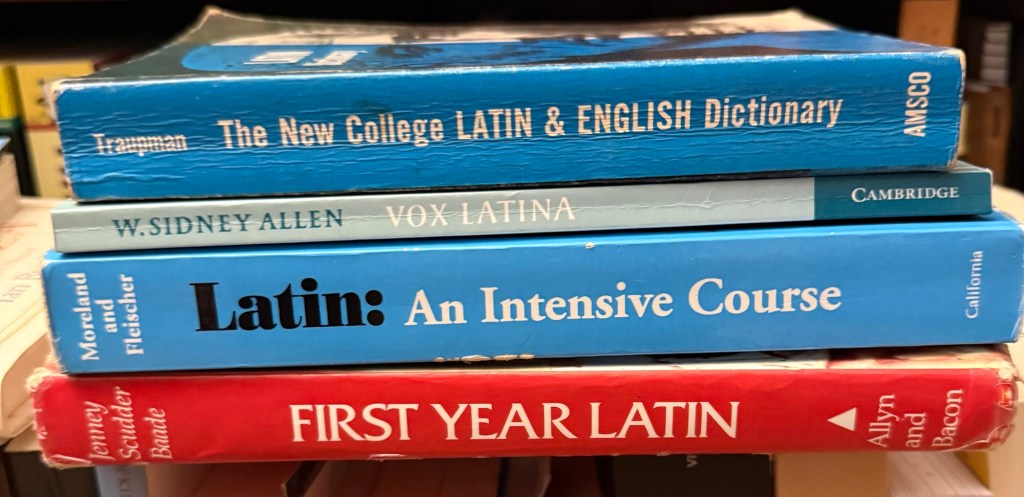
    Some of my physical collection.

    This post collects the top resources I rely on in my study of Classical Latin. The focus here is on tools that are both rigorous and usable—resources I’ve returned to over years (from age 10!) of working with Latin literature, grammar, and historical texts. Whether you’re reading Cicero, Ovid, or Caesar, this toolkit offers a dependable foundation across grammar, vocabulary, style, and reading.

    To Get Started

    Moreland & Fleischer – Latin: An Intensive Course
    A rigorous, grammar-driven introduction to Latin designed for rapid acquisition, often used in intensive summer programs. Each chapter includes vocabulary, grammatical explanations, and exercises, with a strong focus on reading unadapted Latin early. Ideal for learners who appreciate a no-nonsense, immersion-style approach.
    Read online

    Digital Tools

    Logeion
    A fast and comprehensive dictionary interface that includes Lewis & Short, the Elementary Lewis, and other Latin lexica. Entries often include frequency, examples, and morphological info.
    Access online

    Whitaker’s Words
    A downloadable tool (and web version) that parses Latin word forms and offers root definitions. Fast and simple, especially for checking unknown inflected forms.
    Access online

    Perseus Word Study Tool
    Useful for parsing unfamiliar word forms and locating them in context. Linked to the Perseus Digital Library’s extensive collection of classical texts.
    Access online

    The Latin Library
    An enormous archive of classical, medieval, and ecclesiastical Latin texts. No parsing or commentary—just clean, plain Latin.
    Access online

    Hexameter.co
    An interactive tool for learning and practicing dactylic hexameter. Features lines from Vergil, Ovid, Lucretius, and AP Latin selections.
    Access online

    Advanced Topics

    Allen & Greenough – New Latin Grammar
    The most detailed traditional Latin grammar in English, covering syntax, morphology, prosody, and style. Still a go-to reference for advanced students and scholars.
    Read online

    Gildersleeve & Lodge – Latin Grammar
    An alternative to Allen & Greenough with a slightly different emphasis and some unique syntactic classifications. Dense but rewarding for deep grammatical work.
    Read online

    W. Sidney Allen — Vox Latina
    A sister volume to Vox Graeca as mentioned in the Classical Greek Toolkit post. Covers similar ground. Quite foundational; covers many of the quirks of classical pronunciation.
    Read online

    Conclusion

    This toolkit prioritizes depth and clarity in equal measure. Latin is not just a language of forms—it’s a language of authors, arguments, and rhythm. These tools have supported me in reading widely and attentively, and I hope they’ll do the same for you.

    Have favorite resources not listed here? I’d love to hear what’s missing.

    View other toolkits.

  • Tools of the Trade, 5: Toolkit: Mycenaean Greek

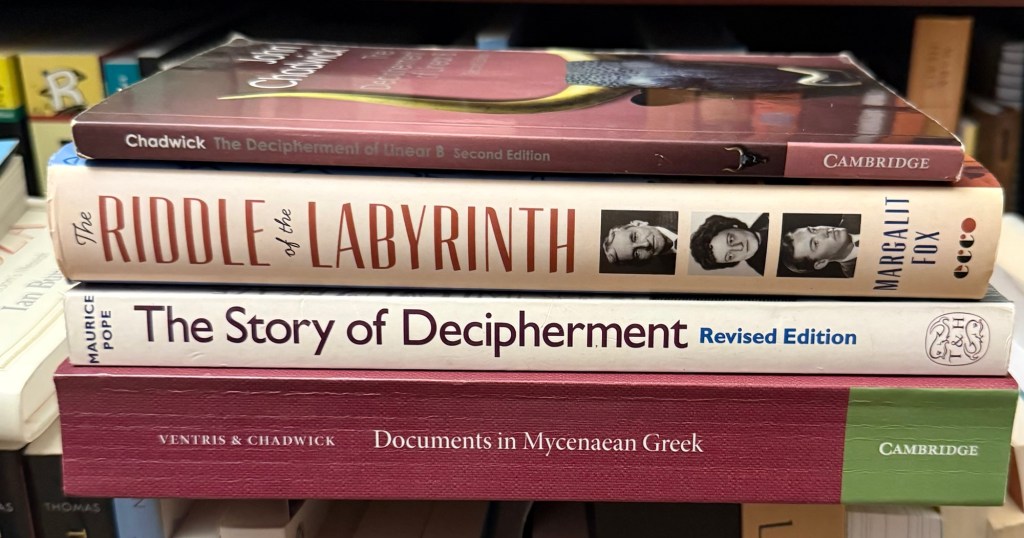
    Some of my physical collection.

    Mycenaean Greek is the earliest recorded form of the Greek language, written in the Linear B syllabary and preserved primarily in administrative documents from palatial centers like Knossos and Pylos. This toolkit collects the core resources I use for studying the language, writing system, and historical context of Mycenaean. While it’s not a language most people “read” in the same way as Homeric or Classical Greek, it’s foundational for understanding the development of the Greek language and the Aegean Bronze Age.

    To Get Started

    Hooker – Linear B: An Introduction
    A concise and accessible introduction to the Linear B writing system, Mycenaean phonology, and key vocabulary. Useful for getting oriented before diving into transcriptions or corpora.
    Read online

    Chadwick – The Decipherment of Linear B
    An essential historical account of how Linear B was deciphered, written by one of its key figures. While dated in some linguistic details, it’s an engaging entry point into the script and its rediscovery.
    Read online

    Digital Tools

    Palaeolexicon: Mycenaean Greek Word List
    A searchable online lexicon of Mycenaean Greek, based on attested forms and reconstructions. Includes syllabic spellings and interpretations. Useful for quick lookups when reading inscriptions.
    Access online

    LiBER (Linear B Electronic Resources)
    An extensive online resource that includes a searchable corpus, transcriptions, sign lists, and links to digitized tablets. Maintained by the University of Cambridge.
    Access online

    Advanced Topics

    Ventris & Chadwick – Documents in Mycenaean Greek
    The foundational reference edition of Linear B tablets, with transcriptions, translations, and commentary. Volume I covers the grammar and lexicon; Volume II includes full texts.
    Read online

    Duhoux & Morpurgo Davies (eds.) – A Companion to Linear B: Mycenaean Greek Texts and Their World
    A more recent scholarly collection covering writing practices, administrative function, linguistics, and interpretive issues. Indispensable for research-level study.
    Read online [Volume 1, Volume 2, Volume 3]

    Aura Jorro – Diccionario Micénico
    A comprehensive lexicon of Mycenaean Greek, keyed to Linear B spellings. In Spanish but used internationally by specialists.
    Read online [Volume 1, Volume 2]

    Conclusion

    Mycenaean Greek is not a reading language in the traditional sense, but it offers unparalleled access to the earliest phase of Greek—its phonology, morphology, and vocabulary in situ. For linguists, epigraphers, and anyone curious about the Bronze Age Aegean, these tools provide a clear entry into the world of palace records and early writing.

    This list includes the materials I’ve found most dependable in my own work. If you’ve found other resources—especially for working with the tablets themselves—I’d love to hear what’s missing.

    View other toolkits.

  • Tools of the Trade, 4: Toolkit: Homeric Greek

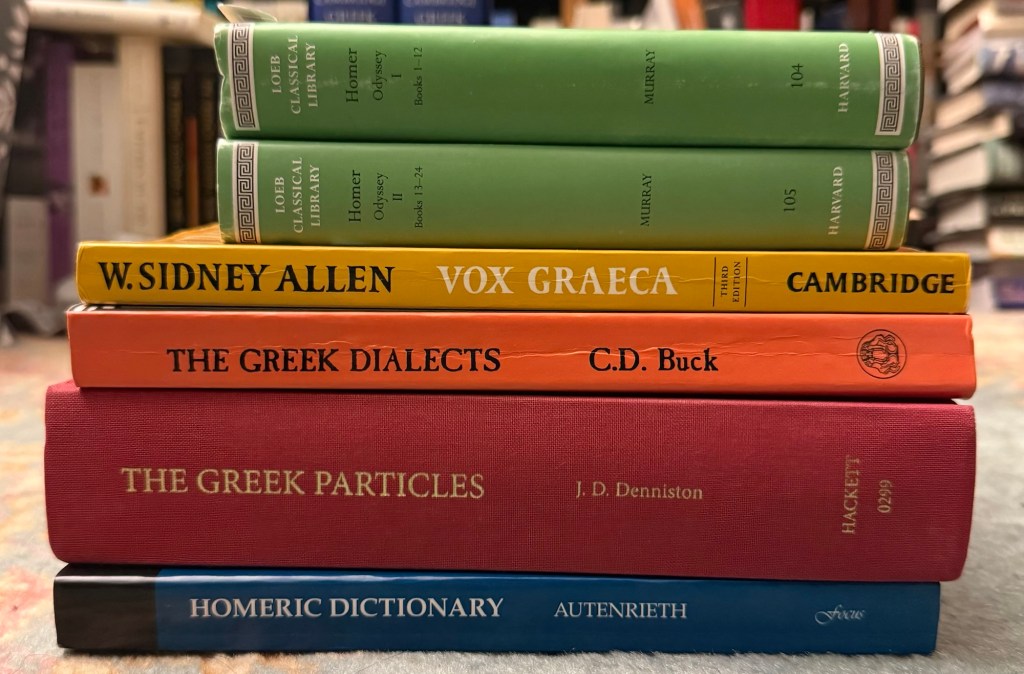
    Some of my collection.

    This post collects the top resources I rely on when reading Homeric Greek, especially the Iliad and Odyssey. While much of the grammar overlaps with Classical Greek, Homeric Greek has distinct forms, vocabulary, and meter that call for specialized tools. The following resources—ranging from primers to advanced philological references—are what I return to again and again when working with epic.

    To Get Started

    Pharr – Homeric Greek: A Book for Beginners
    An older but remarkably focused introduction built around Iliad 1. Includes grammar notes specific to Homeric forms, extensive vocabulary, and progressively annotated readings.
    Read online

    Benner – Selections from Homer’s Iliad
    An excellent annotated reader of Iliad Books I–VI, with extensive grammatical commentary keyed to each line. Ideal for intermediate readers.
    Read online

    Cunliffe – A Lexicon of the Homeric Dialect
    Still the standard Homeric dictionary. Organized by root and form, with citations from epic texts and brief semantic notes.
    Read online

    Digital Tools

    Logeion
    Cunliffe’s Homeric Lexicon is fully searchable on Logeion alongside LSJ. You can easily compare definitions across lexica and check frequency data within the epics.
    Access online

    Perseus Word Study Tool
    Input any inflected form and receive morphological analysis with links to lexicon entries and usage examples across a wide corpus of Greek texts.
    Access online

    Top 500 Homeric Words Deck
    Compiled by Chicago, these are the most common vocabulary items in Homer’s epics, and knowing them makes for an efficient path to smooth reading.
    Access online

    Greek Particles Deck
    Compiled by a Quizlet user, this deck contains over 80 of the most common and important Greek particles to know.
    Access online

    Perseus Digital Library
    Includes the full texts of the Iliad and Odyssey with parsing tools, English translations, and links to grammatical and lexical resources.
    Access online

    Chicago Homer
    Tailored specifically for Homeric epic. Offers side-by-side Greek and English translations, word-by-word morphological data, and metrical annotation.
    Access online

    Advanced Topics

    Monro – A Grammar of the Homeric Dialect
    A classic reference that systematically treats the phonology, morphology, and syntax of Homeric Greek. A bit dense, but indispensable for serious linguistic inquiry.
    Read online

    Buck – The Greek Dialects: Grammar and Selected Readings
    A valuable reference for understanding the dialectal features present in Homeric Greek, which blends primarily Ionic forms with traces of Aeolic. While not focused solely on Homer, this book helps clarify unusual forms and offers broader context for the epic language tradition.
    Read online

    William S. Annis – An Introduction to Greek Meter
    Offers a clear and concise explanation of dactylic hexameter with scansion exercises and helpful mnemonics.
    Read online

    Hexameter.co
    An interactive site that gamifies learning dactylic hexameter. Offers scansion tools for Homer (and 3 Latin authors too). Helpful for developing aural sensitivity and fluency in poetic rhythm.
    Access online

    Conclusion

    This toolkit focuses on materials that prioritize Homeric Greek as a distinct linguistic system—neither a dialect nor a transitional phase, but a carefully stylized literary register. Whether you’re reading your first lines of the Iliad or preparing to write on Homeric formulae or meter, these tools offer a dependable path forward.

    This list isn’t exhaustive, but it covers the resources I’ve found most useful in my own studies. Are there others you swear by for Homeric Greek? I’d love to hear what’s missing.

    View other toolkits.

  • Tools of the Trade, 3: Toolkit: Classical Greek

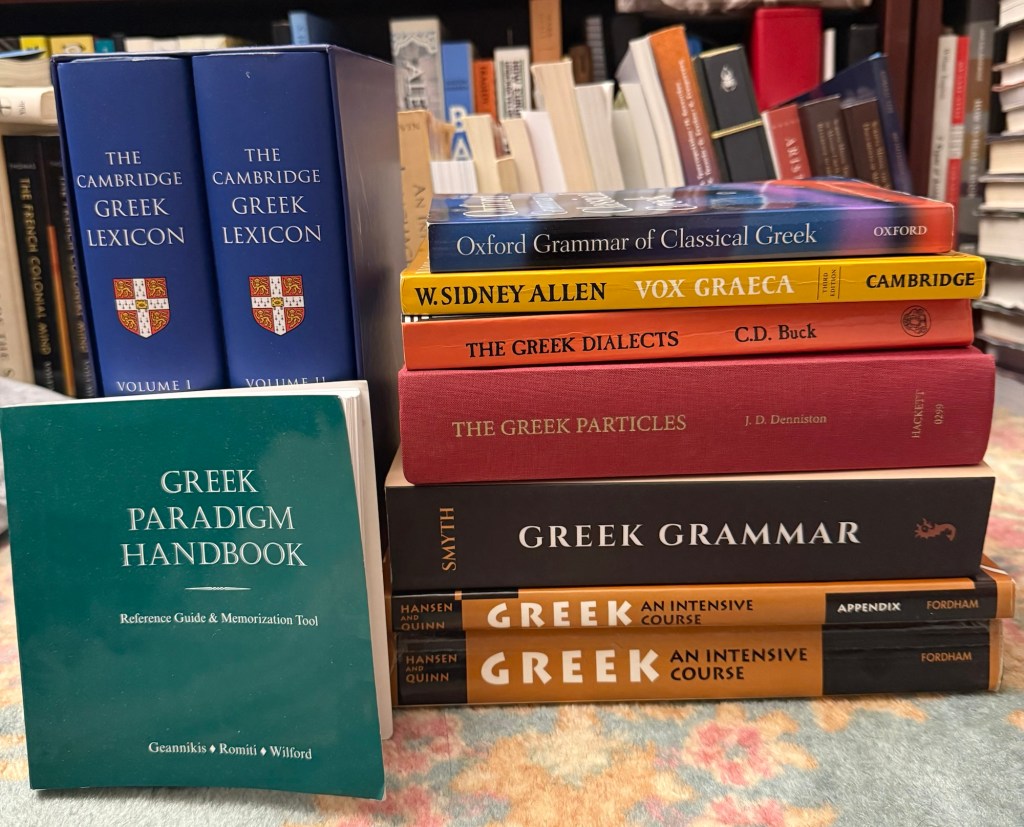
    A small portion of my collection.

    This post collects the top resources I rely on in my own study of Classical Greek. For each category—grammar, vocabulary, reading tools, and advanced study—I’ve selected the best materials available, with a focus on clarity, depth, and long-term usefulness. Whether you’re just beginning or looking to sharpen your command of dialects, meter, or style, this toolkit offers a reliable foundation. These are the books and tools I return to again and again when reading Classical Greek, especially texts in the Attic-Ionic dialect continuum.

    To Get Started

    Hansen & Quinn – Greek: An Intensive Course
    A demanding but highly structured introduction to Classical Greek, often used in college-level intensive courses. Includes graded readings, grammar explanations, and exercises.
    Read online
    H&Q Vocabulary Decks: Quizlet class

    Smyth – Greek Grammar
    A comprehensive and authoritative reference grammar, covering all aspects of Classical Greek morphology and syntax. Best used alongside reading or for targeted review.
    Read online

    Digital Tools

    Logeion
    A lexical lookup tool developed by the University of Chicago. It aggregates major dictionaries, including Liddell-Scott-Jones (LSJ), “Middle Liddell,” and Autenrieth. Entries include frequency data, sample passages, morphological breakdowns, and cross-references.
    Access online

    Perseus Word Study Tool
    Input any inflected form and receive morphological analysis with links to lexicon entries and usage examples across a wide corpus of Greek texts.
    Access online

    Greek Particles Deck
    Compiled by a Quizlet user, this deck contains over 80 of the most common and important Greek particles to know.
    Access online

    Perseus Digital Library
    A major online collection of Greek texts, including works by Homer, Herodotus, Plato, and others. Offers on-hover parsing, English translations, and links to dictionaries and grammar tools.
    Access online

    Advanced Topics

    W. Sidney Allen – Vox Graeca: The Pronunciation of Classical Greek
    A foundational work on ancient Greek phonology and historical pronunciation. Includes reconstructions of Attic phonetics and prosody, with attention to evidence from meter, spelling, and comparative linguistics.
    Read online

    Buck – The Greek Dialects: Grammar and Selected Readings
    A readable introduction to the major dialect groups of Ancient Greek, with grammatical summaries and annotated sample texts. Useful for epigraphy, lyric poetry, and comparative philology.
    Read online

    William S. Annis – An Introduction to Greek Meter
    A concise and accessible guide to reading Greek poetry metrically. Covers major meters with clear examples and scanning advice.
    Read online

    Denniston – The Greek Particles
    An advanced and nuanced treatment of Greek particles. Indispensable for close reading and stylistic analysis, especially in prose authors like Thucydides and Plato.
    Read online

    Conclusion

    This list isn’t exhaustive, but it covers the materials I’ve found most reliable and rewarding. Are there tools or texts you swear by that aren’t here? I’d love to hear what you think is missing.

    View other toolkits.

  • Tools of the Trade: Language Toolkits Incoming!

    The next portion of Tools of the Trade will focus on a series of “core toolkits” for a variety of languages. These will be linked here as they roll out over the next few days. The first five, in order, will be:

    1. Classical Greek,
    2. Homeric Greek,
    3. Mycenaean Greek,
    4. Classical Latin, and
    5. Akkadian.

    If any more are added, I’ll link them here as well. I’m planning on doing Phoenician and Middle Egyptian at some point, and maybe even posts on families, probably Semitic and Indo-European. After that, there will be two more posts on epigraphic tools, followed by a series of computational ones, and then probably some meta-tools (e.g., guides to digital organization, etc.). After that it’s anyone’s game, and I fully welcome suggestions. Feel free to email me here if there’s anything you’ve been wanting to get into but haven’t found good resources for.