This post collects the top resources I rely on in my own study of Classical Greek. For each category—grammar, vocabulary, reading tools, and advanced study—I’ve selected the best materials available, with a focus on clarity, depth, and long-term usefulness. Whether you’re just beginning or looking to sharpen your command of dialects, meter, or style, this toolkit offers a reliable foundation. These are the books and tools I return to again and again when reading Classical Greek, especially texts in the Attic-Ionic dialect continuum.
To Get Started
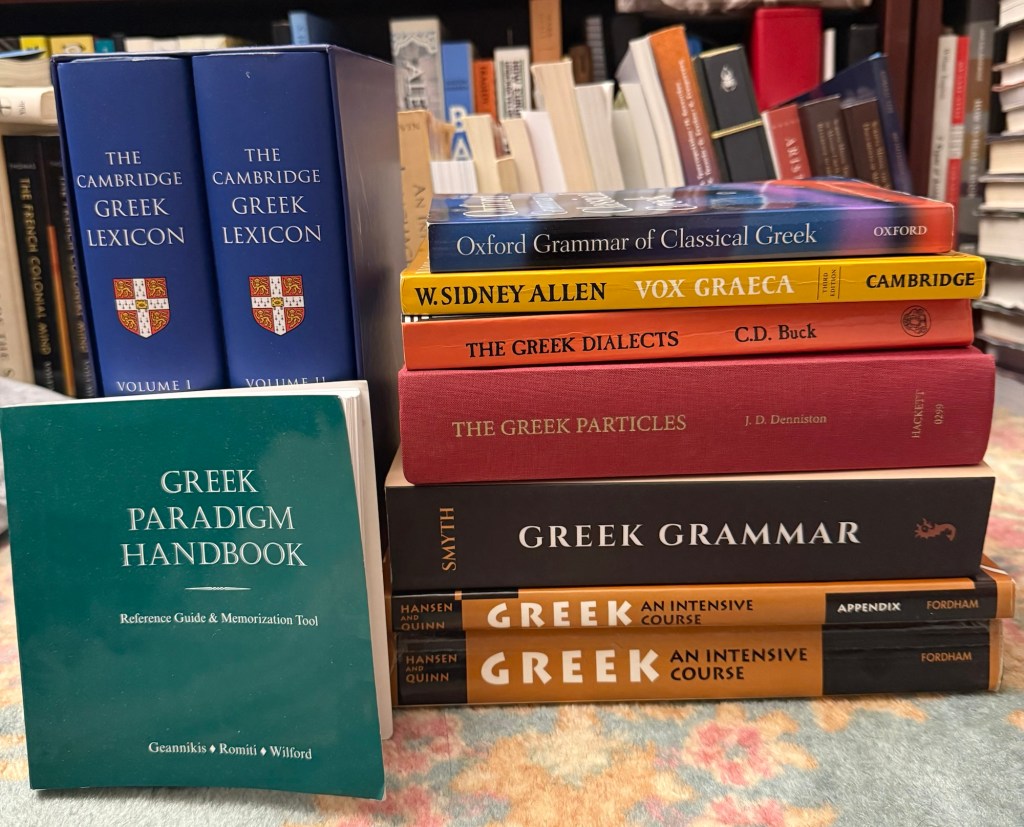
Hansen & Quinn – Greek: An Intensive Course A demanding but highly structured introduction to Classical Greek, often used in college-level intensive courses. Includes graded readings, grammar explanations, and exercises. Read online H&Q Vocabulary Decks: Quizlet class
Smyth – Greek Grammar A comprehensive and authoritative reference grammar, covering all aspects of Classical Greek morphology and syntax. Best used alongside reading or for targeted review. Read online
Digital Tools
Logeion A lexical lookup tool developed by the University of Chicago. It aggregates major dictionaries, including Liddell-Scott-Jones (LSJ), “Middle Liddell,” and Autenrieth. Entries include frequency data, sample passages, morphological breakdowns, and cross-references. Access online
Perseus Word Study Tool Input any inflected form and receive morphological analysis with links to lexicon entries and usage examples across a wide corpus of Greek texts. Access online
Greek Particles Deck Compiled by a Quizlet user, this deck contains over 80 of the most common and important Greek particles to know. Access online
Perseus Digital Library A major online collection of Greek texts, including works by Homer, Herodotus, Plato, and others. Offers on-hover parsing, English translations, and links to dictionaries and grammar tools. Access online
Advanced Topics
W. Sidney Allen – Vox Graeca: The Pronunciation of Classical Greek A foundational work on ancient Greek phonology and historical pronunciation. Includes reconstructions of Attic phonetics and prosody, with attention to evidence from meter, spelling, and comparative linguistics. Read online
Buck – The Greek Dialects: Grammar and Selected Readings A readable introduction to the major dialect groups of Ancient Greek, with grammatical summaries and annotated sample texts. Useful for epigraphy, lyric poetry, and comparative philology. Read online
William S. Annis – An Introduction to Greek Meter A concise and accessible guide to reading Greek poetry metrically. Covers major meters with clear examples and scanning advice. Read online
Denniston – The Greek Particles An advanced and nuanced treatment of Greek particles. Indispensable for close reading and stylistic analysis, especially in prose authors like Thucydides and Plato. Read online
Conclusion
This list isn’t exhaustive, but it covers the materials I’ve found most reliable and rewarding. Are there tools or texts you swear by that aren’t here? I’d love to hear what you think is missing.
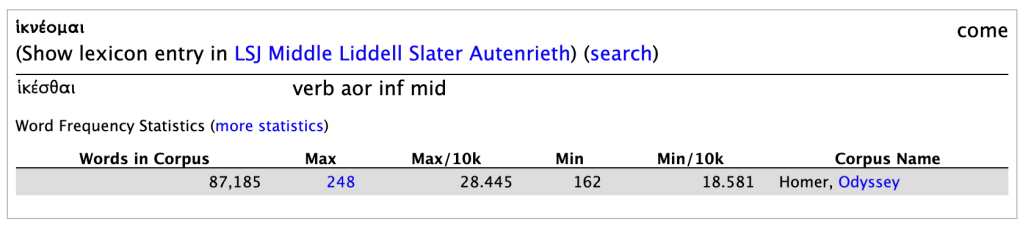
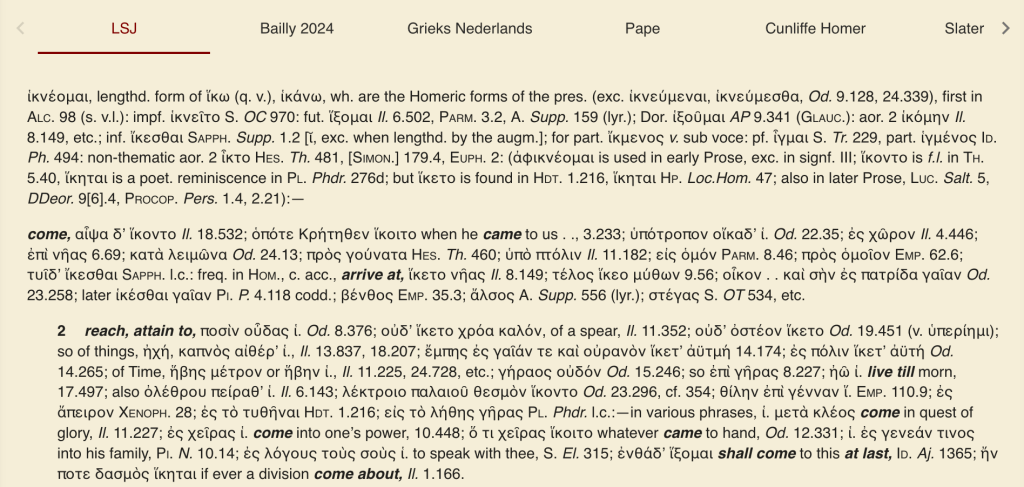
Perseus’s result for ἱκνέομαι: a quick parser, giving form and summary of corpus occurrences.Partial Logeion result for the same word: collates detailed results from nine separate dictionaries with a 10th tab for corpus occurrences.
For anyone studying Latin or Ancient Greek—whether casually, academically, or obsessively—two digital tools stand out as indispensable: Perseus and Logeion. I use both almost every day. While they serve overlapping purposes, each has its own strengths, and learning to navigate between them has made my reading smoother, faster, and more precise.
Perseus, formally known as the Perseus Digital Library, is one of the earliest and most ambitious digital humanities projects in the field of Classics. It provides access to a massive collection of Greek and Latin texts with built-in parsing tools, dictionary links, and (often outdated but still helpful) English translations. Its strength lies in contextual reading—hovering over any word in a text will generate a parsing suggestion and a link to its dictionary entry, which makes it incredibly useful when working through a new author or a grammatically complex passage. The Word Study Tool allows you to input any inflected form and get a list of possible morphological analyses and dictionary headwords, with links to example passages. However, it’s important to note that these parsings are generated by algorithms and are not always reliable, especially for ambiguous forms. The interface can also feel a bit dated, and not all texts are equally well formatted, but for quick reading and parsing, Perseus is great.
By contrast, Logeion is a sleek and powerful lexicon aggregator developed by the University of Chicago. Unlike Perseus, it doesn’t offer complete texts, but it excels at lexical depth. When you enter a word—either in Latin or Greek—Logeion pulls results from multiple dictionaries at once, including LSJ, Middle Liddell, Autenrieth, Lewis & Short, Elementary Lewis, Frieze-Dennison, and others. You also get frequency data, example passages, and, in some cases, idiomatic usages or English-to-Greek reverse entries. Logeion doesn’t parse for you, so you need to know or guess the dictionary form of the word. But once you do, the definitions it offers are more precise and informative than any single dictionary alone. I often use it to compare lexical nuance across genres or authors, and it’s especially helpful when I want to confirm the meaning of a word I already sort of “know.”
The way I use these two tools in tandem is pretty straightforward. When I’m reading through a text, especially something new or poetic, I usually begin in Perseus. I use the on-hover parsing and the Word Study Tool to get oriented, especially with verbs and particles. Once I have the base form, I switch over to Logeion to dig deeper into meaning, idiom, or usage across contexts. Logeion becomes especially helpful when I’m writing, translating, or thinking more syntactically. In many ways, Perseus is like a field guide with helpful margin notes, while Logeion is the serious reference work you turn to when you want to be exact.
If you’re just starting out, don’t feel pressured to master everything at once. But learning to toggle between Perseus and Logeion will give you a huge advantage—especially if you’re not always reading with a print dictionary on hand or don’t have institutional resources. I’ve used these tools for years—they’ve remained central across every stage of my study. They’re fast, free, and surprisingly deep once you know where to look.
If you’ve found tricks for using them more efficiently, or if you have a favorite feature I didn’t mention, let me know what’s missing.
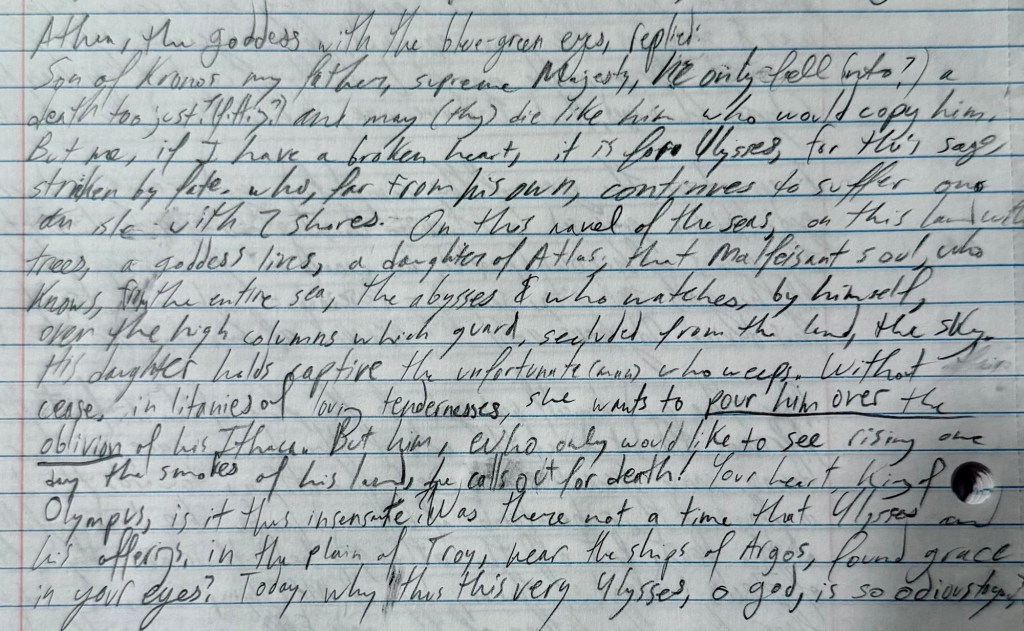
A passage, translated from Bérard, that I found particularly moving. In it, Athena pleads to Zeus, asking that he find mercy in his hardened heart for Odysseus.
Reading for friction, not fluency
In the first week of Tritropic, I found myself reading the same passage in French and Greek on the same day. It seemed like a good idea: reinforce the meaning, triangulate expression, hold the line up to two kinds of light. Instead, once I’d puzzled out the syntax and meaning in one language, the second version became trivial. All the work had already been done, particularly because Bérard’s French hews so closely to the original—here a gift and a curse, since the shape of the sentence had already been laid bare.
What should have been a second act of discovery turned into a performance of memory. And that, for me, is a dead end.
So I’m revising my approach for the next month to see if a new structure works. I now read a Book of the Odyssey in French across a week, then return to the same section in Greek for the next two or three weeks. This reintroduces mystery—just enough forgetting to force me to re-earn my understanding. Each version remains itself so I can’t lean on one to carry the other. However, there’s just enough closeness, I think, for comparison of translation choices. Theory of translation is something I quite want to pursue through this—it’d be a shame to lose that aspect.
Scaffolds and Syntax
In these early days, I’ve learned to be wary of digital tools—pop-up glosses, online parsers, translation extensions. There’s a difference between using scholarly supports and just outsourcing thought. Too often, I found myself parsing without learning. Clicking my way through a passage gave me the answer but not the understanding.
To counter that, I’ve built what I call a “Reading Ladder” for the French. It begins with a cold read—no tools, no support, just me and the text, making guesses about syntax and structure. Next, I pass through a deeper parsing stage, using only a grammar and a basic dictionary to confirm key unknowns, not every minor term. Only after this do I allow myself to consult a translation or ask my fluent friends, not as a crutch but as a corrective.
I plan two final stages once I get my bearings more. These are expressive exercises: retelling the passage in my own French, rereading it aloud for rhythm, and briefly stepping outside the text to engage with something stylistically adjacent—a short piece by Gide, a 19th-century abstract on epic poetics, anything that stretches my sense of what French can do.
Throughout this process, I plan on keeping a syntax journal. Each week, I record one sentence I understood without help, one that tripped me up (with notes on why), and one that delighted me. The journal is to be a miniature Grammaire Bérardienne. It also is meant as a reminder that joy is a form of comprehension.
Greek and Joyful Tedium
Greek, with its distance from both English and the Attic I’m familiar with, is a harder beast—and all the more rewarding because of it. I’ve adopted a multi-pass system here as well. The first time through, I read aloud without stopping. No dictionary, no notes, just the text and the shape of the sentence as much as I can discern it. I underline words I don’t know, try to guess at their meaning from morphology, meter, or context. Only after that do I allow myself to return and parse each word carefully. By then, I’ve already begun to intuit some of the patterns, and the parsing feels earned rather than imposed.
Twice a week, I do blind parsing drills. I take a short passage, cover any translation, and write out the morphological analysis of each verb and noun—tense, mood, case, number, person, source verb or noun. Then I translate from scratch. It’s humbling, but it builds exactly the muscles I’m trying to train.
Every month, I’m going to try to reread an entire Book in Greek with no aids. It’s the closest this kind of study gets to strength training. My professors have told me one of the best things you can do for your Greek (and language skills generally) is to reread, since you’re no longer in just decode-mode. This very much helped me last semester in my Lucian class. The sense of fluency that emerges—halting, but unmistakable—is worth every hour.
I also keep a personal lexicon, noting each unfamiliar form, particle usage, or idiom that gives me pause. And every few weeks, I’ll try my hand at short Homeric compositions—just five or six lines using words and constructions I’ve encountered. In the meantime, I’m studying from two Quizlets: one of the 500 most common Homeric vocabulary items, and one with 70+ important ‘small words.’
What the Text Offers
What I hadn’t fully expected was just how well-suited the Odyssey is for this kind of iterative, interleaved learning. Its repetitions are pedagogical for me. Vocabulary recurs with slight variations, idioms reappear in altered contexts, and the syntax is often rhythmic enough to imprint itself on the brain. Bérard understands this, and he mirrors Homer’s scaffolding with care. His French extends Homer’s use of anaphora, his vocabulary choices build on one another, and his ceremonial tone reinforces structure as it elevates the prose.
In both languages, challenge ramps up at a manageable pace. I’m only a few pages in, but already I can sense the increasing complexity—more embedded clauses, trickier participial constructions, and richer metaphor. But nothing feels unearned. The text supports you even as it stretches you.
Perseverance, Not Performance
There’s a line at the beginning—one I have reached in both languages—that keeps echoing in my head: ὃς μάλα πολλὰ πλάγχθη. It’s often rendered loosely as “he who was greatly tossed about,” but the Greek is more literal than that, and stranger: he who was driven off far or much. It conjures not just aimless wandering, but compelled displacement—someone pushed off course by forces beyond his control.
Bérard translates it as celui qui tant erra—“the one who wandered so much.” Murray’s version is starker: “the man who was driven far astray.” Murray evokes motion without agency, but Bérard is softer, more open to interpretation on whether this wandering was chosen or forced. Yet they both understand that πλάγχθη is not just travel, but deviation.
The line isn’t just about Odysseus, however. It describes what it means to read a difficult language honestly. You’re driven, sometimes astray, but still in motion.
Difficulty, for me, is no longer something to overcome. I recognize it now as an essential condition for progress. Every time I misparse a participle or mistake a clause boundary, I get a little closer to understanding—not just the sentence, but the langauge system that generated it. That’s the rhythm of the tritropic line: wandering with purpose.
2023: Tablet replica I made from a drawing in Huehnergard’s grammar.
I first took Akkadian a few years ago. Since then, the language has been sitting in a kind of suspended animation: just far enough away to feel unreachable, just close enough to make me feel guilty.
This post kicks off Tablets and Tribulations, a new series chronicling my return to Akkadian. I’ll be using it to track my progress, share insights, and reflect on what it means to study something this complex, this demanding, and this strange.
Why Akkadian?
Akkadian sits at the intersection of my academic obsessions: Semitic linguistics, the history of writing systems, and the psycholinguistics of script. It’s a dead language, but not a fossilized one. The more you read it, the more it pulses: with bureaucracy, with poetry, with prayer. And the writing system—a sprawling, phonetically polyvalent syllabary riddled with ideograms—is completely unlike the tight alphabets I’m used to. It demands patience, pattern-recognition, and grit.
There’s also no shortage of material, with estimates of the number of excavated Akkadian texts reaching as high two million—meaning it quite possibly has the most documents of any ancient language; in fact, according to my professor Ronald Wallenfels, more documents than all ancient languages combined. Put that in your pipe and smoke it.
I’m also drawn to it because I’m not naturally good at it. Greek and Latin came to me more intuitively, their logics familiar in a way I hadn’t expected. Akkadian doesn’t let me do that. It forces me to slow down, to wrestle with my perfectionism, to train my brain in new ways. And I love that. I want to get good at something hard. I want to overcome the mental blocks that have held me back before.
What’s Changed
Since that early study, I’ve broadened my exposure to Semitic linguistics and become more confident working with both the script and the medium. I’ve also made peace with how humbling this language is. Once, I even told a syntax class—confidently—that Akkadian had no demonstratives, only to moments later fact-check myself and discover that it had three distinct tiers of them. I then had to publicly correct myself and told them to pray for me… as I had a quiz on Akkadian pronominals the next period.
I’m now studying with two grammars, Huehnergard and Caplice, using Labat’s sign list as my main reference. I’m also switching from just drawing signs to pressing them into clay, and my wax tablets—less sketchbook, more scribal. I’ll be posting more about that process (and my tablet replicas) soon.
What to Expect from This Series
Tablets and Tribulations will be part language log, part material exploration, and part meditation on what it means to study a language with no living speakers and a script that defies modern intuition. Future posts will likely include:
Syntax deep dives (word order, case, verb chains, etc.)
Close readings of texts (legal, literary, magical, bureaucratic)
Reflections on learning signs and navigating polyvalence
Notes on scribal training and cuneiform technique
My own experimental archaeology: pressing and firing tablets
Anecdotes from the museum and the classroom
Psycholinguistic musings on how syllabaries shape cognition
Occasional moments of crisis and triumph
This is going to be hard. But I want that. I want to stretch, stumble, and get back up. That balance—rigor with joy—is what I’m working toward. Each week with Akkadian reminds me how study disciplines the self—not just the mind.

 To Wake the Dead