Akkadian is a Semitic language written in the cuneiform script, with texts ranging from royal inscriptions and law codes to letters, contracts, and epics like Gilgamesh. This toolkit gathers the core resources I use to study the language, from mastering the sign list to parsing verbal forms. Whether you’re preparing for graduate study, brushing up for a seminar, or just drawn to the richness of Mesopotamian literature, these are the tools that ground my work with Akkadian.
A quick note: some of these are in German and French, and of course not everyone reads those. However, Google Translate handles them very well if you upload a screenshot of a paragraph, and as my modern languages are not the strongest yet, I’ve found it invaluable. Use this link to access.
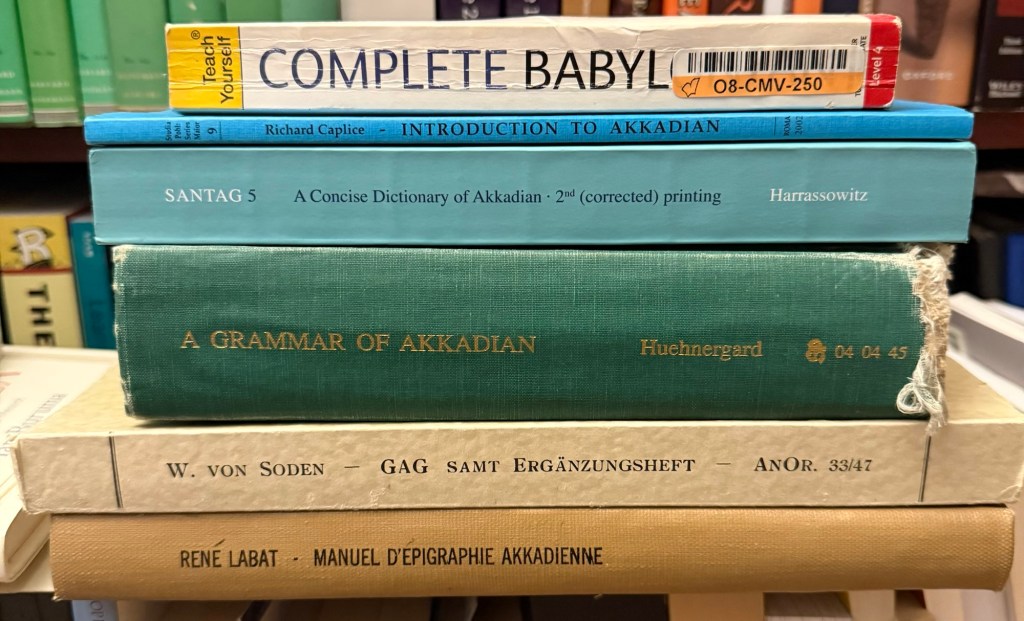
Huehnergard – A Grammar of Akkadian The most widely used modern introduction to Akkadian, especially for Old Babylonian. Combines clear grammatical explanations with exercises, paradigms, and a reading sequence. Thorough and approachable. Read online
Caplice – Introduction to Akkadian More compact and reference-oriented than Huehnergard, with streamlined grammar sections and bilingual text readings. Works well as a complement or for review. Read online
Labat – Manuel d’épigraphie akkadienne: Signes cunéiformes, syllabaires, idéogrammes The definitive sign list for Akkadian cuneiform. Includes syllabic values, logograms, variant shapes, and transcription equivalents. Indispensable when reading from tablets or facsimiles. Read online
Digital Tools
ePSD2 (The Electronic Pennsylvania Sumerian Dictionary) Although primarily for Sumerian, ePSD2 is invaluable for logogram glosses and cross-referencing Akkadian readings of signs. Frequently cited in scholarly work. Access online
ORACC (Open Richly Annotated Cuneiform Corpus) A massive and expanding corpus of annotated Akkadian texts in transliteration and translation, with tools for exploring morphology, genre, and metadata. Excellent for seeing how grammar functions in real texts. Access online
Wiktionary There is no single definitive online Akkadian dictionary, but entries on Wiktionary can help with basic word lookup in transliteration. Access online
Advanced Topics
Von Soden – Grundriss der Akkadischen Grammatik The classic grammar of Akkadian, written in German. Highly detailed, especially in verbal system analysis and historical variants. Read online
Goetze / Landsberger – Text Editions Once you’ve completed initial grammar work, reading annotated text editions from scholars like Goetze or Landsberger will help solidify your grasp of style, genre, and dialect variation.
Conclusion
This toolkit focuses on Old Babylonian and Standard Babylonian as the primary dialects, but the resources here will give you enough flexibility to branch into Assyrian, Middle Babylonian, and other variants. Akkadian is a richly inflected language with a complex writing system, and the path to fluency is best grounded in patient sign recognition, morphological fluency, and careful reading.
These are the resources I’ve found most helpful in learning and returning to Akkadian. If you know of other tools or have advice from the field, I’d love to hear what’s missing.
Mycenaean Greek is the earliest recorded form of the Greek language, written in the Linear B syllabary and preserved primarily in administrative documents from palatial centers like Knossos and Pylos. This toolkit collects the core resources I use for studying the language, writing system, and historical context of Mycenaean. While it’s not a language most people “read” in the same way as Homeric or Classical Greek, it’s foundational for understanding the development of the Greek language and the Aegean Bronze Age.
To Get Started
Hooker – Linear B: An Introduction A concise and accessible introduction to the Linear B writing system, Mycenaean phonology, and key vocabulary. Useful for getting oriented before diving into transcriptions or corpora. Read online
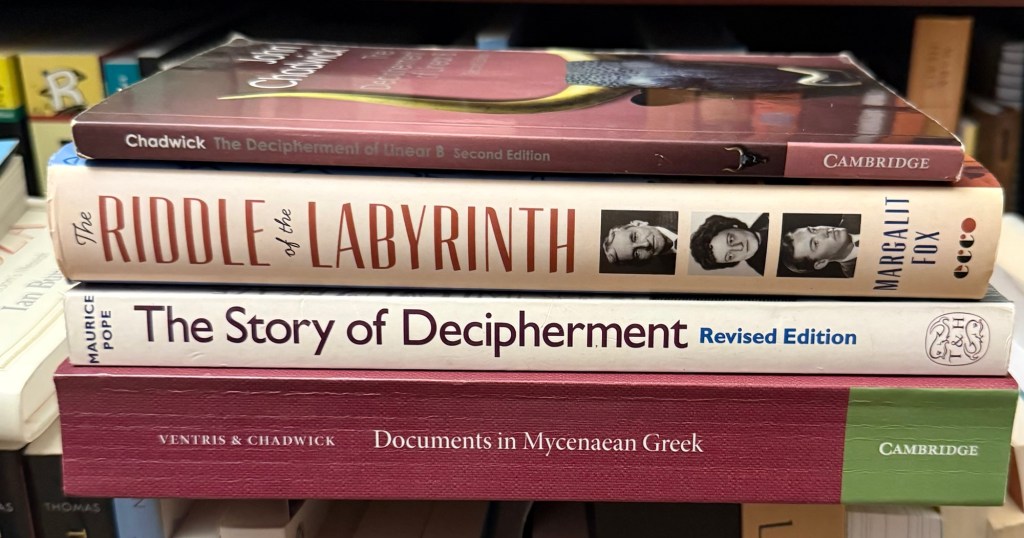
Chadwick – The Decipherment of Linear B An essential historical account of how Linear B was deciphered, written by one of its key figures. While dated in some linguistic details, it’s an engaging entry point into the script and its rediscovery. Read online
Digital Tools
Palaeolexicon: Mycenaean Greek Word List A searchable online lexicon of Mycenaean Greek, based on attested forms and reconstructions. Includes syllabic spellings and interpretations. Useful for quick lookups when reading inscriptions. Access online
LiBER (Linear B Electronic Resources) An extensive online resource that includes a searchable corpus, transcriptions, sign lists, and links to digitized tablets. Maintained by the University of Cambridge. Access online
Advanced Topics
Ventris & Chadwick – Documents in Mycenaean Greek The foundational reference edition of Linear B tablets, with transcriptions, translations, and commentary. Volume I covers the grammar and lexicon; Volume II includes full texts. Read online
Duhoux & Morpurgo Davies (eds.) – A Companion to Linear B: Mycenaean Greek Texts and Their World A more recent scholarly collection covering writing practices, administrative function, linguistics, and interpretive issues. Indispensable for research-level study. Read online [Volume 1, Volume 2, Volume 3]
Aura Jorro – Diccionario Micénico A comprehensive lexicon of Mycenaean Greek, keyed to Linear B spellings. In Spanish but used internationally by specialists. Read online [Volume 1, Volume 2]
Conclusion
Mycenaean Greek is not a reading language in the traditional sense, but it offers unparalleled access to the earliest phase of Greek—its phonology, morphology, and vocabulary in situ. For linguists, epigraphers, and anyone curious about the Bronze Age Aegean, these tools provide a clear entry into the world of palace records and early writing.
This list includes the materials I’ve found most dependable in my own work. If you’ve found other resources—especially for working with the tablets themselves—I’d love to hear what’s missing.
Process for entering the metadata of a given inscription in the GUI I’m designing.
Before APEX can tell us anything about the shapes of letters, we have to tell it what those letters are—where they came from, when, how confidently we know that, and why we think so. Each traced form in the database is embedded in metadata, and each metadata field is a choice. Or, more accurately, a battleground between competing demands: standardization vs. specificity, precision vs. honesty, completeness vs. clarity.
This post is about how those choices get made.
Metadata is Never Neutral
In paleographic projects, metadata is often treated as scaffolding: a tidy column of site names, dates, scripts, and references that supports the real work of analysis. But metadata is also where the most important theoretical decisions live. Is this letter from “Attica” or from “Athens”? Is it dated to “c. 750 BCE,” to “the mid-8th century,” or to “LG I”? Is the script “Euboean” or “Eubo-Cypriot” or just “Greek”? And what happens when those terms carry more ambiguity than certainty?
Each of these choices folds a story into the dataset. A story about geography, chronology, authority, and classification. And once the data is encoded, those stories begin to function as fixed facts—however uncertain or contingent they might actually be.
The Problem of Uncertainty
Uncertainty is endemic to early alphabetic evidence. Sites are excavated unevenly. Inscriptions are fragmentary. Provenance can be speculative. Paleographic dating relies on a mix of typological comparison and stratigraphy, both of which are prone to revision.
But digital systems, including APEX, are uncomfortable with uncertainty. The data model wants a number, not a range; a site name, not a narrative; a script label, not a conditional. This means encoding decisions often involve collapsing complexity into legibility. The trick is to do this transparently, and to leave enough of a trail that the uncertainties can still be seen.
To that end, I’m building out APEX metadata with fields for:
Script classification (source + variant): to distinguish between modern typologies and how scripts were likely conceived by ancient users
Notes: a catch-all for uncertainty flags, alternate readings, or disputed attributions
This structure still imposes a frame, but it tries to make the cracks visible.
Metadata as Narrative
Every field in APEX is a decision, and every decision reflects a point of view—whether archaeological, linguistic, technological, or historiographic. That makes the metadata not just a scaffold but a narrative: a set of assumptions about what kind of thing the alphabet is, how it moves through space and time, and how we can know what we know. As the project scales, that narrative will shape what kinds of conclusions are possible. So I want to make it visible now, while it’s still under construction, as part of the work.
In the next update, I’ll cover the baseline nature of the pipeline and what makes it so difficult—but also so precise.
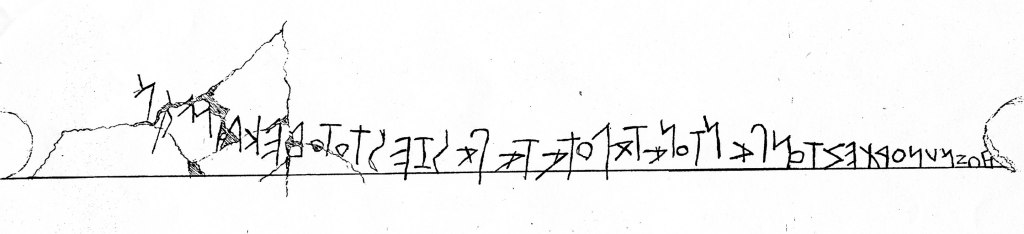
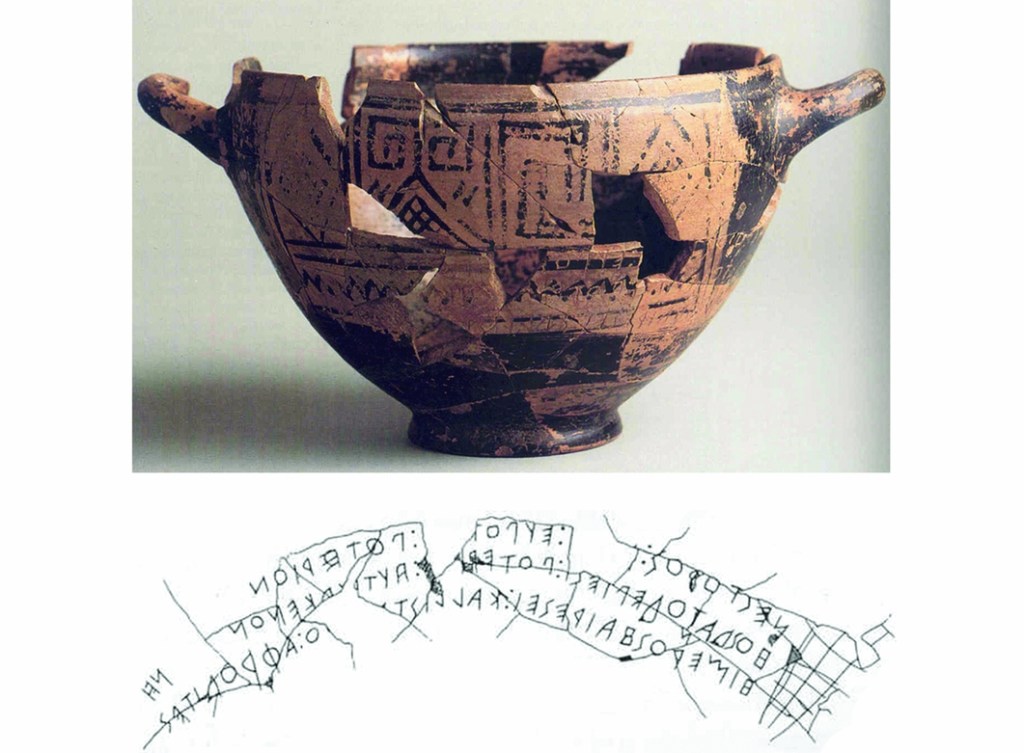
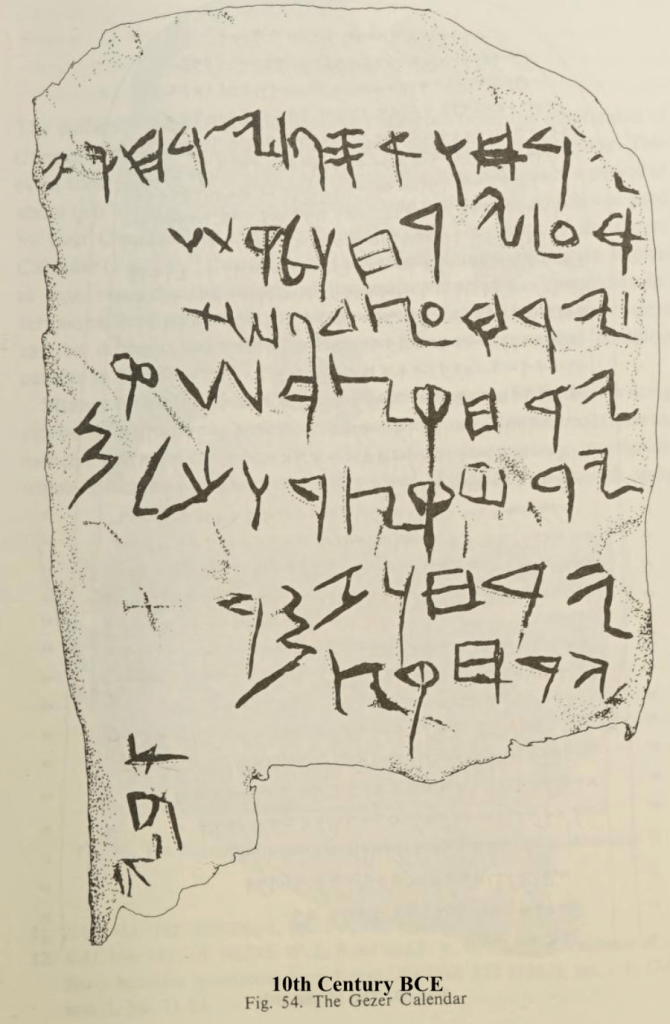
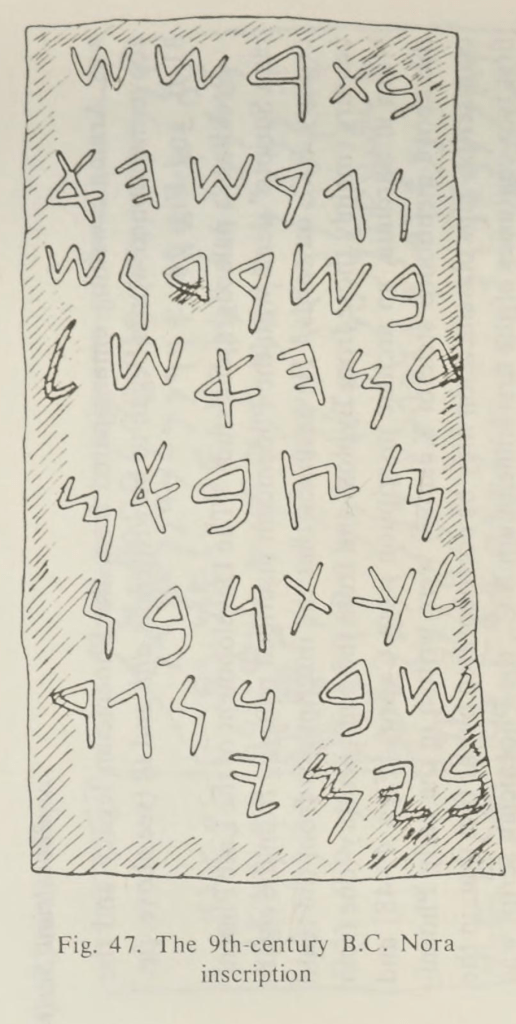
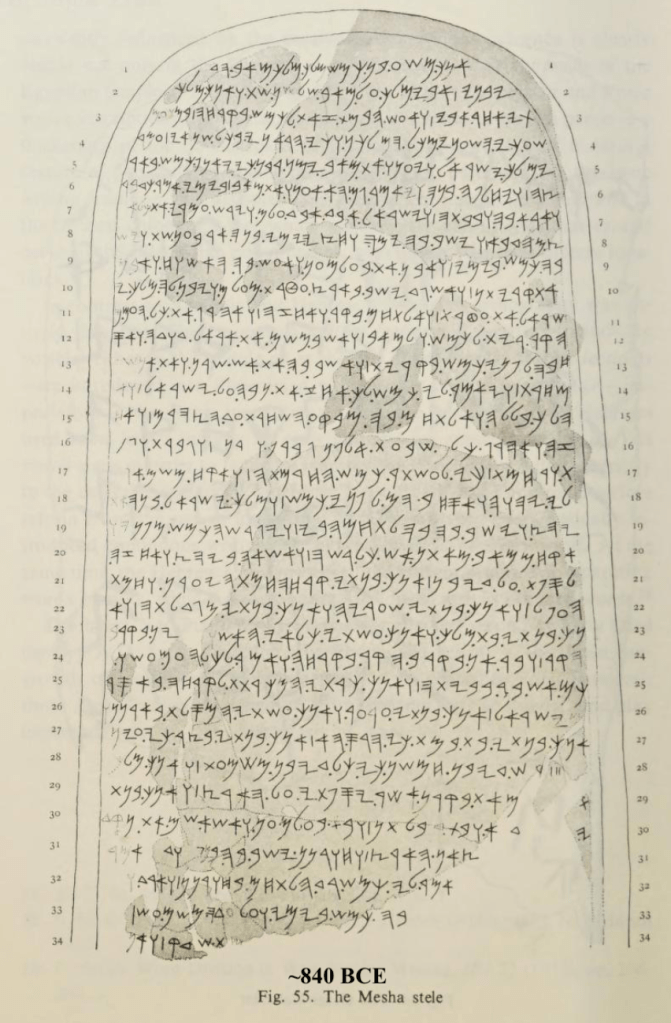
Nestor’s Cup (Pithekoussai, modern Sicily) & Dipylon Inscription (Athens), both dated just after 750 BCE.Three famous Phoenician inscriptions, of various dates, to compare letterforms to the above.
If the first APEX post was about tracing letters, this one is about why those traces matter. Underneath every variant alpha or eccentric epsilon is a deeper question: when, how, and under what conditions did the Greek alphabet emerge from its West Semitic predecessor? This question, which is known in the scholarship as the transmission problem, lies at the core of alphabetic studies, and despite over a century of scholarship, it remains fiercely contested. To map alphabetic transmission is not just to track graphical similarity, but to reckon with how cultures borrow, adapt, forget, and reimagine the systems by which they make language visible.
At its simplest, the transmission problem asks: When did the Greeks adopt the Phoenician script? But the real terrain is messier. Did the transfer happen once or multiple times? Was it sudden or gradual? Coordinated or ad hoc? Which region of the Greek-speaking world was first? Exactly which Semitic script was the donor—or was there a confluence of models? And what kind of evidence—linguistic, paleographic, archaeological—should we privilege when our sources conflict?
Historically, the debate has followed disciplinary lines. Scholars trained in Semitic philology and Near Eastern studies tend to favor a high date for the transmission: sometime in the 11th or 10th century BCE, before the traditional Greek Geometric period (in older scholarship, referred to as the “Greek Dark Age”). This camp emphasizes the strong formal similarities between early Greek and Phoenician letterforms, arguing that Greek epichoric scripts most closely resemble Phoenician forms from around 1050 BCE, not the later shapes one would expect if transmission occurred in the 8th century. Joseph Naveh, for instance, in his landmark Early History of the Alphabet (1982), argued that the Greek system must have branched off before major innovations appear in the Phoenician script, such as the angular mem or evolved forms of shin. Naveh saw the Greek alphabet as a snapshot of an earlier Semitic system—evidence, in his view, of early contact and early borrowing.
On the other side of the debate, Classicists and archaeologists tend to argue for a low date, favoring the 8th century BCE. Their reasoning draws primarily from stratified archaeological contexts: the earliest securely datable Greek inscriptions—such as the Dipylon oinochoe and the Nestor’s Cup from Pithekoussai—belong to the mid-to-late 8th century. Rhys Carpenter was among the earliest and most forceful voices in this camp. In a 1933 article, he wrote that “the argumentum a silentio grows every year more formidable and more conclusive,” referring to the continued absence of any Greek alphabetic inscriptions predating the eighth century (“The Antiquity of the Greek Alphabet,” AJA 37 [1933]: 8–29, at p. 27). For Carpenter, the lack of material evidence was not a gap to be explained away, but itself a powerful datum: if earlier use had existed, we would likely have found traces by now.
This school is generally skeptical of typological comparison, pointing out that letterforms evolve unevenly and can be conservative in certain contexts. Archaeological absence, while never conclusive, is taken seriously—especially when paired with the sudden, near-simultaneous appearance of inscriptions across disparate sites in the 8th century, suggesting a relatively rapid uptake of a recently acquired script. Later scholars, such as Barry B. Powell, built on this foundation. In Homer and the Origin of the Greek Alphabet (1991), Powell controversially argued that the Greek alphabet was deliberately invented for the purpose of recording Homeric verse, dating the invention to around 750 BCE. Though widely criticized for its teleology and lack of evidence for such a top-down design, Powell’s theory exemplifies the kind of interdisciplinary crossfire that defines this problem: where linguistic function, archaeological data, and cultural ideology all collide.
Roger D. Woodard, in Greek Writing from Knossos to Homer (1997), pushed back against Powell while still supporting a relatively late date. Woodard views the alphabet’s adaptation as a process shaped not only by contact with Phoenician traders but also by internal Greek developments—especially the memory of Linear B and broader shifts in literacy practices. He emphasizes the complex interplay between tradition and innovation, seeing the Greek vowel system as a structural solution that could only emerge in a linguistic environment receptive to phonological precision.
The question remains open, but APEX offers a different kind of approach. Rather than anchoring the debate to a single origin point, I focus on regional trajectories and graphical evidence: how letterforms vary, travel, and settle. If the Semitic party line reads the Greek alphabet as a photograph of Phoenician forms from 1000 BCE, and the archaeological model sees it as an emergent public tool of the 8th century, then I want to understand how specific graphemes move through space and time. Which forms remain stable across centuries? Which mutate rapidly? And what can that tell us about the process of transmission, rather than the moment of origin?
In fact, the most immediate goal of the APEX project is to evaluate whether the Greek letterforms do, in fact, most closely resemble the Semitic models from around 1000 BCE—as the high-date camp maintains—or if their nearest parallels lie elsewhere in the Phoenician typology. The intention is to move beyond qualitative comparisons and scholarly intuition, toward a quantitative, statistically grounded assessment of letterform similarity. By measuring and modeling these visual relationships systematically, APEX aims to provide a more objective foundation for dating the moment of greatest resemblance between the Greek and Phoenician scripts.
Rather than jumping straight into letterform similarity metrics, though, the next update will take a detour—one that’s no less crucial. Before the vectors can speak, they must be named, contextualized, and organized. APEX Updates, 3: Encoding Decisions will explore how I’m structuring the metadata that surrounds each traced letter: what counts as “context,” how information is tagged, and why every dataset is also a narrative. As it turns out, deciding how to describe a letter may be just as revealing as deciding how to compare it.
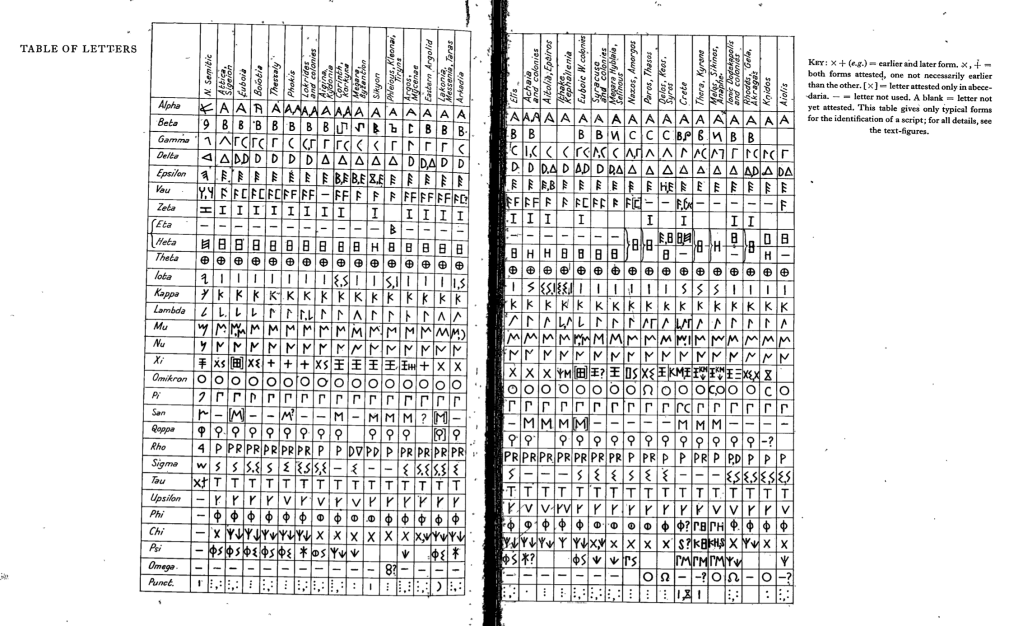
Jeffery’s summary table of all epichoric scripts at the end of LSAG. It is foundational for any work on early regional Greek scripts.
There are very few books I consider truly irreplaceable in my research. Lilian H. Jeffery’s The Local Scripts of Archaic Greece is one of them. First published in 1961 and revised in 1990 with A.W. Johnston, this book remains the reference for regional variations in the Greek alphabet during the archaic period. It’s where I first learned to read epichoric inscriptions with the eye of a paleographer rather than a Classicist alone.
The book is very hard to find, and I only got my copy at an even remotely affordable price after months of scouring secondhand sellers. While copies still circulate among libraries and the used book market, I wanted to make it more accessible to others working in this area. So I hunted diligently before finding it on the Internet Archive. You can read or download it here: The Local Scripts of Archaic Greece (1990 ed.) – Internet Archive
Jeffery’s study remains foundational for any work on early Greek writing—not just in Athens or Ionia, but across the full spectrum of regional scripts: Corinthian, Euboian, Attic-Boeotian, Cretan, Cycladic, and others. It includes extensive commentary, maps, and an invaluable inscriptional catalogue organized by region, with drawings and typographic transcriptions. The 1990 revision added important corrections, expanded references, and additional illustrative material. For those of us studying alphabetic transmission, especially the Phoenician-Greek interface or the evolution of letterforms over time, this book is indispensable.
What makes Local Scripts especially useful is that it bridges the gap between paleography, archaeology, and linguistics. Jeffery doesn’t just chart when and where a particular variant of alpha or epsilon shows up—she explains what those variations might imply for chronology, influence, and contact. And although her typology has been revised and challenged in places (especially with the discovery of new inscriptions), her system remains a critical baseline for almost every study that’s come after.
Whether you’re interested in early Greek literacy, the transmission of the alphabet, the sociopolitical meaning of epigraphy, or just want to be able to tell the difference between Laconian and Euboian chi, this is the book to start with. I hope having it freely available will be helpful to others navigating this fragmentary and fascinating material.
Do you have other resources you pair with Jeffery? I’d love to hear what we can supplement LSAG with.


 To Wake the Dead