There’s no single unifying theme to this list—but there is a feeling. I’m reaching, at once, toward the origins of writing and the frontiers of language technology. It’s structure that’s defining me at the moment: how systems encode meaning, whether that’s Greek orthography or neural networks. And in between, I let myself breathe with fiction—stories that play with form, time, and voice themselves.
Recently Finished:
- Epigraphic Evidence
A technical addition to my current work on inscriptions. Like black coffee: not always easy to imbibe, but quite efficient. - Data Science (MIT Press Essential Knowledge series)
A clean introduction—refreshing for thinking about data both ancient and modern. - Ripley’s Game (Patricia Highsmith)
Cold, elegant, amoral. Hilarious at points. A good palate cleanser between denser texts. - The Sequel (Jean Hanff Korelitz)
Read this mostly for plot, not language—but I love thinking about narrative structures and the great Second Novel Problem. - The English Understand Wool (Helen DeWitt)
Sharp, strange, and delightful. I love a novel about an out-of-touch eccentric navigating the world.
Currently Reading:
- Kairos (Jenny Erpenbeck)
A novel about political and personal time, and a very complicated affair. Thorny for sure. - Word by Word: The Secret Life of Dictionaries (Kory Stamper)
The theme of choice made at all stages of lexicography deeply resonates with me as I encode my own systemic information. Chapters like “Bitch” and “Posh” capture this especially well. - Writing and the Origins of Greek Literature (Barry B. Powell)
I keep coming back to this one in small sips. Chapters go down easy. - Greek Writing from Knossos to Homer (Roger D. Woodard)
Foundational for understanding the transmission of the Greek alphabet. Very well written and thoroughly researched. - Algorithms (MIT Press Essential Knowledge series)
A manageable way to reframe my thinking on rules and structure—not unlike real-life syntactical derivations. - Machine Learning (MIT Press Essential Knowledge series)
Challenging. Still finding where I fit in here. Hoping I can apply to my APEX project by Stage 3. - JSON for Beginners
Very practical for APEX, which is structured with JSON and makes heavy use of standoff annotation. This allows me to encode uncertainty and multiplicitous readings, lowering the amount of assumptions baked into the dataset. - Co-Intelligence: Living and Working with AI (Ethan Mollick)
For someone working on ancient inscriptional data, the future of coworking with AI is too relevant to ignore.
I wouldn’t call this a reading list so much as a reading state, a snapshot of what it feels like to be in the thick of things: academic work, blog writing, thesis planning, and whatever this slow journey toward modern spoken French is shaping up to be.
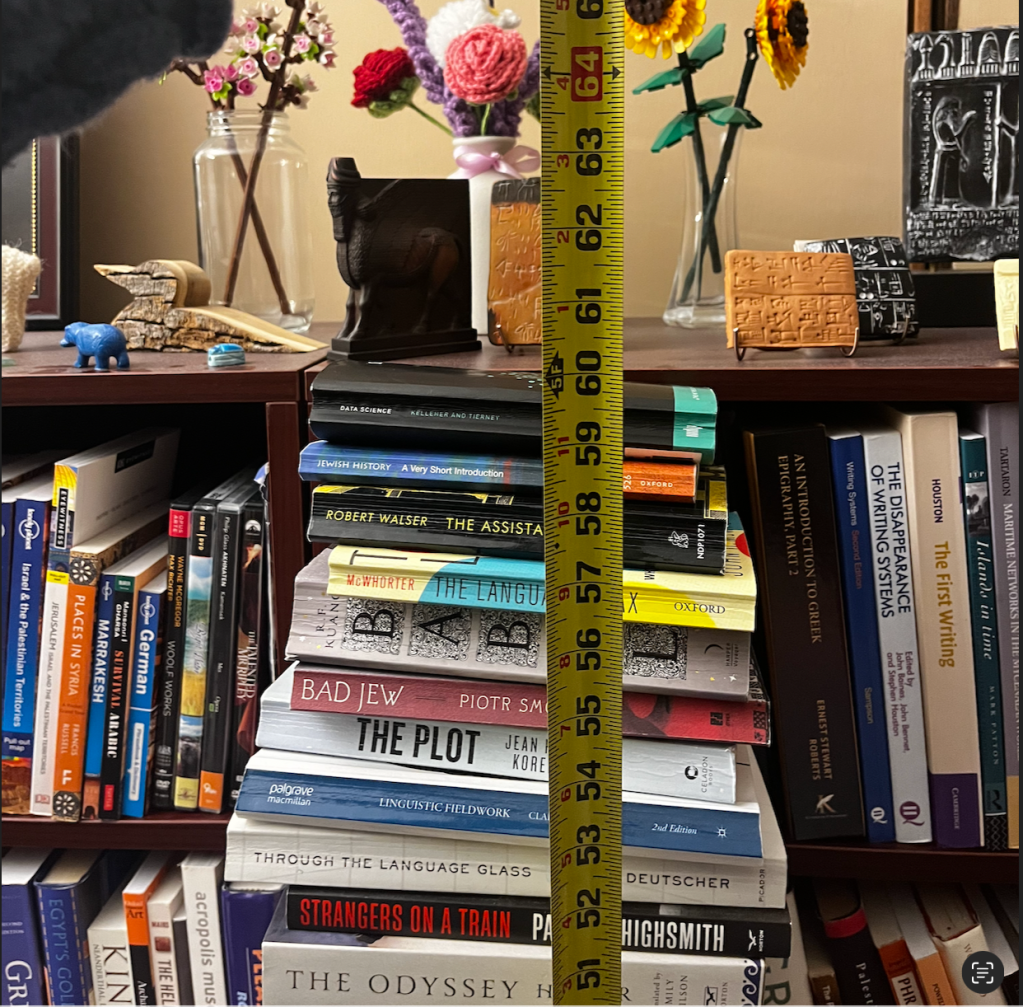
Picture: I’ve been stacking my recent reads as a kind of personal monument—hoping to match my own height before summer.
 To Wake the Dead