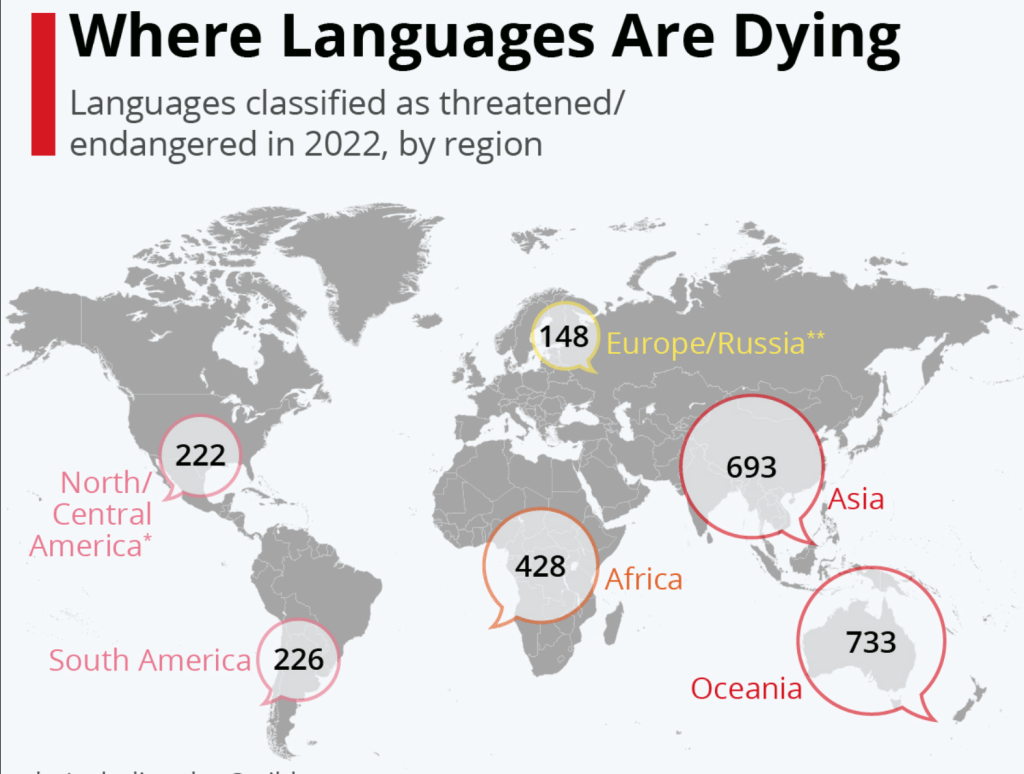
Over the past two months, I had the chance to lead two discussion groups for the NYU League of Linguistics. The first concerned endangered language typology, highlighting interesting features from languages across the world: Austronesian verb-initial sentences, unique Mayan phonologies, and rich Bantu noun classes & declensions.
The second focused on revitalization efforts (video here) around the world, focusing on Hawaiian, Welsh, and Hebrew. We explored how languages can be revived when intergenerational transmission is fading, and what gets negotiated along the way. Key questions were: What counts as success in revitalization? What has become of our own ancestral languages, and why? What trade-offs—like the loss of minority dialects—do we accept? And crucially: where do we, as linguists, fit in?
Together, these sessions became an profound study in contrast: one examining how endangered languages structure and make sense of the world, the other how we might help them endure in it.
As someone who works primarily with dead languages, this topic holds a particular fascination for me. I live among the dead—scripts etched into stone, grammars fossilized in treatises, phonologies inferred but never heard. Endangered languages, by contrast, are not yet dead. Revitalization efforts aim to preserve what I usually only encounter after the fact: living, breathing language. That shift in focus—from excavation to preservation—has reshaped how I think about what linguistic work can be.
It also deepens our understanding of language change. Revitalization doesn’t freeze a language in time—it lets us see what happens next. Take Hawaiian, whose famously tiny consonant inventory (only eight!) allows a wide range of free variation. Will it continue to shrink? Will contrasts harden? Watching a language evolve under new sociopolitical pressures offers historical linguists like me something rare: the chance to witness change not as reconstruction, but as unfolding reality.
One thing that became clear between the two sessions was the importance of community and agency. Typological structures are fascinating—but they exist amid complicated social structures. We came away with a deeper appreciation for linguistic diversity as a lived reality. Our role, ultimately, is not to fix or play savior—but to listen, support, and amplify the work already being done.
 To Wake the Dead