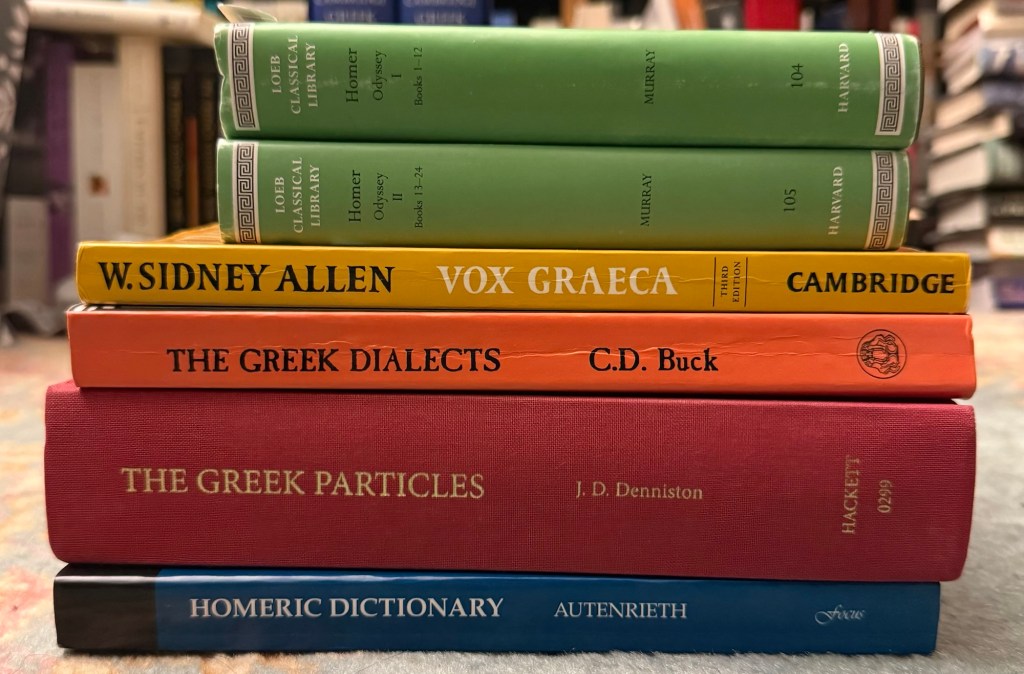
This post collects the top resources I rely on when reading Homeric Greek, especially the Iliad and Odyssey. While much of the grammar overlaps with Classical Greek, Homeric Greek has distinct forms, vocabulary, and meter that call for specialized tools. The following resources—ranging from primers to advanced philological references—are what I return to again and again when working with epic.
To Get Started
Pharr – Homeric Greek: A Book for Beginners
An older but remarkably focused introduction built around Iliad 1. Includes grammar notes specific to Homeric forms, extensive vocabulary, and progressively annotated readings.
Read online
Benner – Selections from Homer’s Iliad
An excellent annotated reader of Iliad Books I–VI, with extensive grammatical commentary keyed to each line. Ideal for intermediate readers.
Read online
Cunliffe – A Lexicon of the Homeric Dialect
Still the standard Homeric dictionary. Organized by root and form, with citations from epic texts and brief semantic notes.
Read online
Digital Tools
Logeion
Cunliffe’s Homeric Lexicon is fully searchable on Logeion alongside LSJ. You can easily compare definitions across lexica and check frequency data within the epics.
Access online
Perseus Word Study Tool
Input any inflected form and receive morphological analysis with links to lexicon entries and usage examples across a wide corpus of Greek texts.
Access online
Top 500 Homeric Words Deck
Compiled by Chicago, these are the most common vocabulary items in Homer’s epics, and knowing them makes for an efficient path to smooth reading.
Access online
Greek Particles Deck
Compiled by a Quizlet user, this deck contains over 80 of the most common and important Greek particles to know.
Access online
Perseus Digital Library
Includes the full texts of the Iliad and Odyssey with parsing tools, English translations, and links to grammatical and lexical resources.
Access online
Chicago Homer
Tailored specifically for Homeric epic. Offers side-by-side Greek and English translations, word-by-word morphological data, and metrical annotation.
Access online
Advanced Topics
Monro – A Grammar of the Homeric Dialect
A classic reference that systematically treats the phonology, morphology, and syntax of Homeric Greek. A bit dense, but indispensable for serious linguistic inquiry.
Read online
Buck – The Greek Dialects: Grammar and Selected Readings
A valuable reference for understanding the dialectal features present in Homeric Greek, which blends primarily Ionic forms with traces of Aeolic. While not focused solely on Homer, this book helps clarify unusual forms and offers broader context for the epic language tradition.
Read online
William S. Annis – An Introduction to Greek Meter
Offers a clear and concise explanation of dactylic hexameter with scansion exercises and helpful mnemonics.
Read online
Hexameter.co
An interactive site that gamifies learning dactylic hexameter. Offers scansion tools for Homer (and 3 Latin authors too). Helpful for developing aural sensitivity and fluency in poetic rhythm.
Access online
Conclusion
This toolkit focuses on materials that prioritize Homeric Greek as a distinct linguistic system—neither a dialect nor a transitional phase, but a carefully stylized literary register. Whether you’re reading your first lines of the Iliad or preparing to write on Homeric formulae or meter, these tools offer a dependable path forward.
This list isn’t exhaustive, but it covers the resources I’ve found most useful in my own studies. Are there others you swear by for Homeric Greek? I’d love to hear what’s missing.
 To Wake the Dead