Tag: Greek epigraphy

  • Tools of the Trade, 5: Toolkit: Mycenaean Greek

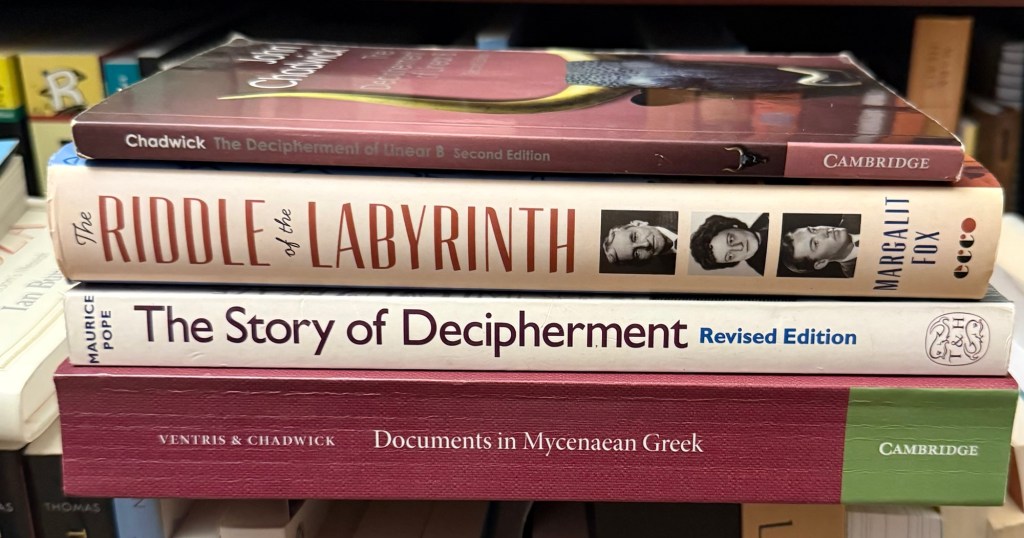
    Some of my physical collection.

    Mycenaean Greek is the earliest recorded form of the Greek language, written in the Linear B syllabary and preserved primarily in administrative documents from palatial centers like Knossos and Pylos. This toolkit collects the core resources I use for studying the language, writing system, and historical context of Mycenaean. While it’s not a language most people “read” in the same way as Homeric or Classical Greek, it’s foundational for understanding the development of the Greek language and the Aegean Bronze Age.

    To Get Started

    Hooker – Linear B: An Introduction
    A concise and accessible introduction to the Linear B writing system, Mycenaean phonology, and key vocabulary. Useful for getting oriented before diving into transcriptions or corpora.
    Read online

    Chadwick – The Decipherment of Linear B
    An essential historical account of how Linear B was deciphered, written by one of its key figures. While dated in some linguistic details, it’s an engaging entry point into the script and its rediscovery.
    Read online

    Digital Tools

    Palaeolexicon: Mycenaean Greek Word List
    A searchable online lexicon of Mycenaean Greek, based on attested forms and reconstructions. Includes syllabic spellings and interpretations. Useful for quick lookups when reading inscriptions.
    Access online

    LiBER (Linear B Electronic Resources)
    An extensive online resource that includes a searchable corpus, transcriptions, sign lists, and links to digitized tablets. Maintained by the University of Cambridge.
    Access online

    Advanced Topics

    Ventris & Chadwick – Documents in Mycenaean Greek
    The foundational reference edition of Linear B tablets, with transcriptions, translations, and commentary. Volume I covers the grammar and lexicon; Volume II includes full texts.
    Read online

    Duhoux & Morpurgo Davies (eds.) – A Companion to Linear B: Mycenaean Greek Texts and Their World
    A more recent scholarly collection covering writing practices, administrative function, linguistics, and interpretive issues. Indispensable for research-level study.
    Read online [Volume 1, Volume 2, Volume 3]

    Aura Jorro – Diccionario Micénico
    A comprehensive lexicon of Mycenaean Greek, keyed to Linear B spellings. In Spanish but used internationally by specialists.
    Read online [Volume 1, Volume 2]

    Conclusion

    Mycenaean Greek is not a reading language in the traditional sense, but it offers unparalleled access to the earliest phase of Greek—its phonology, morphology, and vocabulary in situ. For linguists, epigraphers, and anyone curious about the Bronze Age Aegean, these tools provide a clear entry into the world of palace records and early writing.

    This list includes the materials I’ve found most dependable in my own work. If you’ve found other resources—especially for working with the tablets themselves—I’d love to hear what’s missing.
    View other toolkits.

  • Tools of the Trade, 1: Epigraphy: The Local Scripts of Archaic Greece by L.H. Jeffery

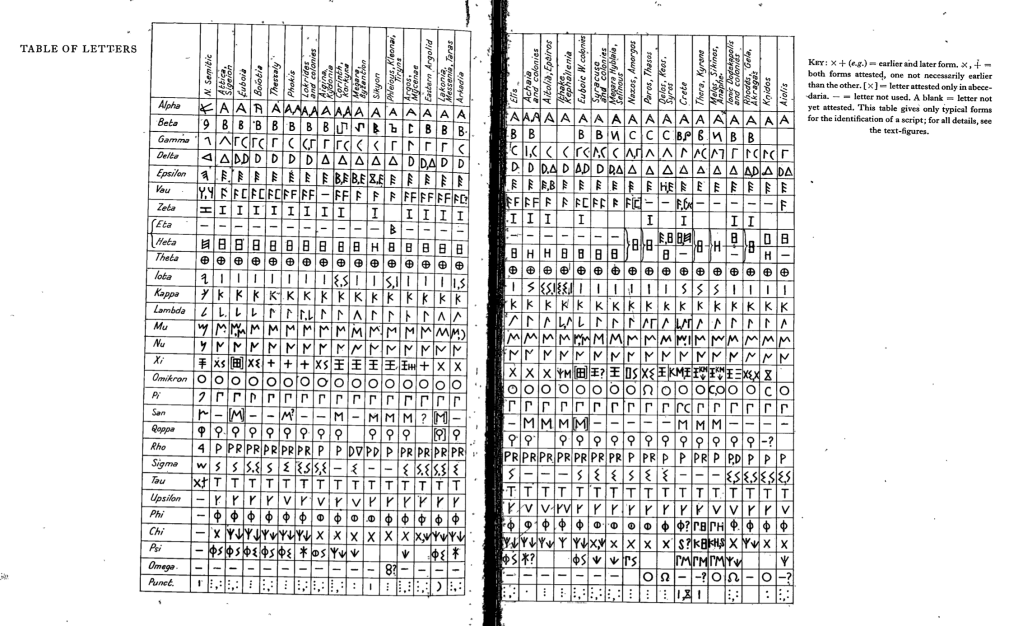
    Jeffery’s summary table of all epichoric scripts at the end of LSAG.
    It is foundational for any work on early regional Greek scripts.

    There are very few books I consider truly irreplaceable in my research. Lilian H. Jeffery’s The Local Scripts of Archaic Greece is one of them. First published in 1961 and revised in 1990 with A.W. Johnston, this book remains the reference for regional variations in the Greek alphabet during the archaic period. It’s where I first learned to read epichoric inscriptions with the eye of a paleographer rather than a Classicist alone.

    The book is very hard to find, and I only got my copy at an even remotely affordable price after months of scouring secondhand sellers. While copies still circulate among libraries and the used book market, I wanted to make it more accessible to others working in this area. So I hunted diligently before finding it on the Internet Archive. You can read or download it here:
    The Local Scripts of Archaic Greece (1990 ed.) – Internet Archive

    Jeffery’s study remains foundational for any work on early Greek writing—not just in Athens or Ionia, but across the full spectrum of regional scripts: Corinthian, Euboian, Attic-Boeotian, Cretan, Cycladic, and others. It includes extensive commentary, maps, and an invaluable inscriptional catalogue organized by region, with drawings and typographic transcriptions. The 1990 revision added important corrections, expanded references, and additional illustrative material. For those of us studying alphabetic transmission, especially the Phoenician-Greek interface or the evolution of letterforms over time, this book is indispensable.

    What makes Local Scripts especially useful is that it bridges the gap between paleography, archaeology, and linguistics. Jeffery doesn’t just chart when and where a particular variant of alpha or epsilon shows up—she explains what those variations might imply for chronology, influence, and contact. And although her typology has been revised and challenged in places (especially with the discovery of new inscriptions), her system remains a critical baseline for almost every study that’s come after.

    Whether you’re interested in early Greek literacy, the transmission of the alphabet, the sociopolitical meaning of epigraphy, or just want to be able to tell the difference between Laconian and Euboian chi, this is the book to start with. I hope having it freely available will be helpful to others navigating this fragmentary and fascinating material.

    Do you have other resources you pair with Jeffery? I’d love to hear what we can supplement LSAG with.