Akkadian is a Semitic language written in the cuneiform script, with texts ranging from royal inscriptions and law codes to letters, contracts, and epics like Gilgamesh. This toolkit gathers the core resources I use to study the language, from mastering the sign list to parsing verbal forms. Whether you’re preparing for graduate study, brushing up for a seminar, or just drawn to the richness of Mesopotamian literature, these are the tools that ground my work with Akkadian.
A quick note: some of these are in German and French, and of course not everyone reads those. However, Google Translate handles them very well if you upload a screenshot of a paragraph, and as my modern languages are not the strongest yet, I’ve found it invaluable. Use this link to access.
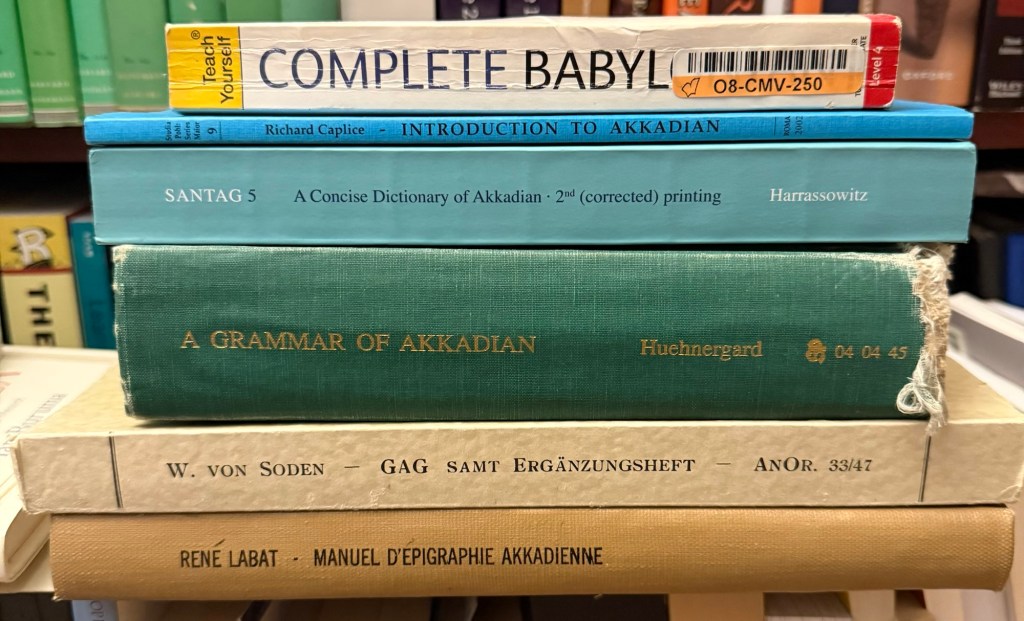
Huehnergard – A Grammar of Akkadian The most widely used modern introduction to Akkadian, especially for Old Babylonian. Combines clear grammatical explanations with exercises, paradigms, and a reading sequence. Thorough and approachable. Read online
Caplice – Introduction to Akkadian More compact and reference-oriented than Huehnergard, with streamlined grammar sections and bilingual text readings. Works well as a complement or for review. Read online
Labat – Manuel d’épigraphie akkadienne: Signes cunéiformes, syllabaires, idéogrammes The definitive sign list for Akkadian cuneiform. Includes syllabic values, logograms, variant shapes, and transcription equivalents. Indispensable when reading from tablets or facsimiles. Read online
Digital Tools
ePSD2 (The Electronic Pennsylvania Sumerian Dictionary) Although primarily for Sumerian, ePSD2 is invaluable for logogram glosses and cross-referencing Akkadian readings of signs. Frequently cited in scholarly work. Access online
ORACC (Open Richly Annotated Cuneiform Corpus) A massive and expanding corpus of annotated Akkadian texts in transliteration and translation, with tools for exploring morphology, genre, and metadata. Excellent for seeing how grammar functions in real texts. Access online
Wiktionary There is no single definitive online Akkadian dictionary, but entries on Wiktionary can help with basic word lookup in transliteration. Access online
Advanced Topics
Von Soden – Grundriss der Akkadischen Grammatik The classic grammar of Akkadian, written in German. Highly detailed, especially in verbal system analysis and historical variants. Read online
Goetze / Landsberger – Text Editions Once you’ve completed initial grammar work, reading annotated text editions from scholars like Goetze or Landsberger will help solidify your grasp of style, genre, and dialect variation.
Conclusion
This toolkit focuses on Old Babylonian and Standard Babylonian as the primary dialects, but the resources here will give you enough flexibility to branch into Assyrian, Middle Babylonian, and other variants. Akkadian is a richly inflected language with a complex writing system, and the path to fluency is best grounded in patient sign recognition, morphological fluency, and careful reading.
These are the resources I’ve found most helpful in learning and returning to Akkadian. If you know of other tools or have advice from the field, I’d love to hear what’s missing.
Replication has become one of my favorite hobbies. I love artifacts, but as any archaeologist or collector will tell you, the barriers to actually owning them are steep—financial, legal, and ethical. How do you store them? protect them? justify having them at all? But when you make something yourself—when you replicate an ancient object by hand—you bypass all that. You get the closeness—a heightened closeness, I’d say—without the risk.
That’s what drew me to recreate the Flood Tablet. Buying a cast would’ve set me back about a hundred dollars. But I wanted to see what I’d learn if I made one myself. Not just held it, but shaped it. Because creating a replica doesn’t just mimic an object—it stages a kind of encounter. You begin with a clean surface, unlike the fragmentary originals, or those replicas that emerge fully formed, and fully unformed, from the get. But when you make it yourself: every crack, every slip, every flaw is something you have to introduce yourself. You get to know the object from the inside out—not just what it looks like, but how it resists you.
I picked this Flood Tablet precisely because it’s ambitious. It’s one of the most iconic inscriptions in the ancient world—a kind of cultural Rosetta Stone, linking Mesopotamian, biblical, and classical traditions. In fact, upon its discovery in the nineteenth century, its similarity to the later Abrahamic tradition sent shockwaves through the scholarly community—truly, its impact cannot be understated.
What’s also beautiful and moving about it is its subject: survival, memory, and catastrophic loss. And it’s been copied, again and again, across centuries. To replicate it now is to take part in that long chain of transmission. It’s not just a story of a flood. It’s a story about what writing saves.
1. The Original: Tablet XI and Its Aura
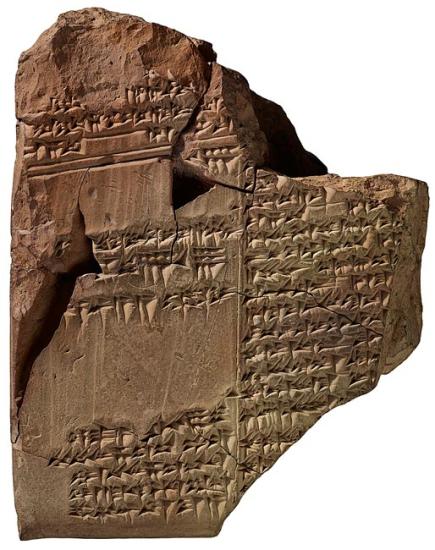
A tablet subsequently discovered, containing the same story, approx. a millennium older than this tablet. Now in the Morgan Library: accession number 225906.
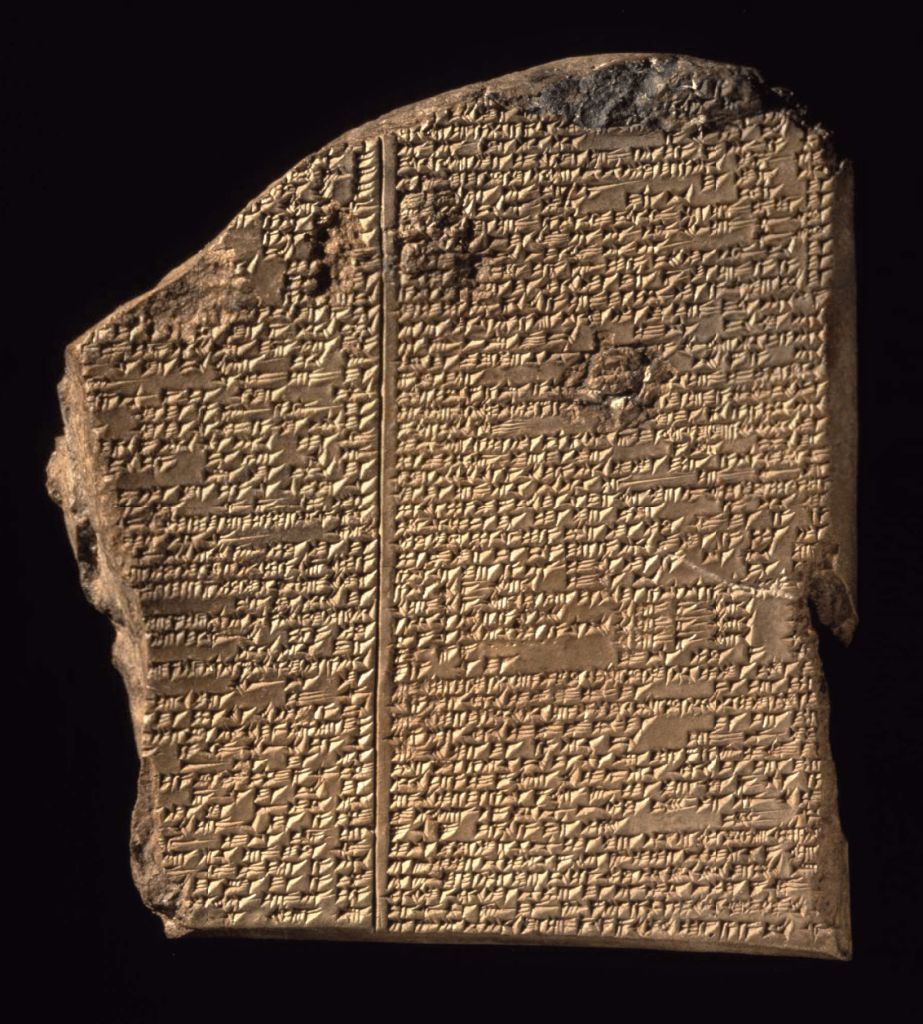
Tablet XI of the Epic of Gilgamesh is arguably the most famous cuneiform text in the world. It tells the story of a great flood, a chosen survivor, a divine warning, and a boat filled with life—centuries before the Book of Genesis recorded a similar arc. In the narrative, Utnapishtim recounts to Gilgamesh how he escaped destruction, was granted immortality, and ultimately became the bearer of a knowledge that even kings could not command. It is one of the clearest points of contact between Mesopotamian myth and later Near Eastern and Mediterranean traditions. Read a translation here.
Found in Nineveh (in the north of modern Iraq, on the Tigris River) on May 7, 1873 by archaeologist George Smith, the tablet is a large, convex slab of clay, its surface densely packed with tight, disciplined cuneiform lines. The edges are broken, some signs lost.
But it’s not a draft or a throwaway. It was meant to endure. To try to recreate it is, in a small way, to step into that intention. The curvature, the spacing, the subtle tilt of each wedge: all these formal features speak not just to aesthetics, but to the technical mastery of the scribes who made them. This isn’t just a myth we inherited. It’s a craftwork that once held it.
2. The Process
I started with two pounds of grey air-dry clay and rolled it out to a thickness of about ¾ of an inch. I wanted enough depth to accommodate firm impressions without risking breakage—a balance between durability and responsiveness.
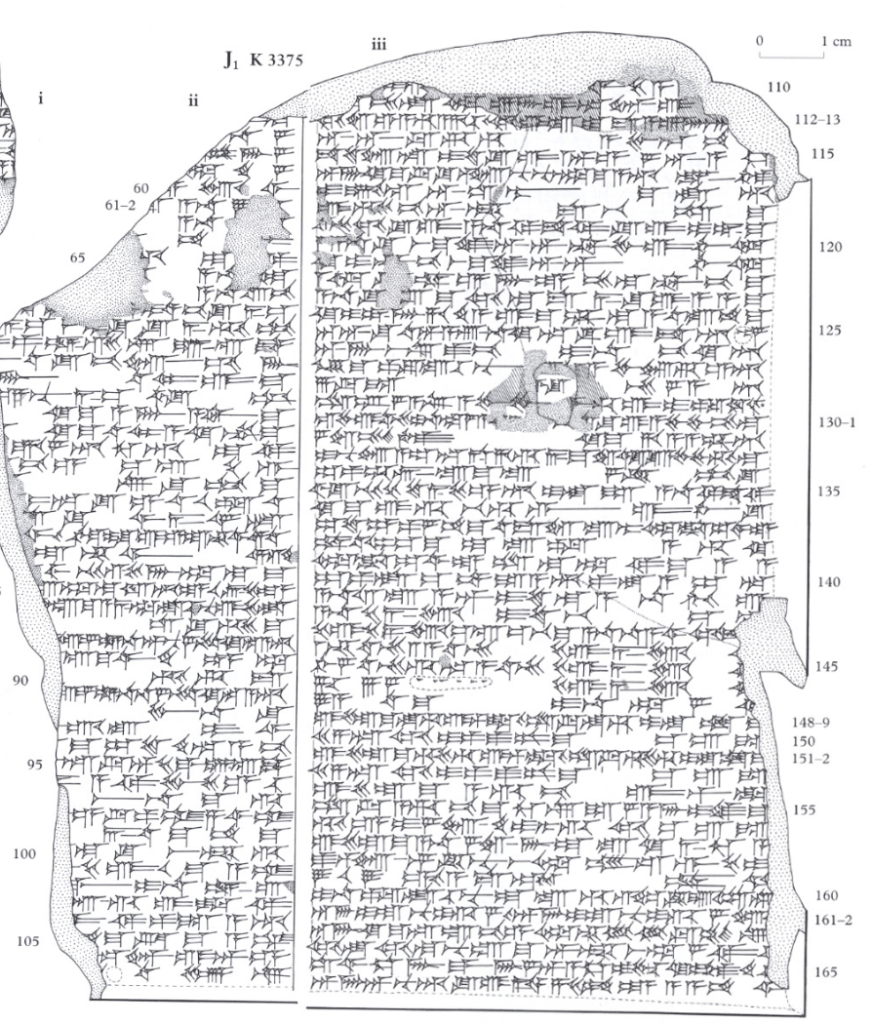
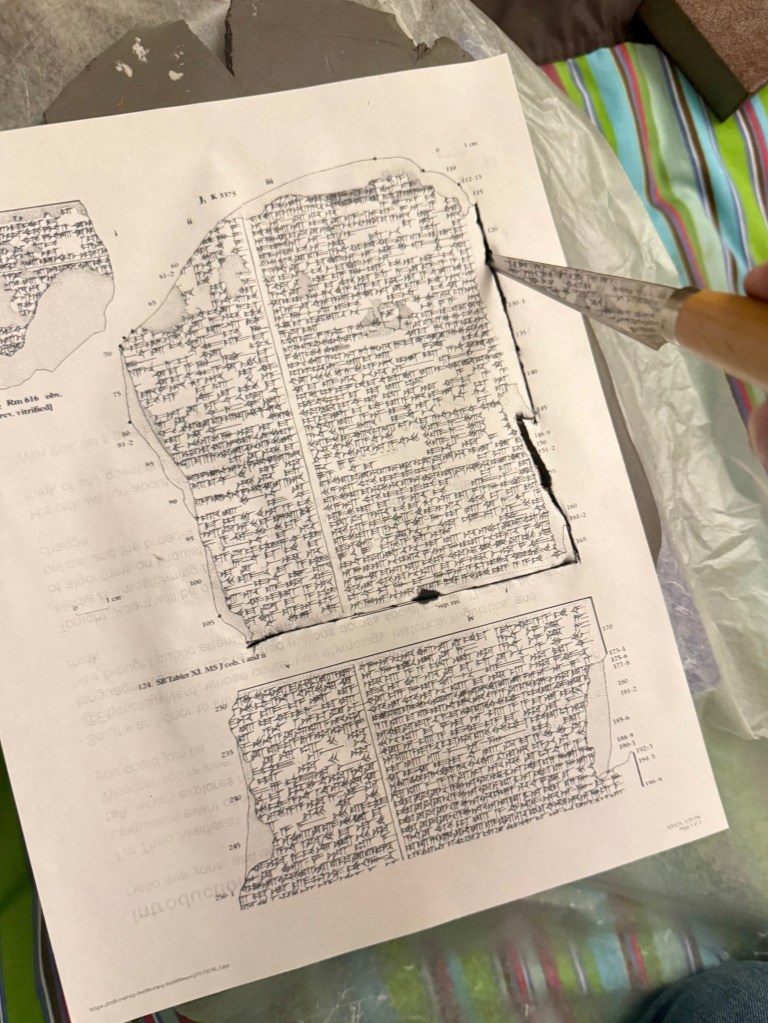
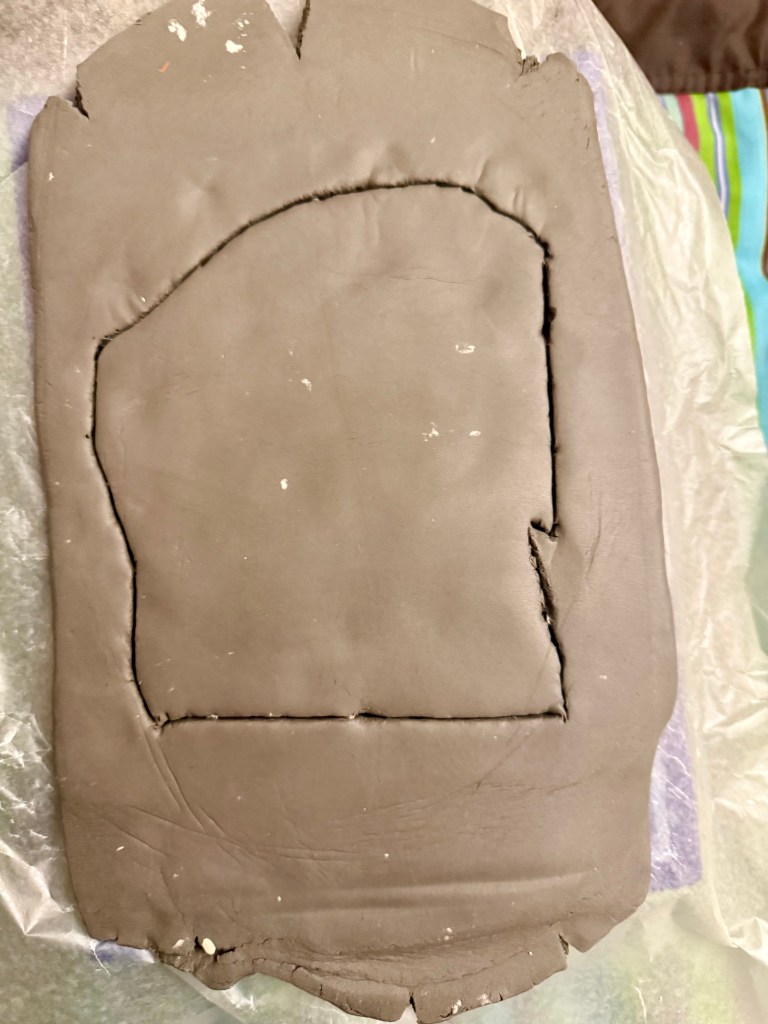
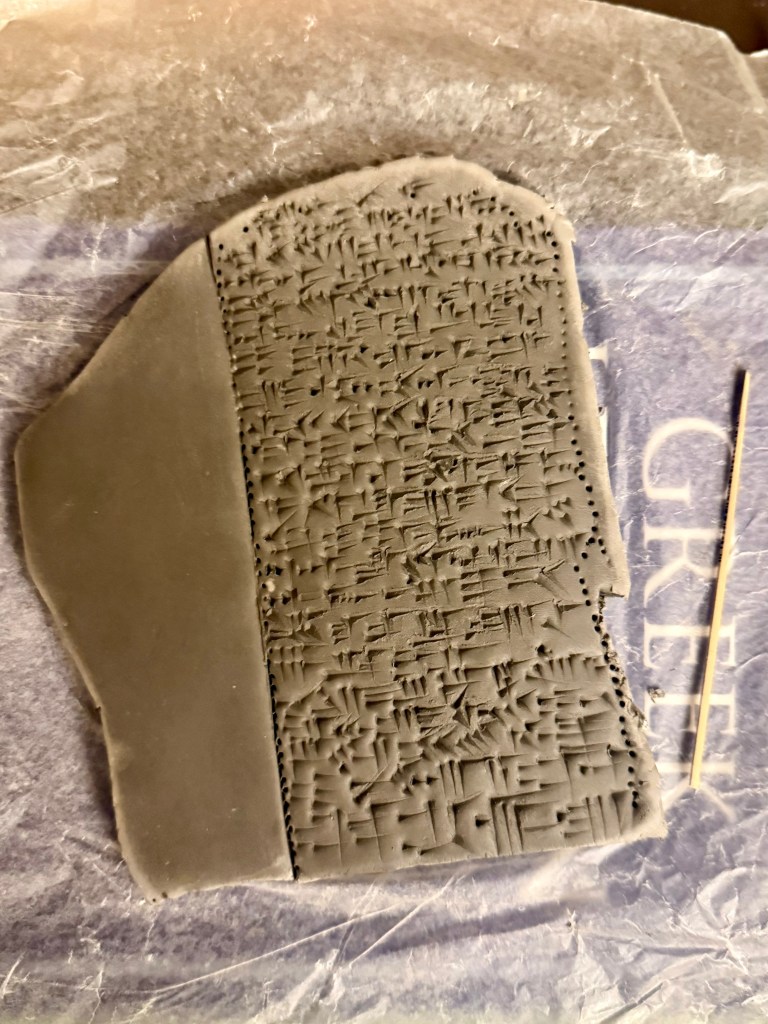
Once I had a smooth surface, I printed a to-scale lineart of one side of the original tablet and laid it directly over the clay. Using a potter’s knife, I cut around the outline to form a proper slab.
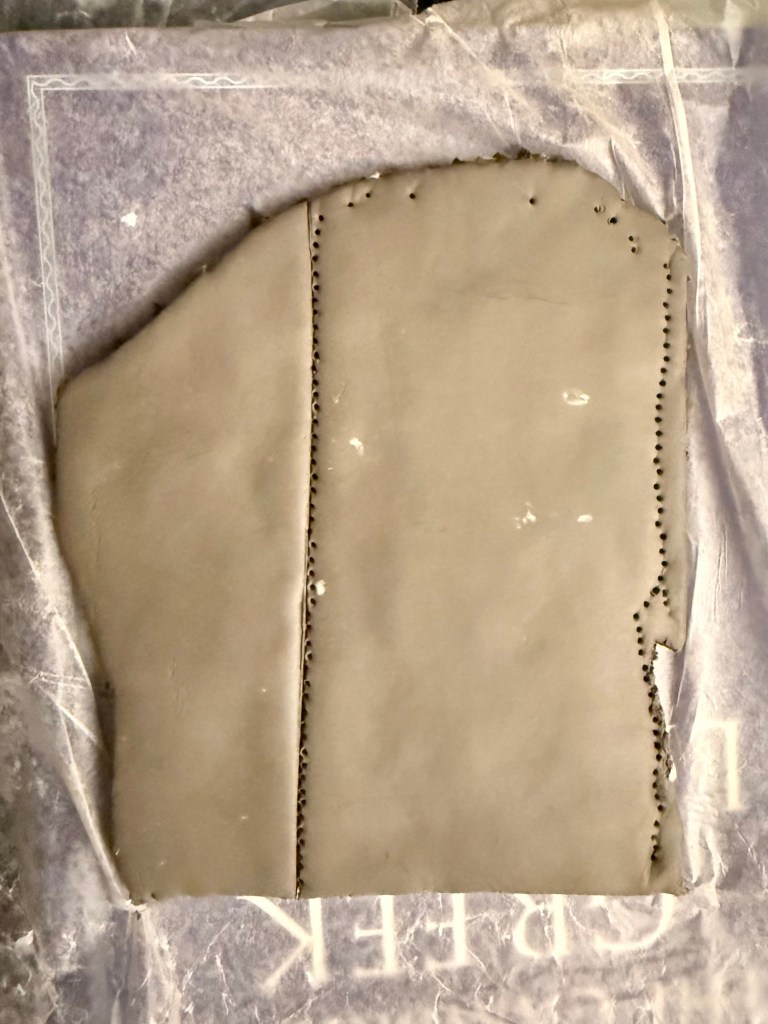
I then scored the signature cleft line that bisects the original tablet. That line helped me rule the text. After that, to mark where each line of writing would begin and end, I took a needle and, with the paper still on top, pricked small bounding dots at the start and stop of every line. This gave me a grid of sorts—not formal ruling, but a subtle framework for spacing. I used actual cuneiform signs from the standard text, fitting in as much as I could per line (which, as I’ll tell you shortly, turned out to be not very much at all).
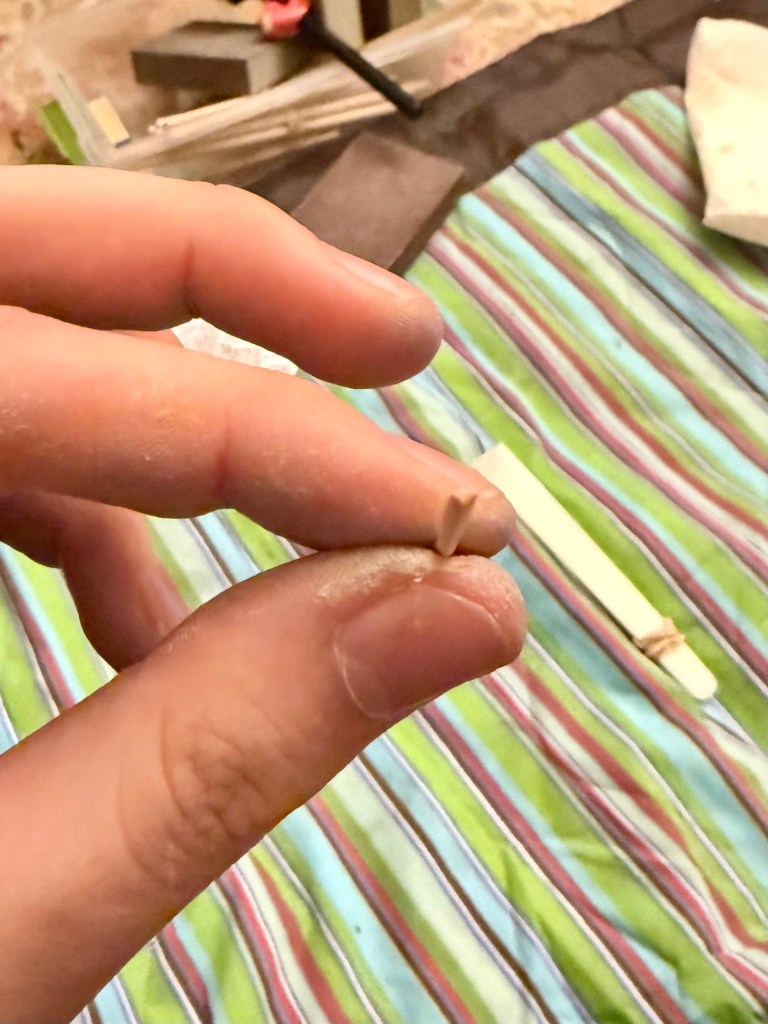
For the inscription itself, I used a homemade stylus made from a square wooden dowel. I had sanded down one corner to create a slightly beveled edge that let me grip it more naturally—pinching it between thumb and middle finger, with my index finger guiding from above. In the course of things, I ended up using two styli. The first began to dull mysteriously partway through, possibly due to the water I kept brushing onto the clay to keep it soft. The wood was porous, and the repeated wetting may have softened or blunted its edges. I hadn’t expected tool fatigue quite so early in the process.
3. Difficulties: Scale, Fatigue, and the Limits of Enthusiasm
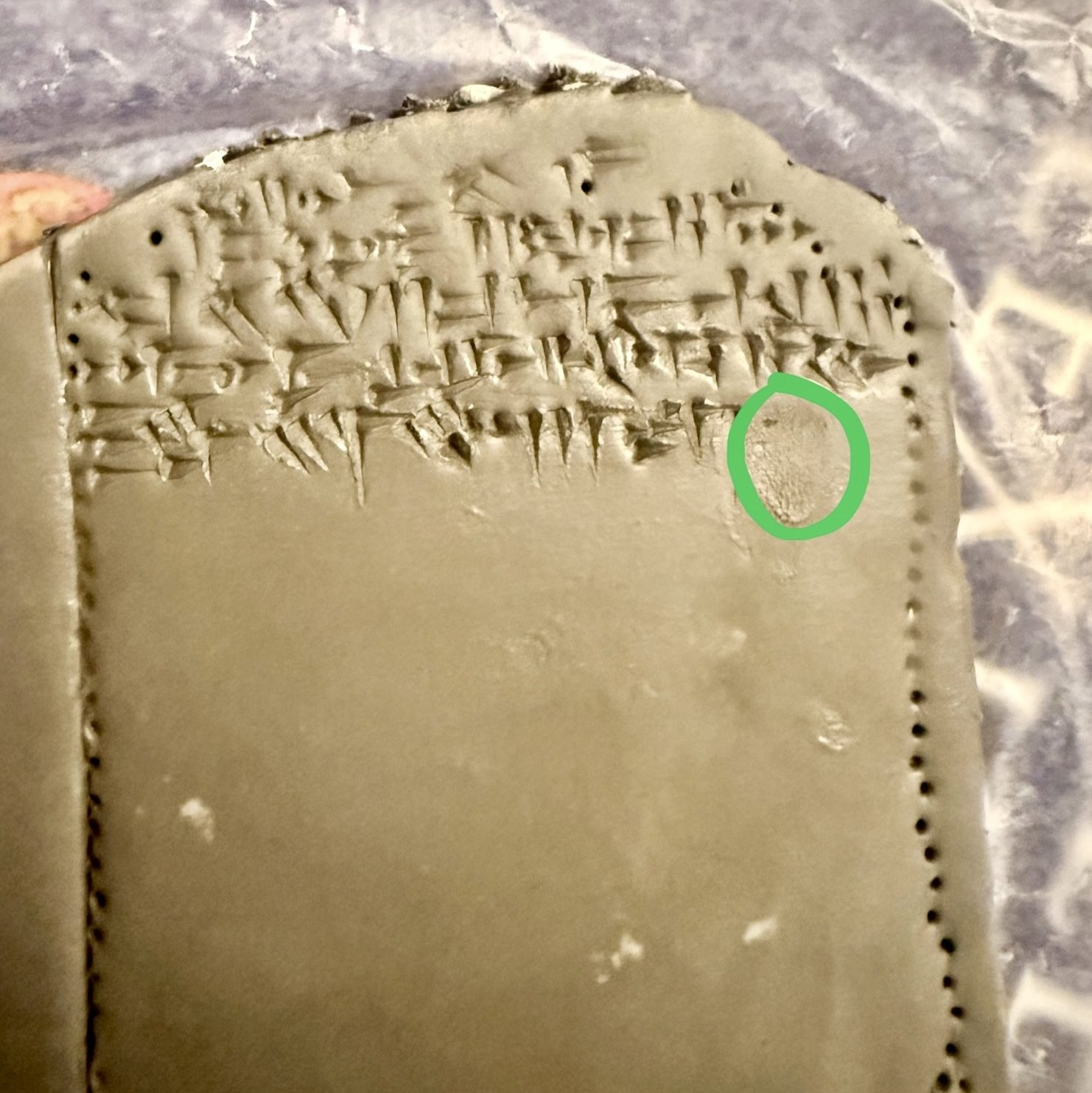
What surprised me most was just how big my signs ended up being. Between the bluntness of my stylus and the limits of my own control, I found I could only produce cuneiform signs that were two to three times the height of the original inscriptions—and at least twice the width. The clay itself wasn’t the issue. If anything, it was a pleasure to work with: I kept smearing water across the surface with my fingertip, especially over unused areas, and that seemed to make the impressions cleaner and more precise. The medium was surprisingly forgiving, an example of an erasure using this technique is given above, in the green circle. My hands were not as pliant.
I started at the top of the right-hand side of the tablet, and you can tell. My signs grew noticeably larger over time as fatigue set in. I spent around two hours just pressing wedges into the clay, and by the end I was feeling it. Not just in my hand, but in my attention span. I’d wildly underestimated how much text I could fit on the slab at the scale I was working—I probably would’ve needed to double the size to get anywhere close to the full line count of the original.
By the end, I had learned what I came to learn—and felt ready to let it rest. I don’t plan to do the other side or fill in any missing fragments. This was enough to teach me what I wanted to know: how hard it is, how slow it is, how deliberate every single wedge has to be. The work left me with admiration, exhaustion, and just enough satisfaction to call it finished.
4. Why It Was So Hard—And What That Tells Us
This was the smallest scale of replica I’ve ever attempted, and still, my signs were roughly 2.5 times the size of the originals. And even at that inflated scale, I’m not confident I could accurately draw what I carved just by looking at the replica. That tells me a lot. It explains, viscerally, why there was an elite scribal class in Mesopotamian society, and why their training was so extensive. It wasn’t just about memorizing hundreds of signs—though that alone is a feat, especially for scribes working in multiple languages. It was about navigating a medium that added layers of challenge: spacing, shaping, texture, tool wear, and fatigue.
I’ve long wanted to understand what made cuneiform so difficult—not just as a writing system, but as a practice. Even after studying the language on paper, I didn’t fully grasp the physical demands until I tried it myself.
I wish we had spent even a single thirty-minute session in Akkadian I making tablets, especially at a small scale like this. The pedagogical value would’ve been enormous. You suddenly understand not just the abstract difficulty of the writing system, but the labor infrastructure around it—the apprenticeship, the specialization, the patience. This little experiment gave me a glimpse into that world, and for that, I’m genuinely grateful.
5. Closing: A New Kind of Knowing
I ended up with a lopsided, oversized, and incomplete tablet. But also: textured, hard-won, and deeply instructive. In the end, as it turns out, this wasn’t really about copying Tablet XI. It was about spending time inside its logic—its weight, its line spacing, its forgiving-but-not medium—and learning something I couldn’t have understood from a textbook.
If you’re studying cuneiform, or even just curious about ancient writing, I can’t recommend this kind of tactile experiment enough. Make a stylus. Roll some clay from your local art-supply store. Try a single line. Your respect for those scribes will double. And you’ll probably come away, as I did, with something small and slightly ridiculous to keep on your shelf—a cracked echo of something monumental. Decidedly not a replica. Rather a kind of conversation.
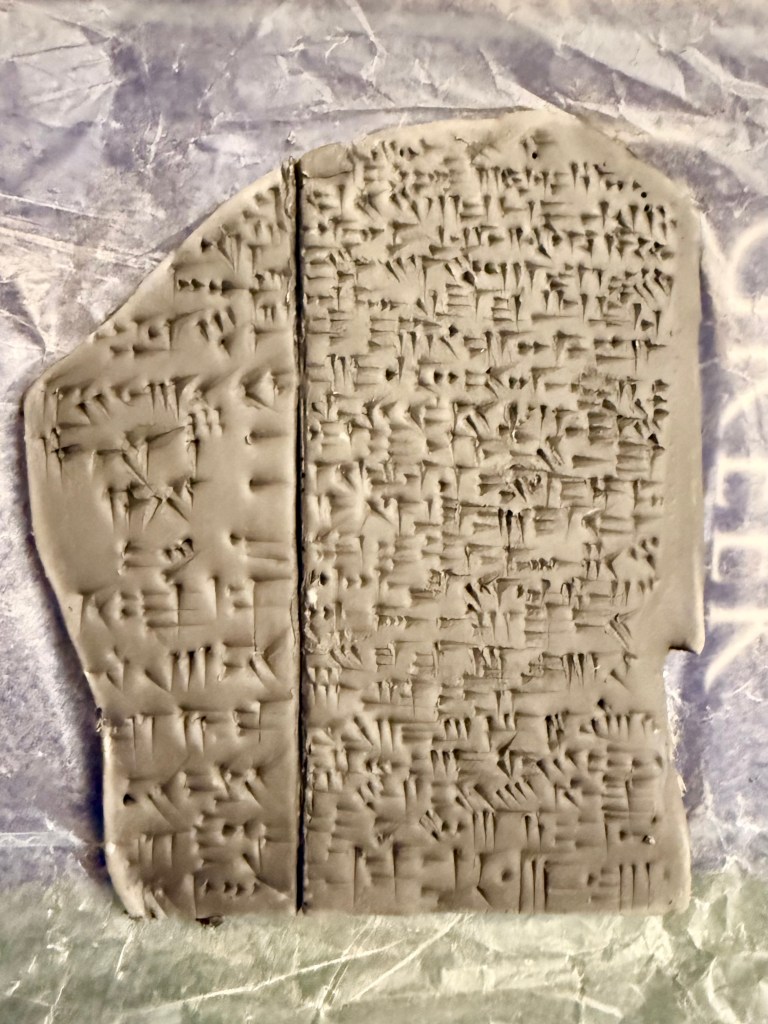
2023: Tablet replica I made from a drawing in Huehnergard’s grammar.
I first took Akkadian a few years ago. Since then, the language has been sitting in a kind of suspended animation: just far enough away to feel unreachable, just close enough to make me feel guilty.
This post kicks off Tablets and Tribulations, a new series chronicling my return to Akkadian. I’ll be using it to track my progress, share insights, and reflect on what it means to study something this complex, this demanding, and this strange.
Why Akkadian?
Akkadian sits at the intersection of my academic obsessions: Semitic linguistics, the history of writing systems, and the psycholinguistics of script. It’s a dead language, but not a fossilized one. The more you read it, the more it pulses: with bureaucracy, with poetry, with prayer. And the writing system—a sprawling, phonetically polyvalent syllabary riddled with ideograms—is completely unlike the tight alphabets I’m used to. It demands patience, pattern-recognition, and grit.
There’s also no shortage of material, with estimates of the number of excavated Akkadian texts reaching as high two million—meaning it quite possibly has the most documents of any ancient language; in fact, according to my professor Ronald Wallenfels, more documents than all ancient languages combined. Put that in your pipe and smoke it.
I’m also drawn to it because I’m not naturally good at it. Greek and Latin came to me more intuitively, their logics familiar in a way I hadn’t expected. Akkadian doesn’t let me do that. It forces me to slow down, to wrestle with my perfectionism, to train my brain in new ways. And I love that. I want to get good at something hard. I want to overcome the mental blocks that have held me back before.
What’s Changed
Since that early study, I’ve broadened my exposure to Semitic linguistics and become more confident working with both the script and the medium. I’ve also made peace with how humbling this language is. Once, I even told a syntax class—confidently—that Akkadian had no demonstratives, only to moments later fact-check myself and discover that it had three distinct tiers of them. I then had to publicly correct myself and told them to pray for me… as I had a quiz on Akkadian pronominals the next period.
I’m now studying with two grammars, Huehnergard and Caplice, using Labat’s sign list as my main reference. I’m also switching from just drawing signs to pressing them into clay, and my wax tablets—less sketchbook, more scribal. I’ll be posting more about that process (and my tablet replicas) soon.
What to Expect from This Series
Tablets and Tribulations will be part language log, part material exploration, and part meditation on what it means to study a language with no living speakers and a script that defies modern intuition. Future posts will likely include:
Syntax deep dives (word order, case, verb chains, etc.)
Close readings of texts (legal, literary, magical, bureaucratic)
Reflections on learning signs and navigating polyvalence
Notes on scribal training and cuneiform technique
My own experimental archaeology: pressing and firing tablets
Anecdotes from the museum and the classroom
Psycholinguistic musings on how syllabaries shape cognition
Occasional moments of crisis and triumph
This is going to be hard. But I want that. I want to stretch, stumble, and get back up. That balance—rigor with joy—is what I’m working toward. Each week with Akkadian reminds me how study disciplines the self—not just the mind.


 To Wake the Dead