The next portion of Tools of the Trade will focus on a series of “core toolkits” for a variety of languages. These will be linked here as they roll out over the next few days. The first five, in order, will be:
If any more are added, I’ll link them here as well. I’m planning on doing Phoenician and Middle Egyptian at some point, and maybe even posts on families, probably Semitic and Indo-European. After that, there will be two more posts on epigraphic tools, followed by a series of computational ones, and then probably some meta-tools (e.g., guides to digital organization, etc.). After that it’s anyone’s game, and I fully welcome suggestions. Feel free to email me here if there’s anything you’ve been wanting to get into but haven’t found good resources for.
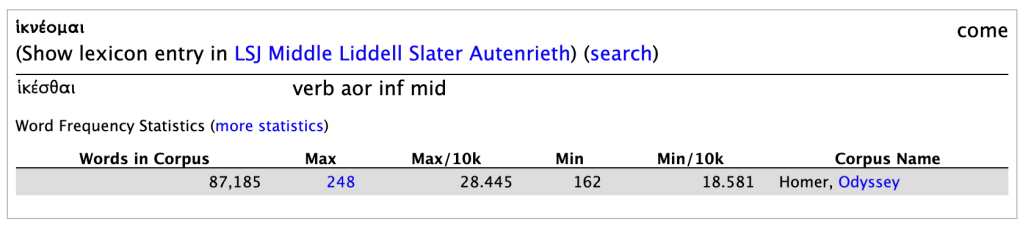
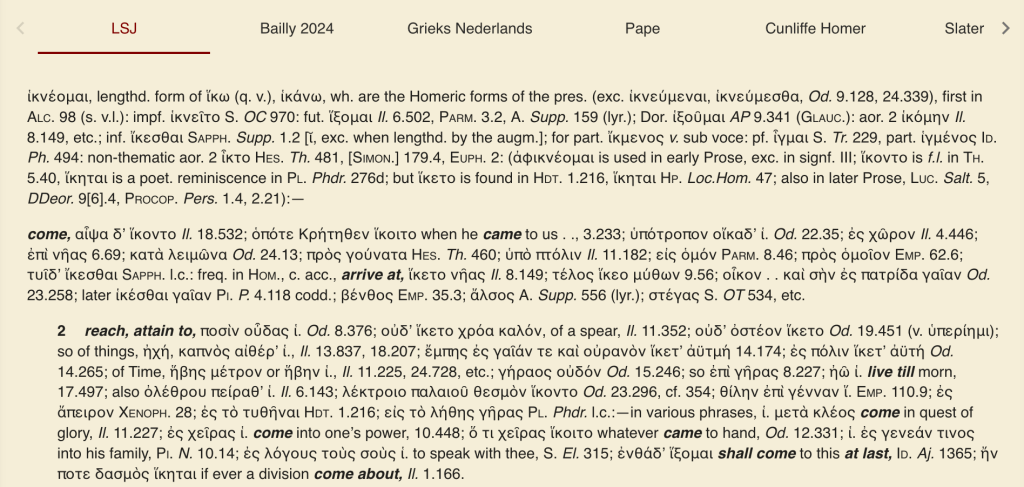
Perseus’s result for ἱκνέομαι: a quick parser, giving form and summary of corpus occurrences.Partial Logeion result for the same word: collates detailed results from nine separate dictionaries with a 10th tab for corpus occurrences.
For anyone studying Latin or Ancient Greek—whether casually, academically, or obsessively—two digital tools stand out as indispensable: Perseus and Logeion. I use both almost every day. While they serve overlapping purposes, each has its own strengths, and learning to navigate between them has made my reading smoother, faster, and more precise.
Perseus, formally known as the Perseus Digital Library, is one of the earliest and most ambitious digital humanities projects in the field of Classics. It provides access to a massive collection of Greek and Latin texts with built-in parsing tools, dictionary links, and (often outdated but still helpful) English translations. Its strength lies in contextual reading—hovering over any word in a text will generate a parsing suggestion and a link to its dictionary entry, which makes it incredibly useful when working through a new author or a grammatically complex passage. The Word Study Tool allows you to input any inflected form and get a list of possible morphological analyses and dictionary headwords, with links to example passages. However, it’s important to note that these parsings are generated by algorithms and are not always reliable, especially for ambiguous forms. The interface can also feel a bit dated, and not all texts are equally well formatted, but for quick reading and parsing, Perseus is great.
By contrast, Logeion is a sleek and powerful lexicon aggregator developed by the University of Chicago. Unlike Perseus, it doesn’t offer complete texts, but it excels at lexical depth. When you enter a word—either in Latin or Greek—Logeion pulls results from multiple dictionaries at once, including LSJ, Middle Liddell, Autenrieth, Lewis & Short, Elementary Lewis, Frieze-Dennison, and others. You also get frequency data, example passages, and, in some cases, idiomatic usages or English-to-Greek reverse entries. Logeion doesn’t parse for you, so you need to know or guess the dictionary form of the word. But once you do, the definitions it offers are more precise and informative than any single dictionary alone. I often use it to compare lexical nuance across genres or authors, and it’s especially helpful when I want to confirm the meaning of a word I already sort of “know.”
The way I use these two tools in tandem is pretty straightforward. When I’m reading through a text, especially something new or poetic, I usually begin in Perseus. I use the on-hover parsing and the Word Study Tool to get oriented, especially with verbs and particles. Once I have the base form, I switch over to Logeion to dig deeper into meaning, idiom, or usage across contexts. Logeion becomes especially helpful when I’m writing, translating, or thinking more syntactically. In many ways, Perseus is like a field guide with helpful margin notes, while Logeion is the serious reference work you turn to when you want to be exact.
If you’re just starting out, don’t feel pressured to master everything at once. But learning to toggle between Perseus and Logeion will give you a huge advantage—especially if you’re not always reading with a print dictionary on hand or don’t have institutional resources. I’ve used these tools for years—they’ve remained central across every stage of my study. They’re fast, free, and surprisingly deep once you know where to look.
If you’ve found tricks for using them more efficiently, or if you have a favorite feature I didn’t mention, let me know what’s missing.
 To Wake the Dead