Reading for friction, not fluency
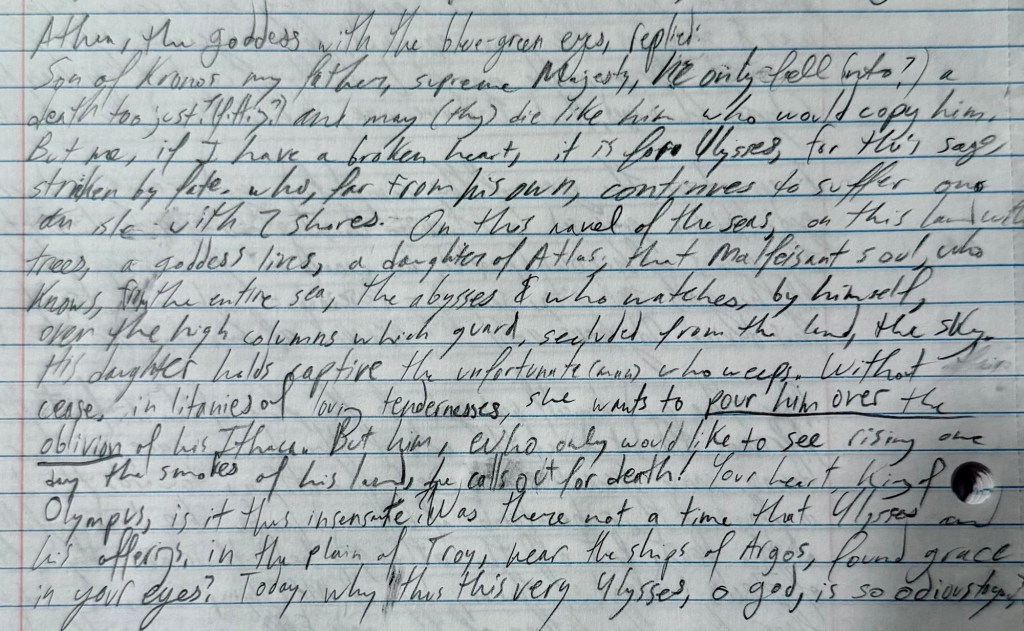
In the first week of Tritropic, I found myself reading the same passage in French and Greek on the same day. It seemed like a good idea: reinforce the meaning, triangulate expression, hold the line up to two kinds of light. Instead, once I’d puzzled out the syntax and meaning in one language, the second version became trivial. All the work had already been done, particularly because Bérard’s French hews so closely to the original—here a gift and a curse, since the shape of the sentence had already been laid bare.
What should have been a second act of discovery turned into a performance of memory. And that, for me, is a dead end.
So I’m revising my approach for the next month to see if a new structure works. I now read a Book of the Odyssey in French across a week, then return to the same section in Greek for the next two or three weeks. This reintroduces mystery—just enough forgetting to force me to re-earn my understanding. Each version remains itself so I can’t lean on one to carry the other. However, there’s just enough closeness, I think, for comparison of translation choices. Theory of translation is something I quite want to pursue through this—it’d be a shame to lose that aspect.
Scaffolds and Syntax
In these early days, I’ve learned to be wary of digital tools—pop-up glosses, online parsers, translation extensions. There’s a difference between using scholarly supports and just outsourcing thought. Too often, I found myself parsing without learning. Clicking my way through a passage gave me the answer but not the understanding.
To counter that, I’ve built what I call a “Reading Ladder” for the French. It begins with a cold read—no tools, no support, just me and the text, making guesses about syntax and structure. Next, I pass through a deeper parsing stage, using only a grammar and a basic dictionary to confirm key unknowns, not every minor term. Only after this do I allow myself to consult a translation or ask my fluent friends, not as a crutch but as a corrective.
I plan two final stages once I get my bearings more. These are expressive exercises: retelling the passage in my own French, rereading it aloud for rhythm, and briefly stepping outside the text to engage with something stylistically adjacent—a short piece by Gide, a 19th-century abstract on epic poetics, anything that stretches my sense of what French can do.
Throughout this process, I plan on keeping a syntax journal. Each week, I record one sentence I understood without help, one that tripped me up (with notes on why), and one that delighted me. The journal is to be a miniature Grammaire Bérardienne. It also is meant as a reminder that joy is a form of comprehension.
Greek and Joyful Tedium
Greek, with its distance from both English and the Attic I’m familiar with, is a harder beast—and all the more rewarding because of it. I’ve adopted a multi-pass system here as well. The first time through, I read aloud without stopping. No dictionary, no notes, just the text and the shape of the sentence as much as I can discern it. I underline words I don’t know, try to guess at their meaning from morphology, meter, or context. Only after that do I allow myself to return and parse each word carefully. By then, I’ve already begun to intuit some of the patterns, and the parsing feels earned rather than imposed.
Twice a week, I do blind parsing drills. I take a short passage, cover any translation, and write out the morphological analysis of each verb and noun—tense, mood, case, number, person, source verb or noun. Then I translate from scratch. It’s humbling, but it builds exactly the muscles I’m trying to train.
Every month, I’m going to try to reread an entire Book in Greek with no aids. It’s the closest this kind of study gets to strength training. My professors have told me one of the best things you can do for your Greek (and language skills generally) is to reread, since you’re no longer in just decode-mode. This very much helped me last semester in my Lucian class. The sense of fluency that emerges—halting, but unmistakable—is worth every hour.
I also keep a personal lexicon, noting each unfamiliar form, particle usage, or idiom that gives me pause. And every few weeks, I’ll try my hand at short Homeric compositions—just five or six lines using words and constructions I’ve encountered. In the meantime, I’m studying from two Quizlets: one of the 500 most common Homeric vocabulary items, and one with 70+ important ‘small words.’
What the Text Offers
What I hadn’t fully expected was just how well-suited the Odyssey is for this kind of iterative, interleaved learning. Its repetitions are pedagogical for me. Vocabulary recurs with slight variations, idioms reappear in altered contexts, and the syntax is often rhythmic enough to imprint itself on the brain. Bérard understands this, and he mirrors Homer’s scaffolding with care. His French extends Homer’s use of anaphora, his vocabulary choices build on one another, and his ceremonial tone reinforces structure as it elevates the prose.
In both languages, challenge ramps up at a manageable pace. I’m only a few pages in, but already I can sense the increasing complexity—more embedded clauses, trickier participial constructions, and richer metaphor. But nothing feels unearned. The text supports you even as it stretches you.
Perseverance, Not Performance
There’s a line at the beginning—one I have reached in both languages—that keeps echoing in my head: ὃς μάλα πολλὰ πλάγχθη. It’s often rendered loosely as “he who was greatly tossed about,” but the Greek is more literal than that, and stranger: he who was driven off far or much. It conjures not just aimless wandering, but compelled displacement—someone pushed off course by forces beyond his control.
Bérard translates it as celui qui tant erra—“the one who wandered so much.” Murray’s version is starker: “the man who was driven far astray.” Murray evokes motion without agency, but Bérard is softer, more open to interpretation on whether this wandering was chosen or forced. Yet they both understand that πλάγχθη is not just travel, but deviation.
The line isn’t just about Odysseus, however. It describes what it means to read a difficult language honestly. You’re driven, sometimes astray, but still in motion.
Difficulty, for me, is no longer something to overcome. I recognize it now as an essential condition for progress. Every time I misparse a participle or mistake a clause boundary, I get a little closer to understanding—not just the sentence, but the langauge system that generated it. That’s the rhythm of the tritropic line: wandering with purpose.
 To Wake the Dead