Tag: Assyriology

  • Tools of the Trade, 7: Toolkit: Akkadian

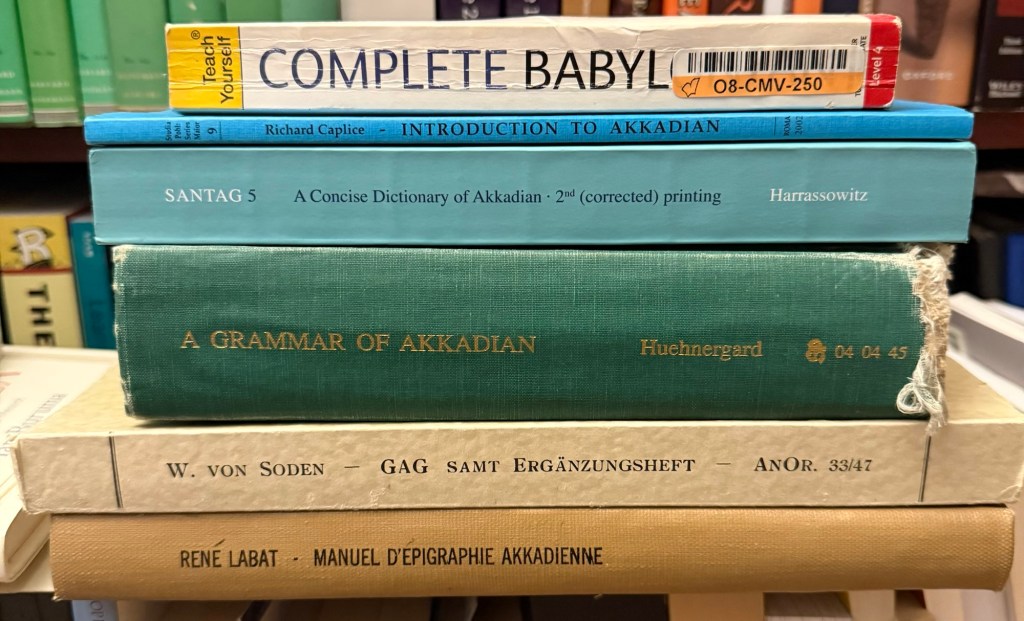
    Some of my physical collection.

    Akkadian is a Semitic language written in the cuneiform script, with texts ranging from royal inscriptions and law codes to letters, contracts, and epics like Gilgamesh. This toolkit gathers the core resources I use to study the language, from mastering the sign list to parsing verbal forms. Whether you’re preparing for graduate study, brushing up for a seminar, or just drawn to the richness of Mesopotamian literature, these are the tools that ground my work with Akkadian.

    A quick note: some of these are in German and French, and of course not everyone reads those. However, Google Translate handles them very well if you upload a screenshot of a paragraph, and as my modern languages are not the strongest yet, I’ve found it invaluable. Use this link to access.

    Huehnergard – A Grammar of Akkadian
    The most widely used modern introduction to Akkadian, especially for Old Babylonian. Combines clear grammatical explanations with exercises, paradigms, and a reading sequence. Thorough and approachable.
    Read online

    Caplice – Introduction to Akkadian
    More compact and reference-oriented than Huehnergard, with streamlined grammar sections and bilingual text readings. Works well as a complement or for review.
    Read online

    Labat – Manuel d’épigraphie akkadienne: Signes cunéiformes, syllabaires, idéogrammes
    The definitive sign list for Akkadian cuneiform. Includes syllabic values, logograms, variant shapes, and transcription equivalents. Indispensable when reading from tablets or facsimiles.
    Read online

    Digital Tools

    ePSD2 (The Electronic Pennsylvania Sumerian Dictionary)
    Although primarily for Sumerian, ePSD2 is invaluable for logogram glosses and cross-referencing Akkadian readings of signs. Frequently cited in scholarly work.
    Access online

    ORACC (Open Richly Annotated Cuneiform Corpus)
    A massive and expanding corpus of annotated Akkadian texts in transliteration and translation, with tools for exploring morphology, genre, and metadata. Excellent for seeing how grammar functions in real texts.
    Access online

    Wiktionary
    There is no single definitive online Akkadian dictionary, but entries on Wiktionary can help with basic word lookup in transliteration.
    Access online

    Advanced Topics

    Von Soden – Grundriss der Akkadischen Grammatik
    The classic grammar of Akkadian, written in German. Highly detailed, especially in verbal system analysis and historical variants.
    Read online

    Goetze / Landsberger – Text Editions
    Once you’ve completed initial grammar work, reading annotated text editions from scholars like Goetze or Landsberger will help solidify your grasp of style, genre, and dialect variation.

    Conclusion

    This toolkit focuses on Old Babylonian and Standard Babylonian as the primary dialects, but the resources here will give you enough flexibility to branch into Assyrian, Middle Babylonian, and other variants. Akkadian is a richly inflected language with a complex writing system, and the path to fluency is best grounded in patient sign recognition, morphological fluency, and careful reading.

    These are the resources I’ve found most helpful in learning and returning to Akkadian. If you know of other tools or have advice from the field, I’d love to hear what’s missing.

    View other toolkits.

  • Tablets and Tribulations, 1: Lapse and Return

    2023: Tablet replica I made from a drawing in Huehnergard’s grammar.

    I first took Akkadian a few years ago. Since then, the language has been sitting in a kind of suspended animation: just far enough away to feel unreachable, just close enough to make me feel guilty.

    This post kicks off Tablets and Tribulations, a new series chronicling my return to Akkadian. I’ll be using it to track my progress, share insights, and reflect on what it means to study something this complex, this demanding, and this strange.

    Why Akkadian?

    Akkadian sits at the intersection of my academic obsessions: Semitic linguistics, the history of writing systems, and the psycholinguistics of script. It’s a dead language, but not a fossilized one. The more you read it, the more it pulses: with bureaucracy, with poetry, with prayer. And the writing system—a sprawling, phonetically polyvalent syllabary riddled with ideograms—is completely unlike the tight alphabets I’m used to. It demands patience, pattern-recognition, and grit.

    There’s also no shortage of material, with estimates of the number of excavated Akkadian texts reaching as high two million—meaning it quite possibly has the most documents of any ancient language; in fact, according to my professor Ronald Wallenfels, more documents than all ancient languages combined. Put that in your pipe and smoke it.

    I’m also drawn to it because I’m not naturally good at it. Greek and Latin came to me more intuitively, their logics familiar in a way I hadn’t expected. Akkadian doesn’t let me do that. It forces me to slow down, to wrestle with my perfectionism, to train my brain in new ways. And I love that. I want to get good at something hard. I want to overcome the mental blocks that have held me back before.

    What’s Changed

    Since that early study, I’ve broadened my exposure to Semitic linguistics and become more confident working with both the script and the medium. I’ve also made peace with how humbling this language is. Once, I even told a syntax class—confidently—that Akkadian had no demonstratives, only to moments later fact-check myself and discover that it had three distinct tiers of them. I then had to publicly correct myself and told them to pray for me… as I had a quiz on Akkadian pronominals the next period.

    I’m now studying with two grammars, Huehnergard and Caplice, using Labat’s sign list as my main reference. I’m also switching from just drawing signs to pressing them into clay, and my wax tablets—less sketchbook, more scribal. I’ll be posting more about that process (and my tablet replicas) soon.

    What to Expect from This Series

    Tablets and Tribulations will be part language log, part material exploration, and part meditation on what it means to study a language with no living speakers and a script that defies modern intuition. Future posts will likely include:

    • Syntax deep dives (word order, case, verb chains, etc.)
    • Close readings of texts (legal, literary, magical, bureaucratic)
    • Reflections on learning signs and navigating polyvalence
    • Notes on scribal training and cuneiform technique
    • My own experimental archaeology: pressing and firing tablets
    • Anecdotes from the museum and the classroom
    • Psycholinguistic musings on how syllabaries shape cognition
    • Occasional moments of crisis and triumph

    This is going to be hard. But I want that. I want to stretch, stumble, and get back up. That balance—rigor with joy—is what I’m working toward. Each week with Akkadian reminds me how study disciplines the self—not just the mind.

    So here’s to the first step. The tablets await.