Tag: Ancient Languages

  • Tools of the Trade, 8: Meta-Tools: Courses for Aspiring Philologists and Archaeo-Linguist Hybrids

    I frequently get asked what classes to take if you want to work with ancient languages, inscriptions, museums, or language technology. This post is a reflection—not a blueprint—on how I’ve built a courseload that supports interdisciplinary work in epigraphy, historical linguistics, and digital tools, and what I’d recommend to others just starting out.

    Start with the Languages (But Be Strategic)

    If you’re reading this, chances are you already love ancient languages. So yes—take Latin. Take Greek. But if you have more than one on your list, resist the urge to take them all at once. Instead, start with one—preferably the one with the strongest institutional support—and stagger the rest. I did Latin in high school, Greek in my first year of college, and Akkadian in my second. That pacing gave me room to go deep into each one without burning out. Now, with that foundation, I’m able to handle several languages at the advanced level without losing clarity or joy.

    If it interests you, try to take—or propose an independent study in—a language that uses a non-alphabetic script early on. Whether it’s cuneiform, hieroglyphs, or Linear B, working with a writing system that doesn’t map neatly onto speech will sharpen your sense of what writing is, how it encodes meaning, and how it changes across time. It will also raise questions—paleographic, technological, cognitive—that you may find yourself returning to long after the class ends.

    Take Linguistics Early (You’ll Use It Constantly)

    I’m biased—I’m a linguist—but even if you don’t plan to major in it, an intro to linguistics course will radically shift how you read ancient languages. You’ll start spotting things like vowel gradation, phonological assimilation, and case alignment everywhere. Once you’ve got the basics, courses like historical linguistics, syntax, or phonology can help you engage more confidently with scholarship and identify patterns in inscriptions, dialect variation, or reconstructed forms. Even if you don’t go further in formal coursework, just knowing the lingo goes a long way—and will keep paying off, quietly and consistently, across everything else you study.

    Follow the Inscriptions and Those Who Teach Them

    If you want to work with writing systems or epigraphy, find the people who do that at your institution. In this field, people often matter more than courses. Research your professors. Read what they’ve written. Faculty bios will give you a general idea of their focus, but their CVs are often more revealing—long, yes (I’ve seen them run 50 pages), but worth scanning for article titles and projects that align with your own interests.

    Getting close to those key people might mean enrolling in something tangential—say, an intro to Greek art—just to build a relationship. Or asking if you can do an independent study reading inscriptions in translation. Some of my best classes weren’t labeled “epigraphy” at all—they were seminars where I was encouraged to bring paleographic questions into the final project. In one case, that was Data Science for Archaeology with Prof. Justin Pargeter, a course that shaped my thinking far beyond its original scope.

    Think Across Disciplines, but Choose a Home

    You’ll need a home base—a department that knows you, supports your work, and can write you letters. Having an intellectual anchor like that is not only strategic, it’s also deeply grounding. That said, your course list doesn’t have to stay confined to one department—and honestly, it probably shouldn’t. Academia is moving ever more toward interdisciplinary inquiry, and the best course of study often cuts across traditional boundaries.

    Some of my most formative classes have been outside my major—art history, computer science, even religious studies (Akkadian lives in Judaic Studies at NYU). Let your questions guide you. If you’re wondering why Phoenician letters look the way they do, or what it means to “revive” a dead language, go find the classes that give you tools to explore those questions, wherever they live.

    Just make sure you’re also building depth somewhere. Breadth can open doors—but it’s depth that gets you through them. Grad schools, mentors, and collaborators alike are looking for people who know how to ask big questions, but also how to sit with them for a long time.

    Study Abroad, If You Can

    There’s no substitute for learning ancient languages in place—or at least near the landscapes, museums, and excavation contexts where they come alive. Study abroad isn’t just about location; it’s about intensity, continuity, and community. My time in Greece, especially on digs and museum visits, made Greek less abstract and more human. It exposed me to a range of paths in classics and gave me access to resources—like fragmentary inscriptions in drawers—and rhythms, like reading in the field, that continue to shape how I think about epigraphy and transmission.

    If you’re aiming for grad school or museum work, study-abroad experience shows initiative. It signals that you’ve navigated other academic systems, worked across language barriers, and engaged directly with material culture. If your program includes language immersion—even better. Even if the modern language isn’t your focus, it sharpens your ear and re-situates ancient texts as living inheritances.

    If funding is a concern, don’t write it off. Many programs offer scholarships, and departments often quietly support students who ask early. At big schools like NYU, the key is often finding the right person—the one who knows how to unlock the support already available.

    Don’t Be Afraid of Skill-Based Classes

    If you’re anything like me, it’s easy to stay in the comfort zone of ancient texts and theoretical conversations. But some of the most valuable courses I’ve taken have been hands-on: digital humanities, data science, archaeological methods, computer science. These classes taught me how to manage a dataset, build a research tool, and think across evidence types. They’ve led directly to portfolio projects, study opportunities, and unexpected collaborations—and they’ve made my work in the ancient world more dynamic and durable.

    Leave Room to Be Surprised

    Some of my most formative classes were ones I hadn’t planned to take: a seminar on the topography and monuments of Athens (Prof. Robert Pitt), a deceptively simple primer in Greek archaeology that opened into real depth (Prof. Hüseyin Öztürk), and a course on the structure of the Russian language (Prof. Stephanie Harves). These were spaces where I tested my assumptions and rewired my thinking. Try to leave room in your schedule each year for one course that isn’t strictly “on track,” but that speaks to something curious or unsettled in you. That’s often where real questions begin.

    Last Word: Plan Backwards

    If you’re thinking about grad school or a research career, try working backwards. Look at the programs you might apply to—what do they expect? What languages, methods, or subfields appear in course requirements or faculty research? Then take classes that prepare you for those conversations. The goal isn’t to become someone else’s version of a scholar—it’s to become the version of yourself who belongs in the rooms you want to be in.

    Closing

    When in doubt, ask people. Older students, professors, internet strangers who study Linear B. This path isn’t something I mapped out alone—almost every turning point in my academic life has come from a conversation, an offhand recommendation, or a generous reply to a cold email. I’ve built my way forward through the advice of others, and I’m always happy to pay it forward.

    In a follow-up post, I’ll share how to structure independent study: designing personal projects, sustaining long-term reading, and building a research portfolio beyond the classroom. Done well, this kind of work lets you follow your own questions, test your interests, and create something distinctly your own. It’s also one of the clearest ways to show grad schools and mentors that you know how to learn without a syllabus.

    Stay tuned. And as always, if you’re not sure where to start, I’d love to hear what you’re thinking about.
  • Tools of the Trade, 6: Toolkit: Classical Latin

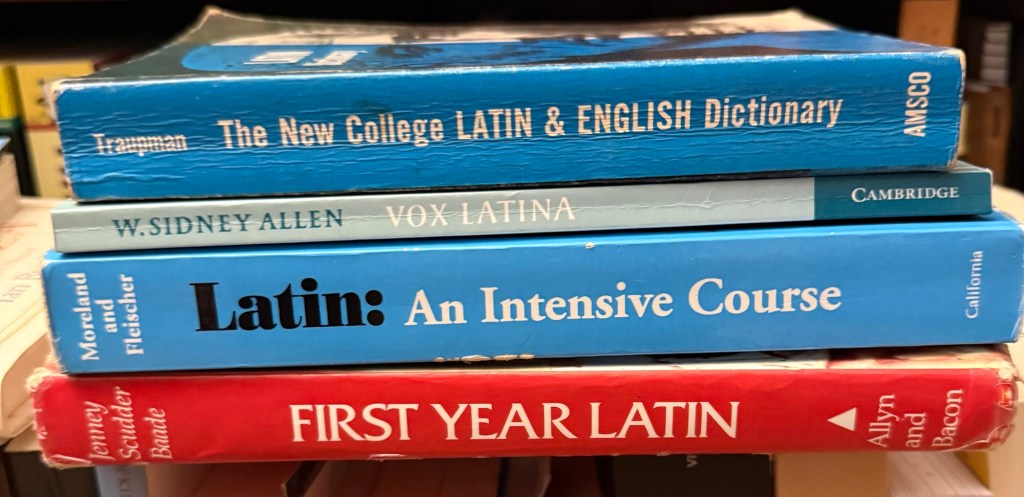
    Some of my physical collection.

    This post collects the top resources I rely on in my study of Classical Latin. The focus here is on tools that are both rigorous and usable—resources I’ve returned to over years (from age 10!) of working with Latin literature, grammar, and historical texts. Whether you’re reading Cicero, Ovid, or Caesar, this toolkit offers a dependable foundation across grammar, vocabulary, style, and reading.

    To Get Started

    Moreland & Fleischer – Latin: An Intensive Course
    A rigorous, grammar-driven introduction to Latin designed for rapid acquisition, often used in intensive summer programs. Each chapter includes vocabulary, grammatical explanations, and exercises, with a strong focus on reading unadapted Latin early. Ideal for learners who appreciate a no-nonsense, immersion-style approach.
    Read online

    Digital Tools

    Logeion
    A fast and comprehensive dictionary interface that includes Lewis & Short, the Elementary Lewis, and other Latin lexica. Entries often include frequency, examples, and morphological info.
    Access online

    Whitaker’s Words
    A downloadable tool (and web version) that parses Latin word forms and offers root definitions. Fast and simple, especially for checking unknown inflected forms.
    Access online

    Perseus Word Study Tool
    Useful for parsing unfamiliar word forms and locating them in context. Linked to the Perseus Digital Library’s extensive collection of classical texts.
    Access online

    The Latin Library
    An enormous archive of classical, medieval, and ecclesiastical Latin texts. No parsing or commentary—just clean, plain Latin.
    Access online

    Hexameter.co
    An interactive tool for learning and practicing dactylic hexameter. Features lines from Vergil, Ovid, Lucretius, and AP Latin selections.
    Access online

    Advanced Topics

    Allen & Greenough – New Latin Grammar
    The most detailed traditional Latin grammar in English, covering syntax, morphology, prosody, and style. Still a go-to reference for advanced students and scholars.
    Read online

    Gildersleeve & Lodge – Latin Grammar
    An alternative to Allen & Greenough with a slightly different emphasis and some unique syntactic classifications. Dense but rewarding for deep grammatical work.
    Read online

    W. Sidney Allen — Vox Latina
    A sister volume to Vox Graeca as mentioned in the Classical Greek Toolkit post. Covers similar ground. Quite foundational; covers many of the quirks of classical pronunciation.
    Read online

    Conclusion

    This toolkit prioritizes depth and clarity in equal measure. Latin is not just a language of forms—it’s a language of authors, arguments, and rhythm. These tools have supported me in reading widely and attentively, and I hope they’ll do the same for you.

    Have favorite resources not listed here? I’d love to hear what’s missing.

    View other toolkits.

  • Tools of the Trade: Language Toolkits Incoming!

    The next portion of Tools of the Trade will focus on a series of “core toolkits” for a variety of languages. These will be linked here as they roll out over the next few days. The first five, in order, will be:

    1. Classical Greek,
    2. Homeric Greek,
    3. Mycenaean Greek,
    4. Classical Latin, and
    5. Akkadian.

    If any more are added, I’ll link them here as well. I’m planning on doing Phoenician and Middle Egyptian at some point, and maybe even posts on families, probably Semitic and Indo-European. After that, there will be two more posts on epigraphic tools, followed by a series of computational ones, and then probably some meta-tools (e.g., guides to digital organization, etc.). After that it’s anyone’s game, and I fully welcome suggestions. Feel free to email me here if there’s anything you’ve been wanting to get into but haven’t found good resources for.

  • Tablets and Tribulations, 1: Lapse and Return

    2023: Tablet replica I made from a drawing in Huehnergard’s grammar.

    I first took Akkadian a few years ago. Since then, the language has been sitting in a kind of suspended animation: just far enough away to feel unreachable, just close enough to make me feel guilty.

    This post kicks off Tablets and Tribulations, a new series chronicling my return to Akkadian. I’ll be using it to track my progress, share insights, and reflect on what it means to study something this complex, this demanding, and this strange.

    Why Akkadian?

    Akkadian sits at the intersection of my academic obsessions: Semitic linguistics, the history of writing systems, and the psycholinguistics of script. It’s a dead language, but not a fossilized one. The more you read it, the more it pulses: with bureaucracy, with poetry, with prayer. And the writing system—a sprawling, phonetically polyvalent syllabary riddled with ideograms—is completely unlike the tight alphabets I’m used to. It demands patience, pattern-recognition, and grit.

    There’s also no shortage of material, with estimates of the number of excavated Akkadian texts reaching as high two million—meaning it quite possibly has the most documents of any ancient language; in fact, according to my professor Ronald Wallenfels, more documents than all ancient languages combined. Put that in your pipe and smoke it.

    I’m also drawn to it because I’m not naturally good at it. Greek and Latin came to me more intuitively, their logics familiar in a way I hadn’t expected. Akkadian doesn’t let me do that. It forces me to slow down, to wrestle with my perfectionism, to train my brain in new ways. And I love that. I want to get good at something hard. I want to overcome the mental blocks that have held me back before.

    What’s Changed

    Since that early study, I’ve broadened my exposure to Semitic linguistics and become more confident working with both the script and the medium. I’ve also made peace with how humbling this language is. Once, I even told a syntax class—confidently—that Akkadian had no demonstratives, only to moments later fact-check myself and discover that it had three distinct tiers of them. I then had to publicly correct myself and told them to pray for me… as I had a quiz on Akkadian pronominals the next period.

    I’m now studying with two grammars, Huehnergard and Caplice, using Labat’s sign list as my main reference. I’m also switching from just drawing signs to pressing them into clay, and my wax tablets—less sketchbook, more scribal. I’ll be posting more about that process (and my tablet replicas) soon.

    What to Expect from This Series

    Tablets and Tribulations will be part language log, part material exploration, and part meditation on what it means to study a language with no living speakers and a script that defies modern intuition. Future posts will likely include:

    • Syntax deep dives (word order, case, verb chains, etc.)
    • Close readings of texts (legal, literary, magical, bureaucratic)
    • Reflections on learning signs and navigating polyvalence
    • Notes on scribal training and cuneiform technique
    • My own experimental archaeology: pressing and firing tablets
    • Anecdotes from the museum and the classroom
    • Psycholinguistic musings on how syllabaries shape cognition
    • Occasional moments of crisis and triumph

    This is going to be hard. But I want that. I want to stretch, stumble, and get back up. That balance—rigor with joy—is what I’m working toward. Each week with Akkadian reminds me how study disciplines the self—not just the mind.

    So here’s to the first step. The tablets await.

  • Marginalia, 1: On The Texture of Dead Languages

    Marginalia, 1: On The Texture of Dead Languages

    I’ve long wondered what it was about ancient languages—as opposed to modern ones—that so captivated me. For more than half my life now (21 years long), they’ve been at the center of my intellectual and emotional world. I’ve done much internal archaeology on this, and here’s where I’ve landed.

    What first drew me to ancient languages wasn’t beauty, or history, or even mystery—this much I knew. But I’ve figured it out, after much reflection: it was structure. At age ten, I was told that Latin had a “very mathematical” nature—and I had a very mathematical mind. That was the pitch that won me over when I was choosing between French, Mandarin, Spanish, and Latin in fourth grade. My friends—older kids who knew me from our accelerated math class—urged me to choose Latin. “It works the way you do,” they said.

    From the beginning, I had a knack for it. Parsing Latin felt like solving elegant equations: all those declension and conjugation charts, the case endings, the tightly constructed sentences. I found the clarity of it deeply satisfying. It’s also what got me into etymology, many a linguist’s bridge into the discipline. I was thrilled to learn that words, and thereby language itself, had discrete histories we could uncover and unlock.

    And, to be honest, I was also avoiding something. I’ve had a lifelong fear of being wrong—especially out loud. The thought of sounding like a toddler in French or Mandarin mortified me, even at that age. Ancient languages, by contrast, required no vocal performance—or at least none you could be substantially corrected on.2 As Mary Beard wrote, it’s a tremendous freedom to read a language without needing to order a pizza in it.

    But beyond the safety of silence and the comfort of structure, ancient languages offered me something stranger and deeper. They are, paradoxically, both rigid and wild—formally inflected, syntactically unruly. Their rich systems of agreement allow a kind of grammatical anarchy. That contradiction fascinated me. And then, there was the sheer alterity: the profound otherness I was only beginning to grasp. These languages came from far away—across centuries and empires—and they had nothing to do with me.

    What I didn’t expect was how intimate they would feel. There’s something magical about reaching across time and space to hear men (alas, mostly men) from millennia ago speak. I feel, in some small way, like I’m raising the dead (see blog title!), giving voice to what was nearly lost. There is mystery in this, in the impossibility of perfect translation, in the silence that always remains. But there is also joy. Sitting at a wooden table, poring over ancient texts with comrades-for-a-semester, I’ve never felt isolated. If anything, I’ve felt surrounded—by the dead, yes, but also by other living readers, deep in the muck of it all.

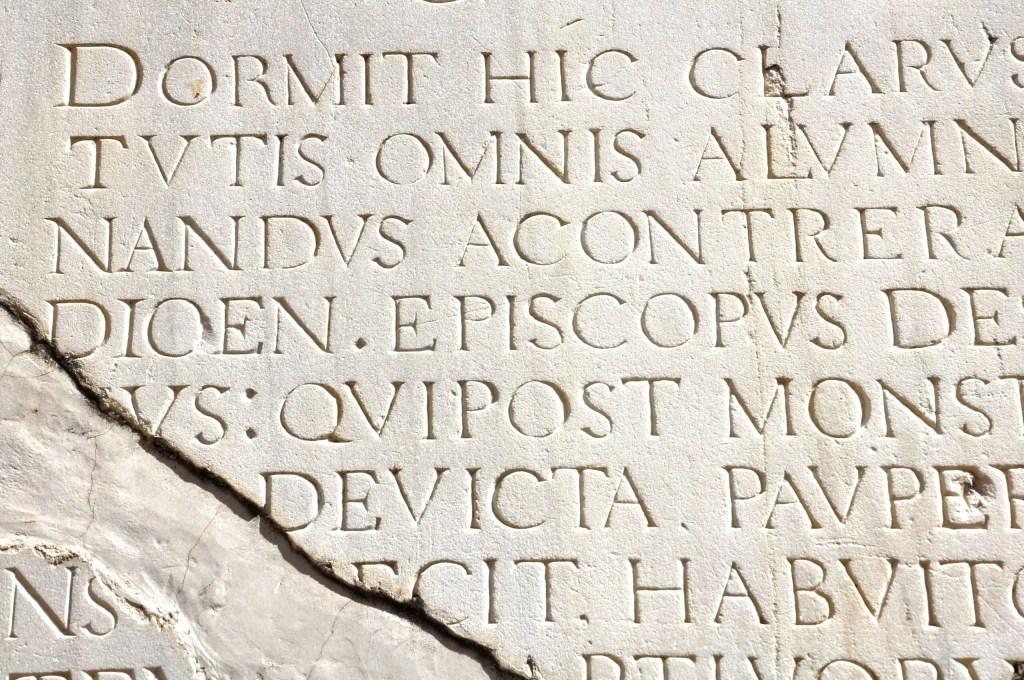
    Inscriptions are my great love: language not filtered through scribes or stylists, but carved directly, once, and then cast into the abyss memoriarum. To read an inscription is to hear a voice that was not supposed to last this long. It reminds me that people have always been this way: strange, familiar, brutal, kind, just like us.3 That realization has made me a softer person, I think. More attuned. You can’t spend your days in conversation with the past—and with the people who help you interpret it—without becoming more human.

    There’s also a tension I feel—quiet but insistent—between my deep love of ancient languages and my commitments to the present. Studying the dead can sometimes feel like retreat: a kind of sequestration in the library, the archive, the ivory tower. And yet, this is also the work that sharpens my ethics. It’s by looking at the long arc of language, power, and survival that I’ve come to understand how political language always is—what gets written down, whose names are preserved, whose voices fade. So while it might look like I’m hiding in the past, I don’t think I am. I’m studying the structures that built the world we live in now—and learning how fragile, and how remakeable, those structures are.

    It’s changed the questions I ask, too. I no longer want to know only what words mean, or what they do. I want to know how they came to be. Who made them. Why they changed. What pressures they both buckled under and resisted. That’s the kind of inquiry ancient languages have trained me for.

    Lately, though, something has changed. For the first time, I’m stepping away from silence. I’m learning a living language—French—and it’s bringing all kinds of old fears and new questions to the surface. But that’s a story for next time, once I’m deeper in it.

    1. To the point I got internet-famous for being a budding particle physicist, which got me invited to labs and observatories around the world, including NYU’s, Columbia’s, and CERN, home of the Large Hadron Collider. ↩︎
    2. After a while, you remember that a Latin “v” is pronounced [w], silly as it sounds aloud. [wɛni widi wiki] just doesn’t hit like [vɛni vidi vit͡ʃi]. ↩︎
    3. Read some of the archaic Theran graffiti (pp. 22-25 of this paper) if you want to see that teenage boys have, in fact, always been teenage boys. ↩︎