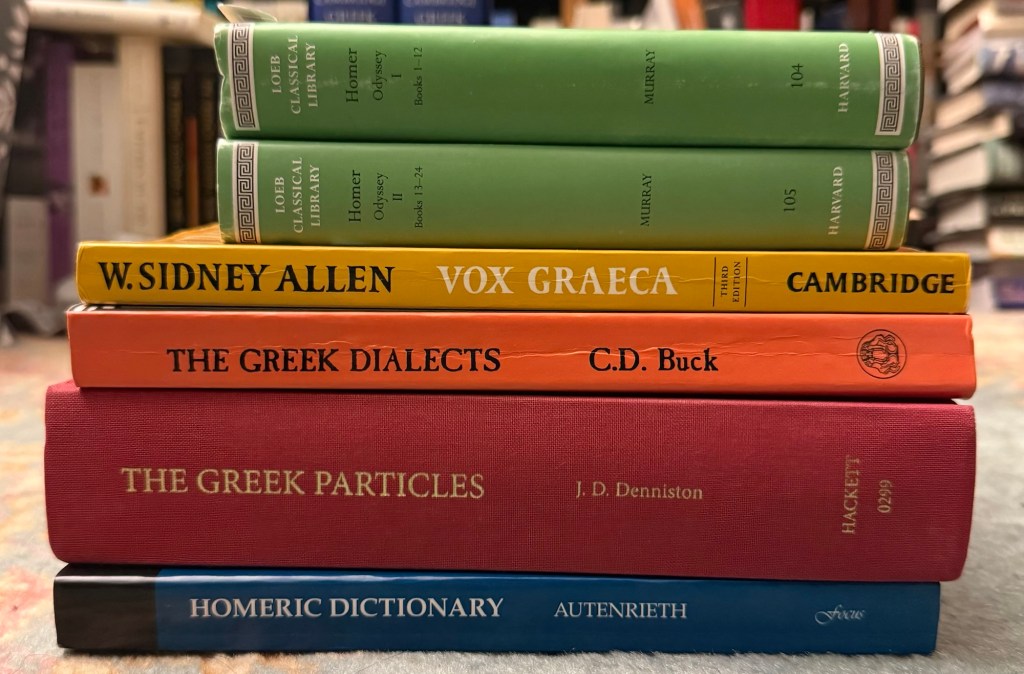
This post collects the top resources I rely on when reading Homeric Greek, especially the Iliad and Odyssey. While much of the grammar overlaps with Classical Greek, Homeric Greek has distinct forms, vocabulary, and meter that call for specialized tools. The following resources—ranging from primers to advanced philological references—are what I return to again and again when working with epic.
To Get Started
Pharr – Homeric Greek: A Book for Beginners An older but remarkably focused introduction built around Iliad 1. Includes grammar notes specific to Homeric forms, extensive vocabulary, and progressively annotated readings. Read online
Benner – Selections from Homer’s Iliad An excellent annotated reader of Iliad Books I–VI, with extensive grammatical commentary keyed to each line. Ideal for intermediate readers. Read online
Cunliffe – A Lexicon of the Homeric Dialect Still the standard Homeric dictionary. Organized by root and form, with citations from epic texts and brief semantic notes. Read online
Digital Tools
Logeion Cunliffe’s Homeric Lexicon is fully searchable on Logeion alongside LSJ. You can easily compare definitions across lexica and check frequency data within the epics. Access online
Perseus Word Study Tool Input any inflected form and receive morphological analysis with links to lexicon entries and usage examples across a wide corpus of Greek texts. Access online
Top 500 Homeric Words Deck Compiled by Chicago, these are the most common vocabulary items in Homer’s epics, and knowing them makes for an efficient path to smooth reading. Access online
Greek Particles Deck Compiled by a Quizlet user, this deck contains over 80 of the most common and important Greek particles to know. Access online
Perseus Digital Library Includes the full texts of the Iliad and Odyssey with parsing tools, English translations, and links to grammatical and lexical resources. Access online
Chicago Homer Tailored specifically for Homeric epic. Offers side-by-side Greek and English translations, word-by-word morphological data, and metrical annotation. Access online
Advanced Topics
Monro – A Grammar of the Homeric Dialect A classic reference that systematically treats the phonology, morphology, and syntax of Homeric Greek. A bit dense, but indispensable for serious linguistic inquiry. Read online
Buck – The Greek Dialects: Grammar and Selected Readings A valuable reference for understanding the dialectal features present in Homeric Greek, which blends primarily Ionic forms with traces of Aeolic. While not focused solely on Homer, this book helps clarify unusual forms and offers broader context for the epic language tradition. Read online
William S. Annis – An Introduction to Greek Meter Offers a clear and concise explanation of dactylic hexameter with scansion exercises and helpful mnemonics. Read online
Hexameter.co An interactive site that gamifies learning dactylic hexameter. Offers scansion tools for Homer (and 3 Latin authors too). Helpful for developing aural sensitivity and fluency in poetic rhythm. Access online
Conclusion
This toolkit focuses on materials that prioritize Homeric Greek as a distinct linguistic system—neither a dialect nor a transitional phase, but a carefully stylized literary register. Whether you’re reading your first lines of the Iliad or preparing to write on Homeric formulae or meter, these tools offer a dependable path forward.
This list isn’t exhaustive, but it covers the resources I’ve found most useful in my own studies. Are there others you swear by for Homeric Greek? I’d love to hear what’s missing.
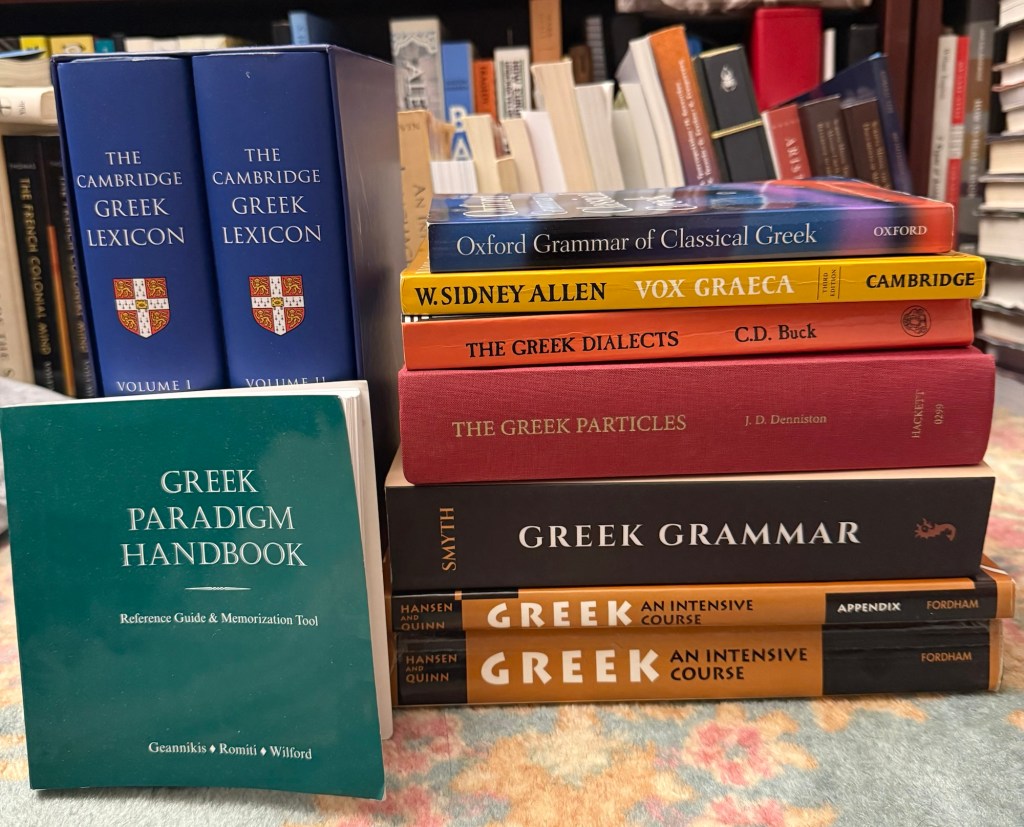
This post collects the top resources I rely on in my own study of Classical Greek. For each category—grammar, vocabulary, reading tools, and advanced study—I’ve selected the best materials available, with a focus on clarity, depth, and long-term usefulness. Whether you’re just beginning or looking to sharpen your command of dialects, meter, or style, this toolkit offers a reliable foundation. These are the books and tools I return to again and again when reading Classical Greek, especially texts in the Attic-Ionic dialect continuum.
To Get Started
Hansen & Quinn – Greek: An Intensive Course A demanding but highly structured introduction to Classical Greek, often used in college-level intensive courses. Includes graded readings, grammar explanations, and exercises. Read online H&Q Vocabulary Decks: Quizlet class
Smyth – Greek Grammar A comprehensive and authoritative reference grammar, covering all aspects of Classical Greek morphology and syntax. Best used alongside reading or for targeted review. Read online
Digital Tools
Logeion A lexical lookup tool developed by the University of Chicago. It aggregates major dictionaries, including Liddell-Scott-Jones (LSJ), “Middle Liddell,” and Autenrieth. Entries include frequency data, sample passages, morphological breakdowns, and cross-references. Access online
Perseus Word Study Tool Input any inflected form and receive morphological analysis with links to lexicon entries and usage examples across a wide corpus of Greek texts. Access online
Greek Particles Deck Compiled by a Quizlet user, this deck contains over 80 of the most common and important Greek particles to know. Access online
Perseus Digital Library A major online collection of Greek texts, including works by Homer, Herodotus, Plato, and others. Offers on-hover parsing, English translations, and links to dictionaries and grammar tools. Access online
Advanced Topics
W. Sidney Allen – Vox Graeca: The Pronunciation of Classical Greek A foundational work on ancient Greek phonology and historical pronunciation. Includes reconstructions of Attic phonetics and prosody, with attention to evidence from meter, spelling, and comparative linguistics. Read online
Buck – The Greek Dialects: Grammar and Selected Readings A readable introduction to the major dialect groups of Ancient Greek, with grammatical summaries and annotated sample texts. Useful for epigraphy, lyric poetry, and comparative philology. Read online
William S. Annis – An Introduction to Greek Meter A concise and accessible guide to reading Greek poetry metrically. Covers major meters with clear examples and scanning advice. Read online
Denniston – The Greek Particles An advanced and nuanced treatment of Greek particles. Indispensable for close reading and stylistic analysis, especially in prose authors like Thucydides and Plato. Read online
Conclusion
This list isn’t exhaustive, but it covers the materials I’ve found most reliable and rewarding. Are there tools or texts you swear by that aren’t here? I’d love to hear what you think is missing.
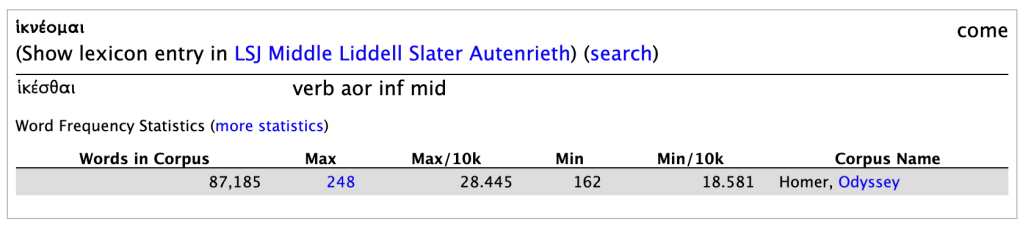
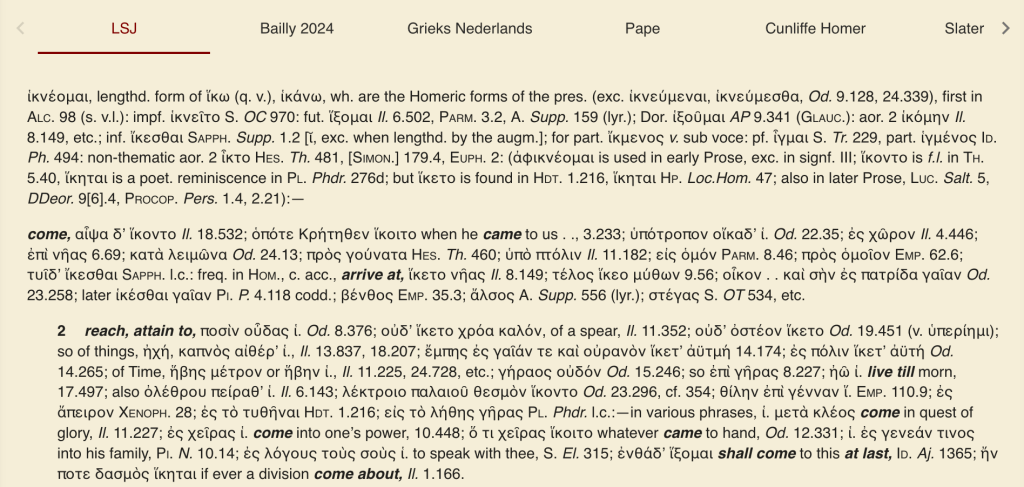
Perseus’s result for ἱκνέομαι: a quick parser, giving form and summary of corpus occurrences.Partial Logeion result for the same word: collates detailed results from nine separate dictionaries with a 10th tab for corpus occurrences.
For anyone studying Latin or Ancient Greek—whether casually, academically, or obsessively—two digital tools stand out as indispensable: Perseus and Logeion. I use both almost every day. While they serve overlapping purposes, each has its own strengths, and learning to navigate between them has made my reading smoother, faster, and more precise.
Perseus, formally known as the Perseus Digital Library, is one of the earliest and most ambitious digital humanities projects in the field of Classics. It provides access to a massive collection of Greek and Latin texts with built-in parsing tools, dictionary links, and (often outdated but still helpful) English translations. Its strength lies in contextual reading—hovering over any word in a text will generate a parsing suggestion and a link to its dictionary entry, which makes it incredibly useful when working through a new author or a grammatically complex passage. The Word Study Tool allows you to input any inflected form and get a list of possible morphological analyses and dictionary headwords, with links to example passages. However, it’s important to note that these parsings are generated by algorithms and are not always reliable, especially for ambiguous forms. The interface can also feel a bit dated, and not all texts are equally well formatted, but for quick reading and parsing, Perseus is great.
By contrast, Logeion is a sleek and powerful lexicon aggregator developed by the University of Chicago. Unlike Perseus, it doesn’t offer complete texts, but it excels at lexical depth. When you enter a word—either in Latin or Greek—Logeion pulls results from multiple dictionaries at once, including LSJ, Middle Liddell, Autenrieth, Lewis & Short, Elementary Lewis, Frieze-Dennison, and others. You also get frequency data, example passages, and, in some cases, idiomatic usages or English-to-Greek reverse entries. Logeion doesn’t parse for you, so you need to know or guess the dictionary form of the word. But once you do, the definitions it offers are more precise and informative than any single dictionary alone. I often use it to compare lexical nuance across genres or authors, and it’s especially helpful when I want to confirm the meaning of a word I already sort of “know.”
The way I use these two tools in tandem is pretty straightforward. When I’m reading through a text, especially something new or poetic, I usually begin in Perseus. I use the on-hover parsing and the Word Study Tool to get oriented, especially with verbs and particles. Once I have the base form, I switch over to Logeion to dig deeper into meaning, idiom, or usage across contexts. Logeion becomes especially helpful when I’m writing, translating, or thinking more syntactically. In many ways, Perseus is like a field guide with helpful margin notes, while Logeion is the serious reference work you turn to when you want to be exact.
If you’re just starting out, don’t feel pressured to master everything at once. But learning to toggle between Perseus and Logeion will give you a huge advantage—especially if you’re not always reading with a print dictionary on hand or don’t have institutional resources. I’ve used these tools for years—they’ve remained central across every stage of my study. They’re fast, free, and surprisingly deep once you know where to look.
If you’ve found tricks for using them more efficiently, or if you have a favorite feature I didn’t mention, let me know what’s missing.
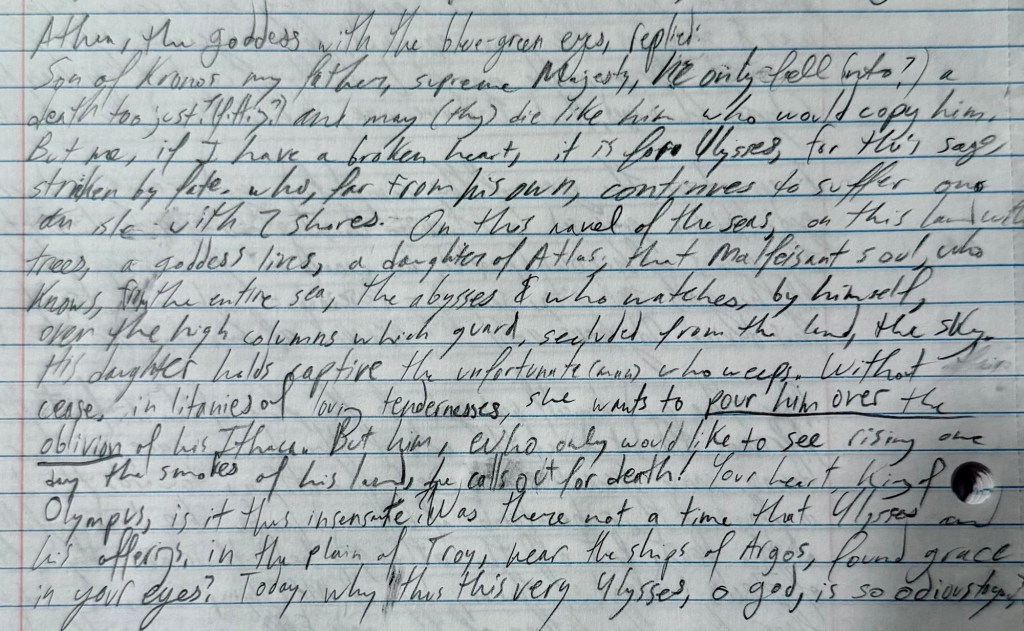
A passage, translated from Bérard, that I found particularly moving. In it, Athena pleads to Zeus, asking that he find mercy in his hardened heart for Odysseus.
Reading for friction, not fluency
In the first week of Tritropic, I found myself reading the same passage in French and Greek on the same day. It seemed like a good idea: reinforce the meaning, triangulate expression, hold the line up to two kinds of light. Instead, once I’d puzzled out the syntax and meaning in one language, the second version became trivial. All the work had already been done, particularly because Bérard’s French hews so closely to the original—here a gift and a curse, since the shape of the sentence had already been laid bare.
What should have been a second act of discovery turned into a performance of memory. And that, for me, is a dead end.
So I’m revising my approach for the next month to see if a new structure works. I now read a Book of the Odyssey in French across a week, then return to the same section in Greek for the next two or three weeks. This reintroduces mystery—just enough forgetting to force me to re-earn my understanding. Each version remains itself so I can’t lean on one to carry the other. However, there’s just enough closeness, I think, for comparison of translation choices. Theory of translation is something I quite want to pursue through this—it’d be a shame to lose that aspect.
Scaffolds and Syntax
In these early days, I’ve learned to be wary of digital tools—pop-up glosses, online parsers, translation extensions. There’s a difference between using scholarly supports and just outsourcing thought. Too often, I found myself parsing without learning. Clicking my way through a passage gave me the answer but not the understanding.
To counter that, I’ve built what I call a “Reading Ladder” for the French. It begins with a cold read—no tools, no support, just me and the text, making guesses about syntax and structure. Next, I pass through a deeper parsing stage, using only a grammar and a basic dictionary to confirm key unknowns, not every minor term. Only after this do I allow myself to consult a translation or ask my fluent friends, not as a crutch but as a corrective.
I plan two final stages once I get my bearings more. These are expressive exercises: retelling the passage in my own French, rereading it aloud for rhythm, and briefly stepping outside the text to engage with something stylistically adjacent—a short piece by Gide, a 19th-century abstract on epic poetics, anything that stretches my sense of what French can do.
Throughout this process, I plan on keeping a syntax journal. Each week, I record one sentence I understood without help, one that tripped me up (with notes on why), and one that delighted me. The journal is to be a miniature Grammaire Bérardienne. It also is meant as a reminder that joy is a form of comprehension.
Greek and Joyful Tedium
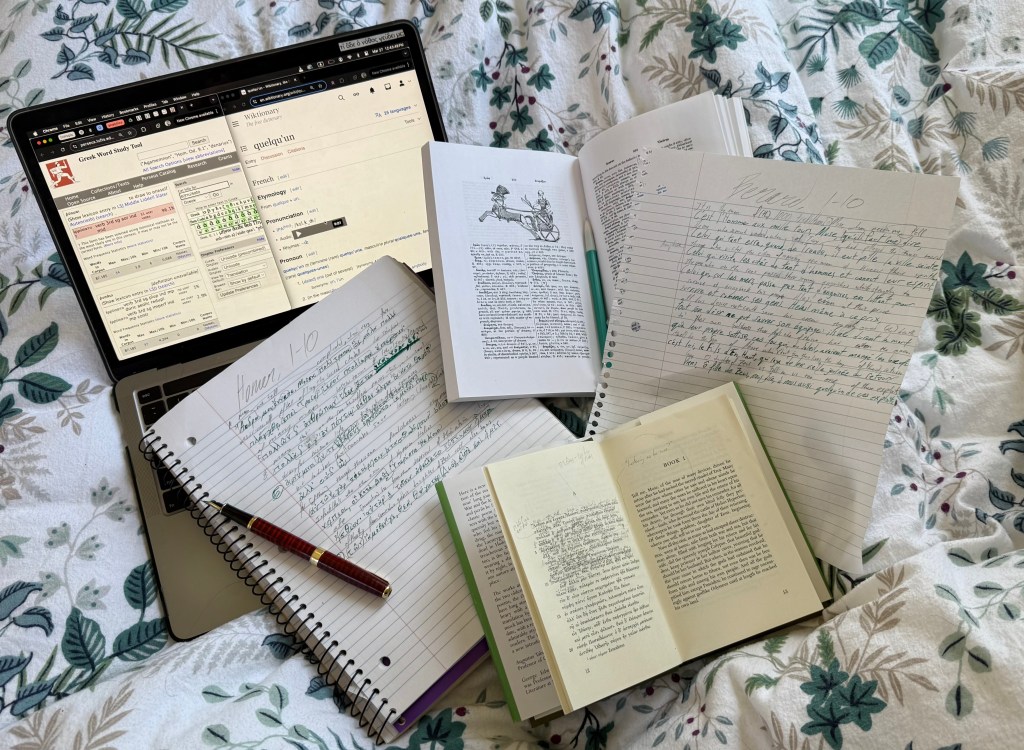
Greek, with its distance from both English and the Attic I’m familiar with, is a harder beast—and all the more rewarding because of it. I’ve adopted a multi-pass system here as well. The first time through, I read aloud without stopping. No dictionary, no notes, just the text and the shape of the sentence as much as I can discern it. I underline words I don’t know, try to guess at their meaning from morphology, meter, or context. Only after that do I allow myself to return and parse each word carefully. By then, I’ve already begun to intuit some of the patterns, and the parsing feels earned rather than imposed.
Twice a week, I do blind parsing drills. I take a short passage, cover any translation, and write out the morphological analysis of each verb and noun—tense, mood, case, number, person, source verb or noun. Then I translate from scratch. It’s humbling, but it builds exactly the muscles I’m trying to train.
Every month, I’m going to try to reread an entire Book in Greek with no aids. It’s the closest this kind of study gets to strength training. My professors have told me one of the best things you can do for your Greek (and language skills generally) is to reread, since you’re no longer in just decode-mode. This very much helped me last semester in my Lucian class. The sense of fluency that emerges—halting, but unmistakable—is worth every hour.
I also keep a personal lexicon, noting each unfamiliar form, particle usage, or idiom that gives me pause. And every few weeks, I’ll try my hand at short Homeric compositions—just five or six lines using words and constructions I’ve encountered. In the meantime, I’m studying from two Quizlets: one of the 500 most common Homeric vocabulary items, and one with 70+ important ‘small words.’
What the Text Offers
What I hadn’t fully expected was just how well-suited the Odyssey is for this kind of iterative, interleaved learning. Its repetitions are pedagogical for me. Vocabulary recurs with slight variations, idioms reappear in altered contexts, and the syntax is often rhythmic enough to imprint itself on the brain. Bérard understands this, and he mirrors Homer’s scaffolding with care. His French extends Homer’s use of anaphora, his vocabulary choices build on one another, and his ceremonial tone reinforces structure as it elevates the prose.
In both languages, challenge ramps up at a manageable pace. I’m only a few pages in, but already I can sense the increasing complexity—more embedded clauses, trickier participial constructions, and richer metaphor. But nothing feels unearned. The text supports you even as it stretches you.
Perseverance, Not Performance
There’s a line at the beginning—one I have reached in both languages—that keeps echoing in my head: ὃς μάλα πολλὰ πλάγχθη. It’s often rendered loosely as “he who was greatly tossed about,” but the Greek is more literal than that, and stranger: he who was driven off far or much. It conjures not just aimless wandering, but compelled displacement—someone pushed off course by forces beyond his control.
Bérard translates it as celui qui tant erra—“the one who wandered so much.” Murray’s version is starker: “the man who was driven far astray.” Murray evokes motion without agency, but Bérard is softer, more open to interpretation on whether this wandering was chosen or forced. Yet they both understand that πλάγχθη is not just travel, but deviation.
The line isn’t just about Odysseus, however. It describes what it means to read a difficult language honestly. You’re driven, sometimes astray, but still in motion.
Difficulty, for me, is no longer something to overcome. I recognize it now as an essential condition for progress. Every time I misparse a participle or mistake a clause boundary, I get a little closer to understanding—not just the sentence, but the langauge system that generated it. That’s the rhythm of the tritropic line: wandering with purpose.
Homer I.1-10 across three languages—with a bit of etymology on the side.
Sing to me of the line turned thrice.
When Homer calls Ulysses polytropos, he conjures a man of many turns—clever, wayward, folded in on himself. But I think of the line itself: turned once, then again, and again.
This series takes its name from that multiplicity—because I, too, am reading each line far more than once. A minimum of three times, actually: English (Murray), French (Bérard), and the original Greek. The goal is not to triangulate a single meaning, but to feel the pressure points, the fault lines where interpretation shifts. The line becomes a hinge, a thing that can bear weight because it bends. Tritropic is about following that movement: reading with the grain, against, and across it.
I start at the question of beginnings. To open something well—an argument, a poem, a conversation—is to create a direction; it prepares the reader for movement without determining the destination. This is the art I want to think about: how an opening invites us in. What is foregrounded, what is sacrificed: what choices author and translator (perhaps a false distinction) are forced to negotiate.
So this is the first go. Tritropic starts from no thesis, but instead a posture: curious, slant, slightly off-center. Like Ulysses on the shore, this is always arriving, always about to depart.
Introduction
Let’s begin with an overview of the three versions and their respective approaches to opening the Odyssey—what each one foregrounds, what gets relegated to the background. From there, we’ll move into close readings of selected lines and phrases to ground the analysis. Finally, we’ll wrap up with a reflection on the interpretive choices each version makes.
Overview
I chose these translations for fidelity rather than flourish. I’ve read more poetic renditions of the Odyssey before—this January, I listened to Emily Wilson’s iambic pentameter version, particularly relishing the experience of orality—and enjoyed them greatly. But since my aim here is to learn both Epic Greek and modern French precisely, I sought translations that hew closely to the original line structure. The occasional flourish is still present, of course, but ideally these embellishments echo Homer’s own style, rather than showcasing the translator’s innovations.
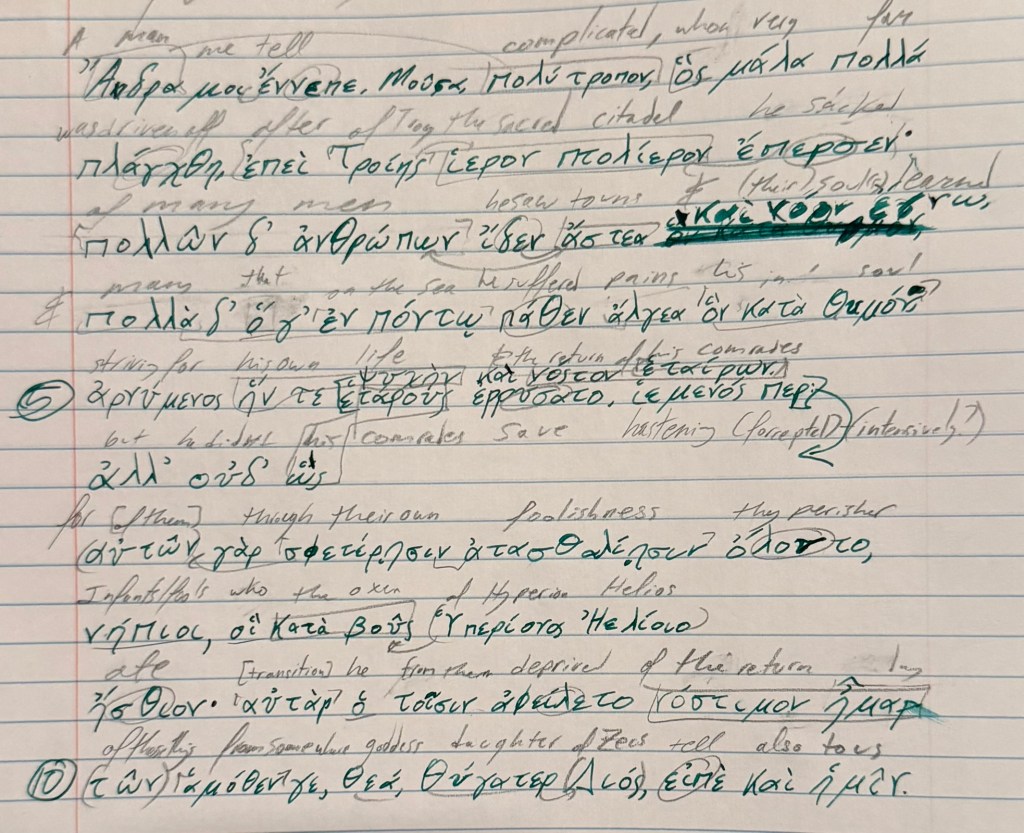
1. Greek (Homer): Epic immediacy and economy. The poem begins mid-thought without naming Odysseus, as if the story is already in motion. The identity of the hero is constructed through epithet and action, not personal detail. Syntax, too, reflects this: the Muse is invoked not in isolation but embedded within the sentence, mid-line, as part of the narrative’s machinery rather than as ornament. The structure is tightly coiled, balancing compression with clarity. It prioritizes movement, ethos, and a certain moral ambiguity: the line blames the men’s deaths on their own actions, but doesn’t dwell on it. The register is neutral, even austere. It’s less about grandeur than narrative pressure.
My handwritten markup of the Greek: an early attempt to track structure, emphasis, and ambiguity.
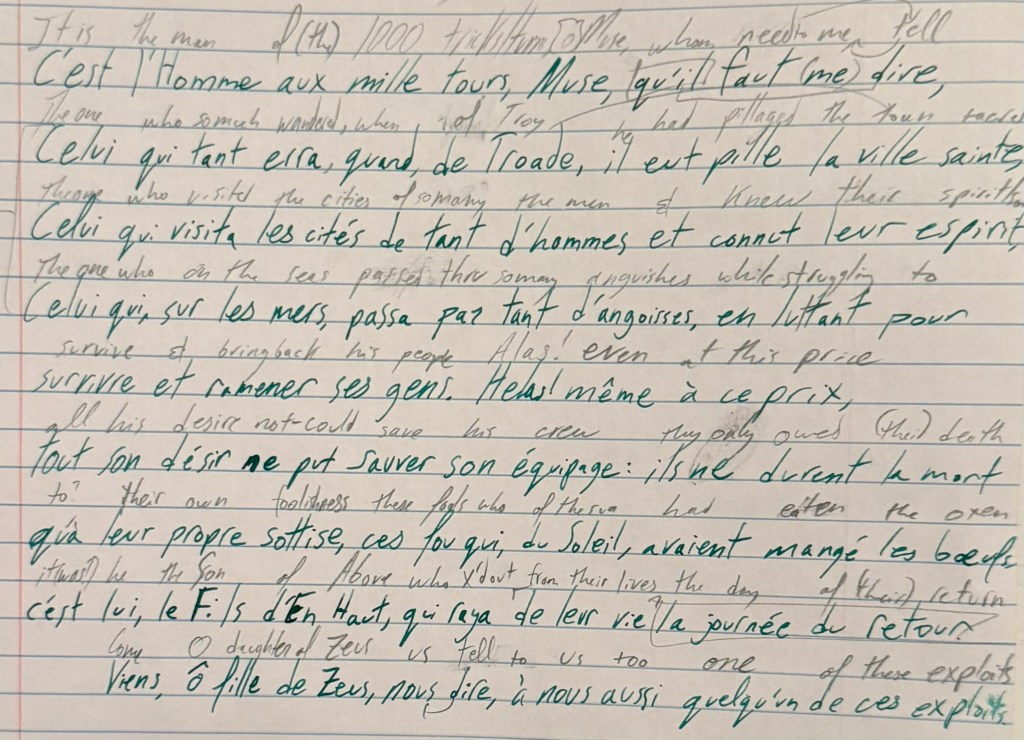
2. French (Bérard): Elevated, rhetorical, almost ceremonial. The anaphoric structure builds rhythm and stature, layering Odysseus’s identity through a litany of actions. He’s gradually evoked, perhaps even summoned, through his deeds and suffering. The effect is reverent, with an undertone of moral reflection. Where Homer enters mid-thought, Bérard expands the opening, giving it space and resonance. It feels less like a launch and more like an unveiling.
C’est l’Homme aux mille tours, Muse, qu’il faut me dire—celui qui tant erra quand, de Troade, il eut pillé la ville sainte; celui qui visita les cités de tant d’hommes et connut leur esprit; celui qui, sur les mers, passa par tant d’angoisses, en luttant pour survivre et ramener ses gens. Hélas! même à ce prix, tout son désir ne put sauver son équipage: ils ne durent la mort qu’à leur propre sottise, ces fous qui, du Soleil, avaient mangé les bœufs; c’est lui, le Fils d’En Haut, qui raya de leur vie la journée du retour. Viens, ô fille de Zeus, nous dire, à nous aussi, quelqu’un de ces exploits.
My markup of the French: tracing rhythm, repetition, and the tonal shift from epic immediacy to ceremonial unveiling.
3. English (Murray): Spare, formal, and slightly distanced. Murray often mirrors the Greek more directly, especially in structure and sequence, but smooths out its syntactic tension. The tone is restrained, almost academic—archival rather than evocative. This is a translation written for sense, not sensation. Compared to Bérard, it holds back emotionally, but gains a kind of angular precision. It doesn’t call attention to itself, but allows the structure of the Greek to show through in quiet outline.
Tell me, Muse, of the man of many devices, driven far astray after he had sacked the sacred citadel of Troy. Many were the men whose cities he saw and whose minds he learned, and many the woes he suffered in his heart upon the sea, seeking to win his own life and the return of his comrades. Yet even so he did not save his comrades, for all his desire, for through their own blind folly they perished fools, who devoured the cattle of Helios Hyperion; whereupon he took from them the day of their returning. Of these things, goddess, daughter of Zeus, beginning where you will, tell us in our turn.
Close Readings
1. πολύτροπος and its discontents
We have no choice but to begin with the very first phrase—so thoroughly debated and reinterpreted throughout Homeric scholarship. I want to focus on the word πολύτροπον (polytropon), and how Murray and Bérard each handle it. Murray uses “the man of many devices,” while Bérard chooses l’Homme aux mille tours—“the man of a thousand tricks” or “turns,” with tours carrying the connotation of sleight-of-hand, deception, or magical illusion. Both gesture toward resourcefulness, but neither quite captures the full semantic range of the Greek. More critically, both seem to assume a certain foreknowledge of Odysseus’s character—baking in the idea that he is clever or crafty from the outset, rather than allowing that identity to emerge gradually.
Let’s briefly review the three primary senses of πολύτροπος. First, there’s the literal reading: “much turned” or “widely traveled”—someone who has been spun about by experience or circumstance. Second, we have the metaphorical sense: “turning many ways,” with its implications of cunning or adaptability—this is the sense Murray and Bérard both foreground. Finally, there’s a broader, more abstract reading: “varied,” “manifold,” or “complex,” which Emily Wilson interestingly captures with her rendering: “Tell me about a complicated man.”
My view is that we are not yet supposed to know Odysseus is wily. Rather, the poem opens with a quality that invites interpretation—ambiguous enough to resonate differently as the narrative unfolds. The word sets up a possibility, one that the story gradually confirms, refines, and occasionally challenges. The opening line becomes a touchstone for the question of who Odysseus really is—and how we come to know him.
That’s why, as compelling as l’Homme aux mille tours is, it risks being too definitive, overly revealing. But this is the dilemma: no single word in English or French captures all three senses of πολύτροπος without tipping the translator’s hand. A phrase suggesting “much turned about” would arguably be more faithful to the line’s ambiguity and the shape of the sentence as a whole. But the translator is constrained by the target language’s limitations—by the impossibility of fully conveying the layered meanings carried by one word in the original. This, in turn, raises fascinating questions about what a translator should do when faced with a linguistic and semantic compression that resists clean transfer.
2. Anaphora of Celui qui
Bérard’s most striking structural departure from Homer is his use of anaphora: the repeated phrase “Celui qui…” (“he who…”), which appears three times in quick succession. This repetition is entirely absent from the Greek, which presents Odysseus’s identity in a single, flowing participial phrase. Bérard, by contrast, builds Odysseus slowly and ceremonially—almost liturgically—through a catalogue of trials. The effect is grand, formal, and reverent: Odysseus is not simply introduced, but elevated, summoned through a rhythmic invocation of his feats. Each “Celui qui…” functions like a rung on a ladder, progressively constructing the man through his actions and sufferings. It slows the tempo of the opening and foregrounds the translator’s interpretive stance: this is not an epic dropped into mid-action, but a hero’s life laid out for consideration. In doing so, Bérard shifts the invocation from Homer’s abrupt immediacy to something closer to an unveiling. We are asked not simply to listen to a tale, but to witness an emergence.
3. Le Fils d’En Haut vs Helios Hyperion
Another departure comes in the form of Bérard’s rendering of Helios Hyperion, the Sun God whose sacred cattle the crew consumed. Where Homer gives us Ὑπερίονος Ἠελίοιο—a doubling of name and epithet that emphasizes divine lineage and radiant power—Bérard offers a striking paraphrase: le Fils d’En Haut, “the Son of the One Above” or “the Son from on High.” While not a direct equivalent, this phrase preserves the sense of elevated origin and distance, reframing Helios less as a named deity and more as a remote, celestial force. The capitalization of En Haut subtly enhances this effect, suggesting a kind of cosmic authority. The result is a tone that feels more solemn, even vaguely moralizing, than the Greek, which names Helios with mythic familiarity. Bérard’s version trades specificity for grandeur, shifting us from epic genealogy to something abstract and severe.
The original suggests a cosmic, almost elemental force—Helios as a being of grandeur and consequence, but not necessarily judgment. Bérard’s phrasing, by contrast, injects a sense of moral authority and divine retribution. It subtly shifts the register from epic cosmology to something more solemn and punitive, perhaps more familiar to modern readers raised in Abrahamic traditions. It’s a moment where fidelity bends toward resonance—and in doing so, reorients the ethical frame of the passage.
Conclusion
Taken together, these choices (lexical, structural, and tonal) reveal the translator’s position as co-creator. The opening of the Odyssey is a test of orientation. What kind of man is Odysseus? What kind of journey is this? And what kind of voice is being summoned to tell it? Each version answers those questions differently—by emphasizing character, or pacing, or cosmic justice—and in doing so, opens several paths at once. The line, turned thrice, doesn’t narrow but widens.
And in this act of beginning—of turning the line three times—I’m also opening something in myself.
If you read the first Marginalia post, you know that I’ve long felt more at ease among the dead. Ancient languages have given me structure, distance, and safety: a world of forms I could move through silently, precisely, without the risk of mispronunciations. I called it intimacy, and it was. But it was also retreat.
Now, for the first time, I’m trying something different. I’m learning a living language to actually use it in my life. And I’m doing it by going to what I know best: texts I already love, structures I’ve long studied, lines I can trust to guide me. I’m approaching French from the inside out, trying to inhabit it the way I first dwelled in Latin: structurally, curiously, joyfully.
This attempt is a kind of bridge for me: between ancient and modern, dead and living, silence and sound. That’s what this Tritropic project is, at heart: not just about literacy, but about vocalizing too. I don’t know where this will go. But I’m here, at the opening, bent toward what comes next.
I’ve long wondered what it was about ancient languages—as opposed to modern ones—that so captivated me. For more than half my life now (21 years long), they’ve been at the center of my intellectual and emotional world. I’ve done much internal archaeology on this, and here’s where I’ve landed.
What first drew me to ancient languages wasn’t beauty, or history, or even mystery—this much I knew. But I’ve figured it out, after much reflection: it was structure. At age ten, I was told that Latin had a “very mathematical” nature—and I had a very mathematical mind. That was the pitch that won me over when I was choosing between French, Mandarin, Spanish, and Latin in fourth grade. My friends—older kids who knew me from our accelerated math class—urged me to choose Latin. “It works the way you do,” they said.
From the beginning, I had a knack for it. Parsing Latin felt like solving elegant equations: all those declension and conjugation charts, the case endings, the tightly constructed sentences. I found the clarity of it deeply satisfying. It’s also what got me into etymology, many a linguist’s bridge into the discipline. I was thrilled to learn that words, and thereby language itself, had discrete histories we could uncover and unlock.
And, to be honest, I was also avoiding something. I’ve had a lifelong fear of being wrong—especially out loud. The thought of sounding like a toddler in French or Mandarin mortified me, even at that age. Ancient languages, by contrast, required no vocal performance—or at least none you could be substantially corrected on.2 As Mary Beard wrote, it’s a tremendous freedom to read a language without needing to order a pizza in it.
But beyond the safety of silence and the comfort of structure, ancient languages offered me something stranger and deeper. They are, paradoxically, both rigid and wild—formally inflected, syntactically unruly. Their rich systems of agreement allow a kind of grammatical anarchy. That contradiction fascinated me. And then, there was the sheer alterity: the profound otherness I was only beginning to grasp. These languages came from far away—across centuries and empires—and they had nothing to do with me.
What I didn’t expect was how intimate they would feel. There’s something magical about reaching across time and space to hear men (alas, mostly men) from millennia ago speak. I feel, in some small way, like I’m raising the dead (see blog title!), giving voice to what was nearly lost. There is mystery in this, in the impossibility of perfect translation, in the silence that always remains. But there is also joy. Sitting at a wooden table, poring over ancient texts with comrades-for-a-semester, I’ve never felt isolated. If anything, I’ve felt surrounded—by the dead, yes, but also by other living readers, deep in the muck of it all.
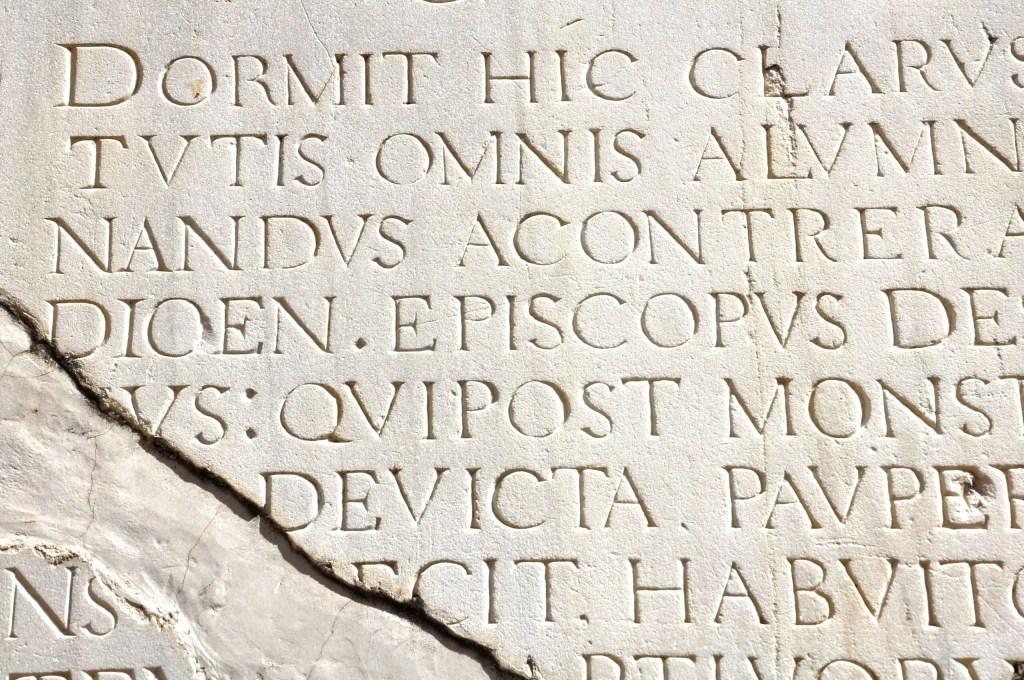
Inscriptions are my great love: language not filtered through scribes or stylists, but carved directly, once, and then cast into the abyss memoriarum. To read an inscription is to hear a voice that was not supposed to last this long. It reminds me that people have always been this way: strange, familiar, brutal, kind, just like us.3 That realization has made me a softer person, I think. More attuned. You can’t spend your days in conversation with the past—and with the people who help you interpret it—without becoming more human.
There’s also a tension I feel—quiet but insistent—between my deep love of ancient languages and my commitments to the present. Studying the dead can sometimes feel like retreat: a kind of sequestration in the library, the archive, the ivory tower. And yet, this is also the work that sharpens my ethics. It’s by looking at the long arc of language, power, and survival that I’ve come to understand how political language always is—what gets written down, whose names are preserved, whose voices fade. So while it might look like I’m hiding in the past, I don’t think I am. I’m studying the structures that built the world we live in now—and learning how fragile, and how remakeable, those structures are.
It’s changed the questions I ask, too. I no longer want to know only what words mean, or what they do. I want to know how they came to be. Who made them. Why they changed. What pressures they both buckled under and resisted. That’s the kind of inquiry ancient languages have trained me for.
Lately, though, something has changed. For the first time, I’m stepping away from silence. I’m learning a living language—French—and it’s bringing all kinds of old fears and new questions to the surface. But that’s a story for next time, once I’m deeper in it.
To the point I got internet-famous for being a budding particle physicist, which got me invited to labs and observatories around the world, including NYU’s, Columbia’s, and CERN, home of the Large Hadron Collider. ↩︎
After a while, you remember that a Latin “v” is pronounced [w], silly as it sounds aloud. [wɛni widi wiki] just doesn’t hit like [vɛni vidi vit͡ʃi]. ↩︎
Read some of the archaic Theran graffiti (pp. 22-25 of this paper) if you want to see that teenage boys have, in fact, always been teenage boys. ↩︎
 To Wake the Dead