
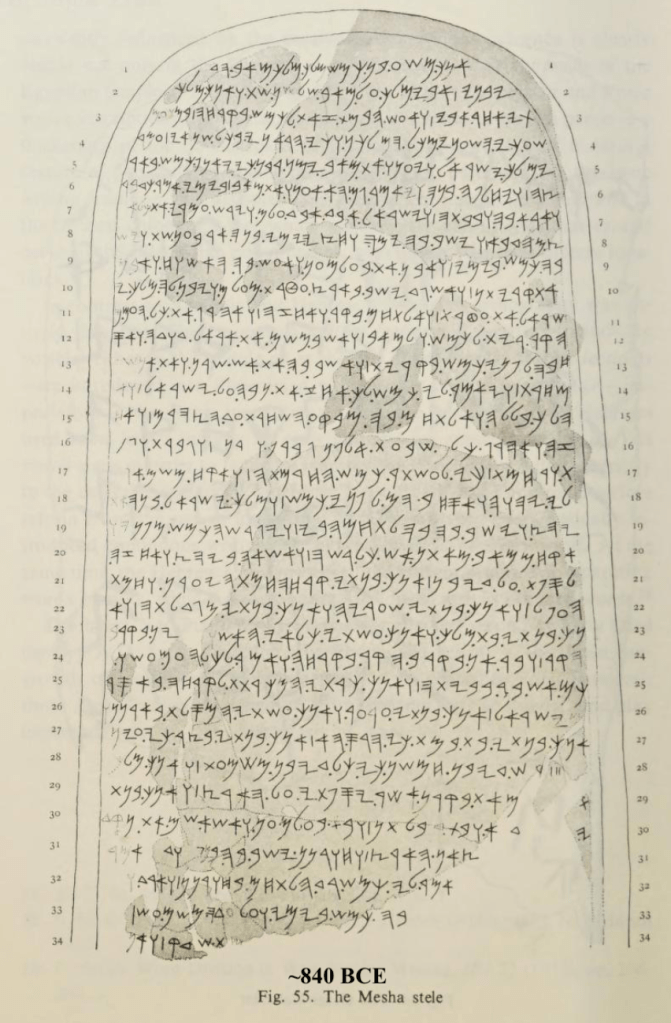
If the first APEX post was about tracing letters, this one is about why those traces matter. Underneath every variant alpha or eccentric epsilon is a deeper question: when, how, and under what conditions did the Greek alphabet emerge from its West Semitic predecessor? This question, which is known in the scholarship as the transmission problem, lies at the core of alphabetic studies, and despite over a century of scholarship, it remains fiercely contested. To map alphabetic transmission is not just to track graphical similarity, but to reckon with how cultures borrow, adapt, forget, and reimagine the systems by which they make language visible.
At its simplest, the transmission problem asks: When did the Greeks adopt the Phoenician script? But the real terrain is messier. Did the transfer happen once or multiple times? Was it sudden or gradual? Coordinated or ad hoc? Which region of the Greek-speaking world was first? Exactly which Semitic script was the donor—or was there a confluence of models? And what kind of evidence—linguistic, paleographic, archaeological—should we privilege when our sources conflict?
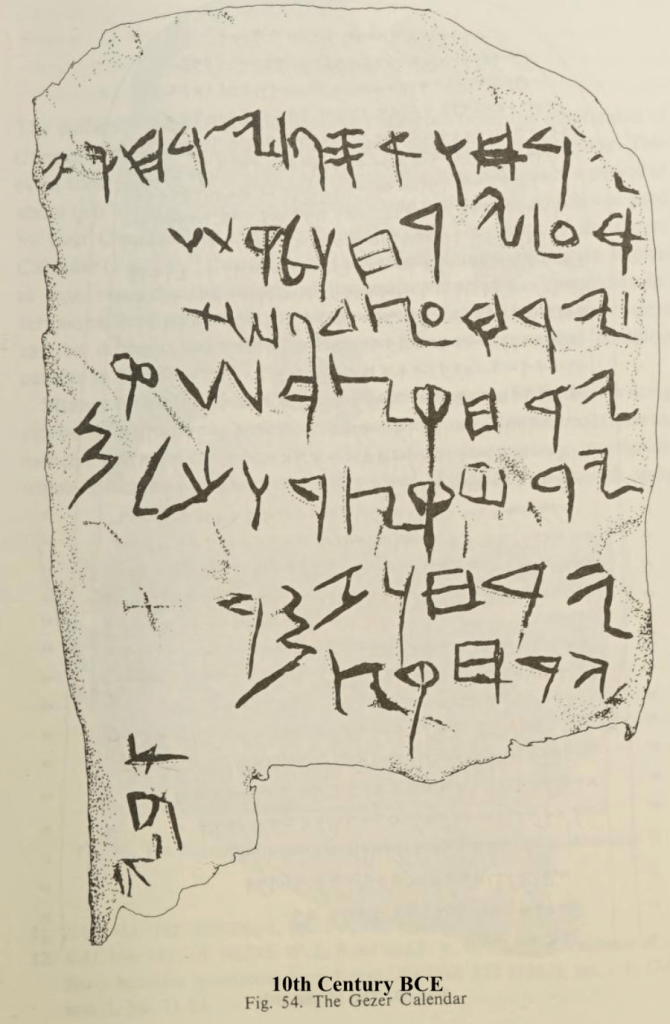
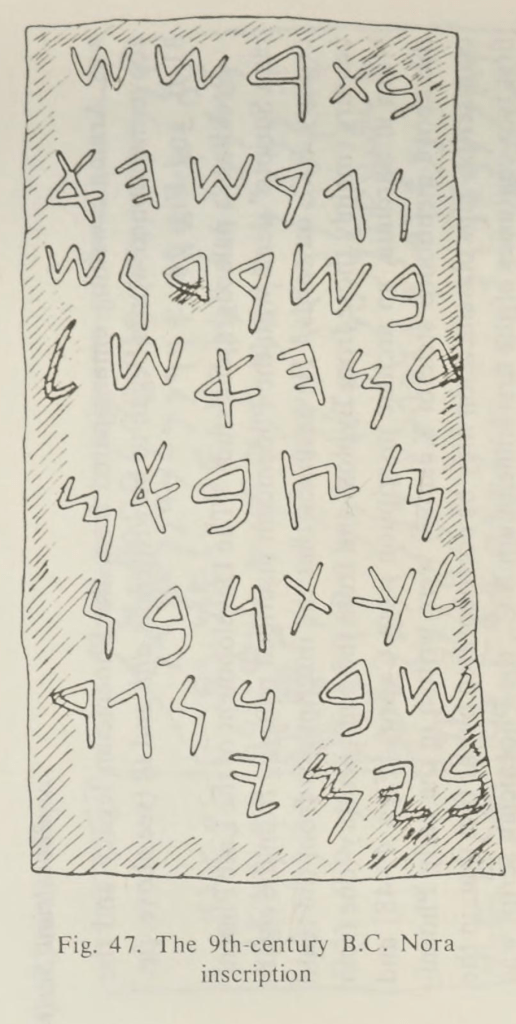
Historically, the debate has followed disciplinary lines. Scholars trained in Semitic philology and Near Eastern studies tend to favor a high date for the transmission: sometime in the 11th or 10th century BCE, before the traditional Greek Geometric period (in older scholarship, referred to as the “Greek Dark Age”). This camp emphasizes the strong formal similarities between early Greek and Phoenician letterforms, arguing that Greek epichoric scripts most closely resemble Phoenician forms from around 1050 BCE, not the later shapes one would expect if transmission occurred in the 8th century. Joseph Naveh, for instance, in his landmark Early History of the Alphabet (1982), argued that the Greek system must have branched off before major innovations appear in the Phoenician script, such as the angular mem or evolved forms of shin. Naveh saw the Greek alphabet as a snapshot of an earlier Semitic system—evidence, in his view, of early contact and early borrowing.
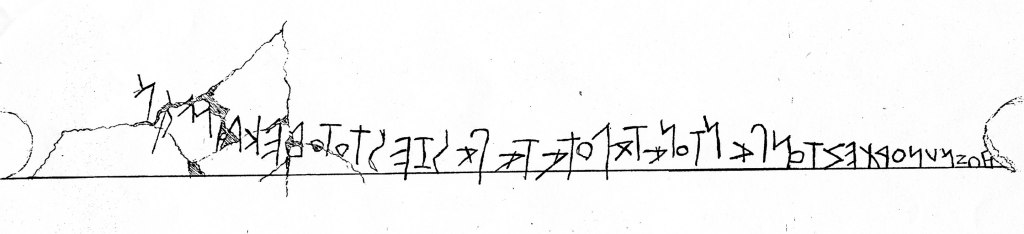
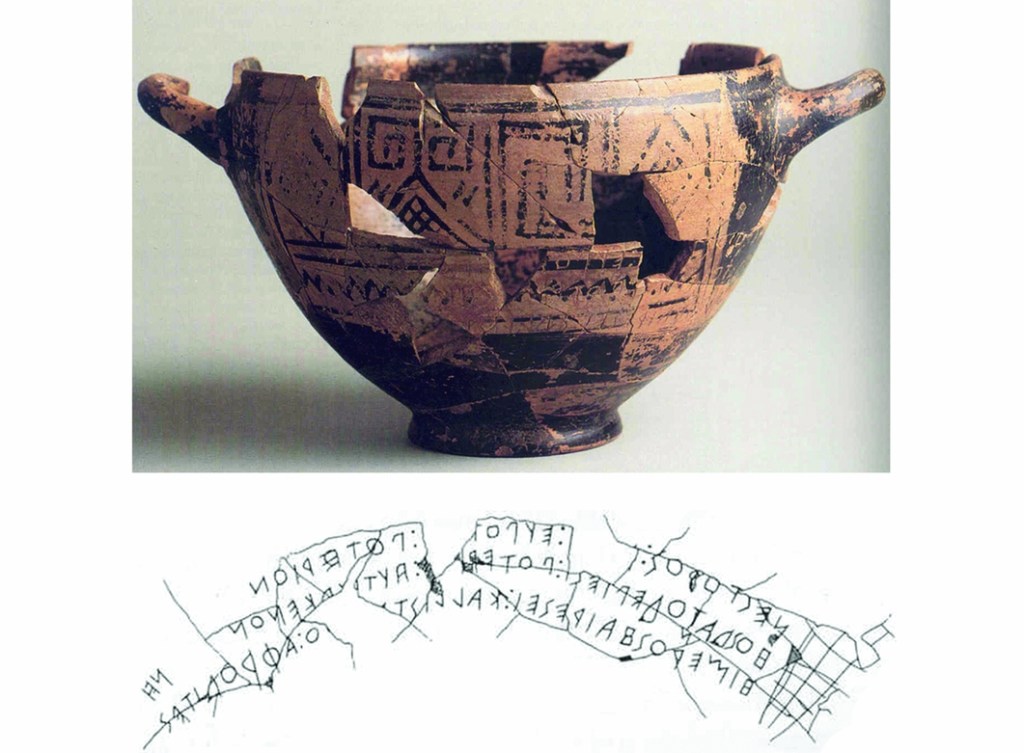
On the other side of the debate, Classicists and archaeologists tend to argue for a low date, favoring the 8th century BCE. Their reasoning draws primarily from stratified archaeological contexts: the earliest securely datable Greek inscriptions—such as the Dipylon oinochoe and the Nestor’s Cup from Pithekoussai—belong to the mid-to-late 8th century. Rhys Carpenter was among the earliest and most forceful voices in this camp. In a 1933 article, he wrote that “the argumentum a silentio grows every year more formidable and more conclusive,” referring to the continued absence of any Greek alphabetic inscriptions predating the eighth century (“The Antiquity of the Greek Alphabet,” AJA 37 [1933]: 8–29, at p. 27). For Carpenter, the lack of material evidence was not a gap to be explained away, but itself a powerful datum: if earlier use had existed, we would likely have found traces by now.
This school is generally skeptical of typological comparison, pointing out that letterforms evolve unevenly and can be conservative in certain contexts. Archaeological absence, while never conclusive, is taken seriously—especially when paired with the sudden, near-simultaneous appearance of inscriptions across disparate sites in the 8th century, suggesting a relatively rapid uptake of a recently acquired script. Later scholars, such as Barry B. Powell, built on this foundation. In Homer and the Origin of the Greek Alphabet (1991), Powell controversially argued that the Greek alphabet was deliberately invented for the purpose of recording Homeric verse, dating the invention to around 750 BCE. Though widely criticized for its teleology and lack of evidence for such a top-down design, Powell’s theory exemplifies the kind of interdisciplinary crossfire that defines this problem: where linguistic function, archaeological data, and cultural ideology all collide.
Roger D. Woodard, in Greek Writing from Knossos to Homer (1997), pushed back against Powell while still supporting a relatively late date. Woodard views the alphabet’s adaptation as a process shaped not only by contact with Phoenician traders but also by internal Greek developments—especially the memory of Linear B and broader shifts in literacy practices. He emphasizes the complex interplay between tradition and innovation, seeing the Greek vowel system as a structural solution that could only emerge in a linguistic environment receptive to phonological precision.
The question remains open, but APEX offers a different kind of approach. Rather than anchoring the debate to a single origin point, I focus on regional trajectories and graphical evidence: how letterforms vary, travel, and settle. If the Semitic party line reads the Greek alphabet as a photograph of Phoenician forms from 1000 BCE, and the archaeological model sees it as an emergent public tool of the 8th century, then I want to understand how specific graphemes move through space and time. Which forms remain stable across centuries? Which mutate rapidly? And what can that tell us about the process of transmission, rather than the moment of origin?
In fact, the most immediate goal of the APEX project is to evaluate whether the Greek letterforms do, in fact, most closely resemble the Semitic models from around 1000 BCE—as the high-date camp maintains—or if their nearest parallels lie elsewhere in the Phoenician typology. The intention is to move beyond qualitative comparisons and scholarly intuition, toward a quantitative, statistically grounded assessment of letterform similarity. By measuring and modeling these visual relationships systematically, APEX aims to provide a more objective foundation for dating the moment of greatest resemblance between the Greek and Phoenician scripts.
Rather than jumping straight into letterform similarity metrics, though, the next update will take a detour—one that’s no less crucial. Before the vectors can speak, they must be named, contextualized, and organized. APEX Updates, 3: Encoding Decisions will explore how I’m structuring the metadata that surrounds each traced letter: what counts as “context,” how information is tagged, and why every dataset is also a narrative. As it turns out, deciding how to describe a letter may be just as revealing as deciding how to compare it.
 To Wake the Dead