Category: Uncategorized

  • Adventures in Materiality, 1: Wax Tablets at Home

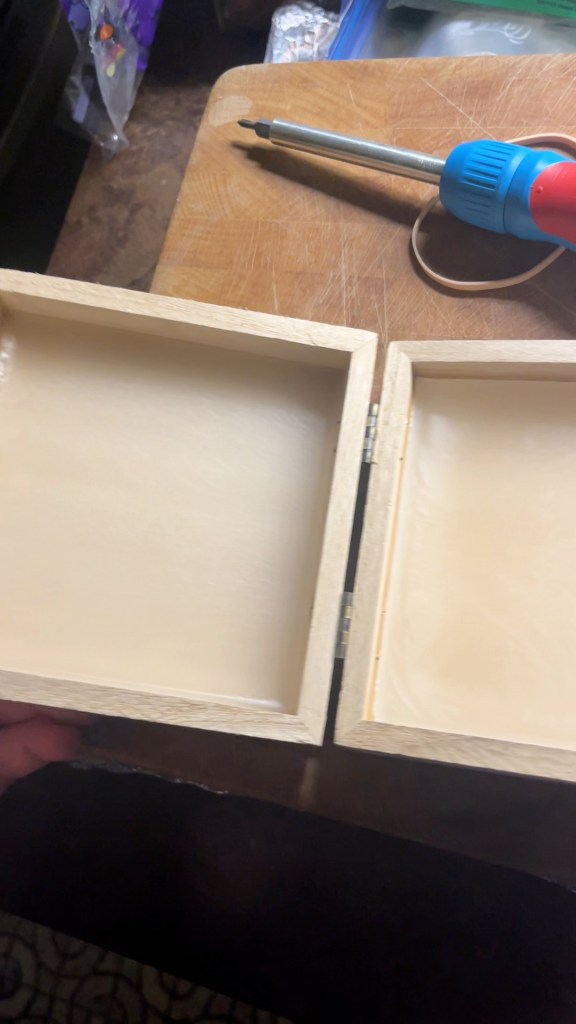
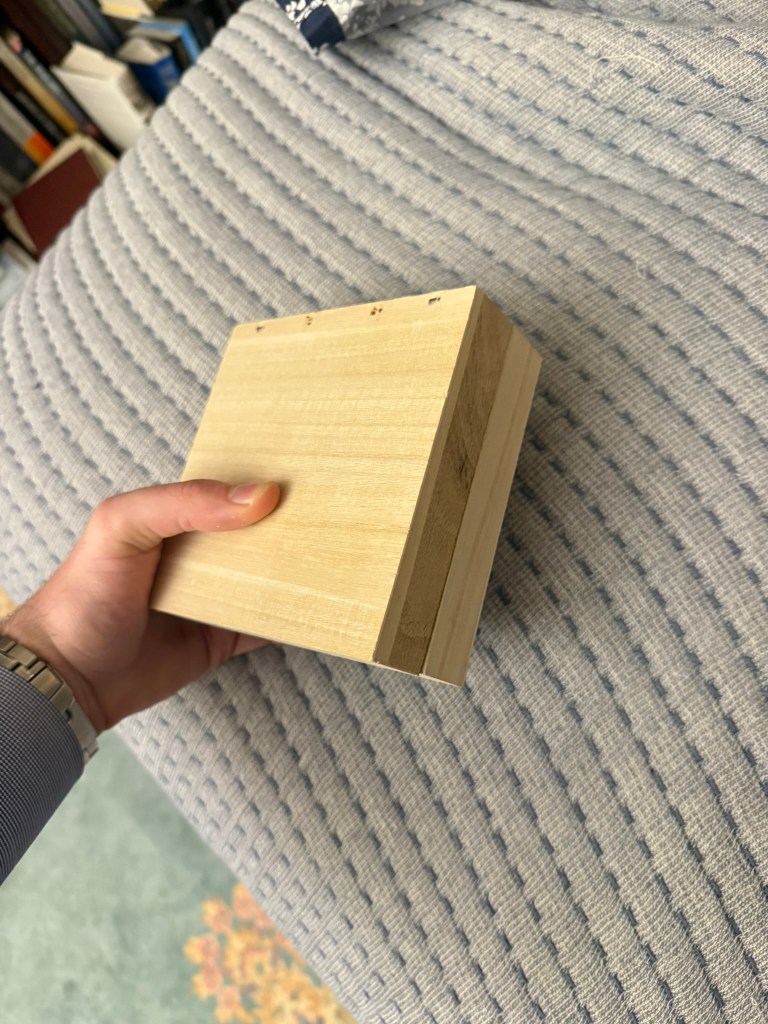
    I’ve made a couple of these tablets, experimenting with form and function. I’ve been learning a lot about historical writing surfaces, woodworking, beeswax temperaments, and the tactile oddities of stylus-based writing. Below is a brief history of the form followed by a quick how-to, with some practical notes from my own experiments at the very end. All pictures are my own, except where attributed.

    A History
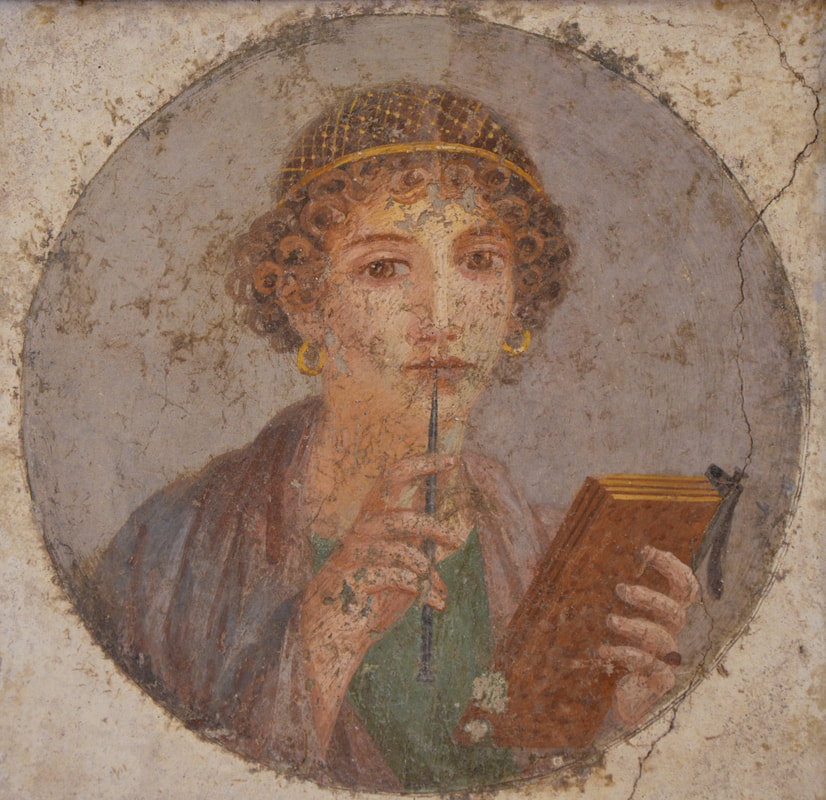
    Woman with wax tablets and stylus (so-called “Sappho”), Fresco, 50-79 CE. World History Encyclopedia.

    Wax tablets have roots that go back over three thousand years. Archaeologists have found bronze styli with pointed tips and flat spatula ends in Bronze Age Anatolia, and by the time of the Neo-Assyrian and Neo-Babylonian periods, it’s likely that wax tablets were being used for both cuneiform and the emerging Aramaic alphabet—showing them to be a flexible medium that could adapt to multiple writing systems. From there, the technology spread west via the Arameans and Phoenicians, eventually reaching the Greek world. The Greek word for a wax tablet, δέλτος, is actually a Phoenician loanword—ultimately from the Akkadian daltu, meaning “door.”
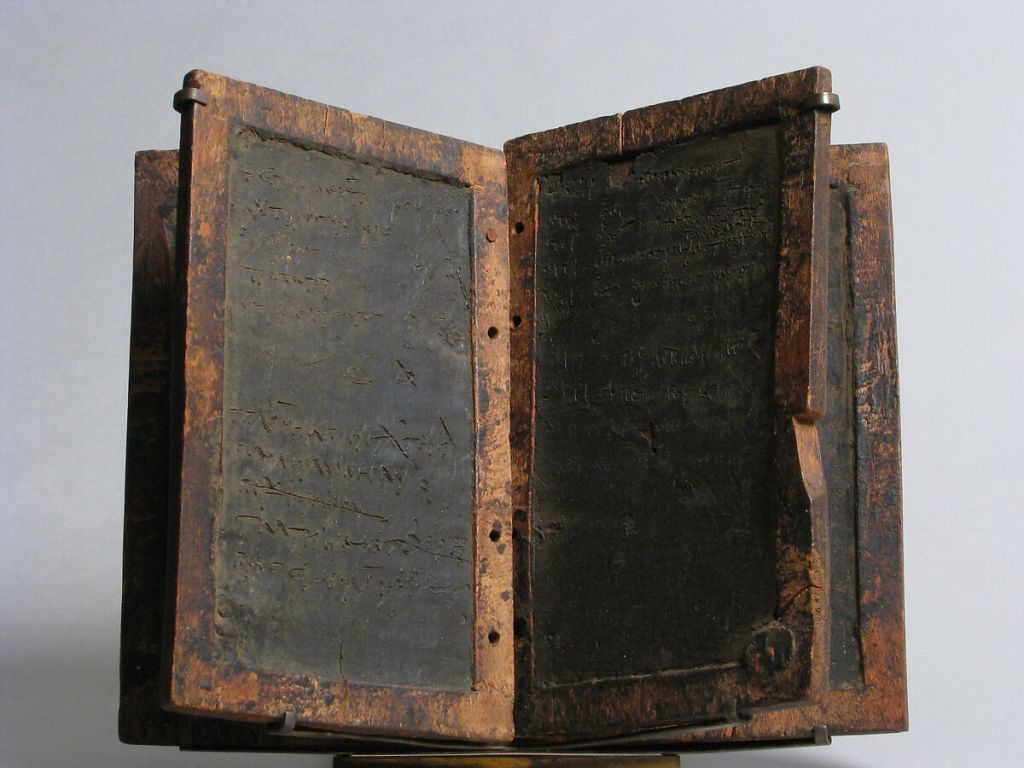
    Wooden Writing Tablets, Coptic, 500–700 CE. The Metropolitan Museum of Art.

    They’re particularly fascinating if you’re interested in letter forms. Because the stylus incises the wax, it encourages different motor habits and line qualities: straighter lines, more angular forms, and simpler geometries. That might be part of why early Greek inscriptions on stone look the way they do: the wax tablet was probably the everyday tool behind the scenes, shaping how people thought letters should be formed.

    At the same time, wax tablets allowed for quick, informal writing which makes them a crucial counterpart to the largely composed inscriptions that endured to today—the outcome of the ‘preservation bias.’ These tablets were a bridge between ephemeral thought and durable text, and working with them now offers a glimpse into how alphabets lived before fossilizing on stone.


    How-to

    0. Materials and Tools

    Tablet components:

    • 1 or 2 wooden panels with an inset well (Google “Cradled Wood Painting Panel” to find these)
    • Beeswax (at least 2 lbs to be safe, but adjust for size, naturally; here are the pellets which are on the softer side that I used for second tablet)
    • Optional hardware (examples that I used on larger tablet linked): closure, small lock with key, corner protectors

    Tools to melt the wax:

    • Pot
    • Something to melt wax in, ideally a Pyrex measuring cup or a glass bowl that sits atop the pot
    • ~1 liter of water
    • Spoon to mix beeswax as it melts (speeds up the process)

    Specifically for notebook-style tablets:

    • 2 small hinges and screws
    • Screwdriver (and drill if your wood is hard or your screws are large)
    • Ruler, for measuring hinge placement

    For the stylus:

    • A wooden dowel (ideally ~6mm or ¼ inch in diameter, this is most comfortable to hold and is the size of a standard pencil, meaning mechanical/electric sharpeners will be able to handle it)
    • Pencil sharpener or sharp knife
    • Sandpaper, ideally 40 or 80 grit (note: smaller the number, the rougher the grit)
    • Saw to cut the dowel, or strong hands to snap it
    • Optional: you can also just buy a bronze stylus which comes with flat “eraser” end

    1. Prepping the Wax
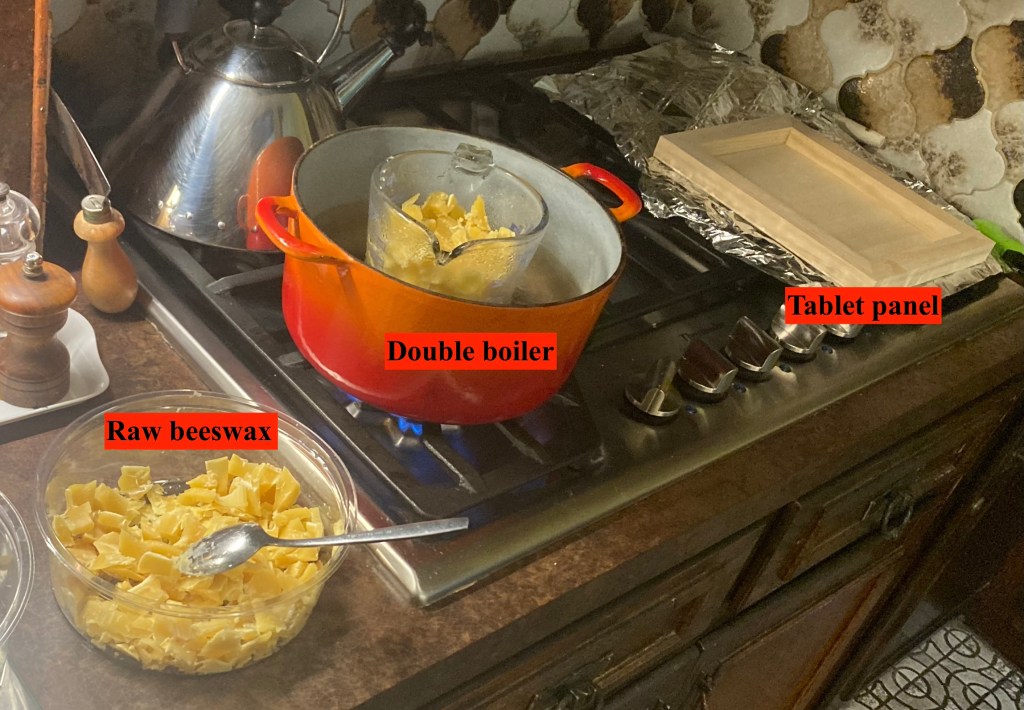
    First time around, I bought a 2-lb block of beeswax and used a hammer and stone-carving chisel to break it up—doable, but kind of a pain. It was also a hard wax, which made writing more difficult. Second time, I used pre-softened pellets from Amazon (linked in section above)—much easier to melt and work with.


    2. Melting and Pouring the Wax
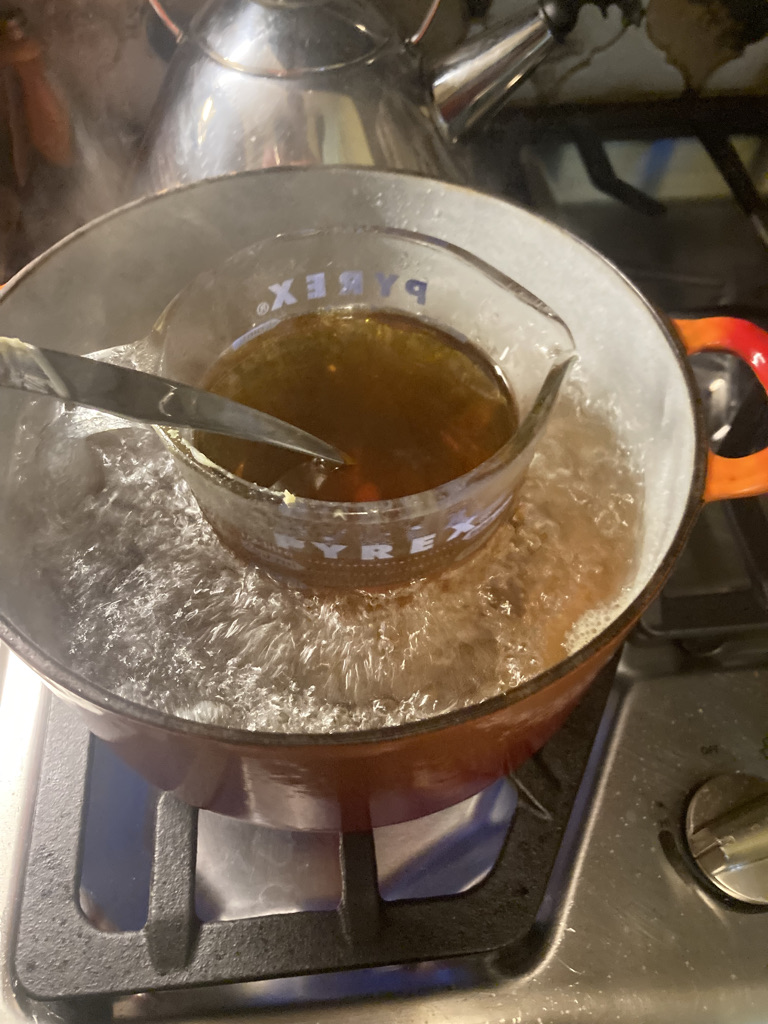
    Use a double boiler setup (I used a Pyrex inside a pot of simmering water). Estimate the amount of wax needed by filling your wooden well with solid wax first, then dumping it into the Pyrex. Add about a third more than this, since melted wax takes up less space. Wait to pour the wax until it is fully liquefied, as below.

    IMPORTANT: Pour continuously! If you pause for even 10–15 seconds, you’ll get visible layers that don’t bond well.


    3. Cooling the Wax
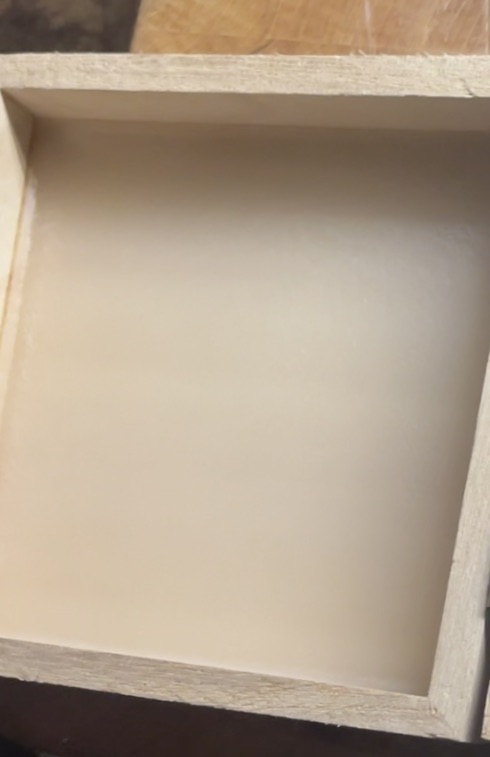
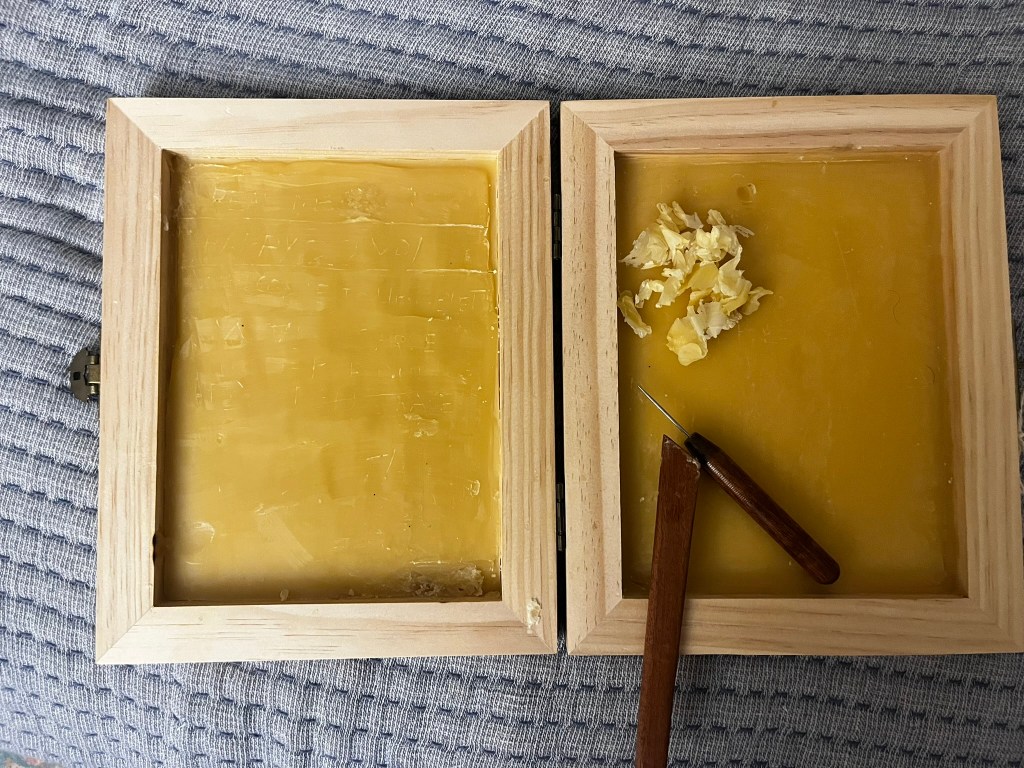
    Let the wax cool on a level surface. You can refrigerate to speed things up—about 15 minutes for a thin layer, but I’d give it 30 minutes to be safe.

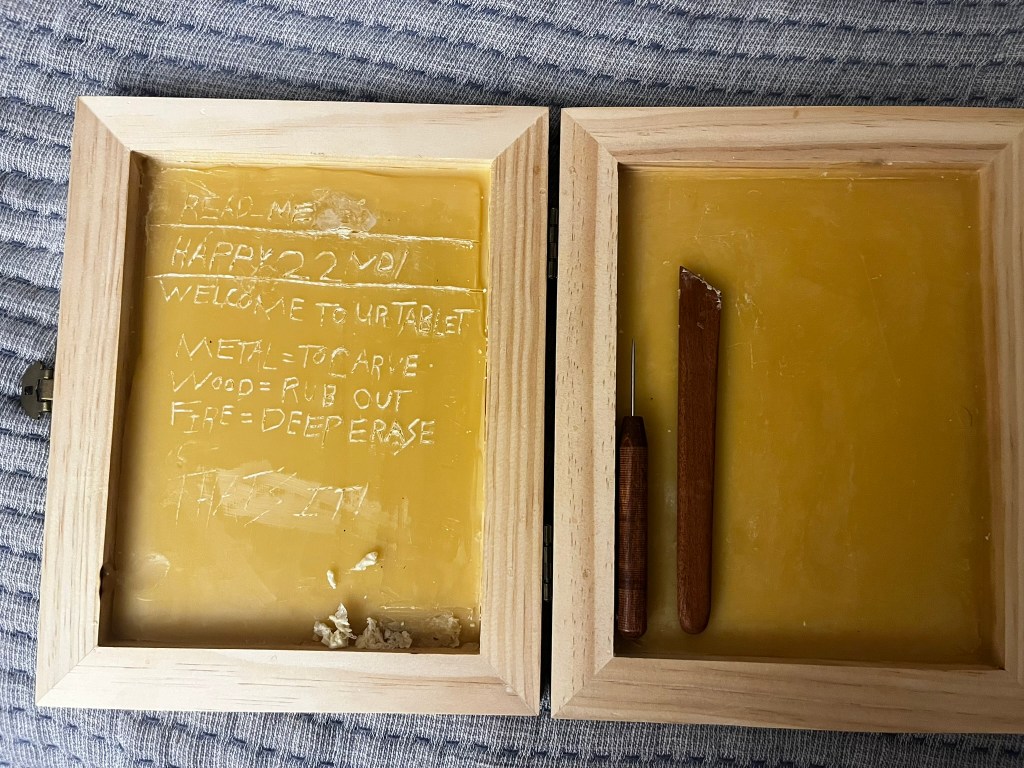
    This image on the left shows what fully hardened wax looks like.


    4. Assembly (For Notebook/Diptych Style)
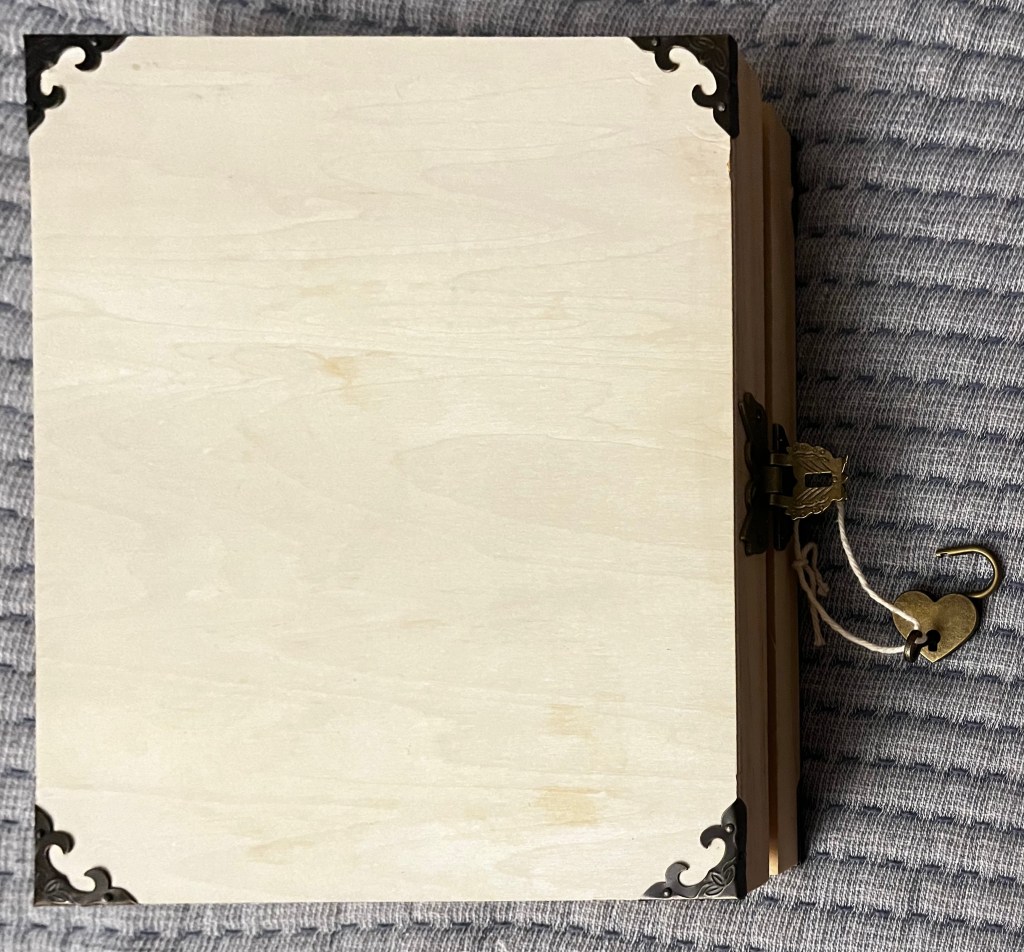
    Measure hinge placement at ¼ and ¾ along the side where the panels meet. Center the hinge’s barrel over the seam. Use a drill for cleaner pilot holes if needed.

    If you’re using optional hardware like a latch or corner protectors, now’s the time. These can help disguise slight asymmetries or keep a wonky tablet shut.


    5. Making a Wooden Stylus

    Cut the dowel to your preferred length. I usually break it by hand, then sand the edge smooth. Sharpen one end to a point using either a pencil sharpener or a knife.
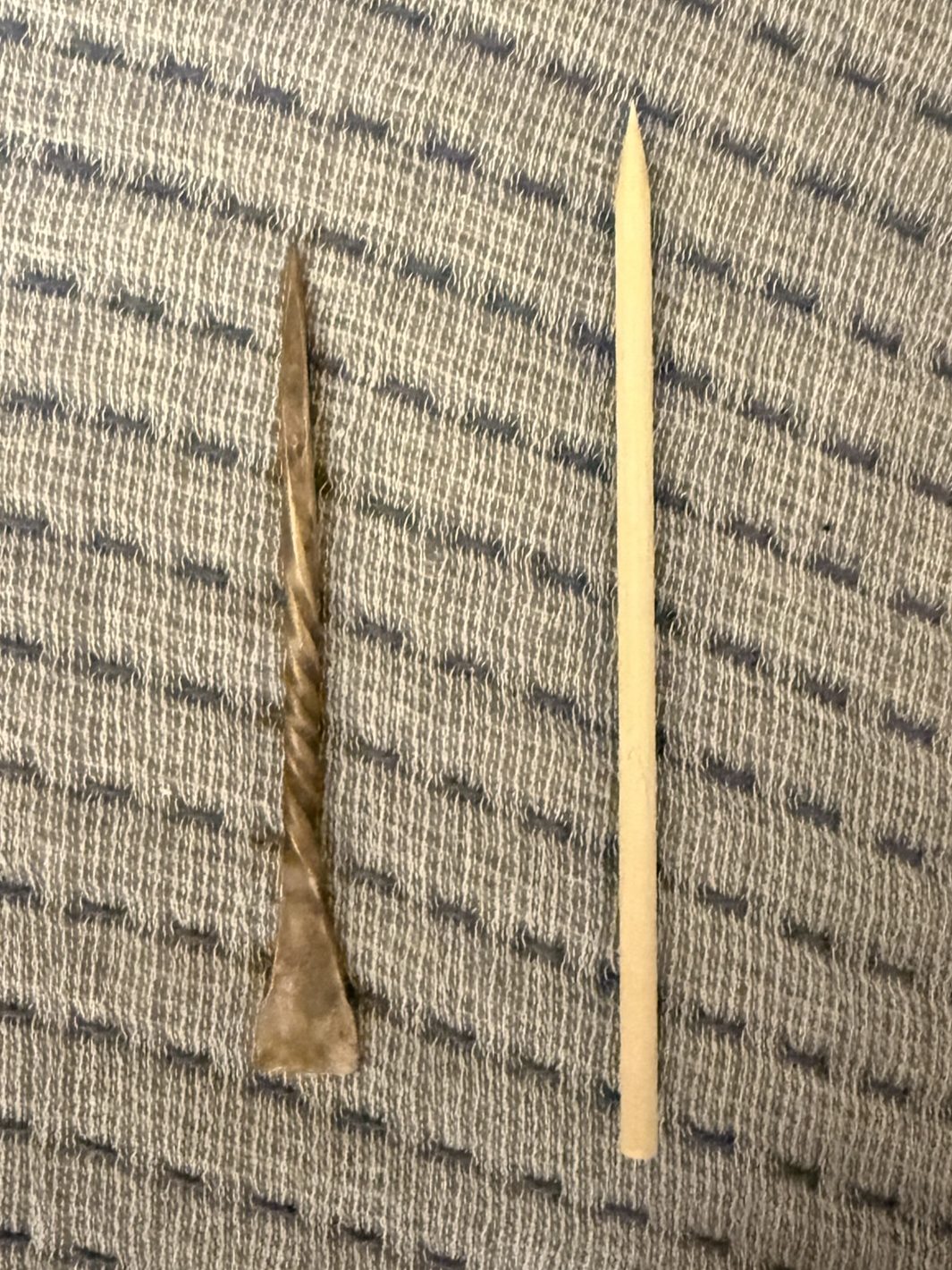
    If you’re using a knife:

    • Always cut away from your body
    • Consider using safety glove (this can be found at hardware and kitchen supply stores, not to mention online—I personally use Wüsthof’s)
    • Be most mindful of your body from elbow to fingertip—this is where most injuries occur in manufactury (shoutout to my friend at Dow Chemical for that tip).

    6. Writing, Erasing, and Experimenting

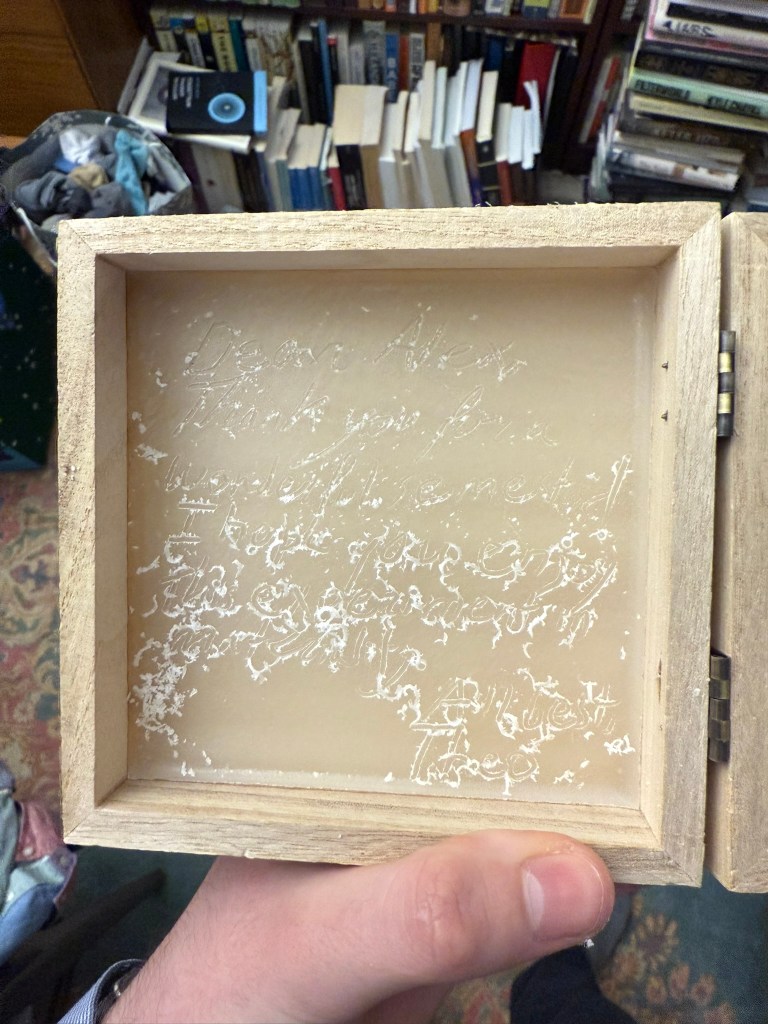
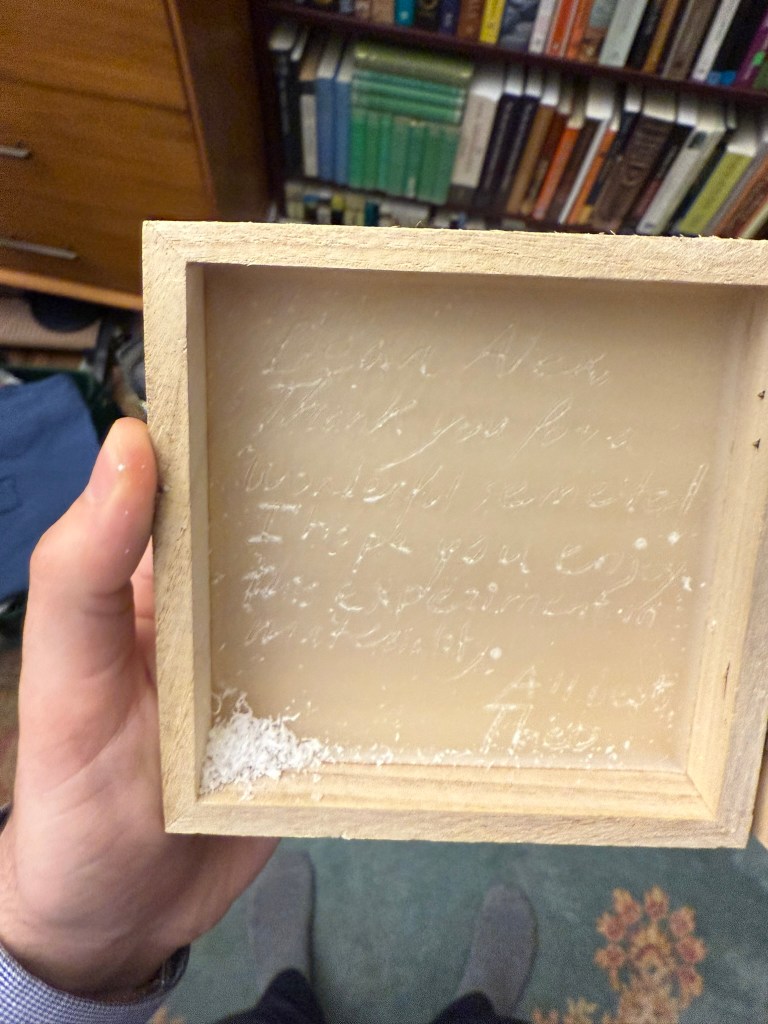
    Try varying your pressure and angle. Deeper strokes are easier to read but leave behind more excess wax. Shallower strokes are neater but harder to see. Softer wax helps a lot with both legibility and tactile feel.

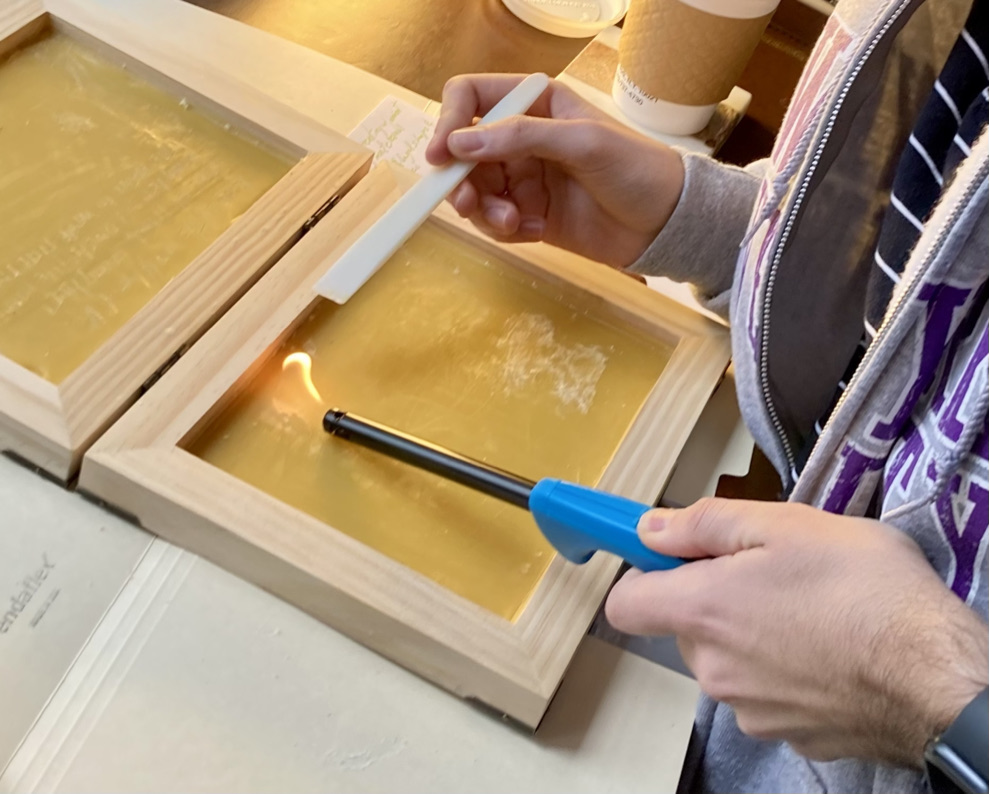
    For erasing, you can use the flat end of a bronze stylus (mine is shaped like a little rake) or just warm the surface slightly (one of the pictures below has me using a pottery smoothing tool and a long-handled lighter) and smooth it over.
    My Observations

    • Wax hardness really matters. The softer wax is dramatically more forgiving (particularly when it comes to erasing) and is significantly more legible.
    • Depth vs. visibility is a real trade-off. Carving deeper makes your letters clearer but creates more crumbly debris and texture. Shallower strokes are neater but vanish in dim light, you really need to hold it at an angle so as to get a “raking light” angle.
    • I think it’d probably have been best as a personal memory tool. The writing isn’t super legible to others, and it can’t hold a ton. I’d think abbreviations would’ve been common, for the sake of economy—which would further ‘personalize’ the tablet and make it harder for another person to read.

    If you try this yourself, I’d love to hear about your materials and results—feel free to email me at tfavdw@nyu.edu!
  • Monthly Reads, 1: March 2025

    Monthly Reads, 1: March 2025

    There’s no single unifying theme to this list—but there is a feeling. I’m reaching, at once, toward the origins of writing and the frontiers of language technology. It’s structure that’s defining me at the moment: how systems encode meaning, whether that’s Greek orthography or neural networks. And in between, I let myself breathe with fiction—stories that play with form, time, and voice themselves.

    Recently Finished:

    • Epigraphic Evidence
      A technical addition to my current work on inscriptions. Like black coffee: not always easy to imbibe, but quite efficient.
    • Data Science (MIT Press Essential Knowledge series)
      A clean introduction—refreshing for thinking about data both ancient and modern.
    • Ripley’s Game (Patricia Highsmith)
      Cold, elegant, amoral. Hilarious at points. A good palate cleanser between denser texts.
    • The Sequel (Jean Hanff Korelitz)
      Read this mostly for plot, not language—but I love thinking about narrative structures and the great Second Novel Problem.
    • The English Understand Wool (Helen DeWitt)
      Sharp, strange, and delightful. I love a novel about an out-of-touch eccentric navigating the world.

    Currently Reading:

    • Kairos (Jenny Erpenbeck)
      A novel about political and personal time, and a very complicated affair. Thorny for sure.
    • Word by Word: The Secret Life of Dictionaries (Kory Stamper)
      The theme of choice made at all stages of lexicography deeply resonates with me as I encode my own systemic information. Chapters like “Bitch” and “Posh” capture this especially well.
    • Writing and the Origins of Greek Literature (Barry B. Powell)
      I keep coming back to this one in small sips. Chapters go down easy.
    • Greek Writing from Knossos to Homer (Roger D. Woodard)
      Foundational for understanding the transmission of the Greek alphabet. Very well written and thoroughly researched.
    • Algorithms (MIT Press Essential Knowledge series)
      A manageable way to reframe my thinking on rules and structure—not unlike real-life syntactical derivations.
    • Machine Learning (MIT Press Essential Knowledge series)
      Challenging. Still finding where I fit in here. Hoping I can apply to my APEX project by Stage 3.
    • JSON for Beginners
      Very practical for APEX, which is structured with JSON and makes heavy use of standoff annotation. This allows me to encode uncertainty and multiplicitous readings, lowering the amount of assumptions baked into the dataset.
    • Co-Intelligence: Living and Working with AI (Ethan Mollick)
      For someone working on ancient inscriptional data, the future of coworking with AI is too relevant to ignore.

    I wouldn’t call this a reading list so much as a reading state, a snapshot of what it feels like to be in the thick of things: academic work, blog writing, thesis planning, and whatever this slow journey toward modern spoken French is shaping up to be.

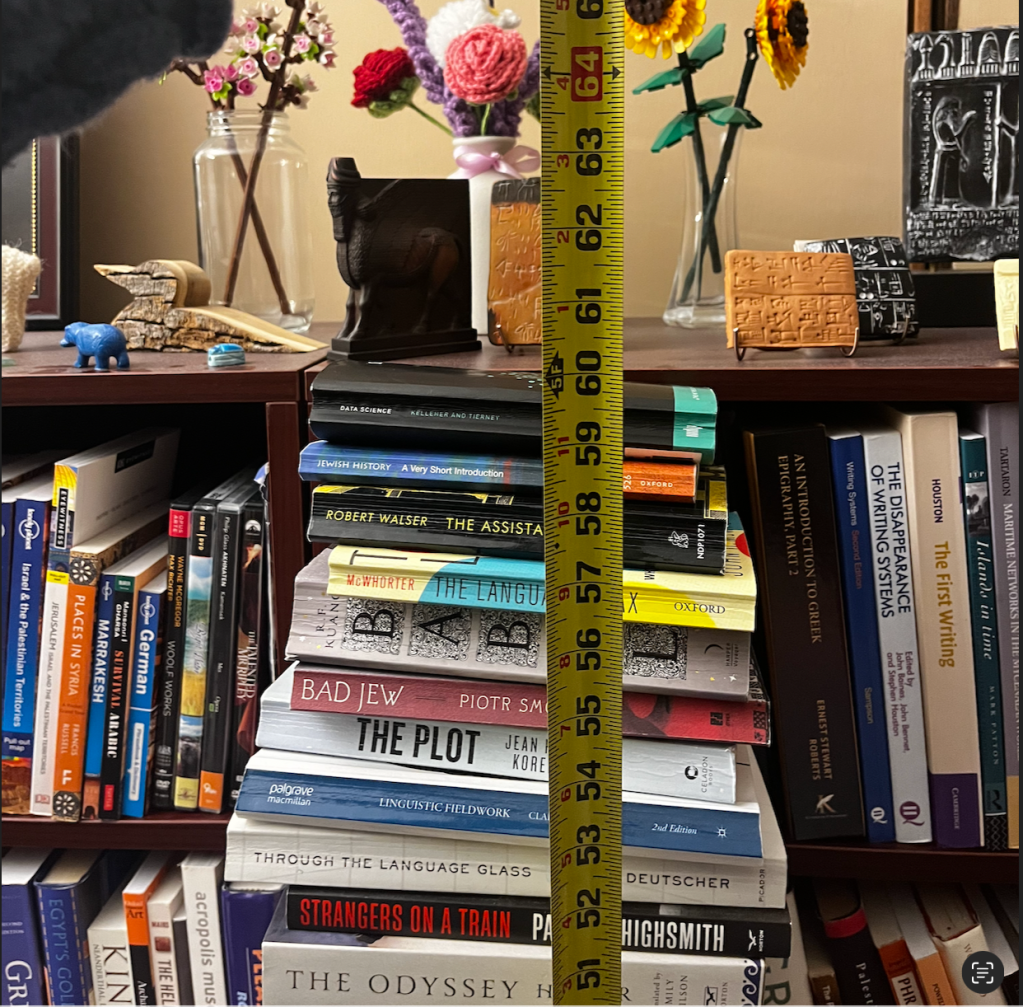
    Picture: I’ve been stacking my recent reads as a kind of personal monument—hoping to match my own height before summer.

  • Marginalia, 1: On The Texture of Dead Languages

    Marginalia, 1: On The Texture of Dead Languages

    I’ve long wondered what it was about ancient languages—as opposed to modern ones—that so captivated me. For more than half my life now (21 years long), they’ve been at the center of my intellectual and emotional world. I’ve done much internal archaeology on this, and here’s where I’ve landed.

    What first drew me to ancient languages wasn’t beauty, or history, or even mystery—this much I knew. But I’ve figured it out, after much reflection: it was structure. At age ten, I was told that Latin had a “very mathematical” nature—and I had a very mathematical mind. That was the pitch that won me over when I was choosing between French, Mandarin, Spanish, and Latin in fourth grade. My friends—older kids who knew me from our accelerated math class—urged me to choose Latin. “It works the way you do,” they said.

    From the beginning, I had a knack for it. Parsing Latin felt like solving elegant equations: all those declension and conjugation charts, the case endings, the tightly constructed sentences. I found the clarity of it deeply satisfying. It’s also what got me into etymology, many a linguist’s bridge into the discipline. I was thrilled to learn that words, and thereby language itself, had discrete histories we could uncover and unlock.

    And, to be honest, I was also avoiding something. I’ve had a lifelong fear of being wrong—especially out loud. The thought of sounding like a toddler in French or Mandarin mortified me, even at that age. Ancient languages, by contrast, required no vocal performance—or at least none you could be substantially corrected on.2 As Mary Beard wrote, it’s a tremendous freedom to read a language without needing to order a pizza in it.

    But beyond the safety of silence and the comfort of structure, ancient languages offered me something stranger and deeper. They are, paradoxically, both rigid and wild—formally inflected, syntactically unruly. Their rich systems of agreement allow a kind of grammatical anarchy. That contradiction fascinated me. And then, there was the sheer alterity: the profound otherness I was only beginning to grasp. These languages came from far away—across centuries and empires—and they had nothing to do with me.

    What I didn’t expect was how intimate they would feel. There’s something magical about reaching across time and space to hear men (alas, mostly men) from millennia ago speak. I feel, in some small way, like I’m raising the dead (see blog title!), giving voice to what was nearly lost. There is mystery in this, in the impossibility of perfect translation, in the silence that always remains. But there is also joy. Sitting at a wooden table, poring over ancient texts with comrades-for-a-semester, I’ve never felt isolated. If anything, I’ve felt surrounded—by the dead, yes, but also by other living readers, deep in the muck of it all.

    Inscriptions are my great love: language not filtered through scribes or stylists, but carved directly, once, and then cast into the abyss memoriarum. To read an inscription is to hear a voice that was not supposed to last this long. It reminds me that people have always been this way: strange, familiar, brutal, kind, just like us.3 That realization has made me a softer person, I think. More attuned. You can’t spend your days in conversation with the past—and with the people who help you interpret it—without becoming more human.

    There’s also a tension I feel—quiet but insistent—between my deep love of ancient languages and my commitments to the present. Studying the dead can sometimes feel like retreat: a kind of sequestration in the library, the archive, the ivory tower. And yet, this is also the work that sharpens my ethics. It’s by looking at the long arc of language, power, and survival that I’ve come to understand how political language always is—what gets written down, whose names are preserved, whose voices fade. So while it might look like I’m hiding in the past, I don’t think I am. I’m studying the structures that built the world we live in now—and learning how fragile, and how remakeable, those structures are.

    It’s changed the questions I ask, too. I no longer want to know only what words mean, or what they do. I want to know how they came to be. Who made them. Why they changed. What pressures they both buckled under and resisted. That’s the kind of inquiry ancient languages have trained me for.

    Lately, though, something has changed. For the first time, I’m stepping away from silence. I’m learning a living language—French—and it’s bringing all kinds of old fears and new questions to the surface. But that’s a story for next time, once I’m deeper in it.

    1. To the point I got internet-famous for being a budding particle physicist, which got me invited to labs and observatories around the world, including NYU’s, Columbia’s, and CERN, home of the Large Hadron Collider. ↩︎
    2. After a while, you remember that a Latin “v” is pronounced [w], silly as it sounds aloud. [wɛni widi wiki] just doesn’t hit like [vɛni vidi vit͡ʃi]. ↩︎
    3. Read some of the archaic Theran graffiti (pp. 22-25 of this paper) if you want to see that teenage boys have, in fact, always been teenage boys. ↩︎

  • Linguistics for All, 1: A World Tour of Endangerment and Hope

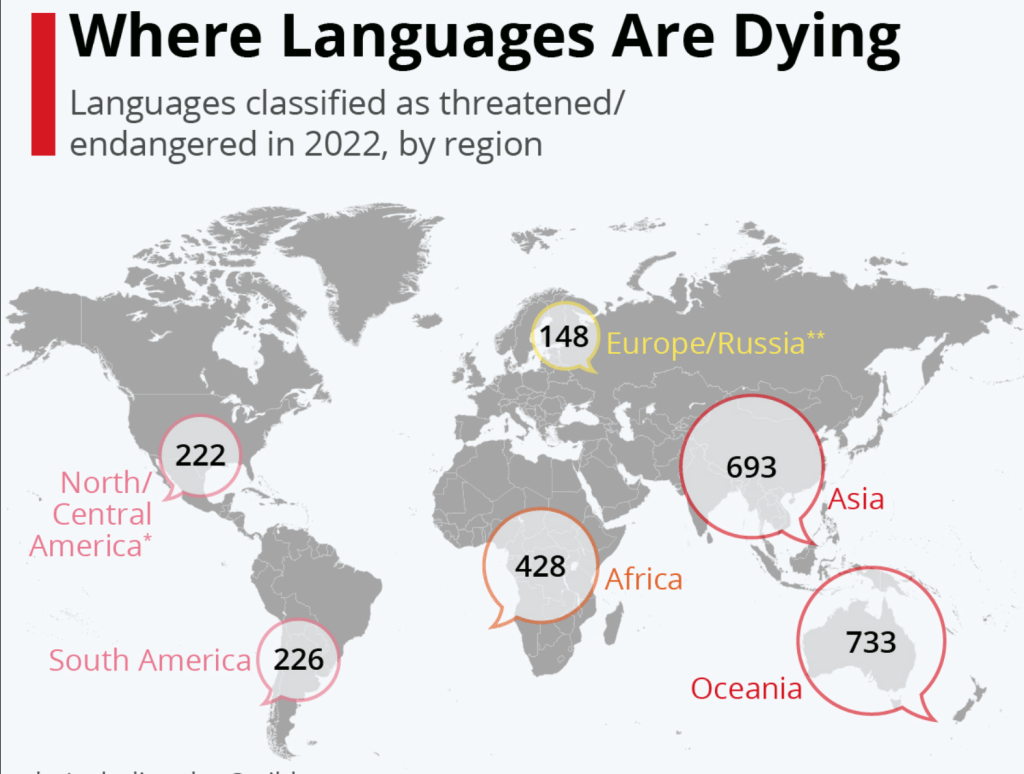
    Map of endangered language prevalence worldwide.

    Over the past two months, I had the chance to lead two discussion groups for the NYU League of Linguistics. The first concerned endangered language typology, highlighting interesting features from languages across the world: Austronesian verb-initial sentences, unique Mayan phonologies, and rich Bantu noun classes & declensions.

    The second focused on revitalization efforts (video here) around the world, focusing on Hawaiian, Welsh, and Hebrew. We explored how languages can be revived when intergenerational transmission is fading, and what gets negotiated along the way. Key questions were: What counts as success in revitalization? What has become of our own ancestral languages, and why? What trade-offs—like the loss of minority dialects—do we accept? And crucially: where do we, as linguists, fit in?

    Together, these sessions became an profound study in contrast: one examining how endangered languages structure and make sense of the world, the other how we might help them endure in it.


    As someone who works primarily with dead languages, this topic holds a particular fascination for me. I live among the dead—scripts etched into stone, grammars fossilized in treatises, phonologies inferred but never heard. Endangered languages, by contrast, are not yet dead. Revitalization efforts aim to preserve what I usually only encounter after the fact: living, breathing language. That shift in focus—from excavation to preservation—has reshaped how I think about what linguistic work can be.

    It also deepens our understanding of language change. Revitalization doesn’t freeze a language in time—it lets us see what happens next. Take Hawaiian, whose famously tiny consonant inventory (only eight!) allows a wide range of free variation. Will it continue to shrink? Will contrasts harden? Watching a language evolve under new sociopolitical pressures offers historical linguists like me something rare: the chance to witness change not as reconstruction, but as unfolding reality.


    One thing that became clear between the two sessions was the importance of community and agency. Typological structures are fascinating—but they exist amid complicated social structures. We came away with a deeper appreciation for linguistic diversity as a lived reality. Our role, ultimately, is not to fix or play savior—but to listen, support, and amplify the work already being done.

  • Introduction (Pinned)

    Introduction (Pinned)

    Welcome to To Wake the Dead — a public research journal by Theo Avedisian.

    I study linguistics & archaeology at NYU, where I also run the League of Linguistics. I’m interested in how ancient languages and scripts evolve—how they’re shaped by material practices and continue to speak across space and time. This blog is a place for me to think aloud and document as I work across Greek, Akkadian, Latin, Phoenician, and French; build tools for studying writing systems; and reflect on the messier, more personal side of learning things slowly and deeply. Generally a record of mind, not of life.

    All writing and research shared here represent my own independent work and views. They are not reviewed, endorsed, or representative of any institution with which I am, or have been, affiliated.

    If you’re new here

    These are a few posts that capture both halves of my project—how I think about things and what I’m trying to build.

    Personal reflections:

    Research & method:

    Series

    The Tritropic Line
    Reflections on reading Homer’s Odyssey in three languages—Greek, French (Bérard), and English (Loeb series, Murray). This combines language study and comparative poetics with the slow joy of close reading.

    Tablets and Tribulations
    A record of my work with Akkadian, of which I’m now in my third semester. Named with as much reverence as chagrin.

    APEX Updates
    This is about my current research project on alphabetic transmission and paleography—mostly Greek and Phoenician. It includes progress notes, technical experiments, and the occasional map or dataset that cooperates. More process-oriented than the dedicated project site.

    Adventures in Materiality
    Here I document my experiments in carving, molding, inscribing, and replicating artifacts. The work is messy, and that’s the point.

    Linguistics for All
    Posts rooted in the events and conversations I help organize, especially through the NYU League of Linguistics. A mix of accessible theory, reflections on public linguistics, and notes on language’s role in community.

    Tools of the Trade
    Every so often, I write about a tool that has helped me read, write, map, or parse. This could be a corpus, a piece of software, or just a clever work-around I’ve devised. One upcoming project: online flashcards of Latin terms found in inscription commentary, making corpora more accessible for non-specialists.

    The Close Read
    Wherein I do a deep dive into a piece of literature, though some nonfiction as well. A fair bit of poetry, as it lends itself to my style.

    Marginalia
    A space for stray thoughts, reflections on studying dead languages as a living person, and the emotional archaeology that sometimes comes with long-term projects.

    This site is where I work in public—testing ideas, gathering feedback, and learning how attention itself becomes a method. Thanks for reading.

    —T

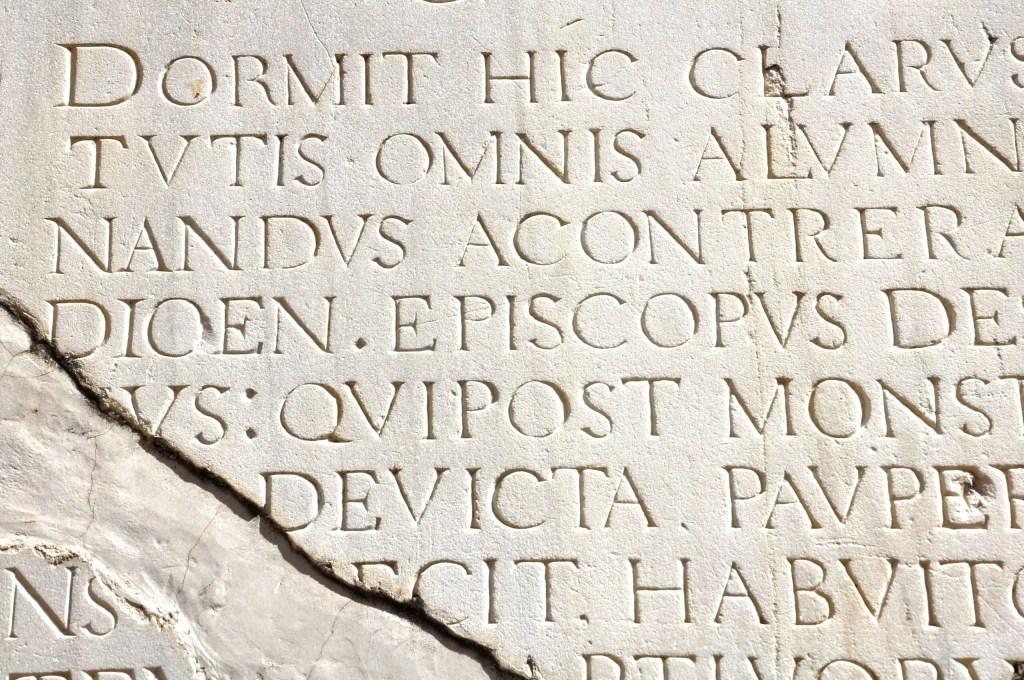
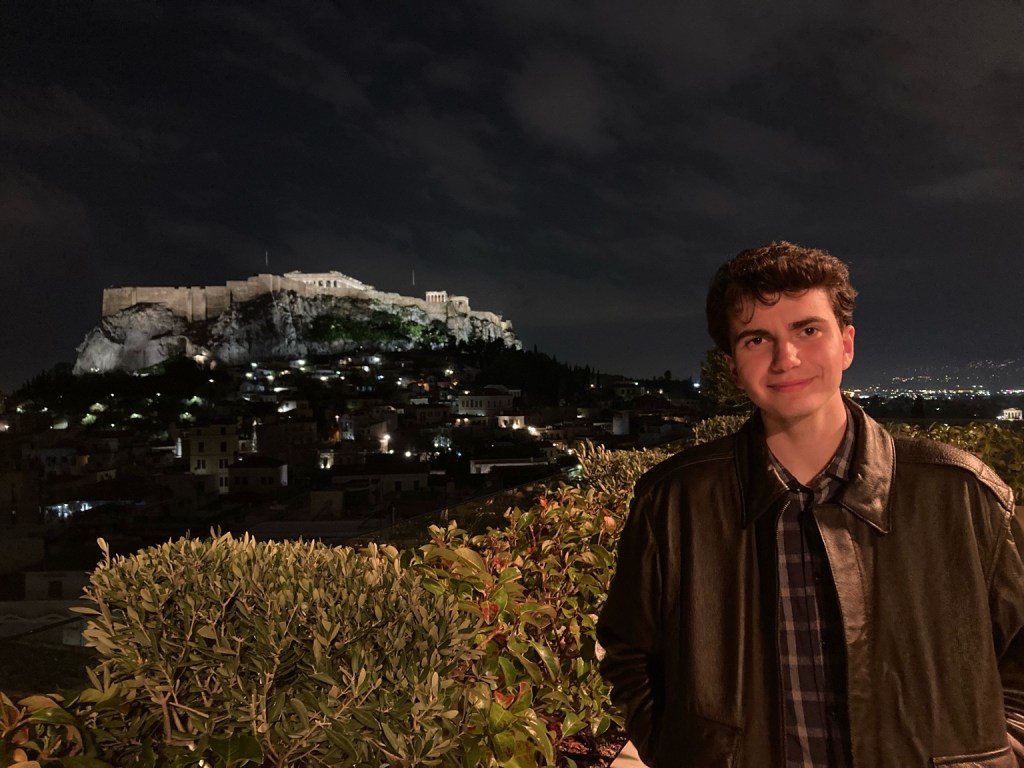
    Picture: Athens, 2021. Birthplace of my epigraphic obsession.