Category: Uncategorized

  • Adventures in Materiality, 2: Carving the Flood: An Amateur Attempt

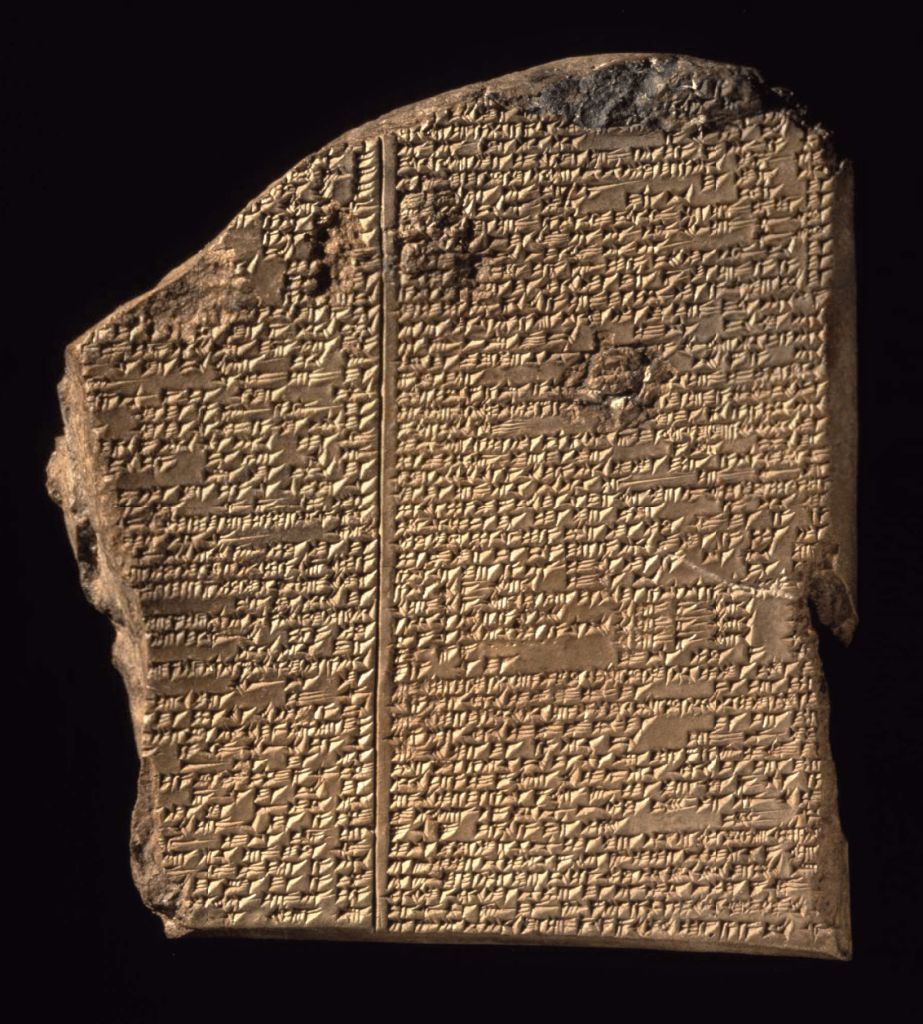
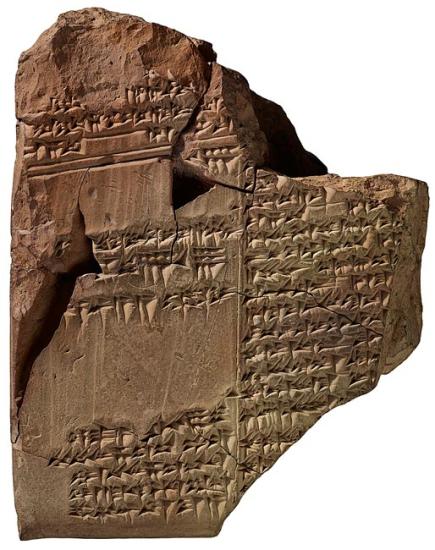
    Image of the Flood Tablet as stored in the British Museum: accession number K.3375.
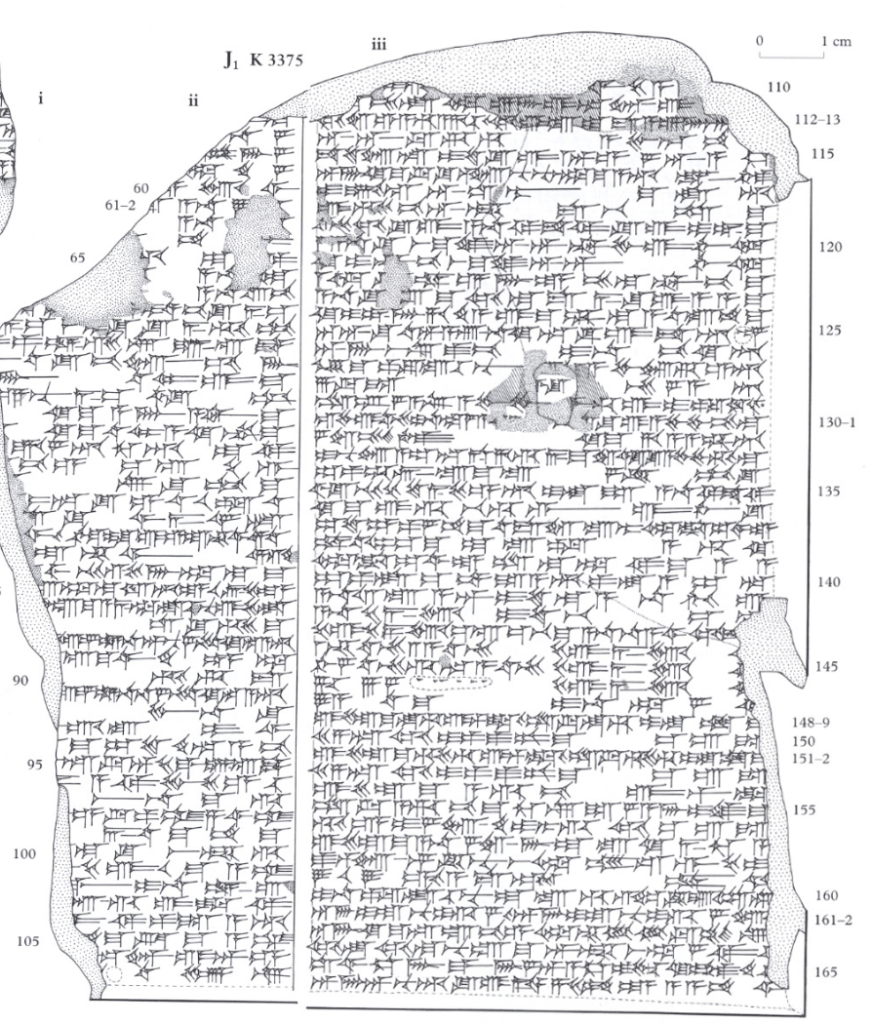
    Lineart of the Flood Tablet as documented in the CDLI: accession number P273210..

    0. Prologue: Why Copy the Flood Tablet?

    Replication has become one of my favorite hobbies. I love artifacts, but as any archaeologist or collector will tell you, the barriers to actually owning them are steep—financial, legal, and ethical. How do you store them? protect them? justify having them at all? But when you make something yourself—when you replicate an ancient object by hand—you bypass all that. You get the closeness—a heightened closeness, I’d say—without the risk.

    That’s what drew me to recreate the Flood Tablet. Buying a cast would’ve set me back about a hundred dollars. But I wanted to see what I’d learn if I made one myself. Not just held it, but shaped it. Because creating a replica doesn’t just mimic an object—it stages a kind of encounter. You begin with a clean surface, unlike the fragmentary originals, or those replicas that emerge fully formed, and fully unformed, from the get. But when you make it yourself: every crack, every slip, every flaw is something you have to introduce yourself. You get to know the object from the inside out—not just what it looks like, but how it resists you.

    I picked this Flood Tablet precisely because it’s ambitious. It’s one of the most iconic inscriptions in the ancient world—a kind of cultural Rosetta Stone, linking Mesopotamian, biblical, and classical traditions. In fact, upon its discovery in the nineteenth century, its similarity to the later Abrahamic tradition sent shockwaves through the scholarly community—truly, its impact cannot be understated.

    What’s also beautiful and moving about it is its subject: survival, memory, and catastrophic loss. And it’s been copied, again and again, across centuries. To replicate it now is to take part in that long chain of transmission. It’s not just a story of a flood. It’s a story about what writing saves.

    1. The Original: Tablet XI and Its Aura
    A tablet subsequently discovered, containing the same story, approx. a millennium older than this tablet. Now in the Morgan Library: accession number 225906.

    Tablet XI of the Epic of Gilgamesh is arguably the most famous cuneiform text in the world. It tells the story of a great flood, a chosen survivor, a divine warning, and a boat filled with life—centuries before the Book of Genesis recorded a similar arc. In the narrative, Utnapishtim recounts to Gilgamesh how he escaped destruction, was granted immortality, and ultimately became the bearer of a knowledge that even kings could not command. It is one of the clearest points of contact between Mesopotamian myth and later Near Eastern and Mediterranean traditions. Read a translation here.

    Found in Nineveh (in the north of modern Iraq, on the Tigris River) on May 7, 1873 by archaeologist George Smith, the tablet is a large, convex slab of clay, its surface densely packed with tight, disciplined cuneiform lines. The edges are broken, some signs lost.

    But it’s not a draft or a throwaway. It was meant to endure. To try to recreate it is, in a small way, to step into that intention. The curvature, the spacing, the subtle tilt of each wedge: all these formal features speak not just to aesthetics, but to the technical mastery of the scribes who made them. This isn’t just a myth we inherited. It’s a craftwork that once held it.

    2. The Process

    I started with two pounds of grey air-dry clay and rolled it out to a thickness of about ¾ of an inch. I wanted enough depth to accommodate firm impressions without risking breakage—a balance between durability and responsiveness.
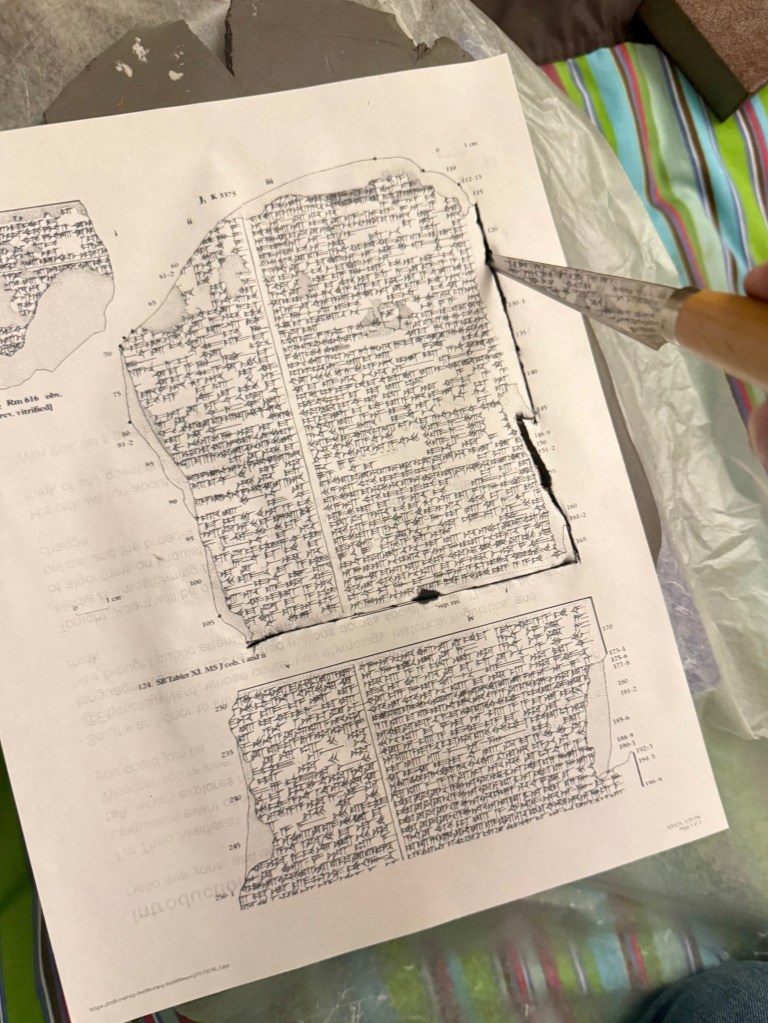
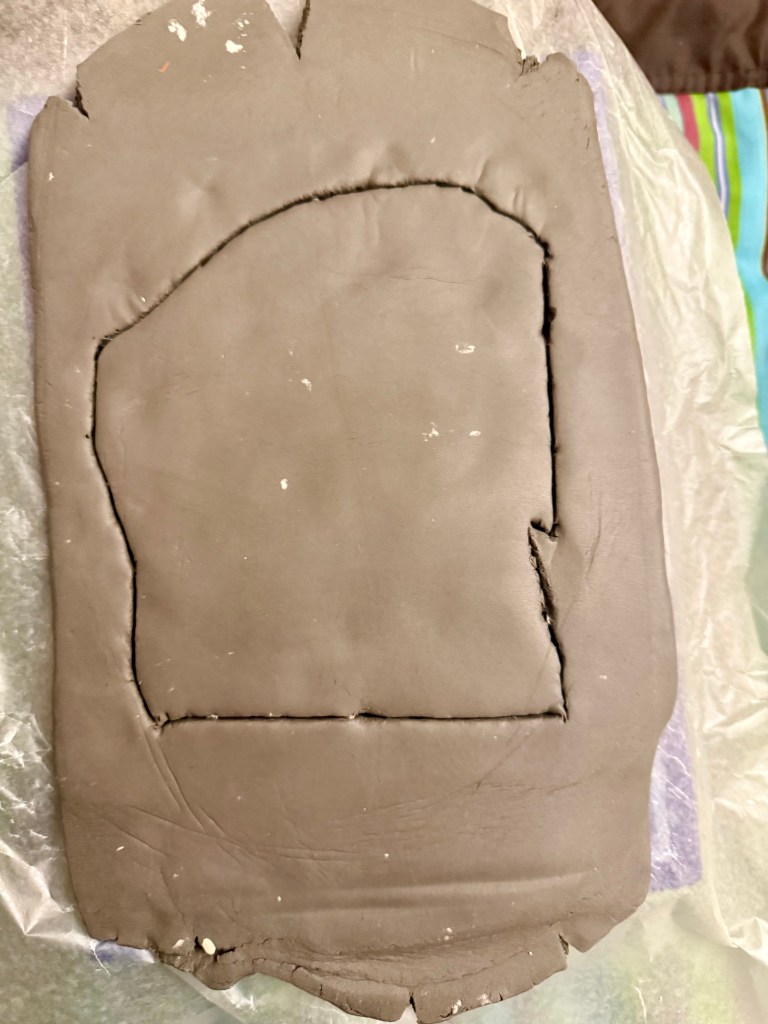
    Once I had a smooth surface, I printed a to-scale lineart of one side of the original tablet and laid it directly over the clay. Using a potter’s knife, I cut around the outline to form a proper slab.
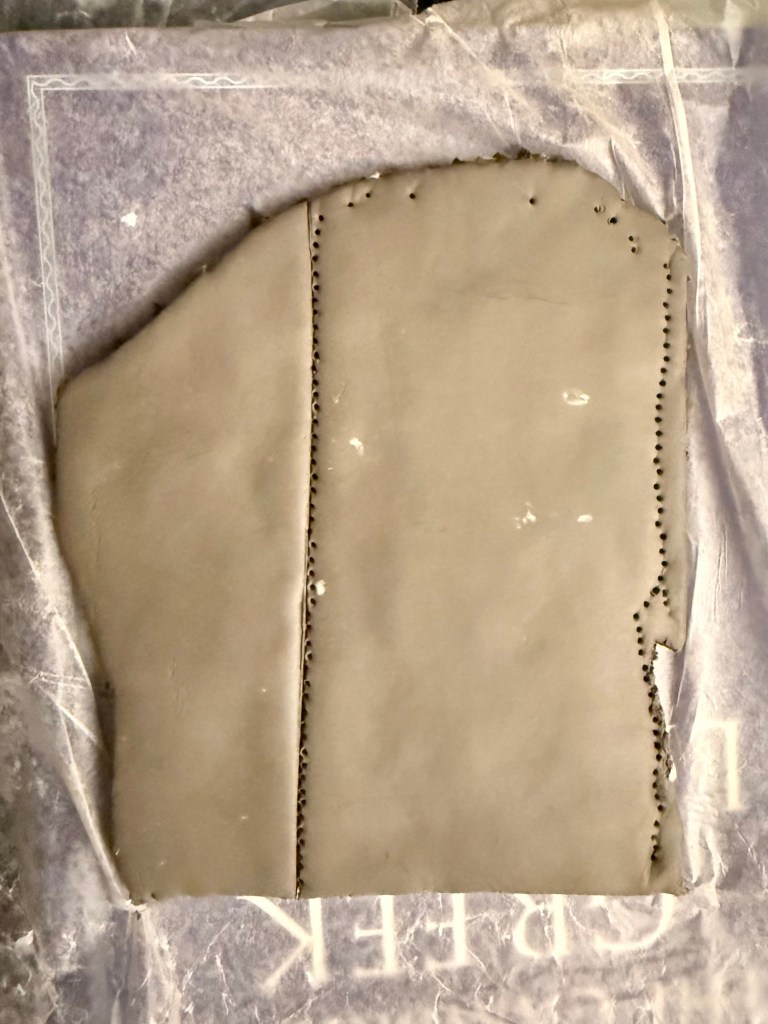
    I then scored the signature cleft line that bisects the original tablet. That line helped me rule the text. After that, to mark where each line of writing would begin and end, I took a needle and, with the paper still on top, pricked small bounding dots at the start and stop of every line. This gave me a grid of sorts—not formal ruling, but a subtle framework for spacing. I used actual cuneiform signs from the standard text, fitting in as much as I could per line (which, as I’ll tell you shortly, turned out to be not very much at all).
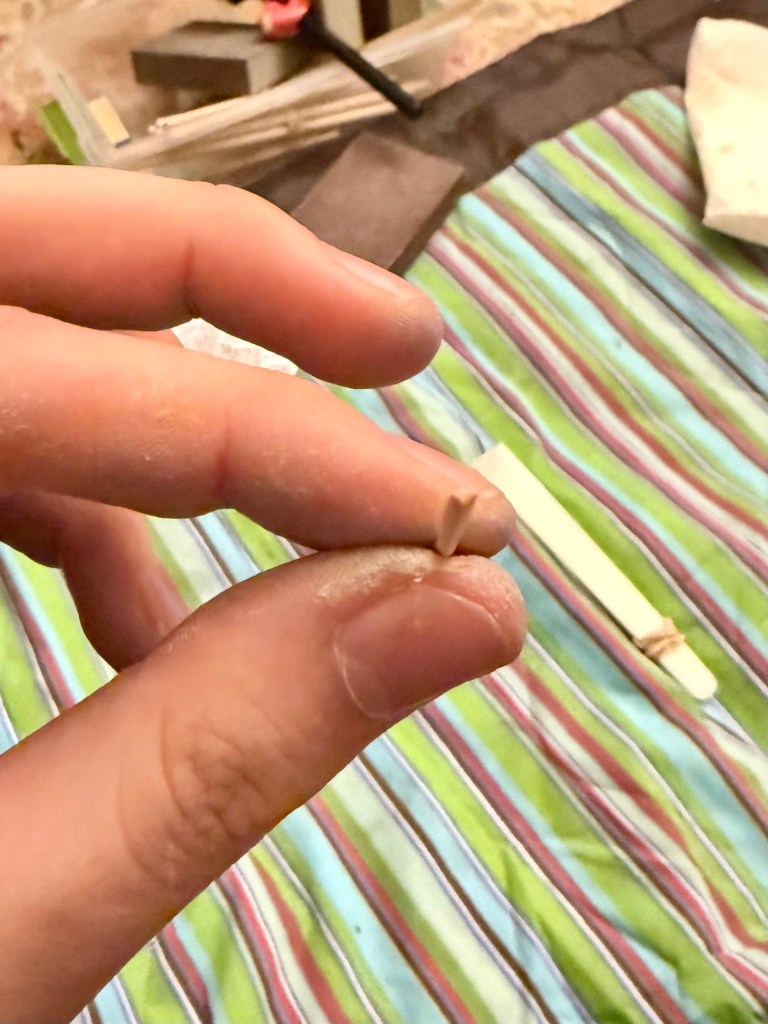
    For the inscription itself, I used a homemade stylus made from a square wooden dowel. I had sanded down one corner to create a slightly beveled edge that let me grip it more naturally—pinching it between thumb and middle finger, with my index finger guiding from above. In the course of things, I ended up using two styli. The first began to dull mysteriously partway through, possibly due to the water I kept brushing onto the clay to keep it soft. The wood was porous, and the repeated wetting may have softened or blunted its edges. I hadn’t expected tool fatigue quite so early in the process.

    3. Difficulties: Scale, Fatigue, and the Limits of Enthusiasm
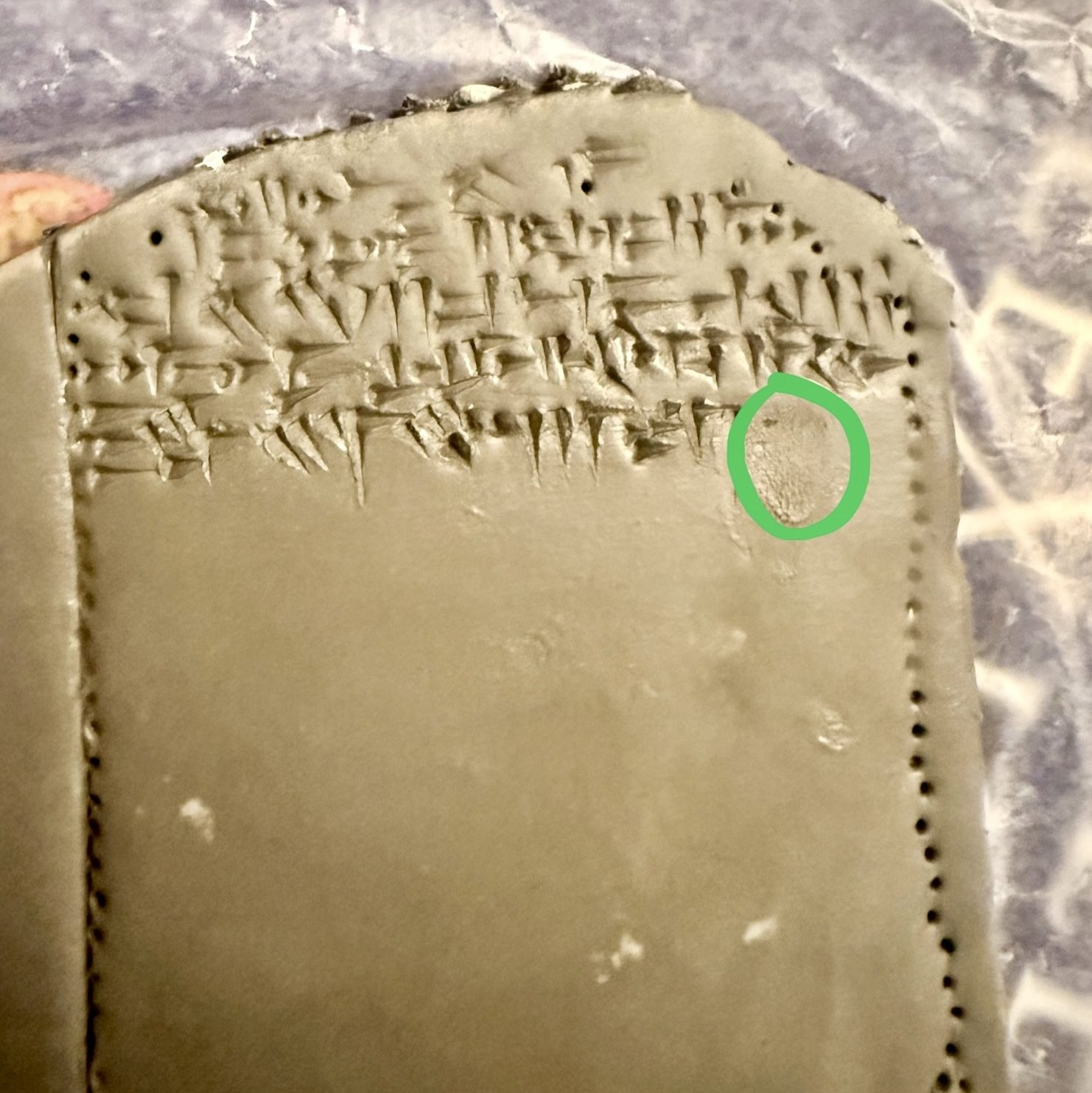
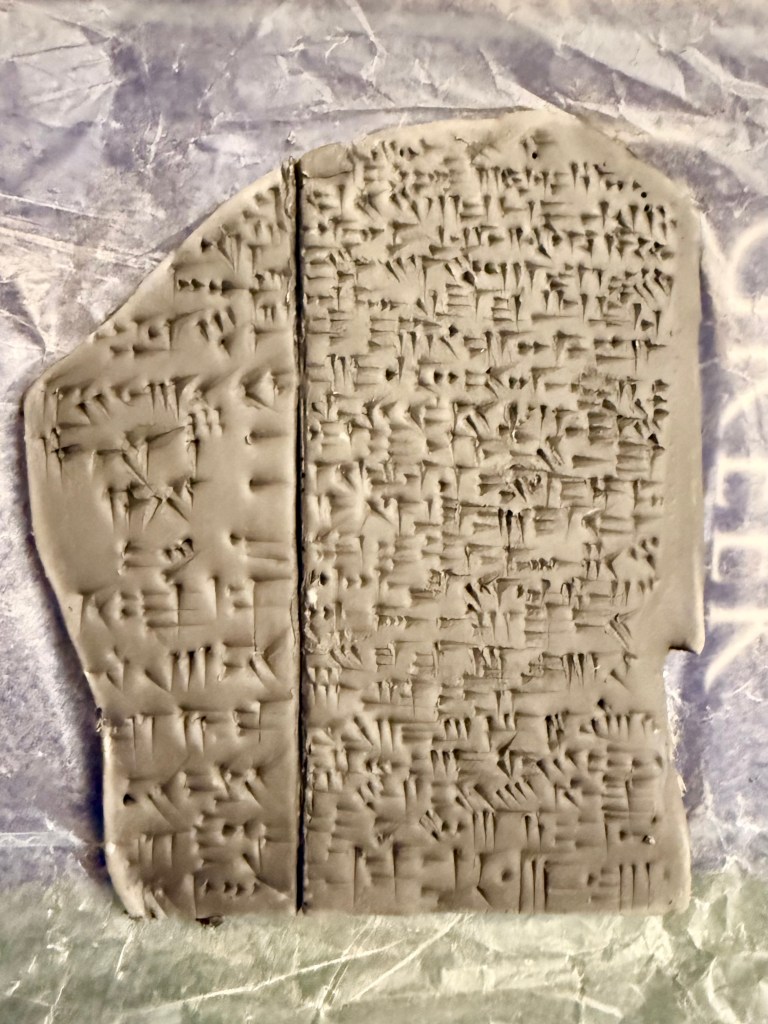
    What surprised me most was just how big my signs ended up being. Between the bluntness of my stylus and the limits of my own control, I found I could only produce cuneiform signs that were two to three times the height of the original inscriptions—and at least twice the width. The clay itself wasn’t the issue. If anything, it was a pleasure to work with: I kept smearing water across the surface with my fingertip, especially over unused areas, and that seemed to make the impressions cleaner and more precise. The medium was surprisingly forgiving, an example of an erasure using this technique is given above, in the green circle. My hands were not as pliant.
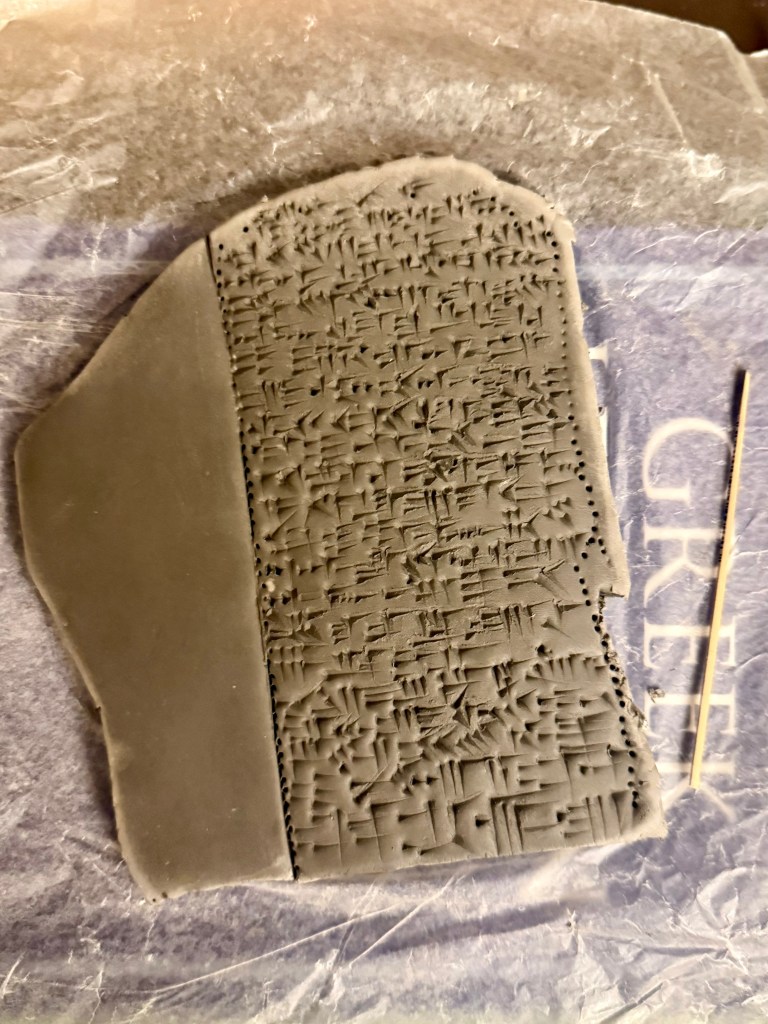
    I started at the top of the right-hand side of the tablet, and you can tell. My signs grew noticeably larger over time as fatigue set in. I spent around two hours just pressing wedges into the clay, and by the end I was feeling it. Not just in my hand, but in my attention span. I’d wildly underestimated how much text I could fit on the slab at the scale I was working—I probably would’ve needed to double the size to get anywhere close to the full line count of the original.

    By the end, I had learned what I came to learn—and felt ready to let it rest. I don’t plan to do the other side or fill in any missing fragments. This was enough to teach me what I wanted to know: how hard it is, how slow it is, how deliberate every single wedge has to be. The work left me with admiration, exhaustion, and just enough satisfaction to call it finished.

    4. Why It Was So Hard—And What That Tells Us

    This was the smallest scale of replica I’ve ever attempted, and still, my signs were roughly 2.5 times the size of the originals. And even at that inflated scale, I’m not confident I could accurately draw what I carved just by looking at the replica. That tells me a lot. It explains, viscerally, why there was an elite scribal class in Mesopotamian society, and why their training was so extensive. It wasn’t just about memorizing hundreds of signs—though that alone is a feat, especially for scribes working in multiple languages. It was about navigating a medium that added layers of challenge: spacing, shaping, texture, tool wear, and fatigue.

    I’ve long wanted to understand what made cuneiform so difficult—not just as a writing system, but as a practice. Even after studying the language on paper, I didn’t fully grasp the physical demands until I tried it myself.

    I wish we had spent even a single thirty-minute session in Akkadian I making tablets, especially at a small scale like this. The pedagogical value would’ve been enormous. You suddenly understand not just the abstract difficulty of the writing system, but the labor infrastructure around it—the apprenticeship, the specialization, the patience. This little experiment gave me a glimpse into that world, and for that, I’m genuinely grateful.

    5. Closing: A New Kind of Knowing

    I ended up with a lopsided, oversized, and incomplete tablet. But also: textured, hard-won, and deeply instructive. In the end, as it turns out, this wasn’t really about copying Tablet XI. It was about spending time inside its logic—its weight, its line spacing, its forgiving-but-not medium—and learning something I couldn’t have understood from a textbook.

    If you’re studying cuneiform, or even just curious about ancient writing, I can’t recommend this kind of tactile experiment enough. Make a stylus. Roll some clay from your local art-supply store. Try a single line. Your respect for those scribes will double. And you’ll probably come away, as I did, with something small and slightly ridiculous to keep on your shelf—a cracked echo of something monumental. Decidedly not a replica. Rather a kind of conversation.

    Here’s the “finished” product:
  • The Tritropic Line, 2: Driven Far, Still Moving

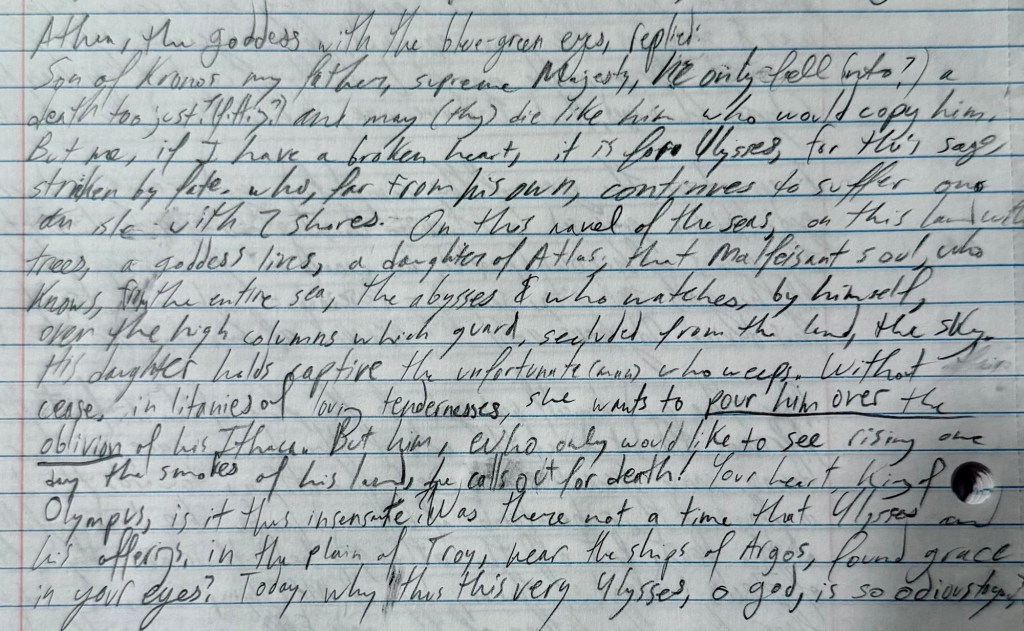
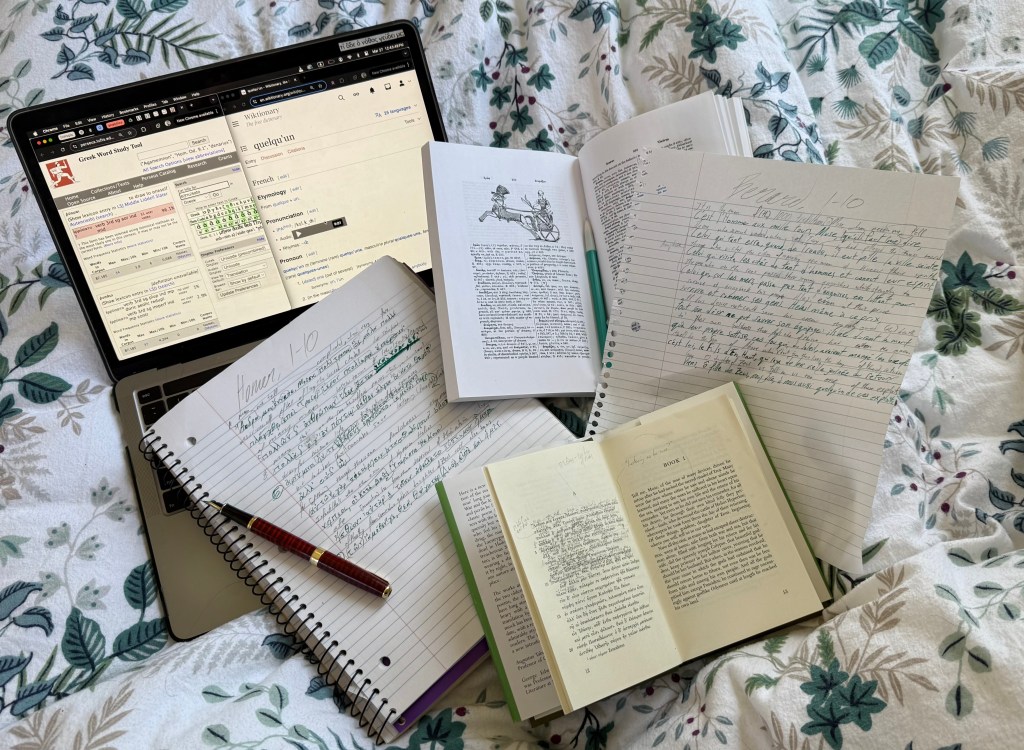
    A passage, translated from Bérard, that I found particularly moving. In it, Athena pleads to Zeus, asking that he find mercy in his hardened heart for Odysseus.

    Reading for friction, not fluency

    In the first week of Tritropic, I found myself reading the same passage in French and Greek on the same day. It seemed like a good idea: reinforce the meaning, triangulate expression, hold the line up to two kinds of light. Instead, once I’d puzzled out the syntax and meaning in one language, the second version became trivial. All the work had already been done, particularly because Bérard’s French hews so closely to the original—here a gift and a curse, since the shape of the sentence had already been laid bare.

    What should have been a second act of discovery turned into a performance of memory. And that, for me, is a dead end.

    So I’m revising my approach for the next month to see if a new structure works. I now read a Book of the Odyssey in French across a week, then return to the same section in Greek for the next two or three weeks. This reintroduces mystery—just enough forgetting to force me to re-earn my understanding. Each version remains itself so I can’t lean on one to carry the other. However, there’s just enough closeness, I think, for comparison of translation choices. Theory of translation is something I quite want to pursue through this—it’d be a shame to lose that aspect.


    Scaffolds and Syntax

    In these early days, I’ve learned to be wary of digital tools—pop-up glosses, online parsers, translation extensions. There’s a difference between using scholarly supports and just outsourcing thought. Too often, I found myself parsing without learning. Clicking my way through a passage gave me the answer but not the understanding.

    To counter that, I’ve built what I call a “Reading Ladder” for the French. It begins with a cold read—no tools, no support, just me and the text, making guesses about syntax and structure. Next, I pass through a deeper parsing stage, using only a grammar and a basic dictionary to confirm key unknowns, not every minor term. Only after this do I allow myself to consult a translation or ask my fluent friends, not as a crutch but as a corrective.

    I plan two final stages once I get my bearings more. These are expressive exercises: retelling the passage in my own French, rereading it aloud for rhythm, and briefly stepping outside the text to engage with something stylistically adjacent—a short piece by Gide, a 19th-century abstract on epic poetics, anything that stretches my sense of what French can do.

    Throughout this process, I plan on keeping a syntax journal. Each week, I record one sentence I understood without help, one that tripped me up (with notes on why), and one that delighted me. The journal is to be a miniature Grammaire Bérardienne. It also is meant as a reminder that joy is a form of comprehension.


    Greek and Joyful Tedium

    Greek, with its distance from both English and the Attic I’m familiar with, is a harder beast—and all the more rewarding because of it. I’ve adopted a multi-pass system here as well. The first time through, I read aloud without stopping. No dictionary, no notes, just the text and the shape of the sentence as much as I can discern it. I underline words I don’t know, try to guess at their meaning from morphology, meter, or context. Only after that do I allow myself to return and parse each word carefully. By then, I’ve already begun to intuit some of the patterns, and the parsing feels earned rather than imposed.

    Twice a week, I do blind parsing drills. I take a short passage, cover any translation, and write out the morphological analysis of each verb and noun—tense, mood, case, number, person, source verb or noun. Then I translate from scratch. It’s humbling, but it builds exactly the muscles I’m trying to train.

    Every month, I’m going to try to reread an entire Book in Greek with no aids. It’s the closest this kind of study gets to strength training. My professors have told me one of the best things you can do for your Greek (and language skills generally) is to reread, since you’re no longer in just decode-mode. This very much helped me last semester in my Lucian class. The sense of fluency that emerges—halting, but unmistakable—is worth every hour.

    I also keep a personal lexicon, noting each unfamiliar form, particle usage, or idiom that gives me pause. And every few weeks, I’ll try my hand at short Homeric compositions—just five or six lines using words and constructions I’ve encountered. In the meantime, I’m studying from two Quizlets: one of the 500 most common Homeric vocabulary items, and one with 70+ important ‘small words.’


    What the Text Offers

    What I hadn’t fully expected was just how well-suited the Odyssey is for this kind of iterative, interleaved learning. Its repetitions are pedagogical for me. Vocabulary recurs with slight variations, idioms reappear in altered contexts, and the syntax is often rhythmic enough to imprint itself on the brain. Bérard understands this, and he mirrors Homer’s scaffolding with care. His French extends Homer’s use of anaphora, his vocabulary choices build on one another, and his ceremonial tone reinforces structure as it elevates the prose.

    In both languages, challenge ramps up at a manageable pace. I’m only a few pages in, but already I can sense the increasing complexity—more embedded clauses, trickier participial constructions, and richer metaphor. But nothing feels unearned. The text supports you even as it stretches you.


    Perseverance, Not Performance

    There’s a line at the beginning—one I have reached in both languages—that keeps echoing in my head: ὃς μάλα πολλὰ πλάγχθη. It’s often rendered loosely as “he who was greatly tossed about,” but the Greek is more literal than that, and stranger: he who was driven off far or much. It conjures not just aimless wandering, but compelled displacement—someone pushed off course by forces beyond his control.

    Bérard translates it as celui qui tant erra—“the one who wandered so much.” Murray’s version is starker: “the man who was driven far astray.” Murray evokes motion without agency, but Bérard is softer, more open to interpretation on whether this wandering was chosen or forced. Yet they both understand that πλάγχθη is not just travel, but deviation.

    The line isn’t just about Odysseus, however. It describes what it means to read a difficult language honestly. You’re driven, sometimes astray, but still in motion.

    Difficulty, for me, is no longer something to overcome. I recognize it now as an essential condition for progress. Every time I misparse a participle or mistake a clause boundary, I get a little closer to understanding—not just the sentence, but the langauge system that generated it. That’s the rhythm of the tritropic line: wandering with purpose.

  • APEX Updates, 2: What is the Transmission Problem? A Brief History of My Research Question

    If the first APEX post was about tracing letters, this one is about why those traces matter. Underneath every variant alpha or eccentric epsilon is a deeper question: when, how, and under what conditions did the Greek alphabet emerge from its West Semitic predecessor? This question, which is known in the scholarship as the transmission problem, lies at the core of alphabetic studies, and despite over a century of scholarship, it remains fiercely contested. To map alphabetic transmission is not just to track graphical similarity, but to reckon with how cultures borrow, adapt, forget, and reimagine the systems by which they make language visible.

    At its simplest, the transmission problem asks: When did the Greeks adopt the Phoenician script? But the real terrain is messier. Did the transfer happen once or multiple times? Was it sudden or gradual? Coordinated or ad hoc? Which region of the Greek-speaking world was first? Exactly which Semitic script was the donor—or was there a confluence of models? And what kind of evidence—linguistic, paleographic, archaeological—should we privilege when our sources conflict?

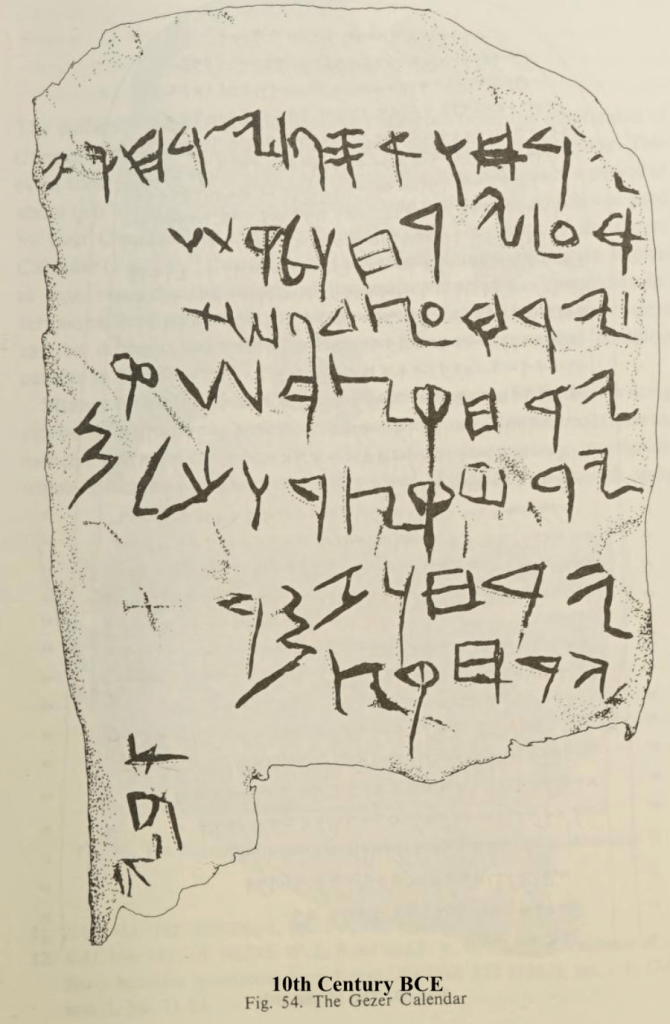
    Historically, the debate has followed disciplinary lines. Scholars trained in Semitic philology and Near Eastern studies tend to favor a high date for the transmission: sometime in the 11th or 10th century BCE, before the traditional Greek Geometric period (in older scholarship, referred to as the “Greek Dark Age”). This camp emphasizes the strong formal similarities between early Greek and Phoenician letterforms, arguing that Greek epichoric scripts most closely resemble Phoenician forms from around 1050 BCE, not the later shapes one would expect if transmission occurred in the 8th century. Joseph Naveh, for instance, in his landmark Early History of the Alphabet (1982), argued that the Greek system must have branched off before major innovations appear in the Phoenician script, such as the angular mem or evolved forms of shin. Naveh saw the Greek alphabet as a snapshot of an earlier Semitic system—evidence, in his view, of early contact and early borrowing.

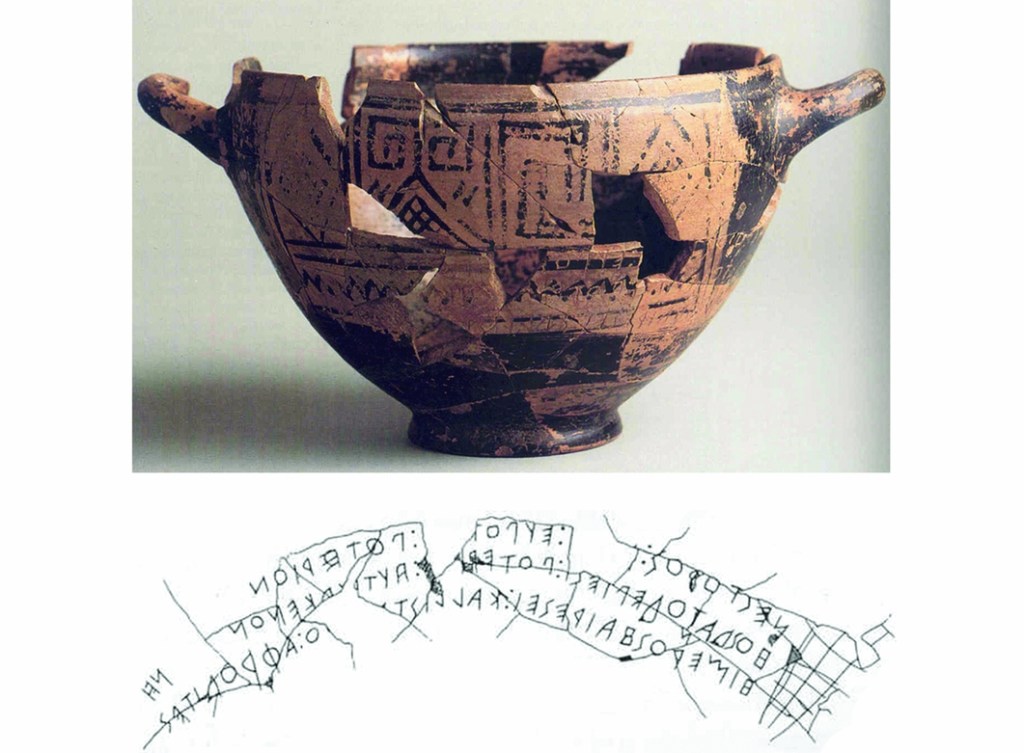
    On the other side of the debate, Classicists and archaeologists tend to argue for a low date, favoring the 8th century BCE. Their reasoning draws primarily from stratified archaeological contexts: the earliest securely datable Greek inscriptions—such as the Dipylon oinochoe and the Nestor’s Cup from Pithekoussai—belong to the mid-to-late 8th century. Rhys Carpenter was among the earliest and most forceful voices in this camp. In a 1933 article, he wrote that “the argumentum a silentio grows every year more formidable and more conclusive,” referring to the continued absence of any Greek alphabetic inscriptions predating the eighth century (“The Antiquity of the Greek Alphabet,” AJA 37 [1933]: 8–29, at p. 27). For Carpenter, the lack of material evidence was not a gap to be explained away, but itself a powerful datum: if earlier use had existed, we would likely have found traces by now.

    This school is generally skeptical of typological comparison, pointing out that letterforms evolve unevenly and can be conservative in certain contexts. Archaeological absence, while never conclusive, is taken seriously—especially when paired with the sudden, near-simultaneous appearance of inscriptions across disparate sites in the 8th century, suggesting a relatively rapid uptake of a recently acquired script. Later scholars, such as Barry B. Powell, built on this foundation. In Homer and the Origin of the Greek Alphabet (1991), Powell controversially argued that the Greek alphabet was deliberately invented for the purpose of recording Homeric verse, dating the invention to around 750 BCE. Though widely criticized for its teleology and lack of evidence for such a top-down design, Powell’s theory exemplifies the kind of interdisciplinary crossfire that defines this problem: where linguistic function, archaeological data, and cultural ideology all collide.

    Roger D. Woodard, in Greek Writing from Knossos to Homer (1997), pushed back against Powell while still supporting a relatively late date. Woodard views the alphabet’s adaptation as a process shaped not only by contact with Phoenician traders but also by internal Greek developments—especially the memory of Linear B and broader shifts in literacy practices. He emphasizes the complex interplay between tradition and innovation, seeing the Greek vowel system as a structural solution that could only emerge in a linguistic environment receptive to phonological precision.

    The question remains open, but APEX offers a different kind of approach. Rather than anchoring the debate to a single origin point, I focus on regional trajectories and graphical evidence: how letterforms vary, travel, and settle. If the Semitic party line reads the Greek alphabet as a photograph of Phoenician forms from 1000 BCE, and the archaeological model sees it as an emergent public tool of the 8th century, then I want to understand how specific graphemes move through space and time. Which forms remain stable across centuries? Which mutate rapidly? And what can that tell us about the process of transmission, rather than the moment of origin?

    In fact, the most immediate goal of the APEX project is to evaluate whether the Greek letterforms do, in fact, most closely resemble the Semitic models from around 1000 BCE—as the high-date camp maintains—or if their nearest parallels lie elsewhere in the Phoenician typology. The intention is to move beyond qualitative comparisons and scholarly intuition, toward a quantitative, statistically grounded assessment of letterform similarity. By measuring and modeling these visual relationships systematically, APEX aims to provide a more objective foundation for dating the moment of greatest resemblance between the Greek and Phoenician scripts.

    Rather than jumping straight into letterform similarity metrics, though, the next update will take a detour—one that’s no less crucial. Before the vectors can speak, they must be named, contextualized, and organized. APEX Updates, 3: Encoding Decisions will explore how I’m structuring the metadata that surrounds each traced letter: what counts as “context,” how information is tagged, and why every dataset is also a narrative. As it turns out, deciding how to describe a letter may be just as revealing as deciding how to compare it.

  • Marginalia, 2: On Diaspora and Scholarship

    Diaspora means a scattering—but not just away from. It’s also a scattering into: people of yours wherever you go. There’s dislocation in that, but also a strange kind of belonging. You’re never quite at home, but also never entirely foreign. We are at home wherever we are, as the Jewish Bundists say.

    I come from the Armenian diaspora. Much of the history I now hold came to me late, in fragments I had to gather myself. So much so that when my family went to Armenia for the 100th anniversary of the genocide, I misunderstood the purpose of our trip. I didn’t yet know what had been left unsaid. I learned the truth online months later. A strange inheritance: delayed, then all at once.

    That moment formed something in me—something about responsibility, memory, and the ethics of knowing. I now see myself as a banner-carrier of the diasporic experience—not just for Armenians, but in solidarity with all displaced and fragmented peoples. Diaspora isn’t a single story but a way of listening, noticing, and asking better questions.

    Ironically, none of the languages I study are mine. I never learned Armenian. I was meant to attend an immersion program in Yerevan in 2020, but it didn’t happen for the obvious reasons. The language now feels like an island—real, reachable, and still far away. It’s typologically unusual and hard to access. And emotionally, I’ve kept it at a distance—not for lack of interest, but for fear of doing it harm.

    Still, the connection shows up. It’s in the care I bring to other people’s histories, in my reverence for displaced traditions, in my work with Semitic languages—speech communities so often marked by rupture. I haven’t yet studied heritage material from my own background, but I carry the stakes of diasporic scholarship into every archive. Distance doesn’t cancel care, it clarifies it.

    My sense of scholarly ethics—especially around archaeology and epigraphy—grows directly from this. I believe in repatriation, in collective self-determination and the right of communities to steward their past. Yes, nations are imagined, but so are all our systems of meaning. So long as national identity structures the world, its claims must be taken seriously.

    Museums, of course, complicate things. Scattering brings both access and erasure. Greek artifacts in London, Mesopotamian seals in New York—these too live in diaspora. There’s value in broader visibility, especially for those who can’t travel. But there’s loss, too: of voice, of sovereignty, of situated knowledge. I think about this often. I haven’t resolved it.

    I don’t just want a life in the library. I want antiquity to be for everyone. I want the past to feel shared, common, alive. I want to show people that our inheritance—linguistic, cultural, intellectual—is truly ours. The more we realize that, the more fully we can meet the present. That’s the gift of diaspora: a way of being scattered that still insists on connection.

  • Linguistics for All, 2: Rare Features of Select Endangered Languages

    Linguistics for All, 2: Rare Features of Select Endangered Languages

    Though this is technically Linguistics for All, 2, this post is about NYU League of Linguistics’ first discussion group of the semester—I’m posting it now because a few people asked for the recap, and I’m more than happy to oblige.

    The conversation focused on typological features found in endangered languages—many of them rare in the languages of the world and very unexpected (to English speakers, that is). We took a fast but focused world tour: Austronesian syntax, Mayan phonology, Bantu morphology, and more. The goal wasn’t comprehensiveness, but curiosity. What kinds of things can human languages do? And what’s at stake when we lose examples of those things?

    Some of the questions that came up:

    • How do syntactic constraints shift when the verb comes first? When the object comes before the subject?
    • Why might a language have a vast and highly irregular consonant inventory? Why might sound changes that are quite unique cross-linguistically emerge?
    • What’s it like to speak a language where every noun has to fit into one of twenty classes, each with its own agreement pattern?

    The point was to slow down and marvel at the extent of linguistic diversity, and just what we’d lose if those languages went extinct. These features are beautiful, in my opinion, but they’re also systemically instructive. They tell us what’s possible in the “design space” of language, and how they resist the tidy models that formalists sometimes prefer.

    For those who couldn’t attend, the slides are linked here along with a short primer on the pre-event readings & videos, plus a folder of journal articles and book chapters in a shared Google Drive. Unfortunately, we weren’t able to record the session, but I’m hoping to incorporate some of this material into future blog entries or curriculum tools.

    And if this is your first time hearing about the League, drop me a line at tfavdw@nyu.edu—we meet semi-regularly and welcome anyone curious about language in any form. NYU affiliates and non-NYU people can both attend.

    Stay tuned for our next session: a hands-on cryptography and forensic linguistic game using real linguistic data, running during midterms as a low-stakes puzzle night (with some surprise mechanics). It’ll be at 10 Washington Place, NY, NY, at 6:30pm on April 1st. More details are available at nyulol.org, and a recording of the presentation portion, delivered by a leading forensic linguist, will be posted shortly after the event.

  • Tools of the Trade, 1: Epigraphy: The Local Scripts of Archaic Greece by L.H. Jeffery

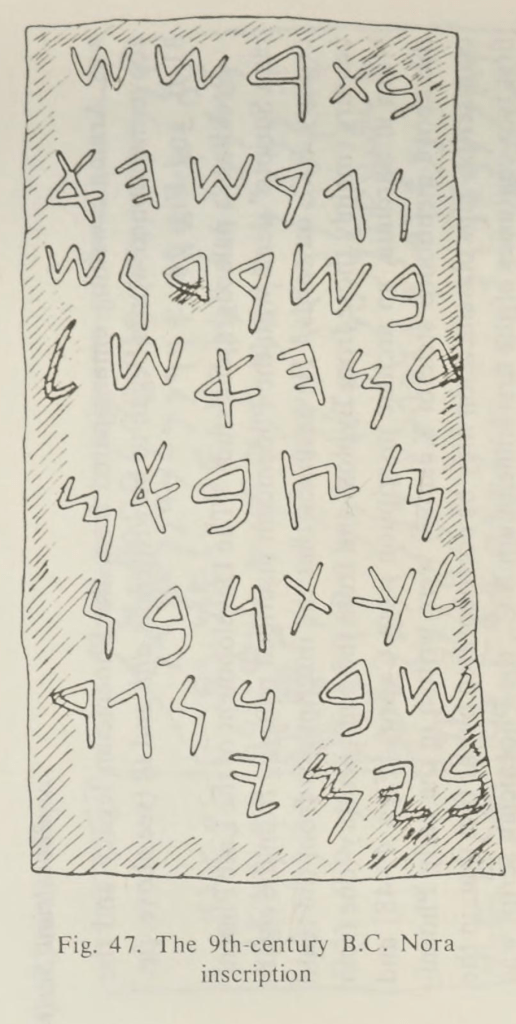
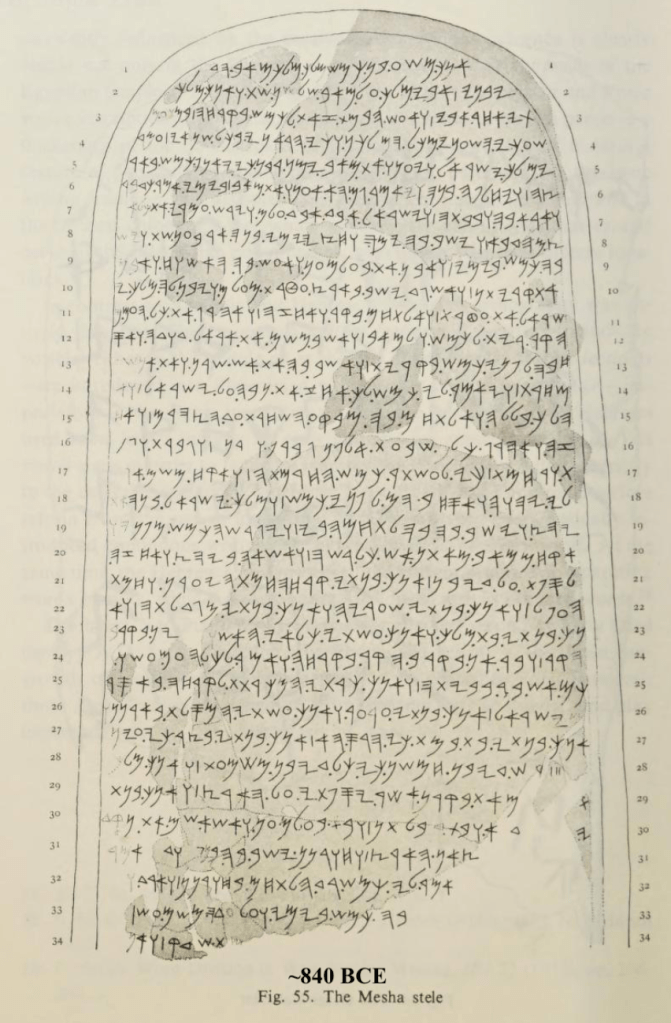
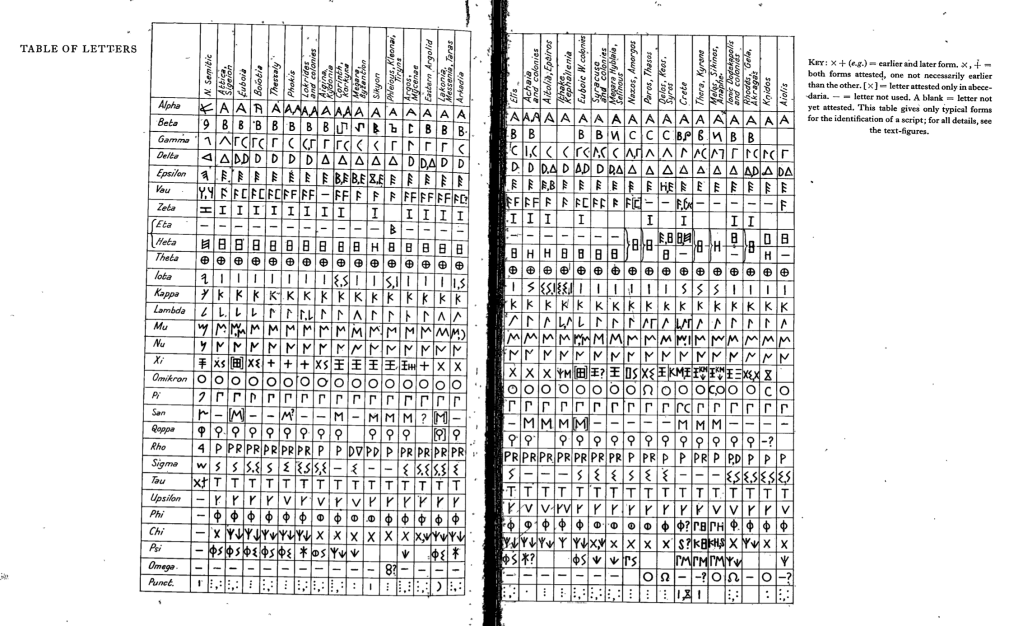
    Jeffery’s summary table of all epichoric scripts at the end of LSAG.
    It is foundational for any work on early regional Greek scripts.

    There are very few books I consider truly irreplaceable in my research. Lilian H. Jeffery’s The Local Scripts of Archaic Greece is one of them. First published in 1961 and revised in 1990 with A.W. Johnston, this book remains the reference for regional variations in the Greek alphabet during the archaic period. It’s where I first learned to read epichoric inscriptions with the eye of a paleographer rather than a Classicist alone.

    The book is very hard to find, and I only got my copy at an even remotely affordable price after months of scouring secondhand sellers. While copies still circulate among libraries and the used book market, I wanted to make it more accessible to others working in this area. So I hunted diligently before finding it on the Internet Archive. You can read or download it here:
    The Local Scripts of Archaic Greece (1990 ed.) – Internet Archive

    Jeffery’s study remains foundational for any work on early Greek writing—not just in Athens or Ionia, but across the full spectrum of regional scripts: Corinthian, Euboian, Attic-Boeotian, Cretan, Cycladic, and others. It includes extensive commentary, maps, and an invaluable inscriptional catalogue organized by region, with drawings and typographic transcriptions. The 1990 revision added important corrections, expanded references, and additional illustrative material. For those of us studying alphabetic transmission, especially the Phoenician-Greek interface or the evolution of letterforms over time, this book is indispensable.

    What makes Local Scripts especially useful is that it bridges the gap between paleography, archaeology, and linguistics. Jeffery doesn’t just chart when and where a particular variant of alpha or epsilon shows up—she explains what those variations might imply for chronology, influence, and contact. And although her typology has been revised and challenged in places (especially with the discovery of new inscriptions), her system remains a critical baseline for almost every study that’s come after.

    Whether you’re interested in early Greek literacy, the transmission of the alphabet, the sociopolitical meaning of epigraphy, or just want to be able to tell the difference between Laconian and Euboian chi, this is the book to start with. I hope having it freely available will be helpful to others navigating this fragmentary and fascinating material.

    Do you have other resources you pair with Jeffery? I’d love to hear what we can supplement LSAG with.

  • Tablets and Tribulations, 1: Lapse and Return

    2023: Tablet replica I made from a drawing in Huehnergard’s grammar.

    I first took Akkadian a few years ago. Since then, the language has been sitting in a kind of suspended animation: just far enough away to feel unreachable, just close enough to make me feel guilty.

    This post kicks off Tablets and Tribulations, a new series chronicling my return to Akkadian. I’ll be using it to track my progress, share insights, and reflect on what it means to study something this complex, this demanding, and this strange.

    Why Akkadian?

    Akkadian sits at the intersection of my academic obsessions: Semitic linguistics, the history of writing systems, and the psycholinguistics of script. It’s a dead language, but not a fossilized one. The more you read it, the more it pulses: with bureaucracy, with poetry, with prayer. And the writing system—a sprawling, phonetically polyvalent syllabary riddled with ideograms—is completely unlike the tight alphabets I’m used to. It demands patience, pattern-recognition, and grit.

    There’s also no shortage of material, with estimates of the number of excavated Akkadian texts reaching as high two million—meaning it quite possibly has the most documents of any ancient language; in fact, according to my professor Ronald Wallenfels, more documents than all ancient languages combined. Put that in your pipe and smoke it.

    I’m also drawn to it because I’m not naturally good at it. Greek and Latin came to me more intuitively, their logics familiar in a way I hadn’t expected. Akkadian doesn’t let me do that. It forces me to slow down, to wrestle with my perfectionism, to train my brain in new ways. And I love that. I want to get good at something hard. I want to overcome the mental blocks that have held me back before.

    What’s Changed

    Since that early study, I’ve broadened my exposure to Semitic linguistics and become more confident working with both the script and the medium. I’ve also made peace with how humbling this language is. Once, I even told a syntax class—confidently—that Akkadian had no demonstratives, only to moments later fact-check myself and discover that it had three distinct tiers of them. I then had to publicly correct myself and told them to pray for me… as I had a quiz on Akkadian pronominals the next period.

    I’m now studying with two grammars, Huehnergard and Caplice, using Labat’s sign list as my main reference. I’m also switching from just drawing signs to pressing them into clay, and my wax tablets—less sketchbook, more scribal. I’ll be posting more about that process (and my tablet replicas) soon.

    What to Expect from This Series

    Tablets and Tribulations will be part language log, part material exploration, and part meditation on what it means to study a language with no living speakers and a script that defies modern intuition. Future posts will likely include:

    • Syntax deep dives (word order, case, verb chains, etc.)
    • Close readings of texts (legal, literary, magical, bureaucratic)
    • Reflections on learning signs and navigating polyvalence
    • Notes on scribal training and cuneiform technique
    • My own experimental archaeology: pressing and firing tablets
    • Anecdotes from the museum and the classroom
    • Psycholinguistic musings on how syllabaries shape cognition
    • Occasional moments of crisis and triumph

    This is going to be hard. But I want that. I want to stretch, stumble, and get back up. That balance—rigor with joy—is what I’m working toward. Each week with Akkadian reminds me how study disciplines the self—not just the mind.

    So here’s to the first step. The tablets await.

  • APEX Updates, 1: Building a Dataset

    Every big project starts with a deceptively small question. For me, it was: how do you turn a carved letter into data?

    APEX (Alphabetic Paleography Explorer) is my attempt to map how the Greek alphabet developed and spread—first across Greek-speaking regions, then into other scripts entirely. But before I can compare, model, or visualize anything, I need something more fundamental: a dataset that doesn’t just record letters, but understands them. That’s where things get tricky.

    Step 0: Drawing the Inscriptions

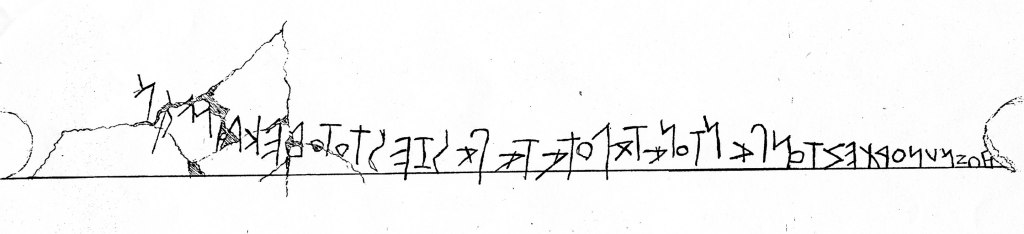
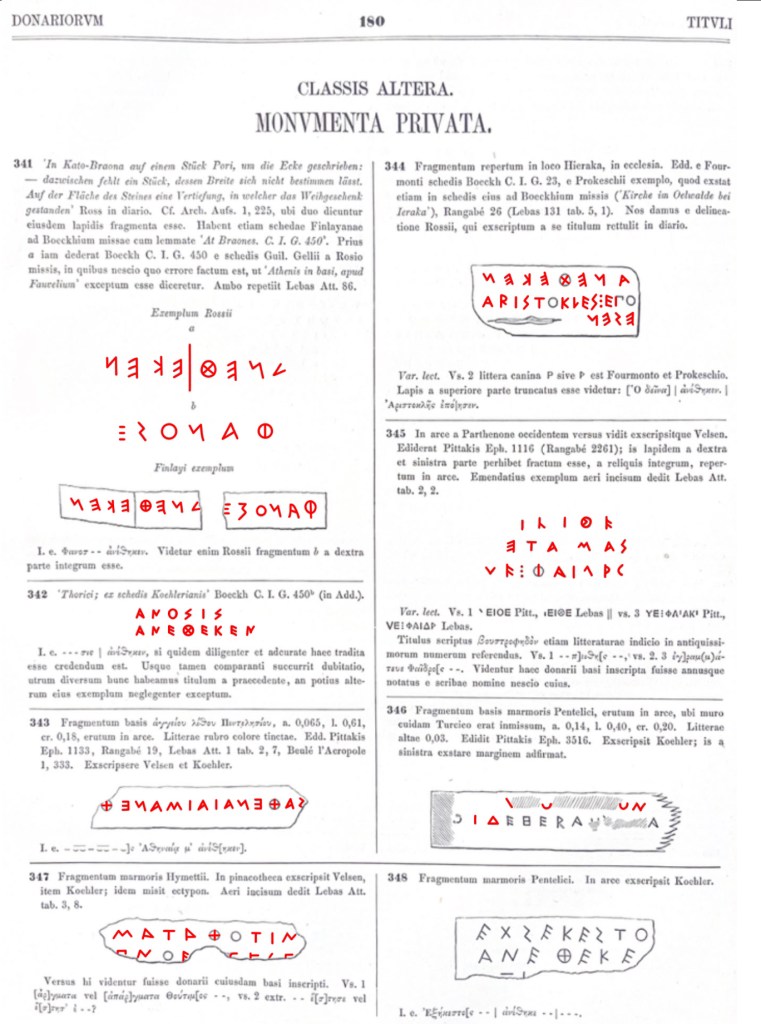
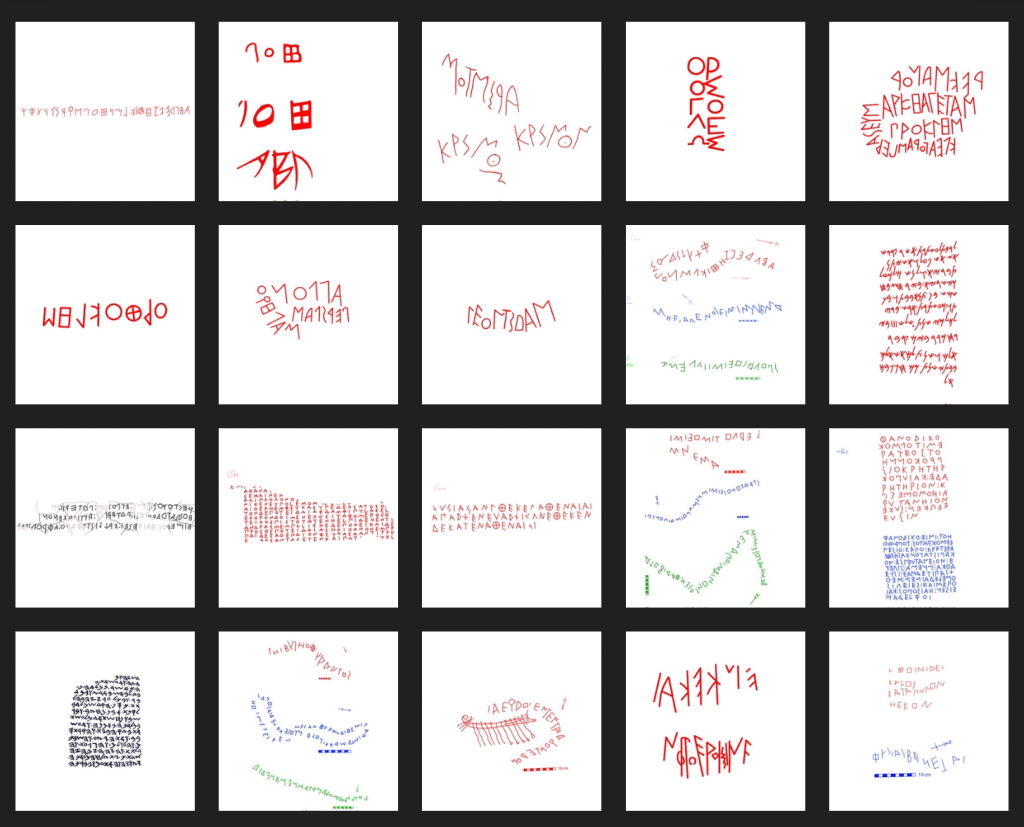
    Most corpora don’t offer clean, high-res images. They give us facsimiles—drawn reconstructions, often made by epigraphers decades ago. I tried using automated skeletonization on those, but the results were messy and inconsistent. So I went manual: scanning documents and tracing letters by hand on my iPad.

    It’s slow. But it gives me clean, consistent vector forms that reflect how letters were actually drawn—and forces me to look closely at every curve, stroke, and variation. In a sense, this is my own kind of excavation.

    What I Track

    Each inscription gets logged with basic info: where it was found, what it was written on, when it was made (as best we can tell), and how damaged it is. But the real heart of the project is the letters.

    For each character, I record:

    • Visual traits (curvature, symmetry, stroke count, proportions)
    • Layout (spacing, alignment, writing direction)
    • Function (sound value, graphemic identity)
    • Notes on ambiguity or damage

    From this, I can start comparing how different regions handled the same letter—Did their rho have a loop? Was their epsilon closed?—and whether that tells us something about cultural contact or local invention.

    The Workflow

    The data entry pipeline looks like this:

    1. Scan + trace the letterform
    2. Enter the inscription’s metadata
    3. Manually mark letter positions and reading direction
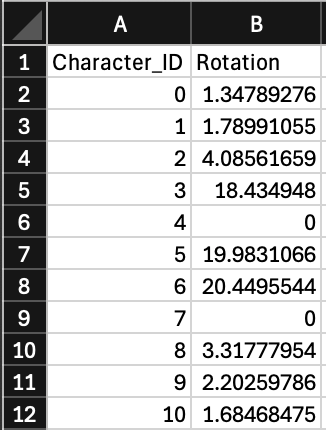
    4. Extract geometric features automatically
    5. Save everything as structured, nestable JSON

    It’s part computer vision, part field notes, and part quiet staring at a very old alpha until you start to feel like it’s looking back.

    Why This Level of Detail?

    Because I want to ask big questions—how alphabets travel, which paths are innovations vs. imitations—but I don’t want to ask them fuzzily. Too much work on writing systems either leans purely qualitative or strips out the messiness for the sake of clean data. APEX is an attempt to hold both: interpretive richness and formal structure.

    This dataset—AlphaBase, soon to be expanded to other open-access museum collections and public domain corpora—is the scaffolding. It’s how I’ll test transmission models later on. But even on its own, it’s already revealing things—like which letterforms stay stable across centuries, and which are quick to splinter under pressure.

    APEX begins here: not with theory, but with tracing. With building a system that doesn’t just store letterforms, but actually listens to what they’re doing. That’s what this first trench is for. Now I get to start digging.

  • The Tritropic Line, 1: The Art of an Opening

    Homer I.1-10 across three languages—with a bit of etymology on the side.

    Sing to me of the line turned thrice.

    When Homer calls Ulysses polytropos, he conjures a man of many turns—clever, wayward, folded in on himself. But I think of the line itself: turned once, then again, and again.

    This series takes its name from that multiplicity—because I, too, am reading each line far more than once. A minimum of three times, actually: English (Murray), French (Bérard), and the original Greek. The goal is not to triangulate a single meaning, but to feel the pressure points, the fault lines where interpretation shifts. The line becomes a hinge, a thing that can bear weight because it bends. Tritropic is about following that movement: reading with the grain, against, and across it.

    I start at the question of beginnings. To open something well—an argument, a poem, a conversation—is to create a direction; it prepares the reader for movement without determining the destination. This is the art I want to think about: how an opening invites us in. What is foregrounded, what is sacrificed: what choices author and translator (perhaps a false distinction) are forced to negotiate.

    So this is the first go. Tritropic starts from no thesis, but instead a posture: curious, slant, slightly off-center. Like Ulysses on the shore, this is always arriving, always about to depart.


    Introduction

    Let’s begin with an overview of the three versions and their respective approaches to opening the Odyssey—what each one foregrounds, what gets relegated to the background. From there, we’ll move into close readings of selected lines and phrases to ground the analysis. Finally, we’ll wrap up with a reflection on the interpretive choices each version makes.

    Overview

    I chose these translations for fidelity rather than flourish. I’ve read more poetic renditions of the Odyssey before—this January, I listened to Emily Wilson’s iambic pentameter version, particularly relishing the experience of orality—and enjoyed them greatly. But since my aim here is to learn both Epic Greek and modern French precisely, I sought translations that hew closely to the original line structure. The occasional flourish is still present, of course, but ideally these embellishments echo Homer’s own style, rather than showcasing the translator’s innovations.

    1. Greek (Homer): Epic immediacy and economy. The poem begins mid-thought without naming Odysseus, as if the story is already in motion. The identity of the hero is constructed through epithet and action, not personal detail. Syntax, too, reflects this: the Muse is invoked not in isolation but embedded within the sentence, mid-line, as part of the narrative’s machinery rather than as ornament. The structure is tightly coiled, balancing compression with clarity. It prioritizes movement, ethos, and a certain moral ambiguity: the line blames the men’s deaths on their own actions, but doesn’t dwell on it. The register is neutral, even austere. It’s less about grandeur than narrative pressure.

    ἄνδρα μοι ἔννεπε, μοῦσα, πολύτροπον, ὃς μάλα πολλὰ
    πλάγχθη, ἐπεὶ Τροίης ἱερὸν πτολίεθρον ἔπερσεν:
    πολλῶν δ᾽ ἀνθρώπων ἴδεν ἄστεα καὶ νόον ἔγνω,
    πολλὰ δ᾽ ὅ γ᾽ ἐν πόντῳ πάθεν ἄλγεα ὃν κατὰ θυμόν,
    ἀρνύμενος ἥν τε ψυχὴν καὶ νόστον ἑταίρων. (5)
    ἀλλ᾽ οὐδ᾽ ὣς ἑτάρους ἐρρύσατο, ἱέμενός περ:
    αὐτῶν γὰρ σφετέρῃσιν ἀτασθαλίῃσιν ὄλοντο,
    νήπιοι, οἳ κατὰ βοῦς Ὑπερίονος Ἠελίοιο
    ἤσθιον: αὐτὰρ ὁ τοῖσιν ἀφείλετο νόστιμον ἦμαρ.
    τῶν ἁμόθεν γε, θεά, θύγατερ Διός, εἰπὲ καὶ ἡμῖν. (10)

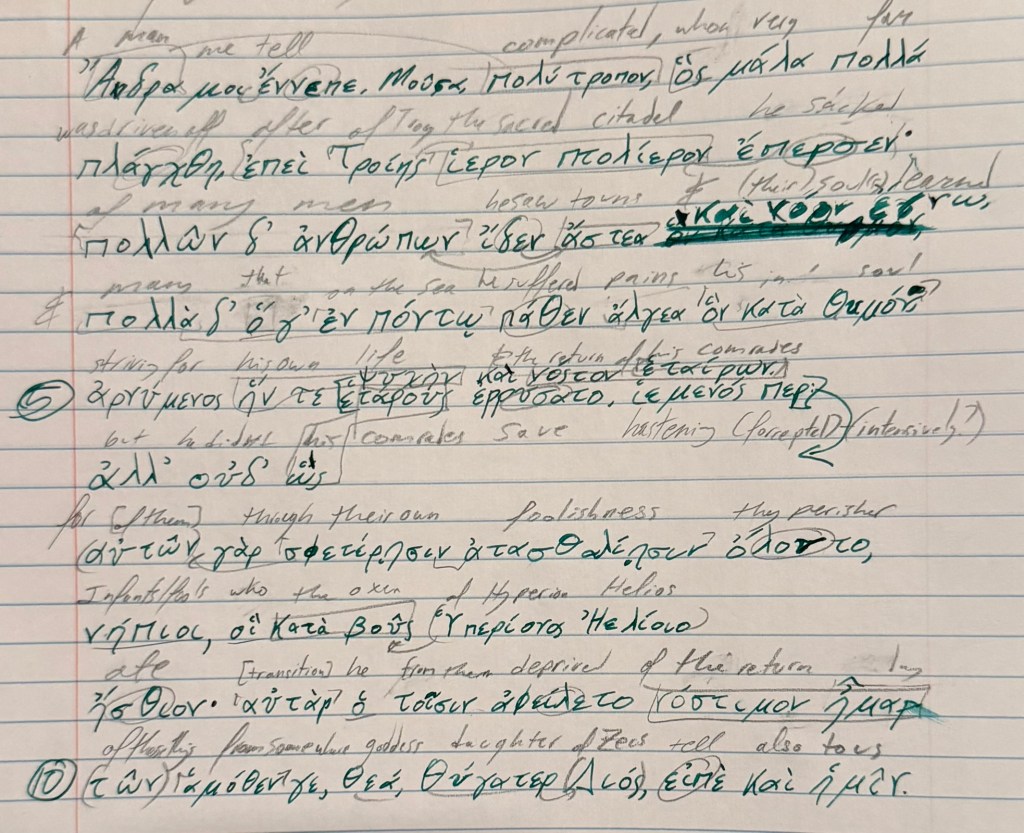
    Handwritten markup of Odyssey lines 1–10 in Greek with interlinear notes and translation cues
    My handwritten markup of the Greek: an early attempt to track structure, emphasis, and ambiguity.

    2. French (Bérard): Elevated, rhetorical, almost ceremonial. The anaphoric structure builds rhythm and stature, layering Odysseus’s identity through a litany of actions. He’s gradually evoked, perhaps even summoned, through his deeds and suffering. The effect is reverent, with an undertone of moral reflection. Where Homer enters mid-thought, Bérard expands the opening, giving it space and resonance. It feels less like a launch and more like an unveiling.

    C’est l’Homme aux mille tours, Muse, qu’il faut me dire—celui qui tant erra quand, de Troade, il eut pillé la ville sainte; celui qui visita les cités de tant d’hommes et connut leur esprit; celui qui, sur les mers, passa par tant d’angoisses, en luttant pour survivre et ramener ses gens. Hélas! même à ce prix, tout son désir ne put sauver son équipage: ils ne durent la mort qu’à leur propre sottise, ces fous qui, du Soleil, avaient mangé les bœufs; c’est lui, le Fils d’En Haut, qui raya de leur vie la journée du retour. Viens, ô fille de Zeus, nous dire, à nous aussi, quelqu’un de ces exploits.

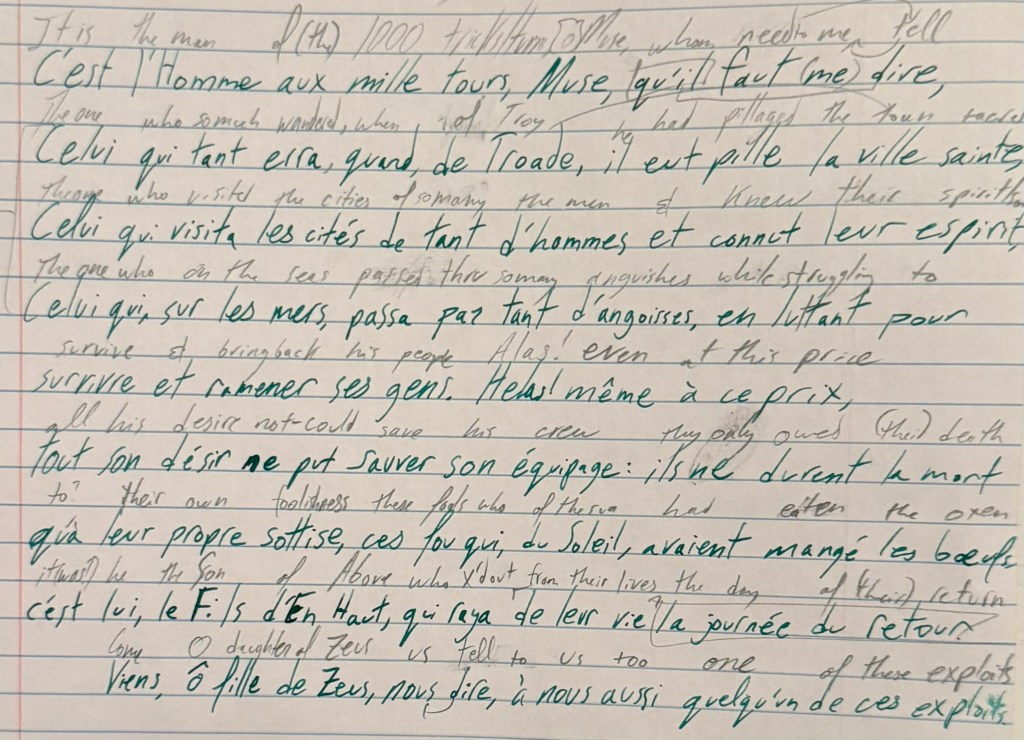
    Handwritten markup of Bérard’s French translation of Odyssey lines 1–10 with English glosses and emphasis underlines
    My markup of the French: tracing rhythm, repetition, and the tonal shift from epic immediacy to ceremonial unveiling.

    3. English (Murray): Spare, formal, and slightly distanced. Murray often mirrors the Greek more directly, especially in structure and sequence, but smooths out its syntactic tension. The tone is restrained, almost academic—archival rather than evocative. This is a translation written for sense, not sensation. Compared to Bérard, it holds back emotionally, but gains a kind of angular precision. It doesn’t call attention to itself, but allows the structure of the Greek to show through in quiet outline.

    Tell me, Muse, of the man of many devices, driven far astray after he had sacked the sacred citadel of Troy. Many were the men whose cities he saw and whose minds he learned, and many the woes he suffered in his heart upon the sea, seeking to win his own life and the return of his comrades. Yet even so he did not save his comrades, for all his desire, for through their own blind folly they perished fools, who devoured the cattle of Helios Hyperion; whereupon he took from them the day of their returning. Of these things, goddess, daughter of Zeus, beginning where you will, tell us in our turn.

    Close Readings

    1. πολύτροπος and its discontents

    We have no choice but to begin with the very first phrase—so thoroughly debated and reinterpreted throughout Homeric scholarship. I want to focus on the word πολύτροπον (polytropon), and how Murray and Bérard each handle it. Murray uses “the man of many devices,” while Bérard chooses l’Homme aux mille tours—“the man of a thousand tricks” or “turns,” with tours carrying the connotation of sleight-of-hand, deception, or magical illusion. Both gesture toward resourcefulness, but neither quite captures the full semantic range of the Greek. More critically, both seem to assume a certain foreknowledge of Odysseus’s character—baking in the idea that he is clever or crafty from the outset, rather than allowing that identity to emerge gradually.

    Let’s briefly review the three primary senses of πολύτροπος. First, there’s the literal reading: “much turned” or “widely traveled”—someone who has been spun about by experience or circumstance. Second, we have the metaphorical sense: “turning many ways,” with its implications of cunning or adaptability—this is the sense Murray and Bérard both foreground. Finally, there’s a broader, more abstract reading: “varied,” “manifold,” or “complex,” which Emily Wilson interestingly captures with her rendering: “Tell me about a complicated man.”

    My view is that we are not yet supposed to know Odysseus is wily. Rather, the poem opens with a quality that invites interpretation—ambiguous enough to resonate differently as the narrative unfolds. The word sets up a possibility, one that the story gradually confirms, refines, and occasionally challenges. The opening line becomes a touchstone for the question of who Odysseus really is—and how we come to know him.

    That’s why, as compelling as l’Homme aux mille tours is, it risks being too definitive, overly revealing. But this is the dilemma: no single word in English or French captures all three senses of πολύτροπος without tipping the translator’s hand. A phrase suggesting “much turned about” would arguably be more faithful to the line’s ambiguity and the shape of the sentence as a whole. But the translator is constrained by the target language’s limitations—by the impossibility of fully conveying the layered meanings carried by one word in the original. This, in turn, raises fascinating questions about what a translator should do when faced with a linguistic and semantic compression that resists clean transfer.

    2. Anaphora of Celui qui

    Bérard’s most striking structural departure from Homer is his use of anaphora: the repeated phrase “Celui qui…” (“he who…”), which appears three times in quick succession. This repetition is entirely absent from the Greek, which presents Odysseus’s identity in a single, flowing participial phrase. Bérard, by contrast, builds Odysseus slowly and ceremonially—almost liturgically—through a catalogue of trials. The effect is grand, formal, and reverent: Odysseus is not simply introduced, but elevated, summoned through a rhythmic invocation of his feats. Each “Celui qui…” functions like a rung on a ladder, progressively constructing the man through his actions and sufferings. It slows the tempo of the opening and foregrounds the translator’s interpretive stance: this is not an epic dropped into mid-action, but a hero’s life laid out for consideration. In doing so, Bérard shifts the invocation from Homer’s abrupt immediacy to something closer to an unveiling. We are asked not simply to listen to a tale, but to witness an emergence.

    3. Le Fils d’En Haut vs Helios Hyperion

    Another departure comes in the form of Bérard’s rendering of Helios Hyperion, the Sun God whose sacred cattle the crew consumed. Where Homer gives us Ὑπερίονος Ἠελίοιο—a doubling of name and epithet that emphasizes divine lineage and radiant power—Bérard offers a striking paraphrase: le Fils d’En Haut, “the Son of the One Above” or “the Son from on High.” While not a direct equivalent, this phrase preserves the sense of elevated origin and distance, reframing Helios less as a named deity and more as a remote, celestial force. The capitalization of En Haut subtly enhances this effect, suggesting a kind of cosmic authority. The result is a tone that feels more solemn, even vaguely moralizing, than the Greek, which names Helios with mythic familiarity. Bérard’s version trades specificity for grandeur, shifting us from epic genealogy to something abstract and severe.

    The original suggests a cosmic, almost elemental force—Helios as a being of grandeur and consequence, but not necessarily judgment. Bérard’s phrasing, by contrast, injects a sense of moral authority and divine retribution. It subtly shifts the register from epic cosmology to something more solemn and punitive, perhaps more familiar to modern readers raised in Abrahamic traditions. It’s a moment where fidelity bends toward resonance—and in doing so, reorients the ethical frame of the passage.

    Conclusion

    Taken together, these choices (lexical, structural, and tonal) reveal the translator’s position as co-creator. The opening of the Odyssey is a test of orientation. What kind of man is Odysseus? What kind of journey is this? And what kind of voice is being summoned to tell it? Each version answers those questions differently—by emphasizing character, or pacing, or cosmic justice—and in doing so, opens several paths at once. The line, turned thrice, doesn’t narrow but widens.


    And in this act of beginning—of turning the line three times—I’m also opening something in myself.

    If you read the first Marginalia post, you know that I’ve long felt more at ease among the dead. Ancient languages have given me structure, distance, and safety: a world of forms I could move through silently, precisely, without the risk of mispronunciations. I called it intimacy, and it was. But it was also retreat.

    Now, for the first time, I’m trying something different. I’m learning a living language to actually use it in my life. And I’m doing it by going to what I know best: texts I already love, structures I’ve long studied, lines I can trust to guide me. I’m approaching French from the inside out, trying to inhabit it the way I first dwelled in Latin: structurally, curiously, joyfully.

    This attempt is a kind of bridge for me: between ancient and modern, dead and living, silence and sound. That’s what this Tritropic project is, at heart: not just about literacy, but about vocalizing too. I don’t know where this will go. But I’m here, at the opening, bent toward what comes next.