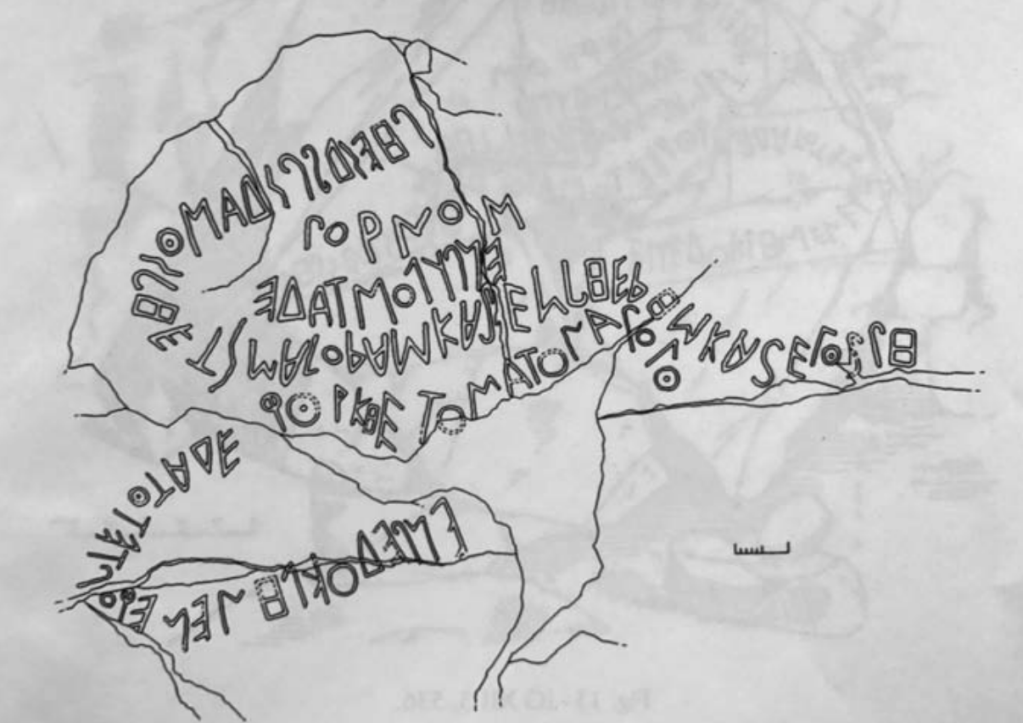
A “snaking” inscription: IG XII 3.536, from Inglese (2008), ISBN-13: 9788888617138.
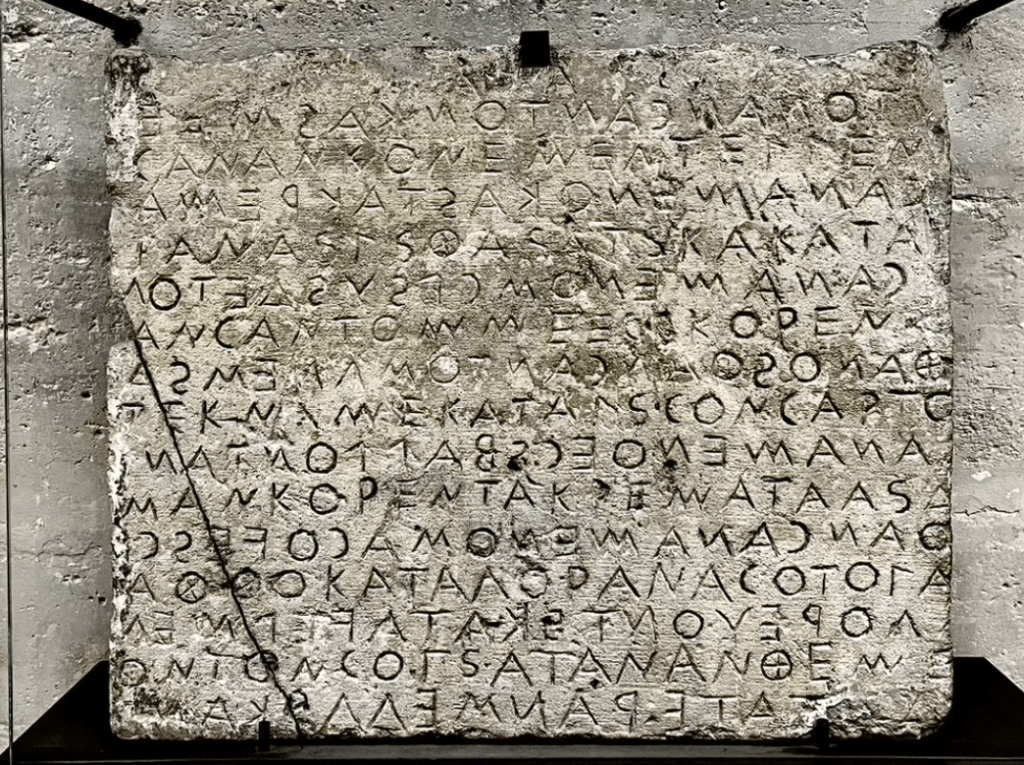
Every interface encodes assumptions, whether on the level of metadata or internal features. Most modern text annotation tools—whether for OCR, NLP, or digital paleography—assume that text runs left to right (dextrograde), top to bottom, in straight lines. Even tools designed for right-to-left (sinistrograde) scripts or vertical layouts often presume uniform orientation and stable reading order. But the moment you encounter Schlangenschrift (examples here and here), or even boustrophedon, (below) that all breaks down.
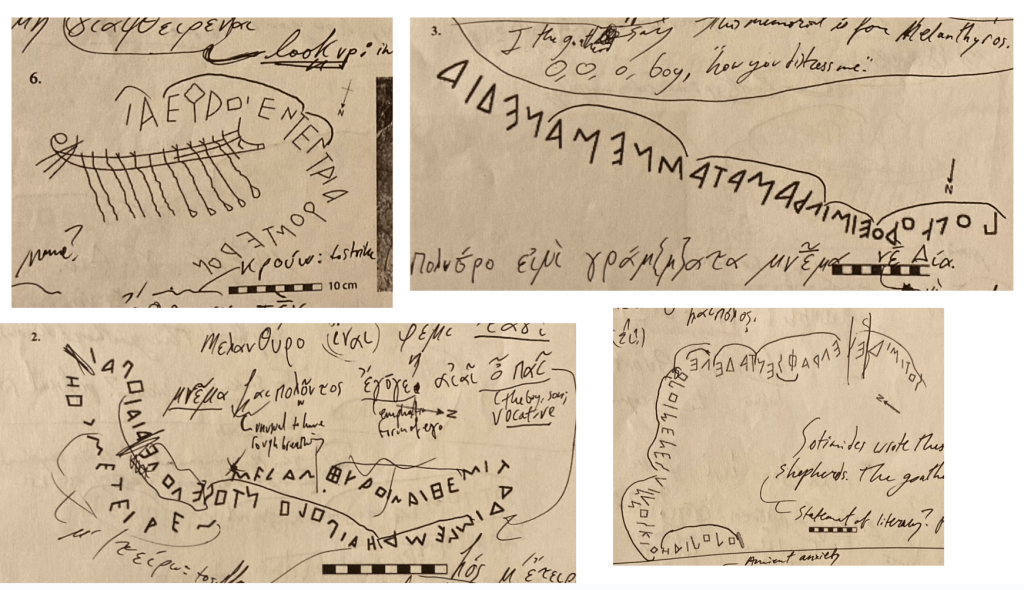
Schlangenschrift, German for “snake writing,” is the term for inscriptions that undulate, loop, or zigzag across their surfaces. They aren’t just retrograde or boustrophedon—they’re playful, nonlinear, and sometimes aggressively nonstandard. Letters may rotate far off baseline, reverse, snake along the rim of a vessel, or float in clustered spirals. They don’t just stretch orthographic conventions—they revel in their own performative visuality.
That’s thrilling, but let me tell you, it’s a pain to encode.
What Makes Schlangenschrift Hard to Handle?
In traditional inscriptions, we assume a stable direction of writing and an inferred reading order from layout. Schlangenschrift breaks both assumptions. Letters might be inverted, flipped, or rotated 180°, and their spatial arrangement doesn’t always match their intended sequence.
This poses problems for annotation on two levels:
How do you tell the system that a letter halfway down the curve should be read before the one at the top?
How do you capture the fact that an archaic alpha is legible but flipped, or that an theta has been rotated 100° clockwise?
And this is before we even deal with issues like ligatures, joined strokes, or unclear boundaries between clustered forms.
What I need eventually is a dedicated GUI: a tool that allows me to annotate forms visually, directly on the letter or inscription image, and store that information in a structured, model-readable format. A few things I imagine it allowing me to do:
Adjust or override reading order by selecting letters in intended sequence
Tag rotation by clicking the “top” of a letter (especially useful for characters rotated more than 90° off baseline)
Split ligatures or joined forms into discrete units—or possibly annotate them as double-readings when appropriate
Attach manual labels and feature flags that will eventually train an ML model to handle the first-pass extraction
In other words, it’s to be a tool that lets human judgment scaffold machine learning—not the other way around. I also hope for it to be accessible to scholars uploading and annotating other inscriptions down the line. After all, it’s called the Alphabetic Paleo-Epigraphic Exchange, and from the beginning it’s been my vision to build a diverse, international, and collaborative community.
Design for a Script That Doesn’t Behave
This GUI wouldn’t be a general-purpose annotation tool, at least, not yet. Perhaps its scope could be expanded if comparative script capabilities (cf. Stages 4 and 5) are added. However, for now, it’ll be shaped by the idiosyncrasies of Greek epigraphy, and especially by the freedom and experimentation of the Archaic period. It would let me preserve uncertainty and flag ambiguity. It would let me document weirdness rather than flatten it.
It might also include inscription-level features: recording whether the script is sinistrograde, boustrophedon, or Schlangenschrift; marking axis drift; allowing toggling between epichoric and normalized readings.
Eventually, I’d like to use this tool not just for Schlangenschrift but for all complex inscriptions—especially ones where reading direction, orientation, and letter identity are uncertain or debated.
For now, though, this post is part wishlist, part blueprint. If you’ve worked on annotation tools for nonlinear writing systems—or have thoughts about how to handle radical variation in letter layout—I’d love to hear from you: tfavdw@nyu.edu.
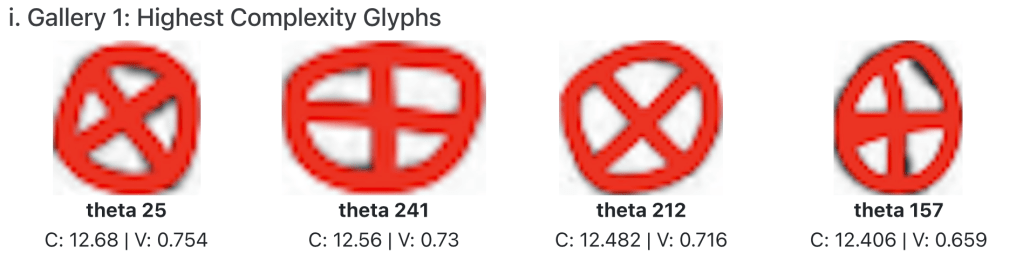
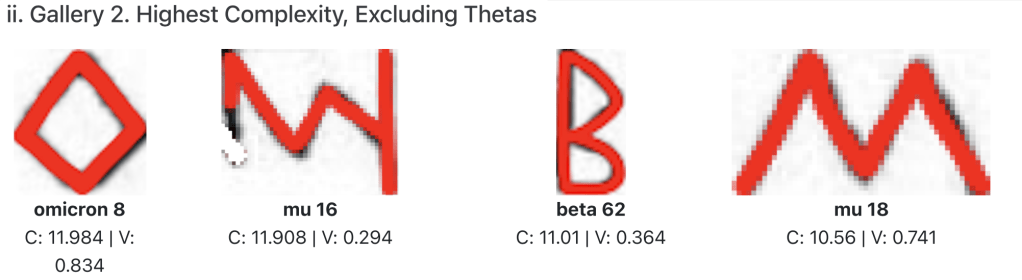
The twelve most complex glyphs in the Styra lead tablet dataset—all thetas. “C” denotes calculated complexity; “V” indicates vertical symmetry. For more context, see the abridged Styra dataset report.This gallery excludes thetas to give a fuller picture of complexity in the Styra cache.
If symmetry was the most natural place to begin—clean, measurable, culturally resonant—then complexity is where things get thornier. This post is about defining and quantifying visual complexity in early Greek letterforms, and why it matters for understanding both the mechanics and the aesthetics of the alphabet’s evolution.
Why Complexity?
Symmetry tells us how aligned a letterform is to itself. Complexity, by contrast, captures how much is going on—how many strokes, how much intersection, the degree of irregularity. Where symmetry can often be intuited at a glance, complexity resists easy perception—but it may prove just as revealing.
I’m interested in complexity as I suspect it plays a major role in the process of visual regularization. If the transmission of the Greek alphabet involved adaptation and simplification, as many have proposed, then more complex letterforms might point toward earlier or more conservative stages. In other cases, complexity might reflect local experimentation or ornamental flair. Either way, tracking it diachronically and geographically could tell us when and where scribes began to standardize—or drift.
How I’m Defining It (For Now)
Unlike symmetry, which can be modeled with relatively stable geometric principles, complexity requires interpretive decisions. For now, I’m treating it as a composite score, derived from features already being measured in APEX. My provisional formula looks like this:
+ (0.5)Stroke_Count + (0.5)Stroke_Intersections
– (0.2)Curvature – (0.2)Symmetry [composed of reflectional and rotational].
In short: more strokes and intersections add complexity, while curvature and symmetry reduce it. Each term is then normalized on a 0–1 scale.
I’m also considering adding a term for relative stroke length, to account for letters that are not just busy but expansive.
Likewise, I’m thinking about adding script direction: if boustrophedon or Schlangenschrift, that adds some complexity too; perhaps adding .5 for the former and 1 for the latter; however, this is an inscription-level feature rather than letter-level. Perhaps I have a separate complexity feature for the overall inscription, including things like average orientation, internal orientation consistency, and internal letter consistency.
Note: this is emphatically a first draft. The weights are intuitive rather than statistically derived, and the model doesn’t yet differentiate between necessary complexity (as in psi or early mu) and anomalous embellishment. Still, it gives me a way to compare letters on a rough scale—from clean and minimal to dense and ornate. I’m also fortunately free of having to account for degree of serif, as this emerges much later and so is outside of my scope (at least for now), and I get the sense a computer would struggle to measure that feature.
If you have any ideas or input please email me at tfavdw@nyu.edu! I’d love to hear from readers on this.
The Value of a Secondary Feature
Complexity is a secondary analysis within APEX. It draws on multiple primary measurements (stroke count, symmetry, curvature, etc.), and as such, it’s vulnerable to all the noise and ambiguity in those inputs. But it also offers a different kind of power: it’s a synthetic trait, one that may correlate with regional style, inscription context, material, date, or internal regularity.
Some questions I’m exploring through this lens:
Do earlier inscriptions have higher average complexity?
Are some regions more tolerant of complexity than others?
Which places and periods hew more closely to Phoenician models? Similar complexity scores between Greek and Phoenician forms may offer a useful proxy for scribal conservatism.
Does higher complexity correlate with less consistency within a single inscription?
Are certain materials (pottery, stone, lead) more prone to complex forms?
Eventually, I’d like to correlate complexity with features like orientation consistency, inter-letter spacing, and standardization level—some of which are already outlined in the APEX coding manual.
The Bigger Picture
If symmetry is about balance, complexity is about density, constraint, and the friction between tradition and invention. My goal isn’t to reward simplicity or penalize elaboration—it’s to understand what these features meant, when they appeared, and how they were shaped by the scribes who carved them.
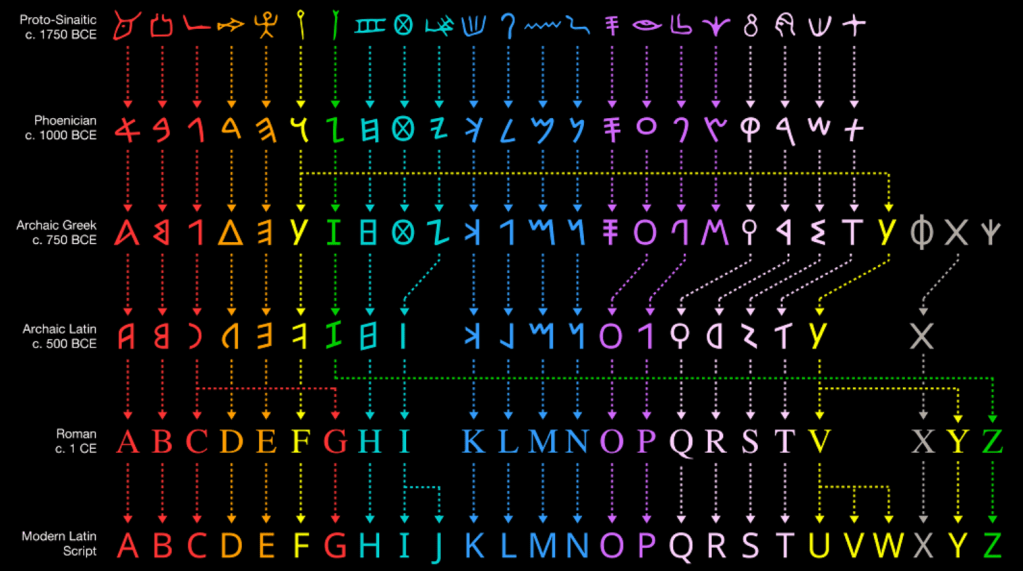
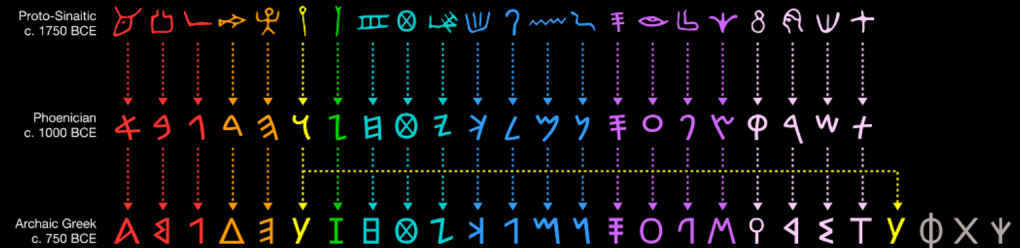
The evolution of our alphabet over the past ~3750 years. Note that symmetry only seems to increase, with only 7 of 26 characters not exhibiting either full or apparent symmetry. Note: I’m counting N and Z as “apparently symmetrical,” giving us 7 of 26 (27%) asymmetricals, a significantly lower amount than the 9 of 22 in Sinaitic (41%) and 10 of 26 (38%) in Archaic Greek.
Before I can ask anything ambitious of my data—like modeling transmission pathways or quantifying regional scribal variation—I have to start with something smaller, simpler, and more grounded. For APEX, that starting point is symmetry.
Symmetry is one of the most visible differences between early Greek and Phoenician scripts. Even without training, most observers can sense the change: Greek letterforms become cleaner, more aligned, more balanced. But to measure that symmetry, I’ve had to define what I mean by symmetry, and build a method to detect it.
This post outlines how I’m operationalizing symmetry in the APEX corpus, why it’s the first feature I’ve chosen to model, and what it’s teaching me about the limits and affordances of computational paleography.
What Symmetry Means Here
In APEX, symmetry is a composite of two measurable traits:
Reflectional: How closely a letter matches its own mirror image, along the axis that yields the best fit—whether vertical, horizontal, diagonal, or something in between.
Rotational: How closely the letter approximates balance when rotated around a central point—typically 180°, though full radial symmetry is rare.
Each of these metrics contributes to an overall symmetry score, though I haven’t yet decided how to weight them relative to each other. (Letters like omicron may score high on both; others like early mu—the one that looks a bit like a waving flag—might have almost none.) The flexibility in axis choice is essential: a rigid expectation of vertical or horizontal mirroring would misread the creative variability of early inscriptions.
Why Symmetry First?
I chose symmetry as APEX’s first feature not because it’s easy, but because it’s easier—more tractable and revealing than most other options on the table. Here’s why:
Symmetry can be formalized geometrically and scored algorithmically, whereas features like curvature or stroke order require more interpretive preprocessing.
It aligns closely with what I called the Geometric Mindset in APEX 5. The Greeks didn’t just write more symmetrically—they seemed to want symmetry. Modeling this desire helps us understand the aesthetics of early alphabetic culture.
Because symmetry is something humans are so good at perceiving, I can use qualitative intuition as a check on the model’s output. If my code says chi is less symmetric than theta, that better match what I see—or I’ll need to refine the metric.
Most importantly, symmetry provides a rigorous baseline. If APEX can measure it reliably, I’ll have a working pipeline to test more complex or subtle features.
How I’m Measuring It
Reflectional symmetry is assessed by identifying the axis of symmetry that produces the highest match between a letter and its mirror. I use a series of transformations—rotation, scaling, and reflection—to find the optimal axis, then measure the residual difference between the original and the reflected form.
Rotational symmetry is calculated by rotating the letter around its centroid and comparing the rotated image with the original. This is usually done in 180° increments, though future iterations may allow for more granular angular measurements.
These outputs will be normalized and combined into a single score. I haven’t yet established weighting, since the balance between reflectional and rotational symmetry might vary by letter category or epigraphic tradition.
The Limits of Automation (So Far)
My computer vision pipeline still has limits. I’m developing this in Python, though most of my coding experience until now has been in R and Java. Here’s what’s working—and what’s not:
My current process overcounts contours by a factor of several hundred, especially in letters with nested or fragmented strokes.
It struggles to distinguish meaningful intersections (like the vertex of alpha) from noise, since it doesn’t yet recognize stroke logic.
Stroke direction is currently inaccessible: I’d need to first solve stroke segmentation, possibly via a trained ML model.
Curvature is hard to measure when the program doesn’t know how many strokes it’s looking at.
Symmetry, for now, is the best foothold: visually salient, structurally clean, and relatively resistant to contour noise—especially when preprocessing is done carefully.
From Obvious Insight to Quantified Claim
Everyone who looks at early Greek inscriptions notices the symmetry. What APEX is trying to do is not discover that fact, but confirm it rigorously—to move from impression to measurement, from observation to score.
This quantification isn’t the end goal. It’s the start of a methodology that can be applied to more difficult questions: which regions favor symmetry more, and when? How do letterforms regularize over time? Does high symmetry correlate with other features—like vertical alignment, spacing, or axis orientation?
Before symmetry became a measurable feature, it was a feeling—one the early Greek world seems deeply attuned to. This post is about that feeling: the cultural, aesthetic, and even spiritual logic that helped shape the forms of the first Greek letters. I call it the Geometric Mindset, a theory I presented to an NYU classics organization—you can find those slides here. (Note: This presentation is image-heavy; I’ve included speaker notes for clarity.)
Essentially, I believe the Greeks’ existing material culture had so thoroughly absorbed geometrism across media that they were primed to favor symmetry, regularity, and visual order—even in a new medium like writing. These features emerged after a period of exploratory and often whimsical experimentation in the Early Archaic. Dates and historiography of this period vary, but it lasts from approximately 750 to 600 BCE.
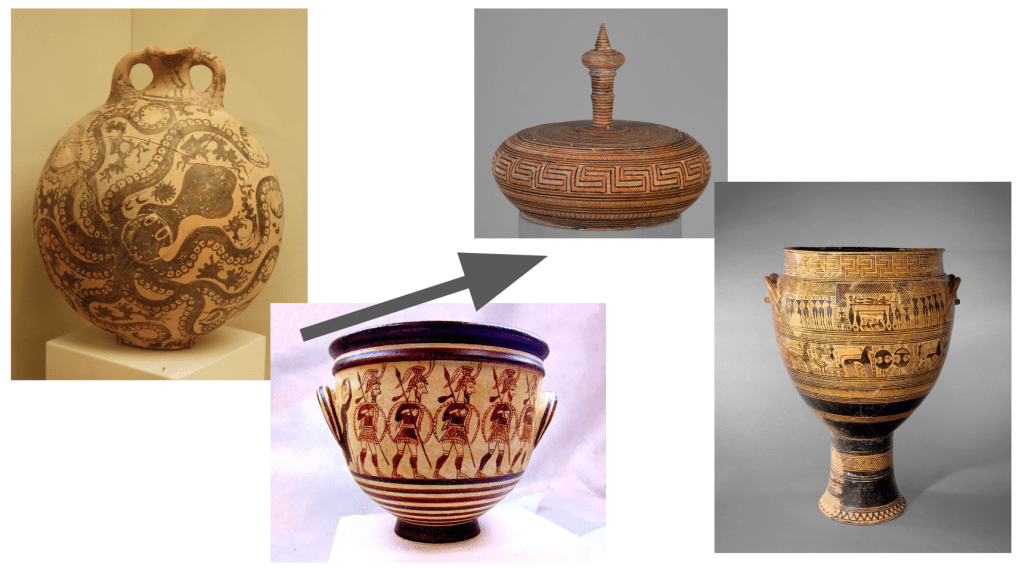
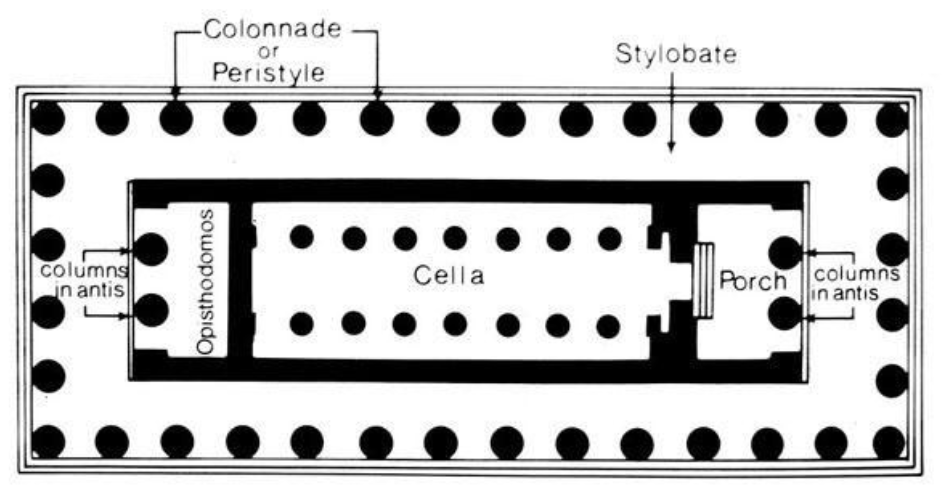
This geometric mindset is hard to define but easy to see. Look at a pot from the Late Geometric period—ending c. 760 BCE—and you’ll find meanders, triangles, and radial bands, repeated with a kind of cosmic insistence. Look at the floorplan of an early temple, and you’ll find axial balance and rhythmic repetition. Look at a letter like omicron carved around this time—round, even, self-contained—and you start to sense a common visual logic. In a world recovering from the Late Bronze Age collapse (c. 1177 BCE), symmetry didn’t just “look good”: it symbolized an order that people lacked and longed for.
Geometrism Before the Alphabet
After the Mycenaean palatial system collapsed around 1177 BCE, Greek society fragmented. Writing disappeared, monumental architecture vanished, and prestige grave goods diminished. In this post-palatial vacuum, the Geometric period emerged—not as a conscious revival, but as a new cultural orientation toward precision, repetition, and stability.
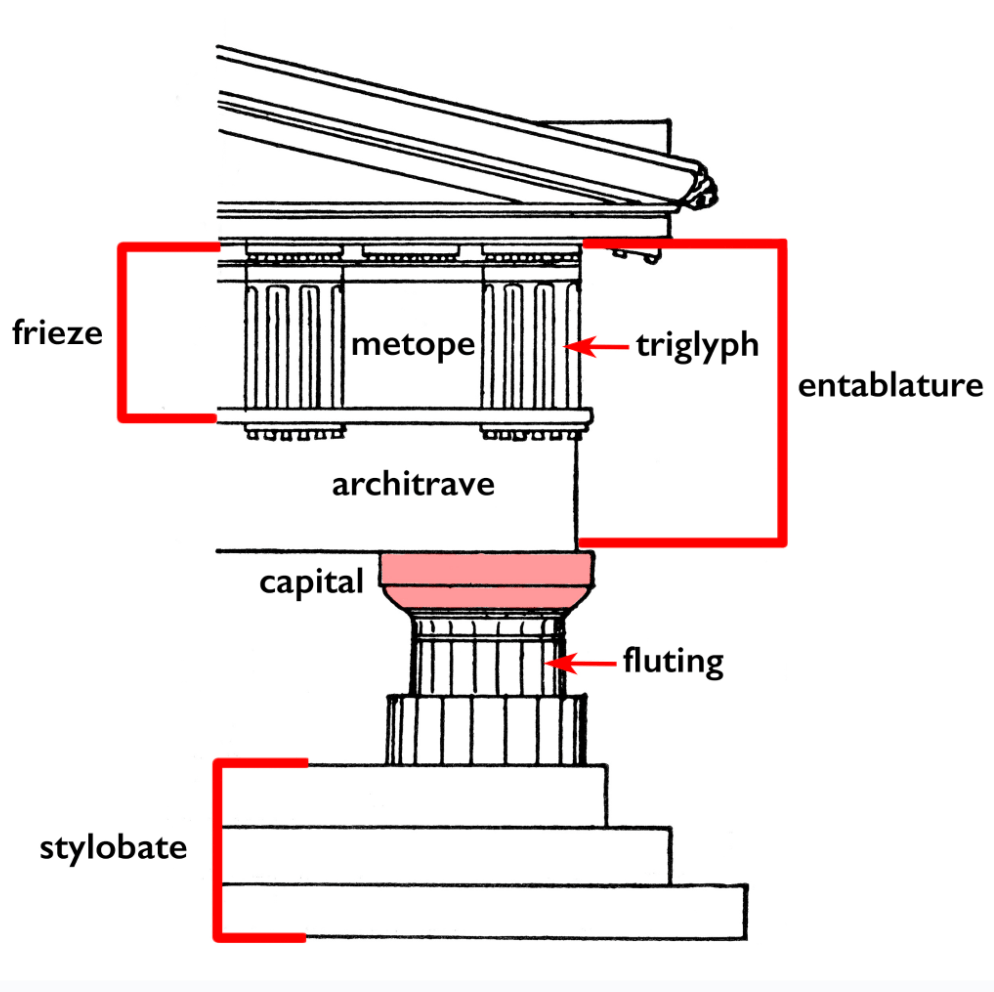
Art historians have long noted the stark transition: from figural representation to geometric abstraction. Between 900–850 BCE, human forms vanish almost entirely from the artistic record. When they reappear, it is only as stylized silhouettes built from circles and triangles. Architecture follows suit: the earliest Greek temples (many in perishable materials) were already laid out in balanced, rectilinear plans that would later be canonized in Doric and Ionic orders. Even the decorative motifs on grave pots shift from curvilinear swirls to angular meanders.
Plan of an Archaic temple. Note the high degree of symmetry and order.
A Canonical Doric scheme.
Technological changes—like the fast-spinning potter’s wheel or rectilinear timber—helped enable this aesthetic, but they can’t explain its pervasiveness. The geometric shift wasn’t just a byproduct of tools. It was a cultural choice.
Sacred Letters, Sacred Shapes
Phylogenetic tree of the Greek alphabet.
The Greek alphabet appears during this same geometric moment. And while it was adapted from Phoenician, the changes made were not purely phonological. They were visual. Symmetry increases. Stroke lengths even out. Letters gain internal alignment. In some cases—like theta or chi—they become almost iconic of the aesthetic that surrounds them.
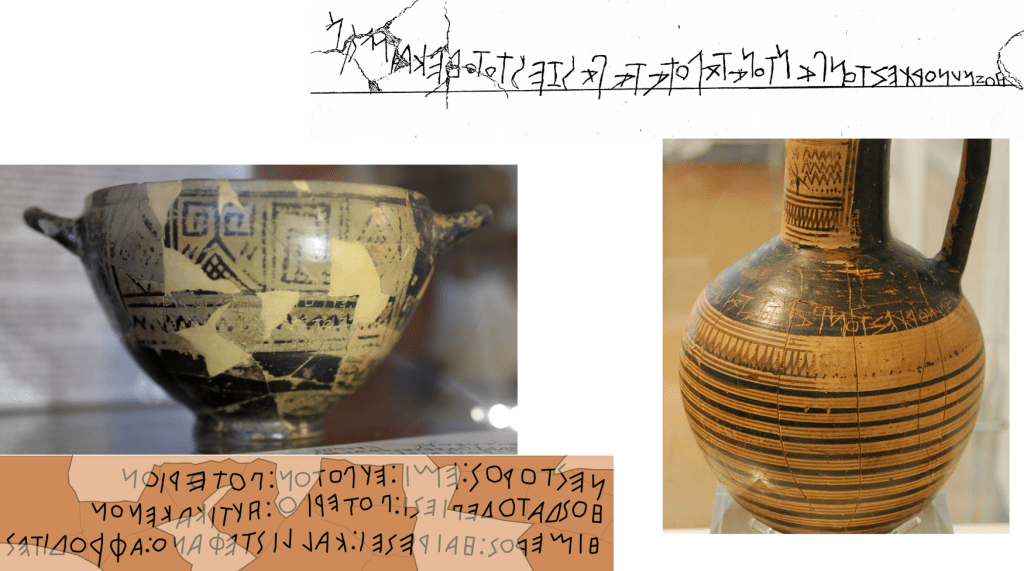
The two earliest known Greek inscriptions, both in verse. 1: Nestor’s Cup, Pithekoussai colonty (Ischia, in modern Italy). 2: Dipylon Inscription, Athens.
Why? Part of the answer lies in the way writing was first received. Unlike every other writing tradition in the world, there is no evidence the system first emerged for economic or administrative purposes. Rather, the earliest alphabetic Greek inscriptions are not inventories or contracts but poems, hymns, names, and dedicatory verses (verses!) to the gods. Writing in early Greece was not merely functional—it was mystical. In the early abecedaries offered at sanctuaries like Mt. Hymettos, the alphabet itself appears as a sacred object. Its form mattered.
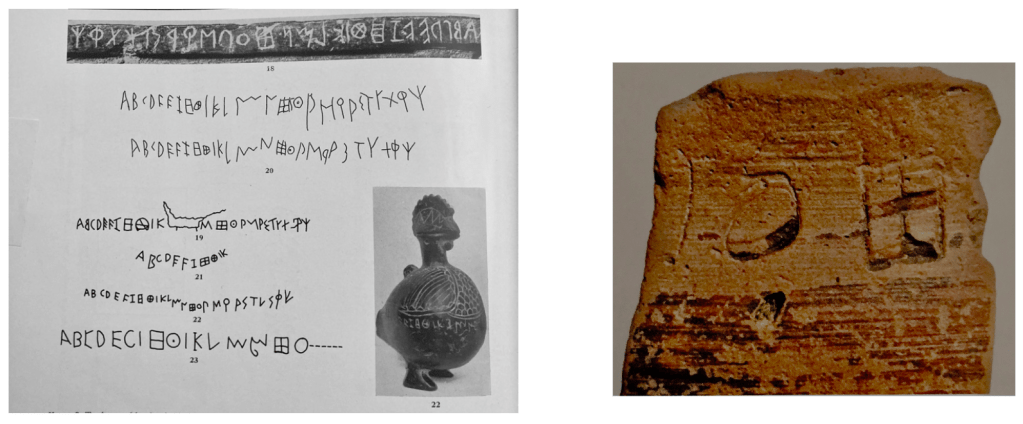
Abecedaries (an inscription where an alphabet is written out, rather than having lexical meaning) and fragments thereof found in sacred Greek and Etruscan contexts.
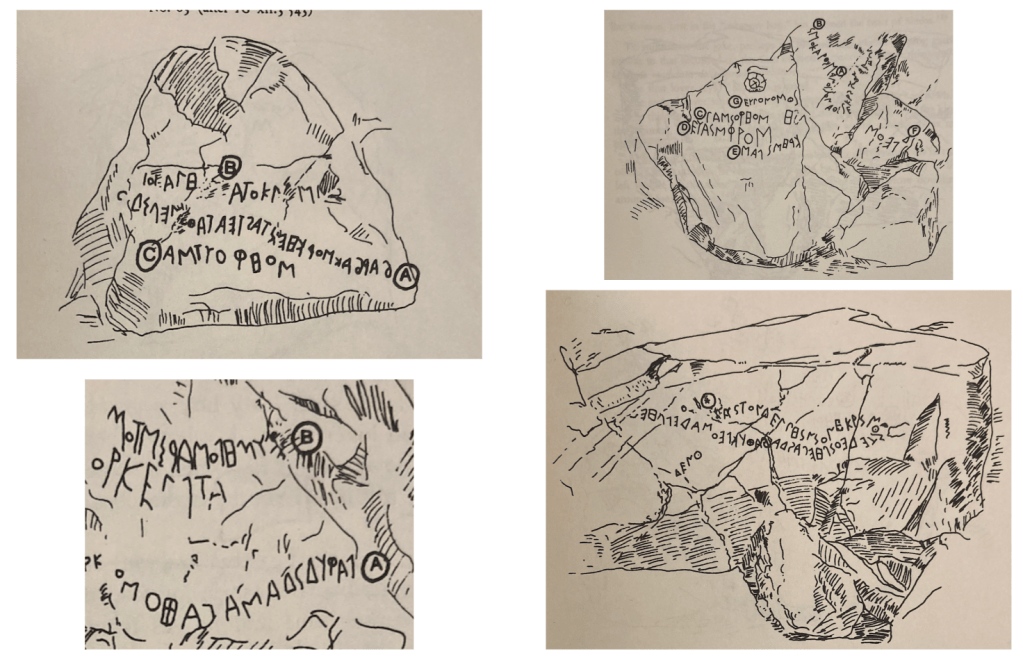
Early attitudes of letterform as artistic motif are also exhibited in the inscriptions left by people at the margins of literate society: shepherds in Attica, young men on Thera (modern Santorini). Their graffiti mixes geometric regularity with expressive play. Letters are art, snaking across stone in “Schlangenschrift,” reversing and rotating in boustrophedon—they stretch, compress, and play. These are not yet standardized forms—but they are already aesthetic ones.
The Theran Schlangenschrift inscriptions.Examples of Attic shepherd graffiti.
Writing, like poetry, was a medium of presence. To inscribe a name was to fix it. To make it visible. To give it shape. And that shape, increasingly, was geometric—according with the idea that the Greeks were in some way primed by their existing architecture, material culture, and general sense of the aesthetic.
Importance to APEX
APEX isn’t just a computational project—it’s a cultural one. Before I try to model formal features, I need to understand what counted as a “good” or “complete” letter to the people who made them. The Geometric Mindset gives me a crucial frame. It tells me that the first Greek inscriptions weren’t striving for speed or utility—they were striving for balance.
That’s why the first feature APEX will try to model is symmetry, as covered in APEX Updates, 6. Because it’s not just a trait but a trace—an artifact of a whole worldview. In the next post, I’ll explain how I’m operationalizing part of that concept: how I define and measure symmetry, and what the limits of those measurements tell us about what the Greeks may have seen and wanted in a letter. To measure symmetry, then, is not to quantify a style—it’s to reconstruct a logic, a way of seeing, and a schematic of belief.
This inscription, the Poteidaia epigram (IG I³ 1179, CEG 1, no. 10), took me 1.5 hours to trace. It contains approximately 260 characters, which works out to a rate of 1 character per 20 seconds.
After weeks of tracing letterforms by hand—squinting at jagged facsimiles and smoothing them into curves—I’ve hit a bottleneck. Manual vectorization has given me precision and intimacy with the material, but it’s not sustainable. Each traced letter takes time, care, and a degree of interpretive judgment that can’t be scaled easily. I even have a bit of a hand tremor that’s sometimes made me rely on line straightening and curve smoothing, which obviously is going to distort the measurement of features such as symmetry and curvature score. As I move toward building a larger corpus, I’ve had to ask: What’s keeping me from working at the scale this project demands?
The answer, in short, is the tracing pipeline. My current workflow looks like this:
Scan the inscription facsimile (mostly from IG, plus some drawings from my 2022 semester in Athens)
Import into Adobe Fresco on my iPad
Trace each letter manually, often with correction enabled due to an unsteady hand
Export as SVG
Import to a Python program for analysis with OpenCV
Export measured features to JSON
This essentially works, but it’s fragile. It depends on my eyesight, my steadiness, and my judgment. More importantly, it doesn’t scale. To move beyond 50 or so well-documented instances, I need to automate at least part of this process.
I’ve brainstormed a few approaches:
Edge detection + curve fitting using OpenCV and Potrace
Image preprocessing to isolate ink
Eventually: Interactive labeling that lets a human confirm or correct bounding boxes and centerlines before full vectorization
So far, nothing replaces the hand trace. However, I’m refining the steps—normalizing resolution, simplifying contours (overcounting has been a major problem, even with hand-vectorization, surprisingly), and reducing noise—so that a machine can at least propose a first draft. Once I trust the pipeline, I can begin comparing letters in bulk—but not until then.
For now, I’m working under this model both as a proof of concept and because I have a hard deadline: an MVP (minimum viable product) is due on April 25th for my final project in my Data Science for Archaeology class. (That’s in NYU’s Anthro department, for anyone curious). That constraint is shaping my whole approach—what gets prioritized, what gets cut, and how I balance the methodological ideals with the practical demands of execution.
In the next post, I’ll zoom out from metadata and back into morphology—not through computation just yet, but through design. This detour will help us begin to operationalize high-level concepts like complexity and similarity—ideas that seem intuitive at first glance, but quickly reveal their computational thorns. APEX Updates, 5 will explore what I’m calling the “Geometric Mindset”: the tendency toward symmetry, regularity, and visual balance that emerges in early Greek inscriptions. What kinds of shapes did Greek scribes favor? What does it mean to “correct” a letter? And how might a cultural aesthetic of order and legibility leave its mark on the alphabet itself?
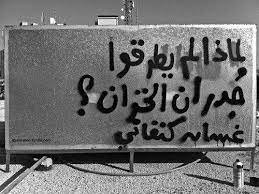
The last line of Men in the Sun, spoken by Abul Khaizuran, considered by some to be the most famous sentence in Palestinian literature: “Why didn’t they knock on the container walls?”
I wrote this essay four years ago, in February 2021, for a seminar on modern Arabic literature. It is very much a product of its time, in the sense that it reflects my worldview then, and is not necessarily how I feel today. I would say I’m a much more hopeful person now. But enough about me.
The subject is Ghassan Kanafani’s novella—a devastating work about three Palestinian refugees, a smuggler, and the unbearable silence that swallows them. Unlike much political fiction, Men in the Sun is neither polemic nor parable. It’s a slow, searching work that renders atrocity through texture, gesture, refusal. I was seventeen when I wrote this piece, but I return to it often. It was the first time I tried to write not just about a text, but with it—staying close to its silences and its grief.
This essay also won my high school’s prize for best literature paper out of a pool of 5,000, but what stayed with me more than the award was the feeling of having touched something real: the shared ache of diaspora, dislocation, and deferred mourning.
It feels right to begin The Close Read here. These are the themes I keep coming back to. These are the questions I still can’t answer.
Kanafani on Ignominy & Anonymity
Sunt lacrimae rerum. — Vergil, The Aeneid, I.462 tr.: “There are tears for things.”
Ghassan Kanafani’s 1962 novella, Men in the Sun, is a centerpiece of Palestinian national literature. With its focus on three Palestinian refugees, the man they pay to smuggle them, and their journey from Basra, Iraq to Kuwait—where they hope to find gainful employment—it renders the massive, overwhelming issue of global refugees fathomable. Kanafani treats the complected lives of these four Palestinian men unflinchingly and a symphonic piece of literature, dense in its motifs and implications, is the result. While the plot reaches its highest pitch in the second-to-last chapter, it is in the final section that its gravity reveals itself. Kanafani depicts the despair of helplessness, and it makes his text universal: to be powerless against massive tragedies—yet to still know of their existence—is what makes us modern. Capturing that universal despair without lapsing into polemic is Kanafani’s true achievement.
As in classical tragedies, the fates of several characters are weaved together; their stories culminate in their shared journey and eventual deaths. The backstory explains how three refugees of divergent ages and backgrounds—Marwan, Assad, and Abu Qais—meet their eventual smuggler, himself a Palestinian, Abul Khaizuran. This is well-established by that penultimate section, which contains the masterfully executed climax. “Sun and Shade” details how they cross the last checkpoint that stands between them and Kuwait. It is a sweltering day in the desert, and in order to cross, Abul Khaizuran has the three men to hide in the lorry. Despite their protests that it seems dangerously hot, he assures them it will be brief: “Think, in seven at the most I’ll open the cover for you. Remember that, it’s half-past eleven.” Marwan’s only response is to “[look] at his watch and nod.” However, the truly tragic, absurd turn comes when a border official, obsessed with “the idea that his friend had slept with a prostitute” detains Abul Khaizuran with lecherous questions for several torturous pages. Twenty-one minutes later, he escapes, but when he climbs into the trailer, discovers that they are dead. The section ends with him re-entering the lorry, discovering Abu Qais’s shirt there, hastily throwing that out of the truck’s cab, and shakily driving onwards. Here (and it is about midday) he is overwhelmed by unspecific emotion: he is dizzy, confused, sweating heavily and likely crying. Kanafani closes this portion on the question of whether the ‘salty drops’ falling into Abul Khaizuran’s eyes are “tears, or sweat running from his burning forehead.”
The next chapter cuts to several hours later, in the dark of night. However, bridging that gap is the solemn, subdued section title, « القَبر», which is as misleading as not. On the one hand, it is inaccurate because Abul Khaizuran does not bury the men: there are zero graves. On the other, it is correct, as they share a final resting place: there is a singular grave when there were going to be three (i.e., plural) graves. It is this title that primes us for the imminent scene and its darkness. Darkness is the crucial metaphor of this section: fittingly, Kanafani opens it with details of a dimming, which establishes the time (the same day, around dusk), sounds the thematic keynote (obscurity and shame), and drives the plot forward (the action requires secrecy). This dimming begins with the sun’s setting, but continues: first with Abul Khaizuran driving far away from the light of civilization and towards the municipal garbage dump, and second, with his switching off of the truck’s lights. The darkness serves two functions: it protects him against detection and allows him to be blind to his grim task.
However, the darkness is an imperfect shield. While insulating him from the obvious grise, it—perversely—amplifies other, more morbid elements. As such, we the readers are immersed in the complete opposite of day: amid darkness and silence, we undergo an inverse sensory experience through (everything but the eyes of) Abul Khaizuran. The primal horror of this section extends and intensifies that of ‘Sun and Shade,’ where just as before, in the darkness, the bodies lose their persons, and the only thing distinguishing them to Abul Khaizuran is how difficult they are to dispose of. How Kanafani situates this scene is subtle: on some level, the plot requires this darkness, but that is just half the reason. Note the continuity between this section and the prior one, where the passengers’ dying moments are not shown to Abul Khaizuran, and so are invisible to the reader. Though Kanafani is clearly comfortable with moving between points of view, he chooses to stay in Abul Khaizuran’s perspective even as the main action separates into the tractor (the driver) and the trailer (the passengers). This arrangement, where we are not forced to watch their death but still must deal with its aftermath, is mimetic of the Palestinian situation: sequestered away from view, cut off from contact, Palestine was—and still quite is—something of a black box as far as news goes. We spectators (which is what we are) do not have to face their faces: hidden from view, their deaths are not anyone’s responsibility. Like our passengers, they get killed, but it is often hard to identify who killed them: that is the effect of, one, modern journalism’s infamous passive voice, and two, deliberate obfuscation of events. However, regardless of how the story is told or not told, the bodies—sometimes, the sole record of those people, and the only proof of the atrocity—are intractably there.
It is this problem, that of stubborn corpses, which makes the scene so ghastly. The dead bodies seem to have a certain power, even in their lifelessness. While questions of dignity, fraternity, and responsibility are the novella’s entire basis, those issues come into sharpest relief in the resolution: the interactions between Abul Khaizuran and the nameless bodies. This is in part achieved by Abul Khaizuran’s (literal) hermeticism. He is far removed from civilization—on the edge of the desert—and set in utter darkness, without even the moon for company. That detail of the moonless night is masterful: there is something so godless about the total desolation. And of course, I cannot neglect the choice of setting—i.e., the municipal dump—because that is another masterstroke. Whatever indignity there is in mass, unmarked, or shallow graves is completely outdone by the sheer brutality of this particular non-grave.
Yet, the non-burial is not something wholly depraved—instead, it is an unsettling and complex mixture: tenderness and apathy, compassion and disregard. On the one hand, it represents Abul Khaizuran trying to give his charges some paltry respect in death: he thinks that they will receive an official burial once the city workers discover them in the morning. At the same time, he is no saint in the matter: the decision also represents his abandoning the plan to bury them properly. But that’s just it—is he to blame? He is genuinely exhausted after the day, and could very well expire on the spot; with the consideration of a city burial, leaving the bodies prominently out may be the honorable thing. It is the next event—the looting—that truly muddles a reader’s judgement.
The looting is the most rarefied turn in the whole book. I think it surpasses even the final sentences in its artistry—especially with, one, how it is almost an afterthought for Abul Khaizuran, and two, how he thinks to not only take their money but Marwan’s watch as well. To me, that watch is the whole book, and is the moment I most remember. Despite the societal belief that corpse looting is one of the most dishonorable acts, the judgement is still complicated: we see Abul Khaizuran’s guilt and faltering, and know that he is not without a conscience. Of course, it is in very poor taste, but he is not so easily condemned. He is only slightly less desperate than his passengers were, and that is the nature of desperation: one lacks the security to say no, and as such, he is not in the position to behave tastefully. Yet his privation does not wholly excuse him here: a dark thought occurs to me: is this not a bigger payout than he would have received? The whole situation recalls the tourist’s earlier comment that “this desert is full of rats [who eat] rats smaller than them” and the ‘law of the jungle’ comes to mind: the wildness is felt acutely when far from civilization.
The brutal, animal loneliness is the essence of the horror: it forces us to realize that we have no one protecting, watching or guarding us and that there is nobody who will grant us succor or solace. That is a very primal fear. As Abul Khaizuran feels genuine anguish at the end and cries into the desert, there is no one to comfort or understand him. Moreover, he realizes, I think, that there is very little intervening between life and death, and that existence is a matter of luck and a weak social contract: little prevents someone from killing him like that: and who would take care of him then?
It is a kind of secular theodicy. The checkpoint episode in the chapter preceding “The Grave,” where Abul Khaizuran tells the three men to enter the lorry, illustrates this: the last interaction he has with the passengers is assuring them, “Think, in seven at the most I’ll open the cover for you. Remember that, it’s half-past eleven,” and meanwhile, Marwan’s only response is to “[look] at his watch and nod”—all the more crushingly, as it is the same watch Abul Khaizuran will later take. The sheer ridiculousness forces us to confront the enormity of the situation along with Abul Khaizuran: because of a chatty clerk, three men have died, and though plenty of people are at fault, there is no one truly to blame. In this moment of reckoning, there is no divine presence; even the old gods— the sun, the moon—are gone. He has ventured so beyond the pale of humanity that he has no god to call upon in this moment. He has no way to materially atone: he does not even have people to apologize to. His guilt has to be his expiation: no other penance is available.
We end on his vox clamantis in deserto, asking a question without an answer. Stricken, alone, in the worst night, he hears the desert call back to him, “Why? Why? Why?” But there is no answer: there was never a ‘why’ to any of it. It is the only fact in a godforsaken world. Ancient societies could take comfort in that “sunt lacrimae rerum,” but here that vanishes: there are no tears for things. This is Kanafani’s ultimate conclusion: in a godless universe, one is only answerable to themselves.
“What is the meaning of life? That was all—a simple question; one that tended to close in on one with years, the great revelation had never come. The great revelation perhaps never did come. Instead, there were little daily miracles, illuminations, matches struck unexpectedly in the dark; here was one.” — Woolf
I. Matches in the Dark
“for it was not knowledge but unity that she desired, not inscriptions on tablets, nothing that could be written in any language known to men, but intimacy itself, which is knowledge,” — Woolf
Some lines live with you, humming at the edge of understanding. This sentence of Woolf’s, nestled in To the Lighthouse, reached me like that. On my first encounter with this lovely passage, I was a teenager in the eerie quiet of the early Covid lockdown, adrift in Manhattan’s uncanny stillness. But I found her words and felt something slacken inside me. To want to be known—fully, wordlessly—is a longing I carried alone, but no, it was shared. This woman I’d never meet or know reached me at my most unreachable. I read that paragraph over and over until it sank into memory. Now I carry it with me: on walks through the city, atop rain-slicked rocks, at the apex of hikes. It isn’t just beautiful—it’s a kind of tether: a signal that someone, once, reached toward the same ache.
That sense of being joined is what draws me back to poems as well. The first one I ever loved (the first I ever read, in fact) was “The Love Song of J. Alfred Prufrock” by Eliot. The sheer music of the “There will be time, there will be time” stanza felt like it was metronomically keeping time with something inside me. There are others, too, that arrive like small prayers. “Do I dare / disturb the universe?” returns when I’m on the edge of decision, when some part of me wants to speak with conviction, to honor what I’m feeling, to do justice to the moment ruat caelum. These lines are faithful companions.
II. Reading Against the Grain
“Expansion. That is the idea the novelist must cling to.” — Forster
There was a time when I read to complete a list, to recognize the titles people mentioned in essays—essentially, to feel equipped. I don’t regret it—I got what I wanted, I’ve read enough and read around enough to feel equipped—but I’ve moved on from reading as accumulation and extraction. These days, my interest lies in tension, in friction, in books that press back against what I think and know. What I want most is to dwell inside the texts, to read and reread without trying to solve or resolve. The books I keep closest are the ones that change shape when I return.
This has made me wary of neatness. When a novel explains too much or closes too elegantly, I doubt its stakes. Complexity isn’t the same as confusion, of course, but I want the sense that the writer followed something unwieldy rather than packaging a thesis. Forster’s idea of expansion feels like an ethical position as much as a technical one, like a kind of structural generosity. The books I care about leave strands loose, characters unfinished, images unresolved. That incompletion is what makes a book stay animate and alive.
III. Reading as Ethical Encounter
“All knowledge that is about human society…rests upon judgment and interpretation… Humanism is the final resistance we have.” — Said
As out of fashion as it seems, I do judge texts. Heavily. I judge when the writing is slack, when the tropes are lazy, when a story moves along the path of least resistance. I don’t demand novelty for its own sake, but I expect a work to push itself—to ask something of its form, its language, its characters. I want it to ask something of its readers, to expect me to rise to its challenge, for there to be serious engagement with the fact it has readers who give a damn.
That doesn’t mean everything has to be experimental: I read across genre, across register. A mystery novel can be as exacting as a modernist one if it honors the demands of its shape. Read Patricia Highsmith or Dorothy Sayers if you doubt me. But, I still want writers to stretch, to try, to care enough to risk failure. I need to feel that the text has earned the time it takes to read it. I read for beauty and daring, and when a piece lacks those things, I feel a genuine sense of betrayal. In short, the emotional stakes run high for me.
I also read with a sharp eye for omission. History is made up of fragments and absences, as Benjamin said, and literature often inherits or amplifies them. When the narrative avoids the hard question, when a character’s inner life is flattened or a story’s resolution comes too easily, I feel it. I don’t mean politically correct inclusivity representative enough for the UN—I mean true attentiveness. I want to see the weight of what’s absent. When a text avoids something it ought to face, it feels like a breach of trust, as if I’m being tricked into satisfaction. The texts I return to are the ones that hold themselves accountable—to complexity, to difficulty, to the reader.
IV. What This Series Will Be
“Who knows but that, on the lower frequencies, I speak for you?” — Ellison
This is not a confessional series: the texts come first. I’m present, of course—I’m always the one reading, worse luck—but my life isn’t the main event. If I mention it, it’s because it feels textually necessary, not biographically revealing. I trust the reader to sit with what’s unsaid as well as what’s underlined. If something is withheld, it isn’t coyness. It’s an invitation to focus. What matters here is the structure of attention: the emotional weight, the syntactic gravity, the ethical pressure of the form itself.
I don’t come to these pieces as a scholar: I’m just a person doing my best to read carefully and think about what that care entails. The texts I include aren’t selected for prestige or alignment. Some are canonical, others are less read, but all of them have marked me in some way. I don’t expect these posts to be definitive, just honest attempts at attention—at remaining. If even a few people take that project seriously, and if I write pieces I’m proud of, then the series will have done what it’s meant to do.
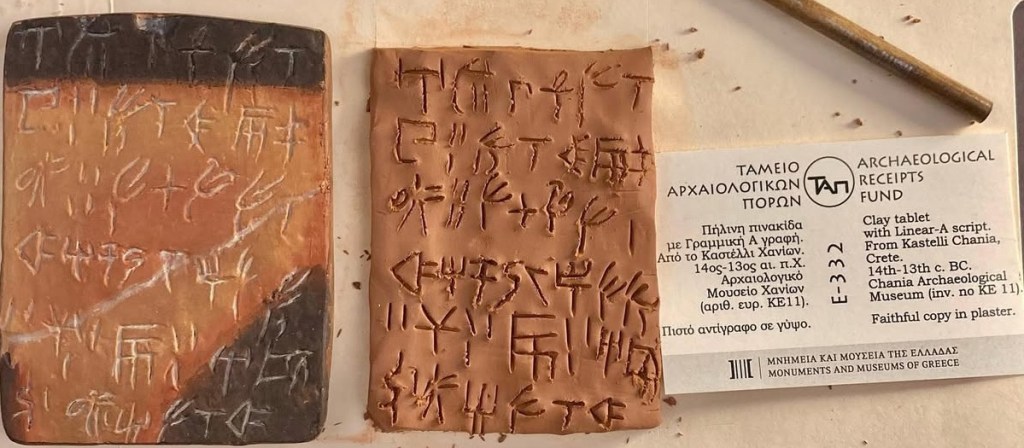
Replica Linear A tablet, incised by hand in cheap air-dry clay during my first experiments with ancient writing practices and materiality—an exercise in learning through making.
I’ve come to think of method less as a set of tools than as a kind of temperament: a composite of instincts, tolerances, pleasures, and refusals. What I reach for first—what I avoid, or delay—says as much about me as any personality test ever could.
My research temperament is structured by two main drives: one towards depth and the other towards care. I’m drawn to slow practice—hand-tracing inscriptions, line-by-line translation, annotating with attention. I like to feel what a text is doing in context, on the object, in the curve of the letter. I start at the center and work outward. This drive isn’t just intellectual—it’s emotional. It’s about fidelity to the thing at hand, a form of care that undergirds both my method and my ethics.
Care, for me, shows up as both method and ethic. When a topic feels especially resonant—diaspora, language loss, archival absence—I become meticulous, sometimes overly so. I revise and rework because I want to honor the stakes. And when I know others will read it—colleagues, strangers, professors—I feel a sense of responsibility that sharpens everything. It comes from a wish to think it through with integrity.
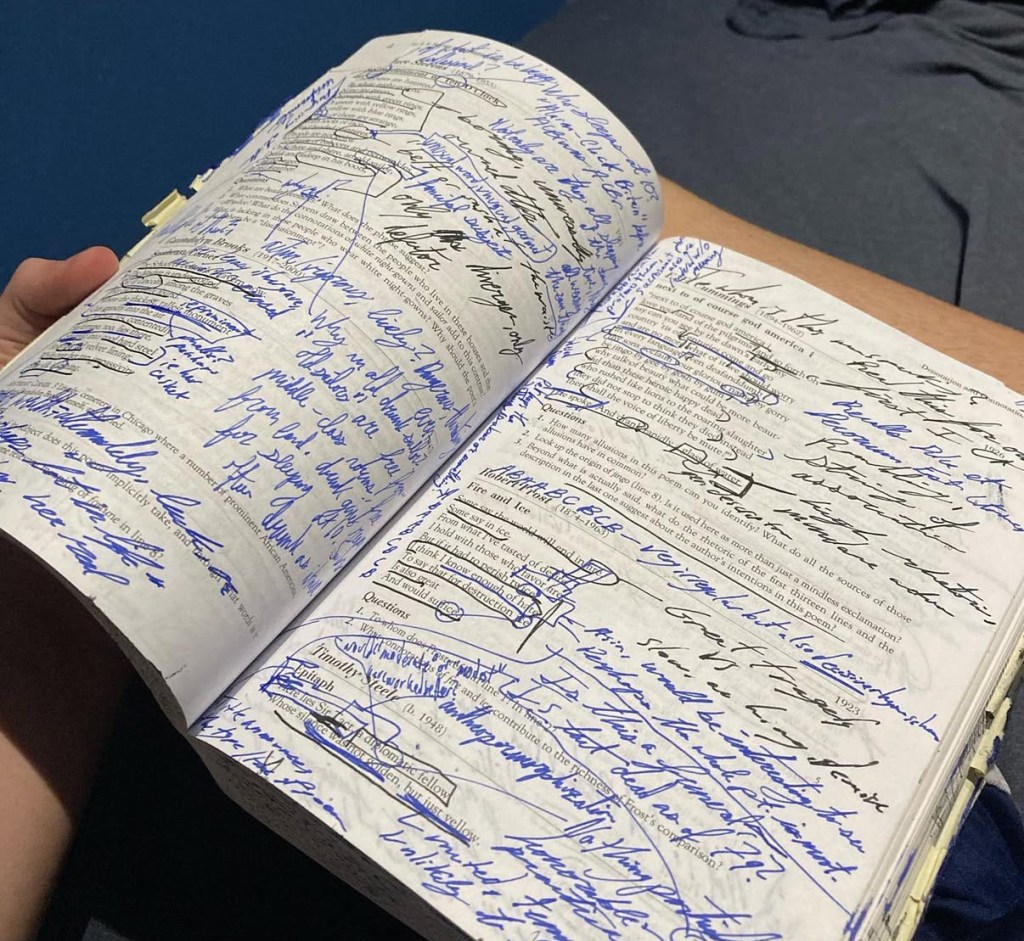
That same temperament—the mix of care and depth—also shapes how I move through time. My pace is uneven. I tend toward long stretches of saturation—reading twenty books at once, letting ideas percolate—punctuated by sudden bursts of output, where everything connects at once. My brain is highly associative and lends itself to this kind of work. Texts imprint themselves. I’ll remember something I read a decade ago—exactly where, on which page, in what margin. But that same connective capacity can make writing difficult, especially academic writing, which demands resolution. I resist closure. I prefer the bracket, the margin, the slow unfurling of something not yet finished. That’s part of why this blog exists. It’s a place to let the incomplete still mean something.
Which is to say: method reveals more than habit. It discloses a relation to uncertainty, to audience, to delight. If someone looked only at my notes, my file structures, my markups, they’d see an unusual mix of chaos and precision. They’d know I’m curious, restless, attentive. But they might miss the joy. The methods reflect care—but it’s here, in the writing, that joy becomes legible. That’s a method, too.
One of the most frequent pieces of advice given to undergraduates is: “network.” But for students in the humanities—especially those who want to study ancient languages, inscriptions, or museum work—that advice often feels vague, awkward, or transactional. This is definitely a conceptual hurdle that I’ve had to overcome.
This post is my attempt to reframe that word into something more grounded: building relationships, but not performatively. Rather, I strive to do so through shared questions, good conversations, and sustained curiosity. I’m not an expert on this at all, but I’ve built a small but meaningful network of scholars who know what I care about, who challenge and support me, and who have helped shape the work I do. This is how I’ve approached it, and what I’d tell someone starting out.
Start Local, Then Reach Out
The best place to start is with the people at your own institution. NYU, being so big, has been a wonderful place for this—with 60,000 students and some 6,000 instructors, it’s a goldmine for people who know what they’re talking about.
But the following advice applies to any school. Go to office hours. Take professors’ classes—not just because the syllabus looks good, but because you’re genuinely interested in how they think. Even if the class isn’t squarely in your area, getting to know the professor might lead to mentorship, research opportunities, or simply perspective you didn’t know you needed. I talked about this in the last post, but it can’t be stressed enough.
Before going to office hours, do your homework. I usually read at least two of a professor’s articles in advance—preferably recent, but not necessarily—and do a deep first pass early on, then a quick skim again right before the meeting to refresh my memory. I come with questions not just about the content, but about the field: how did this approach emerge? What debates is it part of? What’s happening at the edge of this subfield right now, and who’s leading it?
If someone you’d like to connect with isn’t at your institution, email is a powerful tool—when used well. Keep it short, be deferential, have a clear purpose, and make it easy for them to see how they can help. Mention a mutual contact if you have one, such as if they were in the same PhD cohort as a professor at your school or have a student from your undergrad program in their graduate school. However, even a lighter connection—“I came across your work while reading X’s article on…”—can do a lot. You can also ask for an introduction from a professor, but I’ve even gently-warmed cold emails have worked just fine for me.
Follow Up (without Hovering)
It’s easy to get caught in the anxiety of “now what?” after a good meeting or email exchange. My best advice: space it out. A thank-you email goes a long way, especially if you reference something specific they shared. After that, I keep a simple handwritten list of who I’ve contacted, what we discussed, and whether they asked me to follow up.
If you’re working on a long-term project—like my alphabet transmission project, APEX—then sending a short update every month or so when you hit a milestone is a great way to keep people in the loop without overwhelming them. Scholars are busy. Respect their time; this lets you build a slow, steady relationship.
Bring Something to the Table
This doesn’t mean showing off. It means coming into conversations with curiosity and initiative. If you’ve had an idea while reading someone’s work—an application, a parallel, a method they might not have used—bring it up gently and frame it as a question. “Have you ever tried applying X to your corpus?” can be a meaningful way to signal that you’re not just a reader, but a thinker too.
One of the best questions I’ve learned to ask: “Are there any scholars or articles you’d recommend I look at to get a better sense of the field?” When you’re in multiple disciplines, the literature is bottomless. A suggestion from someone experienced can save you weeks of guesswork—and deepen the conversation at the same time.
Use Clubs and Events to Build Connections
One of the unexpected benefits of running the League of Linguistics is that it’s allowed me to reach out to scholars in a semi-official capacity. If you’re organizing an event, moderating a panel, or just planning a syllabus, you have an excuse to email someone you admire—not for yourself, but on behalf of a community. Sometimes they’ll help. Sometimes they’ll become contacts down the line.
Just make sure you’re doing this in good faith. The event should serve your members first. But if it opens up a conversation with someone you’d like to work with, that’s a bonus worth nurturing.
Know What You’re Asking For
Always have a purpose when reaching out. Want to talk about their recent article? Ask for feedback on a related idea? Get advice about graduate programs? Whatever it is, make it clear in the first few lines. Don’t make them guess what you want. And don’t send them a novella. Long emails are a fast way to get ignored—not because professors are rude, but because they’re busy, and clarity is a form of respect.
At the same time, everyone’s different. Some scholars love a detailed intro. Others would rather get three lines asking for a Zoom call and figure out the rest in conversation. When in doubt, start concise—and adjust based on the cues they give you.
Etiquette
Until you’re told otherwise, when you’re in undergrad, always address someone as Professor Lastname. If they sign off with initials, play it safe. Only switch to a first name if they clearly invite it—either in their signature, or later in the conversation. Respect for titles isn’t just about hierarchy—it’s about showing that you’ve taken care in reaching out.
And if they don’t respond? It’s okay. Let it go. Especially if they’re at another institution, or heading multiple research projects, or simply overwhelmed, it’s not about you. If the connection’s meant to grow, you’ll have other chances. If not, trust that others will say yes. I’ve found academics on the whole to be extremely generous with their time, resources, and knowledge. You’ll find your people.
Final Thoughts
The best conversations I’ve had didn’t come from trying to impress someone; they came from being honest about what I care about, what I don’t know, and what I’m trying to figure out. Humility, curiosity, and gratitude are perhaps the most winning combination—especially when you’re early in your career. You don’t need to have all the answers, you just need to be a person worth talking to again.
And one last thing: projects help. If you’re working on something—an independent research blog, a digital tool, a language revitalization game—it gives you a way to reach out that feels natural, not forced. “I’m building something, and I thought of you” is often a more compelling opener than a plain “Can we talk?”
If you’re trying to build up these kinds of contacts, I hope this helps. If you’ve already started, I’d love to hear what’s worked for you. And if you’re not sure where to begin—reach out. I’m still learning too.
I frequently get asked what classes to take if you want to work with ancient languages, inscriptions, museums, or language technology. This post is a reflection—not a blueprint—on how I’ve built a courseload that supports interdisciplinary work in epigraphy, historical linguistics, and digital tools, and what I’d recommend to others just starting out.
Start with the Languages (But Be Strategic)
If you’re reading this, chances are you already love ancient languages. So yes—take Latin. Take Greek. But if you have more than one on your list, resist the urge to take them all at once. Instead, start with one—preferably the one with the strongest institutional support—and stagger the rest. I did Latin in high school, Greek in my first year of college, and Akkadian in my second. That pacing gave me room to go deep into each one without burning out. Now, with that foundation, I’m able to handle several languages at the advanced level without losing clarity or joy.
If it interests you, try to take—or propose an independent study in—a language that uses a non-alphabetic script early on. Whether it’s cuneiform, hieroglyphs, or Linear B, working with a writing system that doesn’t map neatly onto speech will sharpen your sense of what writing is, how it encodes meaning, and how it changes across time. It will also raise questions—paleographic, technological, cognitive—that you may find yourself returning to long after the class ends.
Take Linguistics Early (You’ll Use It Constantly)
I’m biased—I’m a linguist—but even if you don’t plan to major in it, an intro to linguistics course will radically shift how you read ancient languages. You’ll start spotting things like vowel gradation, phonological assimilation, and case alignment everywhere. Once you’ve got the basics, courses like historical linguistics, syntax, or phonology can help you engage more confidently with scholarship and identify patterns in inscriptions, dialect variation, or reconstructed forms. Even if you don’t go further in formal coursework, just knowing the lingo goes a long way—and will keep paying off, quietly and consistently, across everything else you study.
Follow the Inscriptions and Those Who Teach Them
If you want to work with writing systems or epigraphy, find the people who do that at your institution. In this field, people often matter more than courses. Research your professors. Read what they’ve written. Faculty bios will give you a general idea of their focus, but their CVs are often more revealing—long, yes (I’ve seen them run 50 pages), but worth scanning for article titles and projects that align with your own interests.
Getting close to those key people might mean enrolling in something tangential—say, an intro to Greek art—just to build a relationship. Or asking if you can do an independent study reading inscriptions in translation. Some of my best classes weren’t labeled “epigraphy” at all—they were seminars where I was encouraged to bring paleographic questions into the final project. In one case, that was Data Science for Archaeology with Prof. Justin Pargeter, a course that shaped my thinking far beyond its original scope.
Think Across Disciplines, but Choose a Home
You’ll need a home base—a department that knows you, supports your work, and can write you letters. Having an intellectual anchor like that is not only strategic, it’s also deeply grounding. That said, your course list doesn’t have to stay confined to one department—and honestly, it probably shouldn’t. Academia is moving ever more toward interdisciplinary inquiry, and the best course of study often cuts across traditional boundaries.
Some of my most formative classes have been outside my major—art history, computer science, even religious studies (Akkadian lives in Judaic Studies at NYU). Let your questions guide you. If you’re wondering why Phoenician letters look the way they do, or what it means to “revive” a dead language, go find the classes that give you tools to explore those questions, wherever they live.
Just make sure you’re also building depth somewhere. Breadth can open doors—but it’s depth that gets you through them. Grad schools, mentors, and collaborators alike are looking for people who know how to ask big questions, but also how to sit with them for a long time.
Study Abroad, If You Can
There’s no substitute for learning ancient languages in place—or at least near the landscapes, museums, and excavation contexts where they come alive. Study abroad isn’t just about location; it’s about intensity, continuity, and community. My time in Greece, especially on digs and museum visits, made Greek less abstract and more human. It exposed me to a range of paths in classics and gave me access to resources—like fragmentary inscriptions in drawers—and rhythms, like reading in the field, that continue to shape how I think about epigraphy and transmission.
If you’re aiming for grad school or museum work, study-abroad experience shows initiative. It signals that you’ve navigated other academic systems, worked across language barriers, and engaged directly with material culture. If your program includes language immersion—even better. Even if the modern language isn’t your focus, it sharpens your ear and re-situates ancient texts as living inheritances.
If funding is a concern, don’t write it off. Many programs offer scholarships, and departments often quietly support students who ask early. At big schools like NYU, the key is often finding the right person—the one who knows how to unlock the support already available.
Don’t Be Afraid of Skill-Based Classes
If you’re anything like me, it’s easy to stay in the comfort zone of ancient texts and theoretical conversations. But some of the most valuable courses I’ve taken have been hands-on: digital humanities, data science, archaeological methods, computer science. These classes taught me how to manage a dataset, build a research tool, and think across evidence types. They’ve led directly to portfolio projects, study opportunities, and unexpected collaborations—and they’ve made my work in the ancient world more dynamic and durable.
Leave Room to Be Surprised
Some of my most formative classes were ones I hadn’t planned to take: a seminar on the topography and monuments of Athens (Prof. Robert Pitt), a deceptively simple primer in Greek archaeology that opened into real depth (Prof. Hüseyin Öztürk), and a course on the structure of the Russian language (Prof. Stephanie Harves). These were spaces where I tested my assumptions and rewired my thinking. Try to leave room in your schedule each year for one course that isn’t strictly “on track,” but that speaks to something curious or unsettled in you. That’s often where real questions begin.
Last Word: Plan Backwards
If you’re thinking about grad school or a research career, try working backwards. Look at the programs you might apply to—what do they expect? What languages, methods, or subfields appear in course requirements or faculty research? Then take classes that prepare you for those conversations. The goal isn’t to become someone else’s version of a scholar—it’s to become the version of yourself who belongs in the rooms you want to be in.
Closing
When in doubt, ask people. Older students, professors, internet strangers who study Linear B. This path isn’t something I mapped out alone—almost every turning point in my academic life has come from a conversation, an offhand recommendation, or a generous reply to a cold email. I’ve built my way forward through the advice of others, and I’m always happy to pay it forward.
In a follow-up post, I’ll share how to structure independent study: designing personal projects, sustaining long-term reading, and building a research portfolio beyond the classroom. Done well, this kind of work lets you follow your own questions, test your interests, and create something distinctly your own. It’s also one of the clearest ways to show grad schools and mentors that you know how to learn without a syllabus.
Stay tuned. And as always, if you’re not sure where to start, I’d love to hear what you’re thinking about.


 To Wake the Dead

