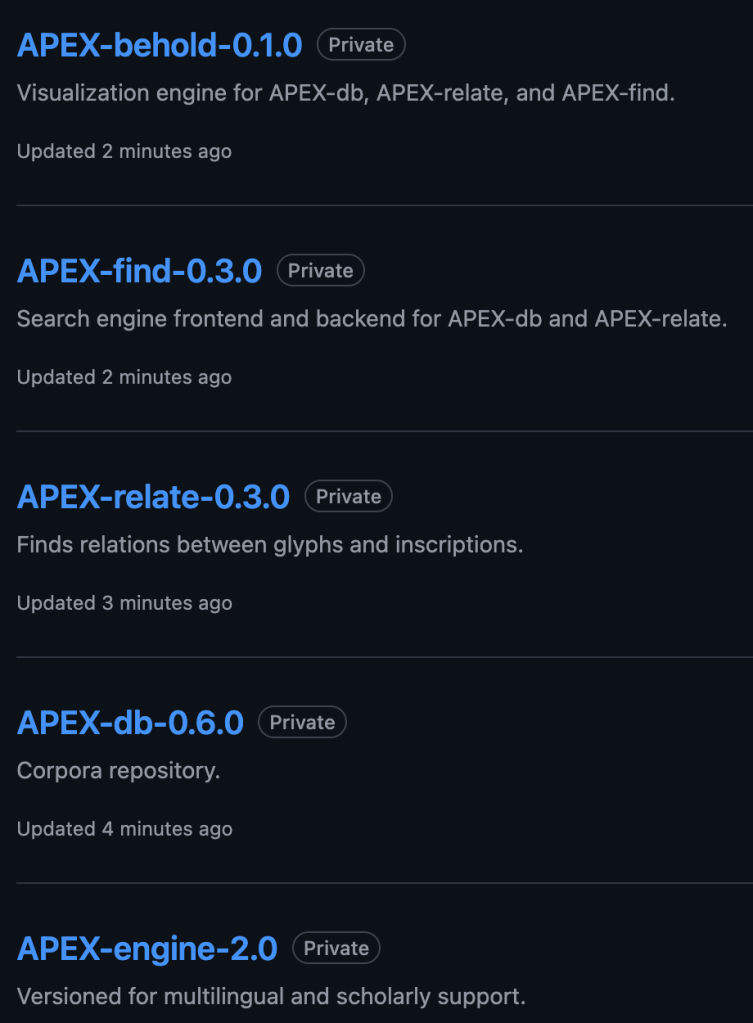
As APEX has grown, its structure has become clearer. What began as 3 files—a single .html, .css, and .py each—in virtually continuous script (perhaps mirroring ancient inscriptions themselves) has developed into a layered system. Each part carries its own method and rhythm, but together form a complete research environment—a cycle that moves from inscription to dataset, from dataset to interpretation, and from interpretation to discovery.
The division is not hierarchical. Each layer depends on the others and stays in motion with them. Separating them made the system intelligible, something that can scale and adapt, something that can be thought inside of, with, and through.
0. Detect
APEX-detect is the system’s first act of perception, currently in development with a machine learning protocol. It won’t interpret or analyze; it’ll isolate. From the continuous surface of a photograph, it will identify the discrete marks that will later become glyphs. Detection turns light and texture into segmented boundaries, carving the visual field into fragments the Engine can later measure, compare, and encode.
1. Engine
APEX-engine is the analytical component. It extracts form from image, turning traced/detected letters into measurable geometry. This layer defines how APEX perceives the world of writing, translating shape into information that can be analyzed, compared, and preserved.
2. Database
APEX-db (public-facing name: AlphaBase) gathers what APEX-engine records. It stores inscriptions, glyphs, and metadata in a coherent schema that keeps the material legible across regions, languages, and media. Each entry carries its archaeological, linguistic, and graphical context. The database ensures continuity and keeps every trace.
3. Relate
The APEX-relate layer will give structure to connection. It is to join individual records into networks, revealing correspondences among letters, scripts, and regions. Relate will be the layer of inference, where data begins to show its meaning.
4. Find
APEX-find will make it all navigable, the memory and relations established by the previous two layers. It transforms the corpus into a searchable field, allowing queries by inscription, feature, script, or drawn form. Each result will draw on the underlying relational structure, turning the accumulated data into an accessible landscape. Find will be the gateway between APEX and its users, the point where the internal logic of the system meets the act of discovery.
5. Witness
APEX-behold is going to make the system visible to itself. It will render “on-premises” (as opposed to in external environments) the processes and relationships established by the other layers into sight: plots, maps, and visual fields where patterns take shape. The interface will allow the eye to follow what the model perceives, aligning computation with human attention.
The System as a Whole
These five layers create a loop of perception and understanding. The engine observes, the database retains, relate connects, find reveals, and witness visually consolidates. Each layer holds a distinct epistemology, shaping a system that can study writing as both artifact and behavior. APEX has reached a stage where its structure echoes its object of study: the layered evolution of form into meaning.
 To Wake the Dead
Leave a comment