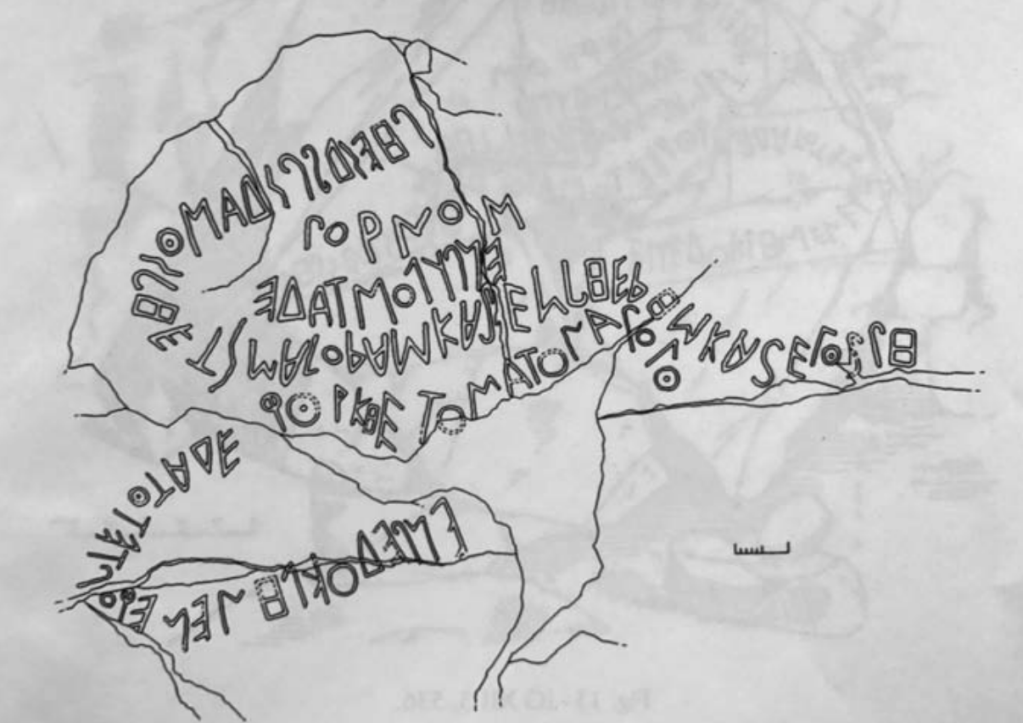
Inglese (2008), ISBN-13: 9788888617138.
Every interface encodes assumptions, whether on the level of metadata or internal features. Most modern text annotation tools—whether for OCR, NLP, or digital paleography—assume that text runs left to right (dextrograde), top to bottom, in straight lines. Even tools designed for right-to-left (sinistrograde) scripts or vertical layouts often presume uniform orientation and stable reading order. But the moment you encounter Schlangenschrift (examples here and here), or even boustrophedon, (below) that all breaks down.
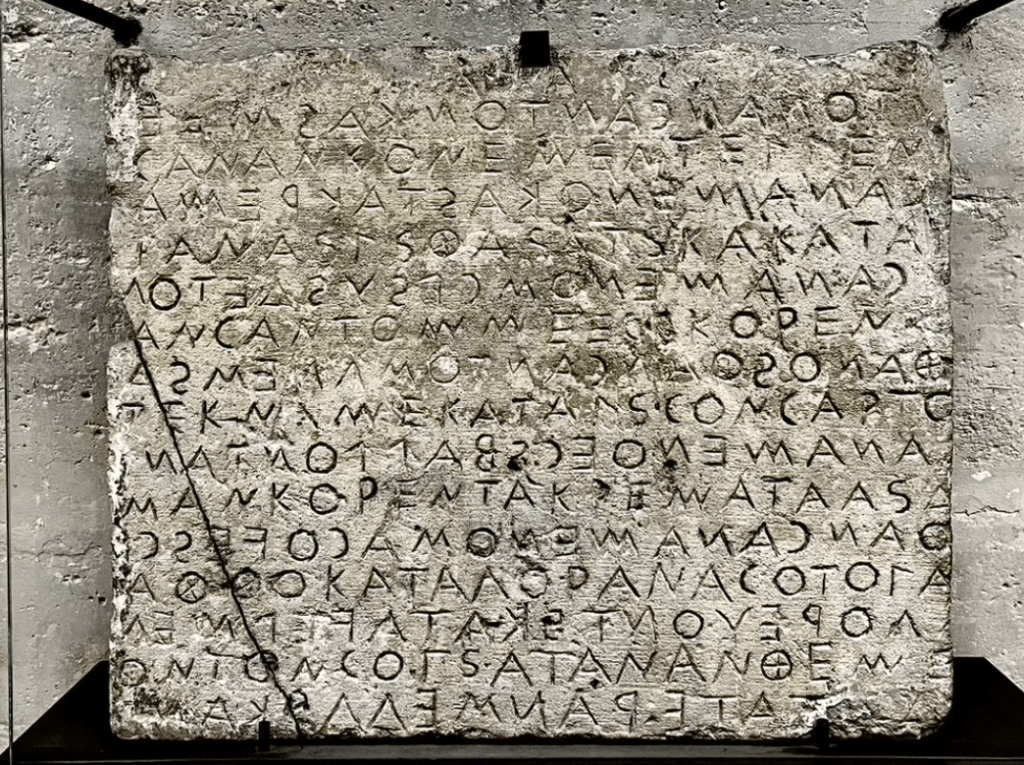
Schlangenschrift, German for “snake writing,” is the term for inscriptions that undulate, loop, or zigzag across their surfaces. They aren’t just retrograde or boustrophedon—they’re playful, nonlinear, and sometimes aggressively nonstandard. Letters may rotate far off baseline, reverse, snake along the rim of a vessel, or float in clustered spirals. They don’t just stretch orthographic conventions—they revel in their own performative visuality.
That’s thrilling, but let me tell you, it’s a pain to encode.
What Makes Schlangenschrift Hard to Handle?
In traditional inscriptions, we assume a stable direction of writing and an inferred reading order from layout. Schlangenschrift breaks both assumptions. Letters might be inverted, flipped, or rotated 180°, and their spatial arrangement doesn’t always match their intended sequence.
This poses problems for annotation on two levels:
- How do you tell the system that a letter halfway down the curve should be read before the one at the top?
- How do you capture the fact that an archaic alpha is legible but flipped, or that an theta has been rotated 100° clockwise?
And this is before we even deal with issues like ligatures, joined strokes, or unclear boundaries between clustered forms.
Why Build a GUI?
Right now, I do all annotation manually in JSON, paired with hand-vectorized tracings in Adobe Fresco. It works, but it’s slow, error-prone, and unsustainable for large-scale corpora—especially once I start working with more experimental or ornamental inscriptions.
What I need eventually is a dedicated GUI: a tool that allows me to annotate forms visually, directly on the letter or inscription image, and store that information in a structured, model-readable format. A few things I imagine it allowing me to do:
- Adjust or override reading order by selecting letters in intended sequence
- Tag rotation by clicking the “top” of a letter (especially useful for characters rotated more than 90° off baseline)
- Split ligatures or joined forms into discrete units—or possibly annotate them as double-readings when appropriate
- Attach manual labels and feature flags that will eventually train an ML model to handle the first-pass extraction
In other words, it’s to be a tool that lets human judgment scaffold machine learning—not the other way around. I also hope for it to be accessible to scholars uploading and annotating other inscriptions down the line. After all, it’s called the Alphabetic Paleo-Epigraphic Exchange, and from the beginning it’s been my vision to build a diverse, international, and collaborative community.
Design for a Script That Doesn’t Behave
This GUI wouldn’t be a general-purpose annotation tool, at least, not yet. Perhaps its scope could be expanded if comparative script capabilities (cf. Stages 4 and 5) are added. However, for now, it’ll be shaped by the idiosyncrasies of Greek epigraphy, and especially by the freedom and experimentation of the Archaic period. It would let me preserve uncertainty and flag ambiguity. It would let me document weirdness rather than flatten it.
It might also include inscription-level features: recording whether the script is sinistrograde, boustrophedon, or Schlangenschrift; marking axis drift; allowing toggling between epichoric and normalized readings.
Eventually, I’d like to use this tool not just for Schlangenschrift but for all complex inscriptions—especially ones where reading direction, orientation, and letter identity are uncertain or debated.
For now, though, this post is part wishlist, part blueprint. If you’ve worked on annotation tools for nonlinear writing systems—or have thoughts about how to handle radical variation in letter layout—I’d love to hear from you: tfavdw@nyu.edu.


Leave a comment