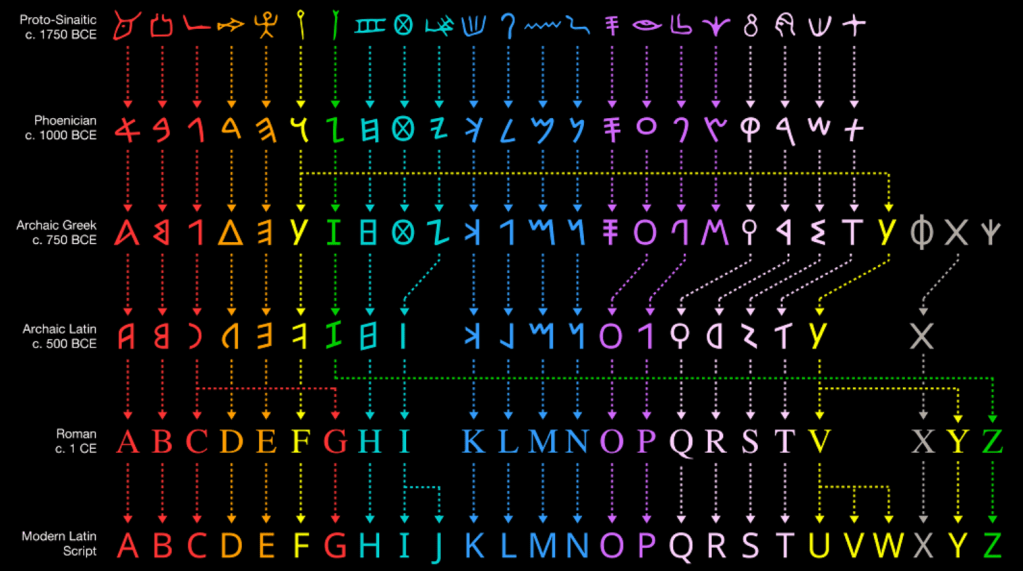
Note: I’m counting N and Z as “apparently symmetrical,” giving us 7 of 26 (27%) asymmetricals,
a significantly lower amount than the 9 of 22 in Sinaitic (41%) and 10 of 26 (38%) in Archaic Greek.
Before I can ask anything ambitious of my data—like modeling transmission pathways or quantifying regional scribal variation—I have to start with something smaller, simpler, and more grounded. For APEX, that starting point is symmetry.
Symmetry is one of the most visible differences between early Greek and Phoenician scripts. Even without training, most observers can sense the change: Greek letterforms become cleaner, more aligned, more balanced. But to measure that symmetry, I’ve had to define what I mean by symmetry, and build a method to detect it.
This post outlines how I’m operationalizing symmetry in the APEX corpus, why it’s the first feature I’ve chosen to model, and what it’s teaching me about the limits and affordances of computational paleography.
What Symmetry Means Here
In APEX, symmetry is a composite of two measurable traits:
- Reflectional: How closely a letter matches its own mirror image, along the axis that yields the best fit—whether vertical, horizontal, diagonal, or something in between.
- Rotational: How closely the letter approximates balance when rotated around a central point—typically 180°, though full radial symmetry is rare.
Each of these metrics contributes to an overall symmetry score, though I haven’t yet decided how to weight them relative to each other. (Letters like omicron may score high on both; others like early mu—the one that looks a bit like a waving flag—might have almost none.) The flexibility in axis choice is essential: a rigid expectation of vertical or horizontal mirroring would misread the creative variability of early inscriptions.
Why Symmetry First?
I chose symmetry as APEX’s first feature not because it’s easy, but because it’s easier—more tractable and revealing than most other options on the table. Here’s why:
- Symmetry can be formalized geometrically and scored algorithmically, whereas features like curvature or stroke order require more interpretive preprocessing.
- It aligns closely with what I called the Geometric Mindset in APEX 5. The Greeks didn’t just write more symmetrically—they seemed to want symmetry. Modeling this desire helps us understand the aesthetics of early alphabetic culture.
- Because symmetry is something humans are so good at perceiving, I can use qualitative intuition as a check on the model’s output. If my code says chi is less symmetric than theta, that better match what I see—or I’ll need to refine the metric.
Most importantly, symmetry provides a rigorous baseline. If APEX can measure it reliably, I’ll have a working pipeline to test more complex or subtle features.
How I’m Measuring It
Reflectional symmetry is assessed by identifying the axis of symmetry that produces the highest match between a letter and its mirror. I use a series of transformations—rotation, scaling, and reflection—to find the optimal axis, then measure the residual difference between the original and the reflected form.
Rotational symmetry is calculated by rotating the letter around its centroid and comparing the rotated image with the original. This is usually done in 180° increments, though future iterations may allow for more granular angular measurements.
These outputs will be normalized and combined into a single score. I haven’t yet established weighting, since the balance between reflectional and rotational symmetry might vary by letter category or epigraphic tradition.
The Limits of Automation (So Far)
My computer vision pipeline still has limits. I’m developing this in Python, though most of my coding experience until now has been in R and Java. Here’s what’s working—and what’s not:
- My current process overcounts contours by a factor of several hundred, especially in letters with nested or fragmented strokes.
- It struggles to distinguish meaningful intersections (like the vertex of alpha) from noise, since it doesn’t yet recognize stroke logic.
- Stroke direction is currently inaccessible: I’d need to first solve stroke segmentation, possibly via a trained ML model.
- Curvature is hard to measure when the program doesn’t know how many strokes it’s looking at.
Symmetry, for now, is the best foothold: visually salient, structurally clean, and relatively resistant to contour noise—especially when preprocessing is done carefully.
From Obvious Insight to Quantified Claim
Everyone who looks at early Greek inscriptions notices the symmetry. What APEX is trying to do is not discover that fact, but confirm it rigorously—to move from impression to measurement, from observation to score.
This quantification isn’t the end goal. It’s the start of a methodology that can be applied to more difficult questions: which regions favor symmetry more, and when? How do letterforms regularize over time? Does high symmetry correlate with other features—like vertical alignment, spacing, or axis orientation?


Leave a comment