Before symmetry became a measurable feature, it was a feeling—one the early Greek world seems deeply attuned to. This post is about that feeling: the cultural, aesthetic, and even spiritual logic that helped shape the forms of the first Greek letters. I call it the Geometric Mindset, a theory I presented to an NYU classics organization—you can find those slides here. (Note: This presentation is image-heavy; I’ve included speaker notes for clarity.)
Essentially, I believe the Greeks’ existing material culture had so thoroughly absorbed geometrism across media that they were primed to favor symmetry, regularity, and visual order—even in a new medium like writing. These features emerged after a period of exploratory and often whimsical experimentation in the Early Archaic. Dates and historiography of this period vary, but it lasts from approximately 750 to 600 BCE.
This geometric mindset is hard to define but easy to see. Look at a pot from the Late Geometric period—ending c. 760 BCE—and you’ll find meanders, triangles, and radial bands, repeated with a kind of cosmic insistence. Look at the floorplan of an early temple, and you’ll find axial balance and rhythmic repetition. Look at a letter like omicron carved around this time—round, even, self-contained—and you start to sense a common visual logic. In a world recovering from the Late Bronze Age collapse (c. 1177 BCE), symmetry didn’t just “look good”: it symbolized an order that people lacked and longed for.
Geometrism Before the Alphabet
After the Mycenaean palatial system collapsed around 1177 BCE, Greek society fragmented. Writing disappeared, monumental architecture vanished, and prestige grave goods diminished. In this post-palatial vacuum, the Geometric period emerged—not as a conscious revival, but as a new cultural orientation toward precision, repetition, and stability.
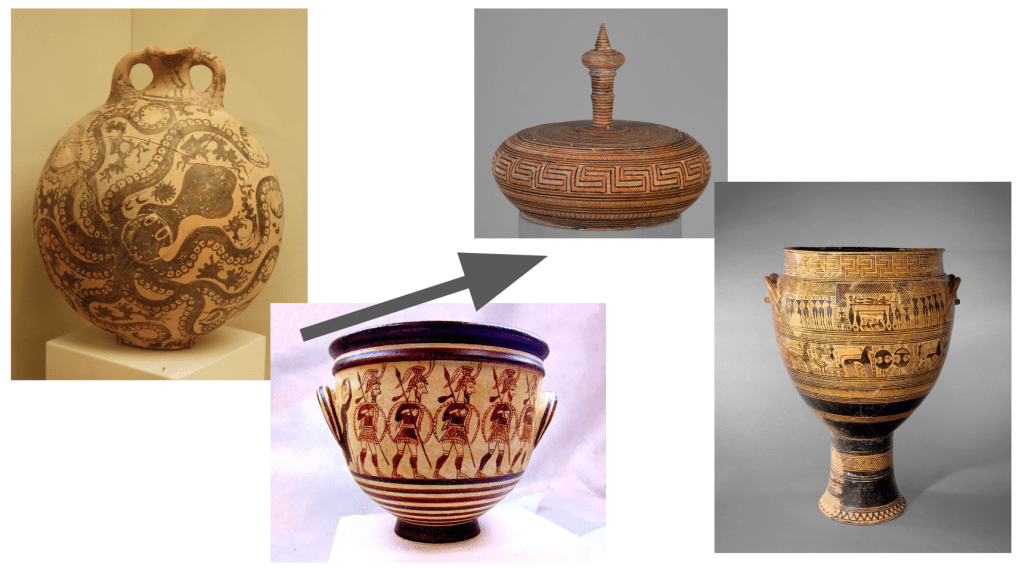
to geometric (example one, two) and later, highly stylized human forms.
Art historians have long noted the stark transition: from figural representation to geometric abstraction. Between 900–850 BCE, human forms vanish almost entirely from the artistic record. When they reappear, it is only as stylized silhouettes built from circles and triangles. Architecture follows suit: the earliest Greek temples (many in perishable materials) were already laid out in balanced, rectilinear plans that would later be canonized in Doric and Ionic orders. Even the decorative motifs on grave pots shift from curvilinear swirls to angular meanders.
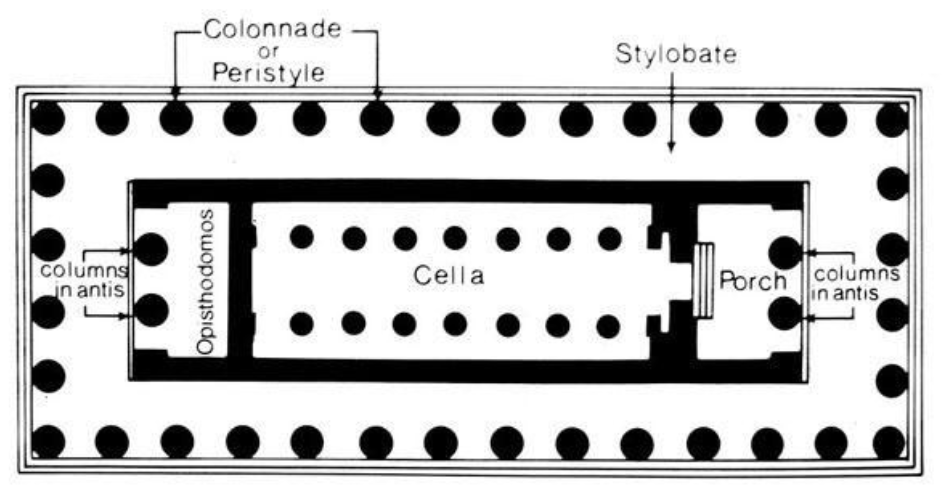
Note the high degree of symmetry and order.
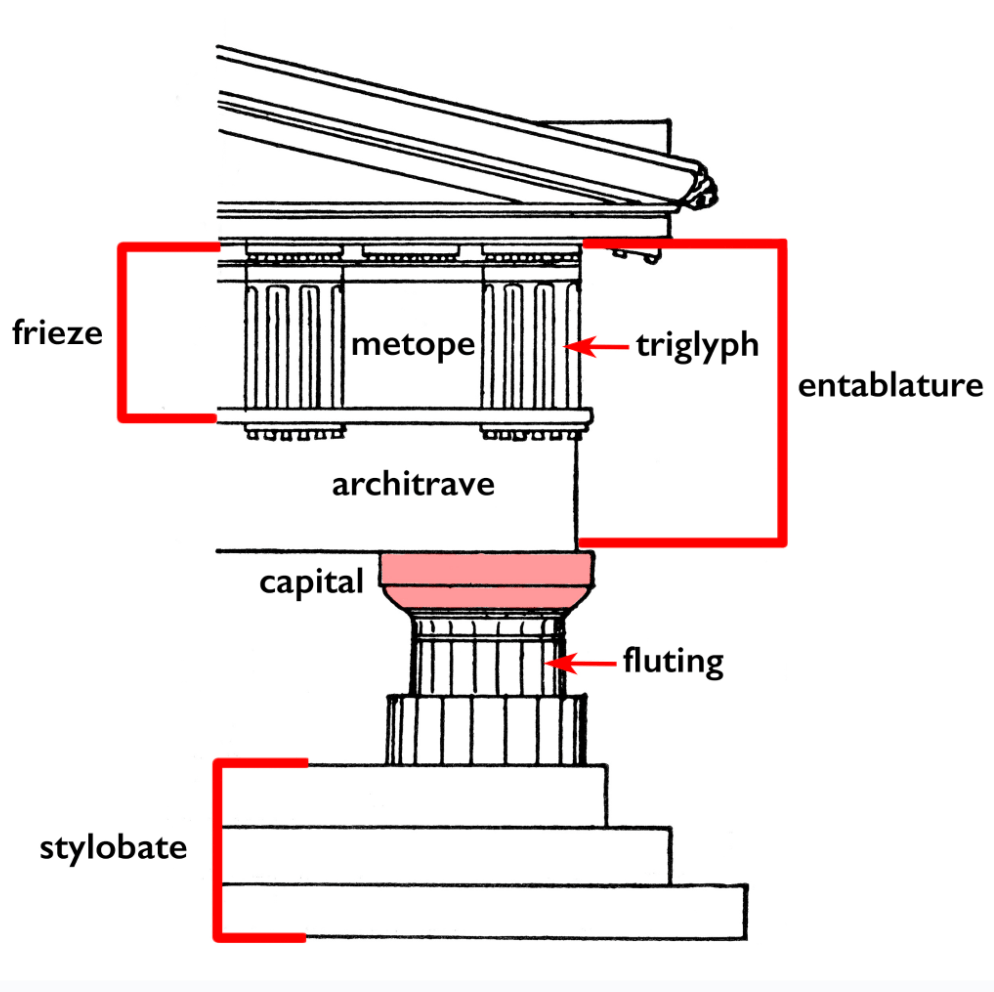
Technological changes—like the fast-spinning potter’s wheel or rectilinear timber—helped enable this aesthetic, but they can’t explain its pervasiveness. The geometric shift wasn’t just a byproduct of tools. It was a cultural choice.
Sacred Letters, Sacred Shapes
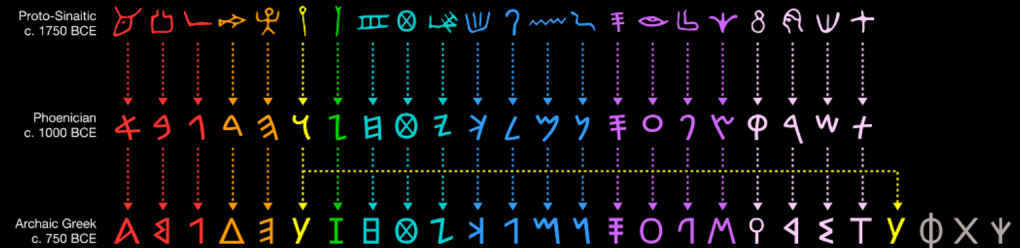
The Greek alphabet appears during this same geometric moment. And while it was adapted from Phoenician, the changes made were not purely phonological. They were visual. Symmetry increases. Stroke lengths even out. Letters gain internal alignment. In some cases—like theta or chi—they become almost iconic of the aesthetic that surrounds them.
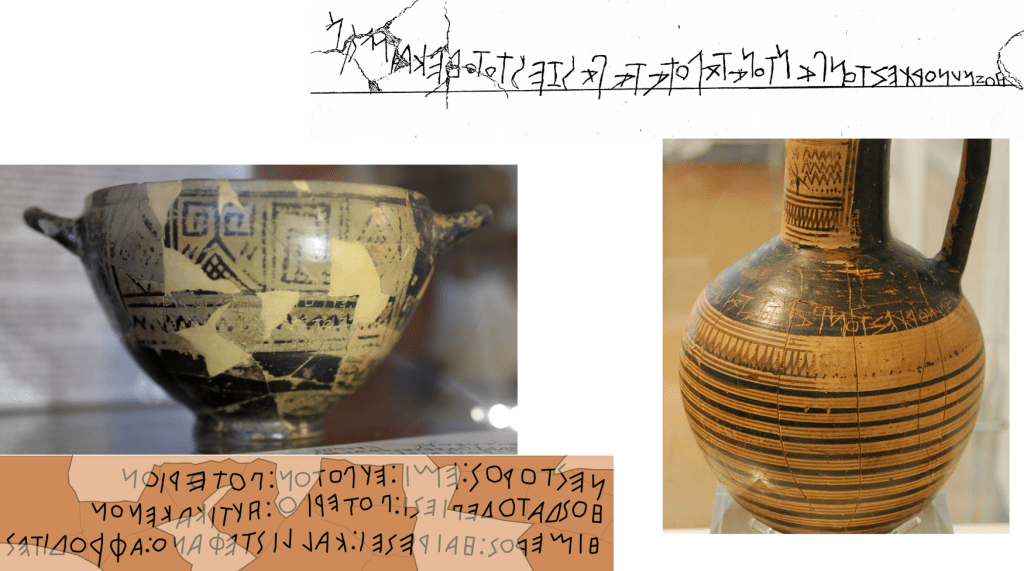
1: Nestor’s Cup, Pithekoussai colonty (Ischia, in modern Italy). 2: Dipylon Inscription, Athens.
Why? Part of the answer lies in the way writing was first received. Unlike every other writing tradition in the world, there is no evidence the system first emerged for economic or administrative purposes. Rather, the earliest alphabetic Greek inscriptions are not inventories or contracts but poems, hymns, names, and dedicatory verses (verses!) to the gods. Writing in early Greece was not merely functional—it was mystical. In the early abecedaries offered at sanctuaries like Mt. Hymettos, the alphabet itself appears as a sacred object. Its form mattered.
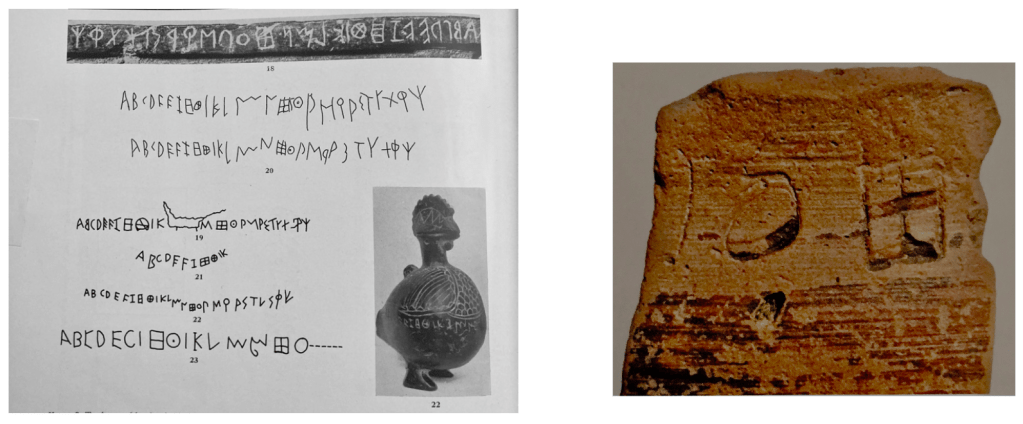
and fragments thereof found in sacred Greek and Etruscan contexts.
Early attitudes of letterform as artistic motif are also exhibited in the inscriptions left by people at the margins of literate society: shepherds in Attica, young men on Thera (modern Santorini). Their graffiti mixes geometric regularity with expressive play. Letters are art, snaking across stone in “Schlangenschrift,” reversing and rotating in boustrophedon—they stretch, compress, and play. These are not yet standardized forms—but they are already aesthetic ones.
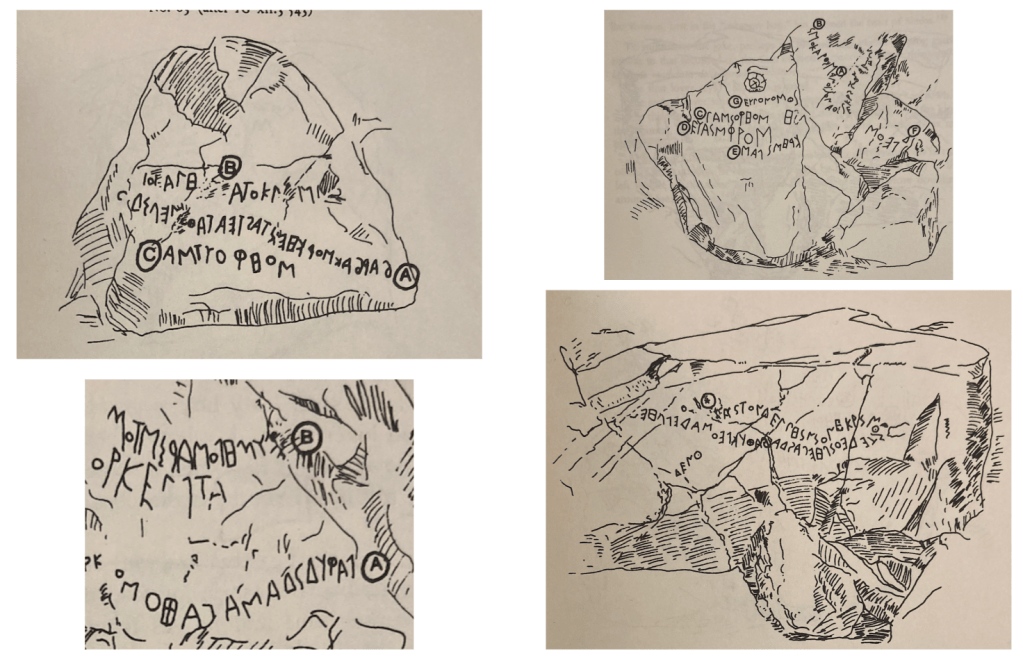
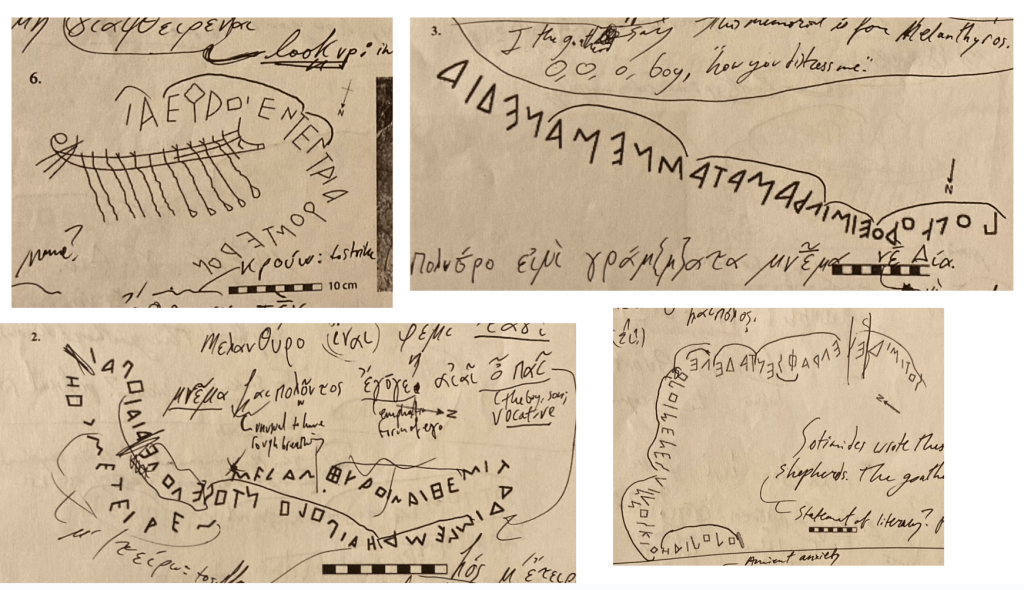
Writing, like poetry, was a medium of presence. To inscribe a name was to fix it. To make it visible. To give it shape. And that shape, increasingly, was geometric—according with the idea that the Greeks were in some way primed by their existing architecture, material culture, and general sense of the aesthetic.
Importance to APEX
APEX isn’t just a computational project—it’s a cultural one. Before I try to model formal features, I need to understand what counted as a “good” or “complete” letter to the people who made them. The Geometric Mindset gives me a crucial frame. It tells me that the first Greek inscriptions weren’t striving for speed or utility—they were striving for balance.
That’s why the first feature APEX will try to model is symmetry, as covered in APEX Updates, 6. Because it’s not just a trait but a trace—an artifact of a whole worldview. In the next post, I’ll explain how I’m operationalizing part of that concept: how I define and measure symmetry, and what the limits of those measurements tell us about what the Greeks may have seen and wanted in a letter. To measure symmetry, then, is not to quantify a style—it’s to reconstruct a logic, a way of seeing, and a schematic of belief.


Leave a comment