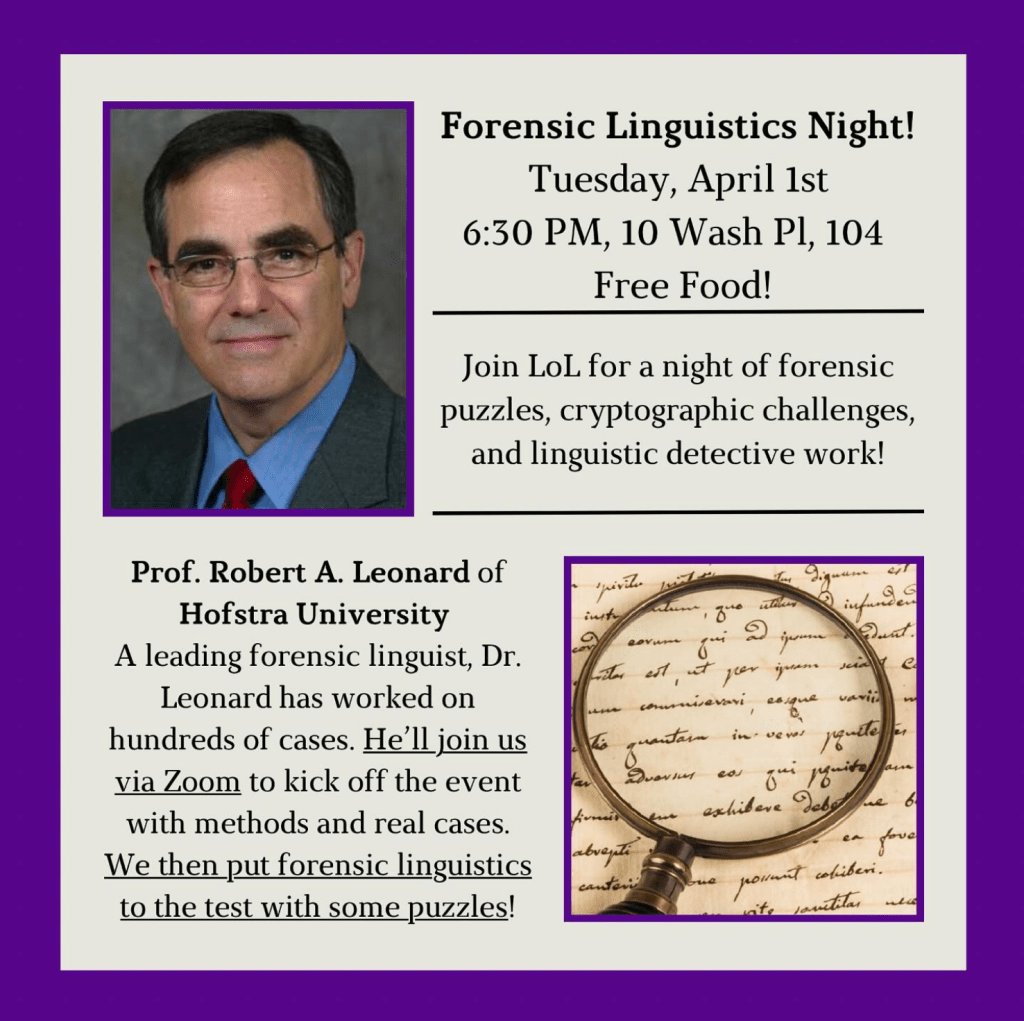
Our most recent League of Linguistics event explored forensic linguistics: the use of language analysis in criminal and legal contexts. Over the course of the year, we’ve convened sessions on endangered languages, revitalization campaigns, and typological surprises from around the globe—but this was the first time the stakes were so immediate. The talk made it clear that language isn’t just a tool for analysis or reflection, but that it can be the hinge on which a life turns.
The moment that struck me most came near the end, around minute 24 of the recording, when the speaker recounted a peculiar case: a series of handwritten gas bomb threats. What looked at first like nonsense—a jumble of malformed clauses and scattershot spelling—became, through careful linguistic reasoning, a solvable riddle. The speaker walked us through the process: ruling nothing out, drawing inferences from unlikely places, using every corner of linguistic insight to close the gap between text and truth. It was one of the clearest demonstrations I’ve ever seen of how creativity and constraint go hand in hand in this field. The talk wasn’t about just being clever for its own sake but rather imaginative care.
That tone—the sense that linguistic inquiry could be both precise and humane—shaped the entire evening. We’d framed the session as a collaborative puzzle. A good portion of our 16 attendees stayed afterward to work through the problem sets we’d prepared (one from the speaker’s files, one of my own invention), forming small teams that often crossed disciplinary lines. One particularly fruitful group included an applied psych major, an English major, and a linguistic anthropology student: their perspectives braided together in exactly the way we’d hoped this year’s programming might enable.
The mood in the room was curious and lively, with just a hint of initial skepticism. This was understandable, given that forensic linguistics isn’t a mainstay of the undergraduate curriculum. But, I’d run a poll beforehand on potential topics, and forensic linguistics had garnered more interest than any other. That sense of collective investment made itself felt: as the speaker moved from general principles to specific cases, the energy in the room visibly sharpened.
Some of that success, I think, came from softening the implicit classroom script. We always meet in one of two rooms that linguistics majors know well—spaces that almost guarantee a certain kind of attentiveness, and a certain kind of restraint. This time, we worked hard to counterbalance that: reframing the talk as a participatory investigation, consulting students from both within and beyond the major beforehand, and providing food (as ever, a nontrivial boost to turnout). The result was something less like a lecture, more like an open file.
It helped, too, that the talk didn’t shy away from gravity. One story in particular—a case where the speaker’s analysis got a Texas woman off death row less than 48 hours before her scheduled execution—shifted the tone completely. He showed, with quiet precision, how her confession bore the marks of coercive interrogation: subtle shifts in language use, unnatural lexical choices, patterns of repetition that tracked with leading and unfair prompts. Linguistic evidence, in that moment, became a form of advocacy. And the room stilled.
In that sense, the event marked a turning point in our series in the claim it made for our discipline. Linguistics is a field that can intervene, that can reshape institutions, correct miscarriages, even save lives. It’s something we have to take seriously.
I hope attendees left with a deeper sense of that potential. I also hoped to broaden their sense of what a linguistics career can look like. Ours is a field that often feels narrowly imagined: academia or bust, syntax or semantics. But here was someone using discourse analysis and pragmatics to do genuine good in the world.
I’ll say this: I’ve rarely seen our group so engaged, so thoughtfully attuned. The past few months have taught me that building a scholarly community isn’t just about events that run smoothly. It’s about events that matter.
 To Wake the Dead
Leave a comment