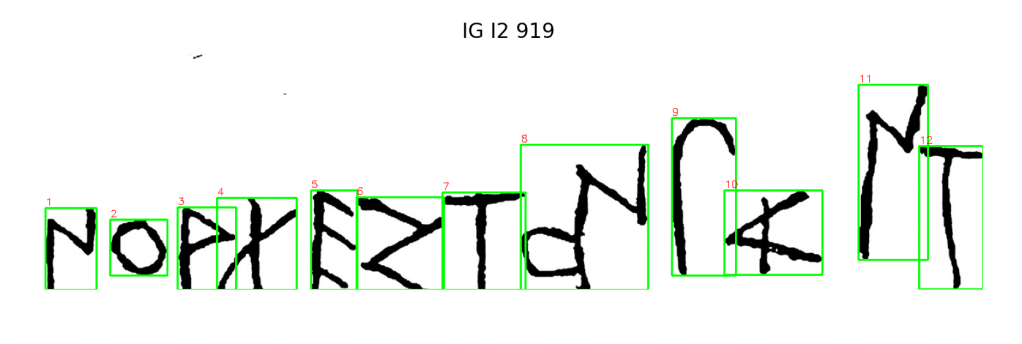
Back in February, I thought two months was enough time to date the transmission of the Greek alphabet.
That was my starting point: a delusional hope. And indeed I began APEX with scant technical ability—poor grasp of concepts and a month of coding background—just a sense that there was something doable at the intersection of computational method and ancient script. That if I could just find a way to measure the shapes of letters, I might be able to tell a new kind of story about how the alphabet traveled, evolved, settled into forms.
It turns out: no, I can’t date the transmission of the alphabet, not at 21, not in 10 weeks. But what I can do is more interesting than I could’ve imagined.
The first time my bounding boxes returned in the correct order, it felt like a miracle. Then came the multiline inscriptions, then symmetry, then even raw drawings, not traced. Every breakthrough brought a little more light. Eventually I wasn’t just copying, being derivative—I was quantifying, contributing. My complexity metric sharpened. The overlay lines grew more reliable. And like a planet in formation, the project developed a center of gravity—and it began to cohere.
And I encountered some surprises, as in the section “Dipylon: When the Data Doesn’t Flinch.” A particular early inscription came back less complex than many of the later ones I tested. That result challenged not just my expectations, but my entire premise. It forced me to reckon with how many qualitative judgments still underpin every “quantitative” metric I generate. What counts as complexity? What gets weighted, and why? Those choices are human. They’re mine.
That’s the most important thing I’ve learned: you don’t escape interpretation by adding math. You just make the interpretation a little more legible. Hopefully.
But still: I measured something. I made a system that can trace chaos and extract structure—not to flatten but honor. The alphabet, in its earliest known Greek forms, is no longer just a field of intuition or artistry or tradition. It’s data. It’s patterns. It’s beautiful.
What does this moment feel like? It feels like I just landed a man on the moon, as in that grainy black-and-white footage: men in short-sleeved white shirts and skinny ties, erupting with joy when the impossible became real. That’s me right now—except I’m just an undergrad with an old laptop and the stubborn belief that I can make something for the field I love.
After months of tracing, testing, and theorizing, APEX just did something real. AlphaBase is expanding. This is what it felt like to land the letters.
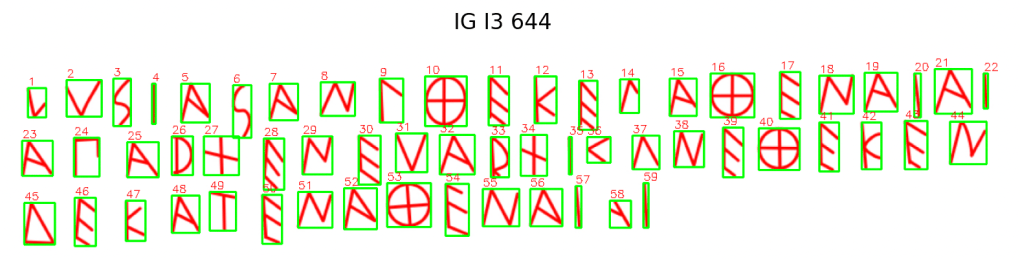
 To Wake the Dead
Leave a comment